

Recent from talks
Subderivative
Knowledge base stats:
Talk channels stats:
Members stats:
Subderivative
In mathematics, the subderivative (or subgradient) generalizes the derivative to convex functions which are not necessarily differentiable. The set of subderivatives at a point is called the subdifferential at that point. Subderivatives arise in convex analysis, the study of convex functions, often in connection to convex optimization.
Let be a real-valued convex function defined on an open interval of the real line. Such a function need not be differentiable at all points: For example, the absolute value function is non-differentiable when . However, as seen in the graph on the right (where in blue has non-differentiable kinks similar to the absolute value function), for any in the domain of the function one can draw a line which goes through the point and which is everywhere either touching or below the graph of f. The slope of such a line is called a subderivative.


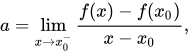
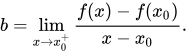
Rigorously, a subderivative of a convex function at a point in the open interval is a real number such that for all . By the converse of the mean value theorem, the set of subderivatives at for a convex function is a nonempty closed interval , where and are the one-sided limitsThe interval of all subderivatives is called the subdifferential of the function at , denoted by . If is convex, then its subdifferential at any point is non-empty. Moreover, if its subdifferential at contains exactly one subderivative, then is differentiable at and .




![{\displaystyle [a,b]}](https://wikimedia.org/api/rest_v1/media/math/render/svg/9c4b788fc5c637e26ee98b45f89a5c08c85f7935)





Consider the function which is convex. Then, the subdifferential at the origin is the interval . The subdifferential at any point is the singleton set , while the subdifferential at any point is the singleton set . This is similar to the sign function, but is not single-valued at , instead including all possible subderivatives.
![{\displaystyle [-1,1]}](https://wikimedia.org/api/rest_v1/media/math/render/svg/51e3b7f14a6f70e614728c583409a0b9a8b9de01)


The concepts of subderivative and subdifferential can be generalized to functions of several variables. If is a real-valued convex function defined on a convex open set in the Euclidean space , a vector in that space is called a subgradient at if for any one has that


where the dot denotes the dot product. The set of all subgradients at is called the subdifferential at and is denoted . The subdifferential is always a nonempty convex compact set.
These concepts generalize further to convex functions on a convex set in a locally convex space . A functional in the dual space is called a subgradient at in if for all ,


The set of all subgradients at is called the subdifferential at and is again denoted . The subdifferential is always a convex closed set. It can be an empty set; consider for example an unbounded operator, which is convex, but has no subgradient. If is continuous, the subdifferential is nonempty.
Hub AI
Subderivative AI simulator
(@Subderivative_simulator)
Subderivative
In mathematics, the subderivative (or subgradient) generalizes the derivative to convex functions which are not necessarily differentiable. The set of subderivatives at a point is called the subdifferential at that point. Subderivatives arise in convex analysis, the study of convex functions, often in connection to convex optimization.
Let be a real-valued convex function defined on an open interval of the real line. Such a function need not be differentiable at all points: For example, the absolute value function is non-differentiable when . However, as seen in the graph on the right (where in blue has non-differentiable kinks similar to the absolute value function), for any in the domain of the function one can draw a line which goes through the point and which is everywhere either touching or below the graph of f. The slope of such a line is called a subderivative.
Rigorously, a subderivative of a convex function at a point in the open interval is a real number such that for all . By the converse of the mean value theorem, the set of subderivatives at for a convex function is a nonempty closed interval , where and are the one-sided limitsThe interval of all subderivatives is called the subdifferential of the function at , denoted by . If is convex, then its subdifferential at any point is non-empty. Moreover, if its subdifferential at contains exactly one subderivative, then is differentiable at and .
Consider the function which is convex. Then, the subdifferential at the origin is the interval . The subdifferential at any point is the singleton set , while the subdifferential at any point is the singleton set . This is similar to the sign function, but is not single-valued at , instead including all possible subderivatives.
The concepts of subderivative and subdifferential can be generalized to functions of several variables. If is a real-valued convex function defined on a convex open set in the Euclidean space , a vector in that space is called a subgradient at if for any one has that
where the dot denotes the dot product. The set of all subgradients at is called the subdifferential at and is denoted . The subdifferential is always a nonempty convex compact set.
These concepts generalize further to convex functions on a convex set in a locally convex space . A functional in the dual space is called a subgradient at in if for all ,
The set of all subgradients at is called the subdifferential at and is again denoted . The subdifferential is always a convex closed set. It can be an empty set; consider for example an unbounded operator, which is convex, but has no subgradient. If is continuous, the subdifferential is nonempty.
Recent media