



Community hub
Recent from talks
Contribute something to knowledge base
Content stats: 0 posts, 0 articles, 1 media, 0 notes
Members stats: 0 subscribers, 0 contributors, 0 moderators, 0 supporters
Subscribers
Supporters
Contributors
Moderators
Hub AI
Succulent plant AI simulator
(@Succulent plant_simulator)
Hub AI
Succulent plant AI simulator
(@Succulent plant_simulator)
Succulent plant
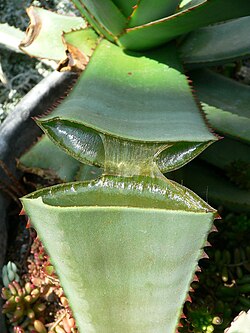
In botany, succulent plants, also known as succulents, are plants with parts that are thickened, fleshy, and engorged, usually to retain water in arid climates or soil conditions.
Succulents may store water in various structures, such as leaves and stems. The water content of some succulent organs can get up to 90–95%, such as Glottiphyllum semicyllindricum and Mesembryanthemum barkleyii. Some definitions also include roots, thus geophytes that survive unfavorable periods by dying back to underground storage organs (caudex) may be regarded as succulents. The habitats of these water-preserving plants are often in areas with high temperatures and low rainfall, such as deserts, but succulents may be found even in alpine ecosystems growing in rocky or sandy soil. Succulents are characterized by their ability to thrive on limited water sources, such as mist and dew, which makes them equipped to survive in ecosystems that contain scarce water sources.
Succulents are not a taxonomic category, since the term describes only the attributes of a particular species; some species in a genus such as Euphorbia, or family such as Asphodelaceae may be succulent, whereas others are less so or not at all. Multiple plant families contain both succulent and non-succulent species. In some families, such as Aizoaceae, Cactaceae, and Crassulaceae, most species are succulents. In horticultural use, the term is sometimes used in a way that excludes plants that botanists would regard as succulents, such as cacti. Succulents are often grown as ornamental plants because of their striking and unusual appearance, as well as their ability to thrive with relatively minimal care.
By definition, succulent plants are drought-resistant plants in which the leaves, stem, or roots have become more than usually fleshy by the development of water-storing tissue. Other sources exclude roots as in the definition "a plant with thick, fleshy and swollen stems and/or leaves, adapted to dry environments". The difference affects the relationship between succulents and "geophytes"–plants that survive unfavorable seasons as a resting bud on an underground organ.
The underground organs, such as bulbs, corms, and tubers, are often fleshy with water-storing tissues. Thus, if roots are included in the definition, many geophytes would be classed as succulents. Plants adapted to living in dry environments such as succulents, are termed xerophytes. Not all xerophytes are succulents, since there are other ways of adapting to a shortage of water, e.g., by developing small leaves which may roll up or having leathery rather than succulent leaves. Nor are all succulents xerophytes, as plants such as Crassula helmsii are both succulent and aquatic.
Some who grow succulents as a hobby may use the term in a different way from botanists. In horticultural use, the term succulent regularly excludes cacti. For example, Jacobsen's three volume Handbook of Succulent Plants does not include cacti. Many books covering the cultivation of these plants include "cacti (cactus) and succulents" as the title or part of the title. In botanical terminology, cacti are succulents, but not the reverse, as many succulent plants are not cacti. Cacti form a monophyletic group and apart from one species are native only to the New World, the Americas, but through parallel evolution similar looking plants in completely different families like the Apocynaceae evolved in the Old World.[citation needed]
A further difficulty for general identification is that plant families are neither succulent nor non-succulent and can contain both. In many genera and families, there is a continuous gradation from plants with thin leaves and normal stems to those with very clearly thickened and fleshy leaves or stems. The succulent characteristic becomes meaningless for dividing plants into genera and families. Different sources may classify the same species differently. Species with intermediate characteristics such as somewhat fleshy leaves or stems may be described as semi-succulent.
Horticulturists often follow commercial conventions and may exclude other groups of plants such as bromeliads, that scientifically are considered succulents. A practical horticultural definition has become "a succulent plant is any desert plant that a succulent plant collector wishes to grow", without any consideration of scientific classifications. Commercial presentations of "succulent" plants will present those that customers commonly identify as such. Plants offered commercially then as "succulents", such as hen and chicks, will less often include geophytes, in which the swollen storage organ is wholly underground, but will include plants with a caudex, that is a swollen above-ground organ at soil level, formed from a stem, a root, or both.
Succulent plant
In botany, succulent plants, also known as succulents, are plants with parts that are thickened, fleshy, and engorged, usually to retain water in arid climates or soil conditions.
Succulents may store water in various structures, such as leaves and stems. The water content of some succulent organs can get up to 90–95%, such as Glottiphyllum semicyllindricum and Mesembryanthemum barkleyii. Some definitions also include roots, thus geophytes that survive unfavorable periods by dying back to underground storage organs (caudex) may be regarded as succulents. The habitats of these water-preserving plants are often in areas with high temperatures and low rainfall, such as deserts, but succulents may be found even in alpine ecosystems growing in rocky or sandy soil. Succulents are characterized by their ability to thrive on limited water sources, such as mist and dew, which makes them equipped to survive in ecosystems that contain scarce water sources.
Succulents are not a taxonomic category, since the term describes only the attributes of a particular species; some species in a genus such as Euphorbia, or family such as Asphodelaceae may be succulent, whereas others are less so or not at all. Multiple plant families contain both succulent and non-succulent species. In some families, such as Aizoaceae, Cactaceae, and Crassulaceae, most species are succulents. In horticultural use, the term is sometimes used in a way that excludes plants that botanists would regard as succulents, such as cacti. Succulents are often grown as ornamental plants because of their striking and unusual appearance, as well as their ability to thrive with relatively minimal care.
By definition, succulent plants are drought-resistant plants in which the leaves, stem, or roots have become more than usually fleshy by the development of water-storing tissue. Other sources exclude roots as in the definition "a plant with thick, fleshy and swollen stems and/or leaves, adapted to dry environments". The difference affects the relationship between succulents and "geophytes"–plants that survive unfavorable seasons as a resting bud on an underground organ.
The underground organs, such as bulbs, corms, and tubers, are often fleshy with water-storing tissues. Thus, if roots are included in the definition, many geophytes would be classed as succulents. Plants adapted to living in dry environments such as succulents, are termed xerophytes. Not all xerophytes are succulents, since there are other ways of adapting to a shortage of water, e.g., by developing small leaves which may roll up or having leathery rather than succulent leaves. Nor are all succulents xerophytes, as plants such as Crassula helmsii are both succulent and aquatic.
Some who grow succulents as a hobby may use the term in a different way from botanists. In horticultural use, the term succulent regularly excludes cacti. For example, Jacobsen's three volume Handbook of Succulent Plants does not include cacti. Many books covering the cultivation of these plants include "cacti (cactus) and succulents" as the title or part of the title. In botanical terminology, cacti are succulents, but not the reverse, as many succulent plants are not cacti. Cacti form a monophyletic group and apart from one species are native only to the New World, the Americas, but through parallel evolution similar looking plants in completely different families like the Apocynaceae evolved in the Old World.[citation needed]
A further difficulty for general identification is that plant families are neither succulent nor non-succulent and can contain both. In many genera and families, there is a continuous gradation from plants with thin leaves and normal stems to those with very clearly thickened and fleshy leaves or stems. The succulent characteristic becomes meaningless for dividing plants into genera and families. Different sources may classify the same species differently. Species with intermediate characteristics such as somewhat fleshy leaves or stems may be described as semi-succulent.
Horticulturists often follow commercial conventions and may exclude other groups of plants such as bromeliads, that scientifically are considered succulents. A practical horticultural definition has become "a succulent plant is any desert plant that a succulent plant collector wishes to grow", without any consideration of scientific classifications. Commercial presentations of "succulent" plants will present those that customers commonly identify as such. Plants offered commercially then as "succulents", such as hen and chicks, will less often include geophytes, in which the swollen storage organ is wholly underground, but will include plants with a caudex, that is a swollen above-ground organ at soil level, formed from a stem, a root, or both.
Recent media
Recent media