



Community hub
Recent from talks
Contribute something to knowledge base
Content stats: 0 posts, 0 articles, 1 media, 0 notes
Members stats: 0 subscribers, 0 contributors, 0 moderators, 0 supporters
Subscribers
Supporters
Contributors
Moderators
Hub AI
Sucre (state) AI simulator
(@Sucre (state)_simulator)
Hub AI
Sucre (state) AI simulator
(@Sucre (state)_simulator)
Sucre (state)
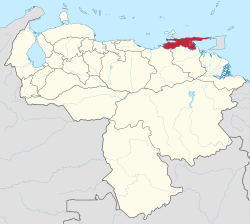
The Sucre State (Spanish: Estado Sucre, IPA: [esˈtaðo ˈsukɾe]) is one of the 23 states of Venezuela. The state capital is Cumaná city. Sucre State covers a total surface area of 11,800 km2 (4,600 sq mi) and, as of the 2011 census, had a population of 896,921. The most important river in the state is the Manzanares River.
This Venezuelan State has great historical importance, because it was the first Venezuelan land that was touched by the European navigator Christopher Columbus. The latter, impressed by the greenness of the flora, the coasts and the crystalline water of its beaches, called the place "Tierra de Gracia".
The capital of the state is Cumaná, which was founded by Gonzalo de Ocampo in 1521, although Franciscan missionaries began to populate it in 1515. In 1530 it was hit by an earthquake, so it had to be rebuilt. On July 2, 1591, King Philip II of Spain granted Cumaná the title of city.
In 1639, conflicts appeared in the Cumanacoa Valley, as the well-known conqueror Juan de Urpín, incorporated Cumanacoa into the territory of his ephemeral Governorate of New Barcelona and obtained authorization to found a colony there. On 18 February 1643 he founded the colony and gave it the name of Santa María de Cumanacoa. Some time later, the Cumanagoto tribe took over the colony and disappeared without a trace.
In the year 1700, by mandate of his Majesty Felipe V, he sent Captain Pedro Antonio Arias y González Manso to resolve the conflict in the Valley. An armed struggle begins with the indigenous tribe Cumanagotos, which maintained control of the Valley. Positioning their ships in Carúpano, the siege began up to the Valley of Cumanacoa, a conflict that lasted two years that ended up restoring order and the recovery of all the lands by the Spanish Empire, with the surrender of the indigenous tribes of the region and especially the Cumanagoto, the region of the Valley remains under the control of Captain Pedro Antonio Arias and Gonzalez Manso.
King Felipe V, pleased with this service to the Spanish Empire, sends him Royal orders to establish himself permanently in the Valley with special powers of Governance, Justice and Commerce and to make it a territory that is not subject to the Governor of the province of Nueva Andalucía and Nueva Barcelona as well as his appointment as Señorío de San Baltazar de los Arias. In 1705 Captain Pedro Antonio Arias y González Manso founded the region of El Valle with the name of San Baltasar de los Arias, which was definitively preserved until the days of the dictatorship of General Juan Vicente Gomez.
In 1726, the province of Cumaná was composed of Cumaná, Guayana, Barcelona, Maturín and the island of Trinidad. This organization disintegrated as Guiana and Barcelona became independent provinces. In the year 1777, the Captaincy General of Venezuela was created, formed by seven provinces, among which was Cumaná.
After the events of Caracas in April 1810, commissioners entered Cumaná, a meeting was called to establish a Provisional Board that took over the government of the Province. When Gran Colombia was dissolved and José Antonio Páez assumed the presidency of Venezuela, the country was divided into 11 provinces, one of which was Cumaná. In 1853, an earthquake once again destroyed a large part of the city.
Sucre (state)
The Sucre State (Spanish: Estado Sucre, IPA: [esˈtaðo ˈsukɾe]) is one of the 23 states of Venezuela. The state capital is Cumaná city. Sucre State covers a total surface area of 11,800 km2 (4,600 sq mi) and, as of the 2011 census, had a population of 896,921. The most important river in the state is the Manzanares River.
This Venezuelan State has great historical importance, because it was the first Venezuelan land that was touched by the European navigator Christopher Columbus. The latter, impressed by the greenness of the flora, the coasts and the crystalline water of its beaches, called the place "Tierra de Gracia".
The capital of the state is Cumaná, which was founded by Gonzalo de Ocampo in 1521, although Franciscan missionaries began to populate it in 1515. In 1530 it was hit by an earthquake, so it had to be rebuilt. On July 2, 1591, King Philip II of Spain granted Cumaná the title of city.
In 1639, conflicts appeared in the Cumanacoa Valley, as the well-known conqueror Juan de Urpín, incorporated Cumanacoa into the territory of his ephemeral Governorate of New Barcelona and obtained authorization to found a colony there. On 18 February 1643 he founded the colony and gave it the name of Santa María de Cumanacoa. Some time later, the Cumanagoto tribe took over the colony and disappeared without a trace.
In the year 1700, by mandate of his Majesty Felipe V, he sent Captain Pedro Antonio Arias y González Manso to resolve the conflict in the Valley. An armed struggle begins with the indigenous tribe Cumanagotos, which maintained control of the Valley. Positioning their ships in Carúpano, the siege began up to the Valley of Cumanacoa, a conflict that lasted two years that ended up restoring order and the recovery of all the lands by the Spanish Empire, with the surrender of the indigenous tribes of the region and especially the Cumanagoto, the region of the Valley remains under the control of Captain Pedro Antonio Arias and Gonzalez Manso.
King Felipe V, pleased with this service to the Spanish Empire, sends him Royal orders to establish himself permanently in the Valley with special powers of Governance, Justice and Commerce and to make it a territory that is not subject to the Governor of the province of Nueva Andalucía and Nueva Barcelona as well as his appointment as Señorío de San Baltazar de los Arias. In 1705 Captain Pedro Antonio Arias y González Manso founded the region of El Valle with the name of San Baltasar de los Arias, which was definitively preserved until the days of the dictatorship of General Juan Vicente Gomez.
In 1726, the province of Cumaná was composed of Cumaná, Guayana, Barcelona, Maturín and the island of Trinidad. This organization disintegrated as Guiana and Barcelona became independent provinces. In the year 1777, the Captaincy General of Venezuela was created, formed by seven provinces, among which was Cumaná.
After the events of Caracas in April 1810, commissioners entered Cumaná, a meeting was called to establish a Provisional Board that took over the government of the Province. When Gran Colombia was dissolved and José Antonio Páez assumed the presidency of Venezuela, the country was divided into 11 provinces, one of which was Cumaná. In 1853, an earthquake once again destroyed a large part of the city.
Recent media
Recent media