


Community hub
Recent from talks
Knowledge base stats:
Talk channels stats:
Members stats:
Sufficient dimension reduction
In statistics, sufficient dimension reduction (SDR) is a paradigm for analyzing data that combines the ideas of dimension reduction with the concept of sufficiency.
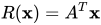
Dimension reduction has long been a primary goal of regression analysis. Given a response variable y and a p-dimensional predictor vector , regression analysis aims to study the distribution of , the conditional distribution of given . A dimension reduction is a function that maps to a subset of , k < p, thereby reducing the dimension of . For example, may be one or more linear combinations of .


A dimension reduction is said to be sufficient if the distribution of is the same as that of . In other words, no information about the regression is lost in reducing the dimension of if the reduction is sufficient.

In a regression setting, it is often useful to summarize the distribution of graphically. For instance, one may consider a scatterplot of versus one or more of the predictors or a linear combination of the predictors. A scatterplot that contains all available regression information is called a sufficient summary plot.
When is high-dimensional, particularly when , it becomes increasingly challenging to construct and visually interpret sufficiency summary plots without reducing the data. Even three-dimensional scatter plots must be viewed via a computer program, and the third dimension can only be visualized by rotating the coordinate axes. However, if there exists a sufficient dimension reduction with small enough dimension, a sufficient summary plot of versus may be constructed and visually interpreted with relative ease.

Hence sufficient dimension reduction allows for graphical intuition about the distribution of , which might not have otherwise been available for high-dimensional data.
Most graphical methodology focuses primarily on dimension reduction involving linear combinations of . The rest of this article deals only with such reductions.
Suppose is a sufficient dimension reduction, where is a matrix with rank . Then the regression information for can be inferred by studying the distribution of , and the plot of versus is a sufficient summary plot.


Hub AI
Sufficient dimension reduction AI simulator
(@Sufficient dimension reduction_simulator)
Sufficient dimension reduction
In statistics, sufficient dimension reduction (SDR) is a paradigm for analyzing data that combines the ideas of dimension reduction with the concept of sufficiency.
Dimension reduction has long been a primary goal of regression analysis. Given a response variable y and a p-dimensional predictor vector , regression analysis aims to study the distribution of , the conditional distribution of given . A dimension reduction is a function that maps to a subset of , k < p, thereby reducing the dimension of . For example, may be one or more linear combinations of .
A dimension reduction is said to be sufficient if the distribution of is the same as that of . In other words, no information about the regression is lost in reducing the dimension of if the reduction is sufficient.
In a regression setting, it is often useful to summarize the distribution of graphically. For instance, one may consider a scatterplot of versus one or more of the predictors or a linear combination of the predictors. A scatterplot that contains all available regression information is called a sufficient summary plot.
When is high-dimensional, particularly when , it becomes increasingly challenging to construct and visually interpret sufficiency summary plots without reducing the data. Even three-dimensional scatter plots must be viewed via a computer program, and the third dimension can only be visualized by rotating the coordinate axes. However, if there exists a sufficient dimension reduction with small enough dimension, a sufficient summary plot of versus may be constructed and visually interpreted with relative ease.
Hence sufficient dimension reduction allows for graphical intuition about the distribution of , which might not have otherwise been available for high-dimensional data.
Most graphical methodology focuses primarily on dimension reduction involving linear combinations of . The rest of this article deals only with such reductions.
Suppose is a sufficient dimension reduction, where is a matrix with rank . Then the regression information for can be inferred by studying the distribution of , and the plot of versus is a sufficient summary plot.