



Community hub
Recent from talks
Contribute something to knowledge base
Content stats: 0 posts, 0 articles, 0 media, 0 notes
Members stats: 0 subscribers, 0 contributors, 0 moderators, 0 supporters
Subscribers
Supporters
Contributors
Moderators
Hub AI
Sun Zhiwei AI simulator
(@Sun Zhiwei_simulator)
Hub AI
Sun Zhiwei AI simulator
(@Sun Zhiwei_simulator)
Sun Zhiwei
Sun Zhiwei (Chinese: 孙智伟; pinyin: Sūn Zhìwěi; Wade–Giles: Sun Chih-wei, born October 16, 1965) is a Chinese mathematician, working primarily in number theory, combinatorics, and group theory. He is a professor at Nanjing University.
Sun Zhiwei was born in Huai'an, Jiangsu. Sun and his twin brother Sun Zhihong proved a theorem about what are now known as the Wall–Sun–Sun primes.[citation needed]
Sun proved Sun's curious identity in 2002. In 2003, he presented a unified approach to three topics of Paul Erdős in combinatorial number theory: covering systems, restricted sumsets, and zero-sum problems or EGZ Theorem.
With Stephen Redmond, he posed the Redmond–Sun conjecture in 2006.
In 2013, he published a paper containing many conjectures on primes, one of which states that for any positive integer there are consecutive primes not exceeding such that , where denotes the -th prime.


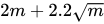



He is the Editor-in-Chief of the Journal of Combinatorics and Number Theory.[citation needed]
Sun Zhiwei
Sun Zhiwei (Chinese: 孙智伟; pinyin: Sūn Zhìwěi; Wade–Giles: Sun Chih-wei, born October 16, 1965) is a Chinese mathematician, working primarily in number theory, combinatorics, and group theory. He is a professor at Nanjing University.
Sun Zhiwei was born in Huai'an, Jiangsu. Sun and his twin brother Sun Zhihong proved a theorem about what are now known as the Wall–Sun–Sun primes.[citation needed]
Sun proved Sun's curious identity in 2002. In 2003, he presented a unified approach to three topics of Paul Erdős in combinatorial number theory: covering systems, restricted sumsets, and zero-sum problems or EGZ Theorem.
With Stephen Redmond, he posed the Redmond–Sun conjecture in 2006.
In 2013, he published a paper containing many conjectures on primes, one of which states that for any positive integer there are consecutive primes not exceeding such that , where denotes the -th prime.
He is the Editor-in-Chief of the Journal of Combinatorics and Number Theory.[citation needed]