
Recent from talks
Parinaud's syndrome
Knowledge base stats:
Talk channels stats:
Members stats:
Parinaud's syndrome
Parinaud's syndrome is a constellation of neurological signs indicating injury to the dorsal midbrain. More specifically, compression of the vertical gaze center at the rostral interstitial nucleus of medial longitudinal fasciculus (riMLF).
It is a group of abnormalities of eye movement and pupil dysfunction and is named for Henri Parinaud (1844–1905), considered to be the father of French ophthalmology.
Parinaud's syndrome is a cluster of abnormalities of eye movement and pupil dysfunction, characterized by:
It is also commonly associated with bilateral papilledema. It has less commonly been associated with spasm of accommodation on attempted upward gaze, pseudoabducens palsy (also known as thalamic esotropia) or slower movements of the abducting eye than the adducting eye during horizontal saccades, see-saw nystagmus and associated ocular motility deficits including skew deviation, oculomotor nerve palsy, trochlear nerve palsy and internuclear ophthalmoplegia.
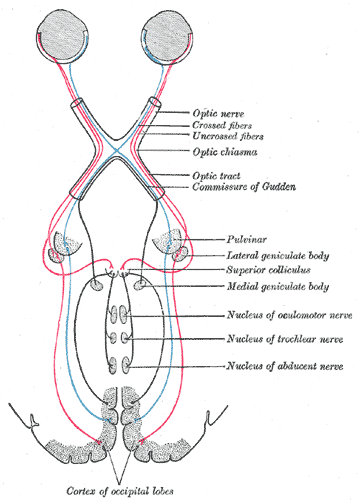
Parinaud's syndrome results from injury, either direct or compressive, to the dorsal midbrain. Specifically, compression or ischemic damage of the mesencephalic tectum, including the superior colliculus adjacent oculomotor (origin of cranial nerve III) and Edinger-Westphal nuclei, causing dysfunction to the motor function of the eye.
Classically, it has been associated with three major groups:
However, any other compression, ischemia or damage to this region can produce these phenomena: hydrocephalus, midbrain hemorrhage, cerebral arteriovenous malformation, trauma and brainstem toxoplasmosis infection. Neoplasms and giant aneurysms of the posterior fossa have also been associated with the midbrain syndrome.
Vertical supranuclear ophthalmoplegia has also been associated with metabolic disorders, such as Niemann-Pick disease, Wilson's disease, kernicterus, and barbiturate overdose.
Hub AI
Parinaud's syndrome AI simulator
(@Parinaud's syndrome_simulator)
Parinaud's syndrome
Parinaud's syndrome is a constellation of neurological signs indicating injury to the dorsal midbrain. More specifically, compression of the vertical gaze center at the rostral interstitial nucleus of medial longitudinal fasciculus (riMLF).
It is a group of abnormalities of eye movement and pupil dysfunction and is named for Henri Parinaud (1844–1905), considered to be the father of French ophthalmology.
Parinaud's syndrome is a cluster of abnormalities of eye movement and pupil dysfunction, characterized by:
It is also commonly associated with bilateral papilledema. It has less commonly been associated with spasm of accommodation on attempted upward gaze, pseudoabducens palsy (also known as thalamic esotropia) or slower movements of the abducting eye than the adducting eye during horizontal saccades, see-saw nystagmus and associated ocular motility deficits including skew deviation, oculomotor nerve palsy, trochlear nerve palsy and internuclear ophthalmoplegia.
Parinaud's syndrome results from injury, either direct or compressive, to the dorsal midbrain. Specifically, compression or ischemic damage of the mesencephalic tectum, including the superior colliculus adjacent oculomotor (origin of cranial nerve III) and Edinger-Westphal nuclei, causing dysfunction to the motor function of the eye.
Classically, it has been associated with three major groups:
However, any other compression, ischemia or damage to this region can produce these phenomena: hydrocephalus, midbrain hemorrhage, cerebral arteriovenous malformation, trauma and brainstem toxoplasmosis infection. Neoplasms and giant aneurysms of the posterior fossa have also been associated with the midbrain syndrome.
Vertical supranuclear ophthalmoplegia has also been associated with metabolic disorders, such as Niemann-Pick disease, Wilson's disease, kernicterus, and barbiturate overdose.
Recent media