

Recent from talks
Surface phonon
Knowledge base stats:
Talk channels stats:
Members stats:
Surface phonon
In solid state physics, a surface phonon is the quantum of a lattice vibration mode associated with a solid surface. Similar to the ordinary lattice vibrations in a bulk solid (whose quanta are simply called phonons), the nature of surface vibrations depends on details of periodicity and symmetry of a crystal structure. Surface vibrations are however distinct from the bulk vibrations, as they arise from the abrupt termination of a crystal structure at the surface of a solid. Knowledge of surface phonon dispersion gives important information related to the amount of surface relaxation, the existence and distance between an adsorbate and the surface, and information regarding presence, quantity, and type of defects existing on the surface.
In modern semiconductor research, surface vibrations are of interest as they can couple with electrons and thereby affect the electrical and optical properties of semiconductor devices. They are most relevant for devices where the electronic active area is near a surface, as is the case in two-dimensional electron systems and in quantum dots. As a specific example, the decreasing size of CdSe quantum dots was found to result in increasing frequency of the surface vibration resonance, which can couple with electrons and affect their properties.
Two methods are used for modeling surface phonons. One is the "slab method", which approaches the problem using lattice dynamics for a solid with parallel surfaces, and the other is based on Green's functions. Which of these approaches is employed is based upon what type of information is required from the computation. For broad surface phonon phenomena, the conventional lattice dynamics method can be used; for the study of lattice defects, resonances, or phonon state density, the Green's function method yields more useful results.
Surface phonons are represented by a wave vector along the surface, q, and an energy corresponding to a particular vibrational mode frequency, ω. The surface Brillouin zone (SBZ) for phonons consists of two dimensions, rather than three for bulk. For example, the face-centered cubic (100) surface is described by the directions ΓX and ΓM, referring to the [110] direction and [100] direction, respectively.
The description of the atomic displacements by the harmonic approximation assumes that the force on an atom is a function of its displacement with respect to neighboring atoms, i.e. Hooke's law holds. Higher order anharmonicity terms can be accounted by using perturbative methods.
The positions are then given by the relation where i is the place where the atom would sit if it were in equilibrium, mi is the mass of the atom that should sit at i, α is the direction of its displacement, ui,α is the amount of displacement of the atom from i, and are the force constants which come from the crystal potential.
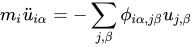

The solution to this gives the atomic displacement due to the phonon, which is given by where the atomic position i is described by l, m, and κ, which represent the specific atomic layer, l, the particular unit cell it is in, m, and the position of the atom with respect to its own unit cell, κ. The term x(l,m) is the position of the unit cell with respect to some chosen origin.
![{\displaystyle u_{\ell ,m,\kappa ,\alpha }={\sqrt {(m_{\kappa })}}v_{\ell ,\kappa ,\alpha }(\omega ,q)e^{i[\omega t-qx(\ell ,m)]}}](https://wikimedia.org/api/rest_v1/media/math/render/svg/6adaeb823875e1e0de8199518b6414def415426a)
Phonons can be labeled by the manner in which the vibrations occur. If the vibration occurs lengthwise in the direction of the wave and involves contraction and relaxation of the lattice, the phonon is called a "longitudinal phonon". Alternatively, the atoms may vibrate side-to-side, perpendicular to wave propagation direction; this is known as a "transverse phonon”. In general, transverse vibrations tend to have smaller frequencies than longitudinal vibrations.
Hub AI
Surface phonon AI simulator
(@Surface phonon_simulator)
Surface phonon
In solid state physics, a surface phonon is the quantum of a lattice vibration mode associated with a solid surface. Similar to the ordinary lattice vibrations in a bulk solid (whose quanta are simply called phonons), the nature of surface vibrations depends on details of periodicity and symmetry of a crystal structure. Surface vibrations are however distinct from the bulk vibrations, as they arise from the abrupt termination of a crystal structure at the surface of a solid. Knowledge of surface phonon dispersion gives important information related to the amount of surface relaxation, the existence and distance between an adsorbate and the surface, and information regarding presence, quantity, and type of defects existing on the surface.
In modern semiconductor research, surface vibrations are of interest as they can couple with electrons and thereby affect the electrical and optical properties of semiconductor devices. They are most relevant for devices where the electronic active area is near a surface, as is the case in two-dimensional electron systems and in quantum dots. As a specific example, the decreasing size of CdSe quantum dots was found to result in increasing frequency of the surface vibration resonance, which can couple with electrons and affect their properties.
Two methods are used for modeling surface phonons. One is the "slab method", which approaches the problem using lattice dynamics for a solid with parallel surfaces, and the other is based on Green's functions. Which of these approaches is employed is based upon what type of information is required from the computation. For broad surface phonon phenomena, the conventional lattice dynamics method can be used; for the study of lattice defects, resonances, or phonon state density, the Green's function method yields more useful results.
Surface phonons are represented by a wave vector along the surface, q, and an energy corresponding to a particular vibrational mode frequency, ω. The surface Brillouin zone (SBZ) for phonons consists of two dimensions, rather than three for bulk. For example, the face-centered cubic (100) surface is described by the directions ΓX and ΓM, referring to the [110] direction and [100] direction, respectively.
The description of the atomic displacements by the harmonic approximation assumes that the force on an atom is a function of its displacement with respect to neighboring atoms, i.e. Hooke's law holds. Higher order anharmonicity terms can be accounted by using perturbative methods.
The positions are then given by the relation where i is the place where the atom would sit if it were in equilibrium, mi is the mass of the atom that should sit at i, α is the direction of its displacement, ui,α is the amount of displacement of the atom from i, and are the force constants which come from the crystal potential.
The solution to this gives the atomic displacement due to the phonon, which is given by where the atomic position i is described by l, m, and κ, which represent the specific atomic layer, l, the particular unit cell it is in, m, and the position of the atom with respect to its own unit cell, κ. The term x(l,m) is the position of the unit cell with respect to some chosen origin.
Phonons can be labeled by the manner in which the vibrations occur. If the vibration occurs lengthwise in the direction of the wave and involves contraction and relaxation of the lattice, the phonon is called a "longitudinal phonon". Alternatively, the atoms may vibrate side-to-side, perpendicular to wave propagation direction; this is known as a "transverse phonon”. In general, transverse vibrations tend to have smaller frequencies than longitudinal vibrations.
Recent media