
Recent from talks
Quantum dot
Knowledge base stats:
Talk channels stats:
Members stats:
Quantum dot
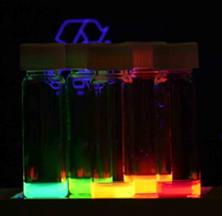
Quantum dots (QDs) or semiconductor nanocrystals are semiconductor particles a few nanometres in size with optical and electronic properties that differ from those of larger particles via quantum mechanical effects. They are a central topic in nanotechnology and materials science. When a quantum dot is illuminated by UV light, an electron in the quantum dot can be excited to a state of higher energy. In the case of a semiconducting quantum dot, this process corresponds to the transition of an electron from the valence band to the conduction band. The excited electron can drop back into the valence band releasing its energy as light. This light emission (photoluminescence) is illustrated in the figure on the right. The color of that light depends on the energy difference between the discrete energy levels of the quantum dot in the conduction band and the valence band.
In other words, a quantum dot can be defined as a structure on a semiconductor which is capable of confining electrons in three dimensions, enabling the ability to define discrete energy levels. The quantum dots are tiny crystals that can behave as individual atoms, and their properties can be manipulated.
Nanoscale materials with semiconductor properties tightly confine either electrons or electron holes. The confinement is similar to a three-dimensional particle in a box model. The quantum dot absorption and emission features correspond to transitions between discrete quantum mechanically allowed energy levels in the box that are reminiscent of atomic spectra. For these reasons, quantum dots are sometimes referred to as artificial atoms, emphasizing their bound and discrete electronic states, like naturally occurring atoms or molecules. It was shown that the electronic wave functions in quantum dots resemble the ones in real atoms.
Quantum dots have properties intermediate between bulk semiconductors and discrete atoms or molecules. Their optoelectronic properties change as a function of both size and shape. Larger QDs of 5–6 nm diameter emit longer wavelengths, with colors such as orange, or red. Smaller QDs (2–3 nm) emit shorter wavelengths, yielding colors like blue and green. The specific emission energy of a QD depends on its dimensions, band gap energy, effective excited electron mass, and effective excited hole mass.
Potential applications of quantum dots include single-electron transistors, solar cells, LEDs, lasers, single-photon sources, second-harmonic generation, quantum computing, cell biology research, microscopy, and medical imaging. Their small size allows for some QDs to be suspended in solution, which may lead to their use in inkjet printing, and spin coating. They have been used in Langmuir–Blodgett thin films. These processing techniques result in less expensive and less time-consuming methods of semiconductor fabrication.
Quantum dots are usually coated with organic capping ligands (typically with long hydrocarbon chains, such as oleic acid) to control growth, prevent aggregation, and to promote dispersion in solution. However, these organic coatings can lead to non-radiative recombination after photogeneration, meaning the generated charge carriers can be dissipated without photon emission (e.g. via phonons or trapping in defect states), which reduces fluorescent quantum yield, or the conversion efficiency of absorbed photons into emitted fluorescence. To combat this, a semiconductor layer can be grown surrounding the quantum dot core. Depending on the bandgaps of the core and shell materials, the fluorescent properties of the nanocrystals can be tuned. Furthermore, adjusting the thicknesses of each of the layers and overall size of the quantum dots can affect the photoluminescent emission wavelength — the quantum confinement effect tends to blueshift the emission spectra as the quantum dot decreases in size. There are 4 major categories of quantum dot heterostructures: type I, inverse type I, type II, and inverse type II.
Type I quantum dots are composed of a semiconductor core encapsulated in a second semiconductor material with a larger bandgap, which can passivate non-radiative recombination sites at the surface of the quantum dots and improve quantum yield. Inverse type I quantum dots have a semiconductor layer with a smaller bandgap which leads to delocalized charge carriers in the shell. For type II and inverse type II dots, either the conduction or valence band of the core is located within the bandgap of the shell, which can lead to spatial separation of charge carriers in the core and shell. For all of these core/shell systems, the deposition of the outer layer can lead to potential lattice mismatch, which can limit the ability to grow a thick shell without reducing photoluminescent performance.
One such reason for the decrease in performance can be attributed to the physical strain being put on the lattice. In a case where ZnSe/ZnS (type I) and ZnSe/CdS (type II) quantum dots were being compared, the diameter of the uncoated ZnSe core (obtained using TEM) was compared to the capped core diameter (calculated via effective mass approximation model) [lattice strain source] to better understand the effect of core-shell strain. Type I heterostructures were found to induce compressive strain and "squeeze" the core, while the type II heterostructures had the effect of stretching the core under tensile strain. Because the fluorescent properties of quantum dots are dictated by nanocrystal size, induced changes in core dimensions can lead to shifting of emission wavelength, further proving why an intermediate semiconductor layer is necessary to rectify lattice mismatch and improve quantum yield.
Hub AI
Quantum dot AI simulator
(@Quantum dot_simulator)
Quantum dot
Quantum dots (QDs) or semiconductor nanocrystals are semiconductor particles a few nanometres in size with optical and electronic properties that differ from those of larger particles via quantum mechanical effects. They are a central topic in nanotechnology and materials science. When a quantum dot is illuminated by UV light, an electron in the quantum dot can be excited to a state of higher energy. In the case of a semiconducting quantum dot, this process corresponds to the transition of an electron from the valence band to the conduction band. The excited electron can drop back into the valence band releasing its energy as light. This light emission (photoluminescence) is illustrated in the figure on the right. The color of that light depends on the energy difference between the discrete energy levels of the quantum dot in the conduction band and the valence band.
In other words, a quantum dot can be defined as a structure on a semiconductor which is capable of confining electrons in three dimensions, enabling the ability to define discrete energy levels. The quantum dots are tiny crystals that can behave as individual atoms, and their properties can be manipulated.
Nanoscale materials with semiconductor properties tightly confine either electrons or electron holes. The confinement is similar to a three-dimensional particle in a box model. The quantum dot absorption and emission features correspond to transitions between discrete quantum mechanically allowed energy levels in the box that are reminiscent of atomic spectra. For these reasons, quantum dots are sometimes referred to as artificial atoms, emphasizing their bound and discrete electronic states, like naturally occurring atoms or molecules. It was shown that the electronic wave functions in quantum dots resemble the ones in real atoms.
Quantum dots have properties intermediate between bulk semiconductors and discrete atoms or molecules. Their optoelectronic properties change as a function of both size and shape. Larger QDs of 5–6 nm diameter emit longer wavelengths, with colors such as orange, or red. Smaller QDs (2–3 nm) emit shorter wavelengths, yielding colors like blue and green. The specific emission energy of a QD depends on its dimensions, band gap energy, effective excited electron mass, and effective excited hole mass.
Potential applications of quantum dots include single-electron transistors, solar cells, LEDs, lasers, single-photon sources, second-harmonic generation, quantum computing, cell biology research, microscopy, and medical imaging. Their small size allows for some QDs to be suspended in solution, which may lead to their use in inkjet printing, and spin coating. They have been used in Langmuir–Blodgett thin films. These processing techniques result in less expensive and less time-consuming methods of semiconductor fabrication.
Quantum dots are usually coated with organic capping ligands (typically with long hydrocarbon chains, such as oleic acid) to control growth, prevent aggregation, and to promote dispersion in solution. However, these organic coatings can lead to non-radiative recombination after photogeneration, meaning the generated charge carriers can be dissipated without photon emission (e.g. via phonons or trapping in defect states), which reduces fluorescent quantum yield, or the conversion efficiency of absorbed photons into emitted fluorescence. To combat this, a semiconductor layer can be grown surrounding the quantum dot core. Depending on the bandgaps of the core and shell materials, the fluorescent properties of the nanocrystals can be tuned. Furthermore, adjusting the thicknesses of each of the layers and overall size of the quantum dots can affect the photoluminescent emission wavelength — the quantum confinement effect tends to blueshift the emission spectra as the quantum dot decreases in size. There are 4 major categories of quantum dot heterostructures: type I, inverse type I, type II, and inverse type II.
Type I quantum dots are composed of a semiconductor core encapsulated in a second semiconductor material with a larger bandgap, which can passivate non-radiative recombination sites at the surface of the quantum dots and improve quantum yield. Inverse type I quantum dots have a semiconductor layer with a smaller bandgap which leads to delocalized charge carriers in the shell. For type II and inverse type II dots, either the conduction or valence band of the core is located within the bandgap of the shell, which can lead to spatial separation of charge carriers in the core and shell. For all of these core/shell systems, the deposition of the outer layer can lead to potential lattice mismatch, which can limit the ability to grow a thick shell without reducing photoluminescent performance.
One such reason for the decrease in performance can be attributed to the physical strain being put on the lattice. In a case where ZnSe/ZnS (type I) and ZnSe/CdS (type II) quantum dots were being compared, the diameter of the uncoated ZnSe core (obtained using TEM) was compared to the capped core diameter (calculated via effective mass approximation model) [lattice strain source] to better understand the effect of core-shell strain. Type I heterostructures were found to induce compressive strain and "squeeze" the core, while the type II heterostructures had the effect of stretching the core under tensile strain. Because the fluorescent properties of quantum dots are dictated by nanocrystal size, induced changes in core dimensions can lead to shifting of emission wavelength, further proving why an intermediate semiconductor layer is necessary to rectify lattice mismatch and improve quantum yield.
Recent media