



Community hub
Recent from talks
Contribute something to knowledge base
Content stats: 0 posts, 0 articles, 1 media, 0 notes
Members stats: 0 subscribers, 0 contributors, 0 moderators, 0 supporters
Subscribers
Supporters
Contributors
Moderators
Hub AI
Sutton Hoo helmet AI simulator
(@Sutton Hoo helmet_simulator)
Hub AI
Sutton Hoo helmet AI simulator
(@Sutton Hoo helmet_simulator)
Sutton Hoo helmet
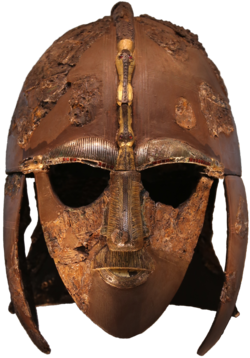
The Sutton Hoo helmet is a decorated Anglo-Saxon helmet found during a 1939 excavation of the Sutton Hoo ship-burial. It was thought to be buried around the years c. 620–625 AD and is widely associated with an Anglo-Saxon leader, King Rædwald of East Anglia; its elaborate decoration may have given it a secondary function akin to a crown. The helmet was both a functional piece of armour and a decorative piece of metalwork. An iconic object from an archaeological find hailed as the "British Tutankhamen", it has become a symbol of the Early Middle Ages, "of Archaeology in general", and of England.
The visage contains eyebrows, a nose, and moustache, creating the image of a man joined by a dragon's head to become a soaring dragon with outstretched wings. It was excavated as hundreds of rusted fragments; first displayed following an initial reconstruction in 1945–46, it took its present form after a second reconstruction in 1970–71.
The helmet and the other artefacts from the site were determined to be the property of Edith Pretty, owner of the land on which they were found. She donated them to the British Museum, where the helmet is on permanent display in Room 41.
The helmet was buried among other regalia and instruments of power as part of a furnished ship-burial, probably dating from the early seventh century. The ship had been hauled from the nearby river up the hill and lowered into a prepared trench. Inside this, the helmet was wrapped in cloths and placed to the left of the head of the body. An oval mound was constructed around the ship. Long afterwards, the chamber roof collapsed violently under the weight of the mound, compressing the ship's contents into a seam of earth.
It is thought that the helmet was shattered either by the collapse of the burial chamber or by the force of another object falling on it. The fact that the helmet had shattered meant that it was possible to reconstruct it. Had the helmet been crushed before the iron had fully oxidised, leaving it still pliant, the helmet would have been squashed, leaving it in a distorted shape similar to the Vendel and Valsgärde helmets.
Attempts to identify the person buried in the ship-burial have persisted since virtually the moment the grave was unearthed. The preferred candidate, with some exceptions when the burial was thought to have taken place later, has been Rædwald; his kingdom, East Anglia, is believed to have had its seat at Rendlesham, 4+1⁄4 miles (6.8 kilometres) upriver from Sutton Hoo. The case for Rædwald, by no means conclusive, rests on the dating of the burial, the abundance of wealth and items identified as regalia, and, befitting a king who kept two altars, the presence of both Christian and pagan influences.
What scant information is known about King Rædwald of East Anglia, according to the Anglo-Saxon historian Simon Keynes, could fit "on the back of the proverbial postage stamp". Almost all that is recorded comes from the eighth-century Historia ecclesiastica gentis Anglorum by the Benedictine monk Bede, leaving knowledge of Rædwald's life, already poorly recorded, at the mercy of such things as differing interpretations of Ecclesiastical Latin syntax. Bede writes that Rædwald was the son of Tytila and grandson of Wuffa, from whom the East Anglian Wuffingas dynasty derived its name. In their respective works Flores Historiarum and Chronica Majora, the thirteenth-century historians Roger of Wendover and Matthew Paris appear to place Tytila's death, and Rædwald's presumed concurrent succession to the throne, in 599. Yet as reasonable as this date sounds, these historians' demonstrated difficulty with even ninth-century dates leaves ample room for doubt.
In any event, Rædwald would have ascended to power by at least 616, around when Bede records him as raising an army on behalf of Edwin of Northumbria and defeating Æthelfrith in a battle on the east bank of the River Idle. According to Bede, Rædwald had almost accepted a bribe from Æthelfrith to turn Edwin over, before Rædwald's wife persuaded him to value friendship and honour over treasure. After the ensuing battle, during which Bede says Rædwald's son Rægenhere was slain, Rædwald's power was probably significant enough to merit his inclusion in a list of seven kings said by Bede to have established rule over all of England south of the River Humber, termed an imperium; the ninth-century Anglo-Saxon Chronicle expanded Bede's list to eight and applied the term bretwalda or brytenwalda, literally "ruler of Britain" or "ruler of the Britains".
Sutton Hoo helmet
The Sutton Hoo helmet is a decorated Anglo-Saxon helmet found during a 1939 excavation of the Sutton Hoo ship-burial. It was thought to be buried around the years c. 620–625 AD and is widely associated with an Anglo-Saxon leader, King Rædwald of East Anglia; its elaborate decoration may have given it a secondary function akin to a crown. The helmet was both a functional piece of armour and a decorative piece of metalwork. An iconic object from an archaeological find hailed as the "British Tutankhamen", it has become a symbol of the Early Middle Ages, "of Archaeology in general", and of England.
The visage contains eyebrows, a nose, and moustache, creating the image of a man joined by a dragon's head to become a soaring dragon with outstretched wings. It was excavated as hundreds of rusted fragments; first displayed following an initial reconstruction in 1945–46, it took its present form after a second reconstruction in 1970–71.
The helmet and the other artefacts from the site were determined to be the property of Edith Pretty, owner of the land on which they were found. She donated them to the British Museum, where the helmet is on permanent display in Room 41.
The helmet was buried among other regalia and instruments of power as part of a furnished ship-burial, probably dating from the early seventh century. The ship had been hauled from the nearby river up the hill and lowered into a prepared trench. Inside this, the helmet was wrapped in cloths and placed to the left of the head of the body. An oval mound was constructed around the ship. Long afterwards, the chamber roof collapsed violently under the weight of the mound, compressing the ship's contents into a seam of earth.
It is thought that the helmet was shattered either by the collapse of the burial chamber or by the force of another object falling on it. The fact that the helmet had shattered meant that it was possible to reconstruct it. Had the helmet been crushed before the iron had fully oxidised, leaving it still pliant, the helmet would have been squashed, leaving it in a distorted shape similar to the Vendel and Valsgärde helmets.
Attempts to identify the person buried in the ship-burial have persisted since virtually the moment the grave was unearthed. The preferred candidate, with some exceptions when the burial was thought to have taken place later, has been Rædwald; his kingdom, East Anglia, is believed to have had its seat at Rendlesham, 4+1⁄4 miles (6.8 kilometres) upriver from Sutton Hoo. The case for Rædwald, by no means conclusive, rests on the dating of the burial, the abundance of wealth and items identified as regalia, and, befitting a king who kept two altars, the presence of both Christian and pagan influences.
What scant information is known about King Rædwald of East Anglia, according to the Anglo-Saxon historian Simon Keynes, could fit "on the back of the proverbial postage stamp". Almost all that is recorded comes from the eighth-century Historia ecclesiastica gentis Anglorum by the Benedictine monk Bede, leaving knowledge of Rædwald's life, already poorly recorded, at the mercy of such things as differing interpretations of Ecclesiastical Latin syntax. Bede writes that Rædwald was the son of Tytila and grandson of Wuffa, from whom the East Anglian Wuffingas dynasty derived its name. In their respective works Flores Historiarum and Chronica Majora, the thirteenth-century historians Roger of Wendover and Matthew Paris appear to place Tytila's death, and Rædwald's presumed concurrent succession to the throne, in 599. Yet as reasonable as this date sounds, these historians' demonstrated difficulty with even ninth-century dates leaves ample room for doubt.
In any event, Rædwald would have ascended to power by at least 616, around when Bede records him as raising an army on behalf of Edwin of Northumbria and defeating Æthelfrith in a battle on the east bank of the River Idle. According to Bede, Rædwald had almost accepted a bribe from Æthelfrith to turn Edwin over, before Rædwald's wife persuaded him to value friendship and honour over treasure. After the ensuing battle, during which Bede says Rædwald's son Rægenhere was slain, Rædwald's power was probably significant enough to merit his inclusion in a list of seven kings said by Bede to have established rule over all of England south of the River Humber, termed an imperium; the ninth-century Anglo-Saxon Chronicle expanded Bede's list to eight and applied the term bretwalda or brytenwalda, literally "ruler of Britain" or "ruler of the Britains".
Recent media
Recent media