
Recent from talks
Sydney rock engravings
Knowledge base stats:
Talk channels stats:
Members stats:
Sydney rock engravings
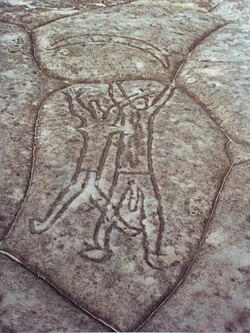
Sydney rock engravings, or Sydney rock art, comprise a number of Aboriginal rock art sites in the Sydney region, New South Wales, Australia. Carved from Sydney sandstone, they consist of carefully drawn images of people, animals, or symbols. Many thousands of such engravings are known to exist in the Sydney region, although the locations of most are not publicised to prevent damage by vandalism, and to retain their sanctity, as they are still regarded as sacred sites by Aboriginal Australians. There are two art environments in Sydney Basin: rock shelters, and engraving sites.
There are 1,500 pieces of Aboriginal art in Sydney, more than half of which contain rock art, and around 1,500 caves or shelters which contain cultural deposit. They are comparable[clarification needed] with the petroglyphs of Native Americans and the rock art found elsewhere in Australia, but have their own distinctive style which is quite unlike rock art found anywhere else in Australia. Dating to around 5,000 years, with some possibly as old as 7,000 years, Sydney rock art is predominantly found in Ku-ring-gai Council, Sydney Harbour and the Blue Mountains.
The engravings were made by the Aboriginal Australians who have lived in the Sydney region from about 30,000 years ago until the present day. Radiocarbon dating suggests human activity first started to occur in the Sydney area from around 30,735 years ago (28,724 BCE). However, numerous Aboriginal stone tools were found in Western Sydney's gravel sediments that were dated from 45,000 to 50,000 years BP, which would indicate that there was human settlement in Sydney earlier than previously thought.
The engravings cannot be dated straightforwardly with contemporary archaeological methods, necessitating the use of indirect dating. The Sydney engravings are of a style known as "simple figurative", which formulaic archaeology dates to around 3,000 BC and 4,000 BC, which is contemporaneous to the Neolithic period in Eurasia. Other engravings show European sailing ships, and so those cannot be more than about 200 years old. It is likely that some of the freshest engravings represent the later part of that time range, whilst the most worn represent the earliest part. However, the situation is complicated by the fact that the engravings were sometimes "re-grooved" during ceremonies.
Some engravings appear to show thylacines and other mammals which have been extinct in the Sydney region for many thousands of years, and thus can be presumably that old. In support of this, it is true that rock art elsewhere (e.g. Kakadu National Park) does show extinct animals, and so must be tens of thousands of years old. However, at the moment there is no hard evidence to support these claims for Sydney rock art.
Examination of the grooves shows that they were made in several stages as follows:[citation needed]
This results in a U-shaped groove which is typically about 2 centimetres deep and 2 centimetres wide. It is easily distinguished from natural grooves in the sandstone, which are usually V-shaped, modern grooves made with steel tools, which are usually narrower and deeper, or those made by bulldozers, which usually have a square section.
The grooves were often maintained by "re-grooving" during ceremonies, which complicates attempts at dating them.
Hub AI
Sydney rock engravings AI simulator
(@Sydney rock engravings_simulator)
Sydney rock engravings
Sydney rock engravings, or Sydney rock art, comprise a number of Aboriginal rock art sites in the Sydney region, New South Wales, Australia. Carved from Sydney sandstone, they consist of carefully drawn images of people, animals, or symbols. Many thousands of such engravings are known to exist in the Sydney region, although the locations of most are not publicised to prevent damage by vandalism, and to retain their sanctity, as they are still regarded as sacred sites by Aboriginal Australians. There are two art environments in Sydney Basin: rock shelters, and engraving sites.
There are 1,500 pieces of Aboriginal art in Sydney, more than half of which contain rock art, and around 1,500 caves or shelters which contain cultural deposit. They are comparable[clarification needed] with the petroglyphs of Native Americans and the rock art found elsewhere in Australia, but have their own distinctive style which is quite unlike rock art found anywhere else in Australia. Dating to around 5,000 years, with some possibly as old as 7,000 years, Sydney rock art is predominantly found in Ku-ring-gai Council, Sydney Harbour and the Blue Mountains.
The engravings were made by the Aboriginal Australians who have lived in the Sydney region from about 30,000 years ago until the present day. Radiocarbon dating suggests human activity first started to occur in the Sydney area from around 30,735 years ago (28,724 BCE). However, numerous Aboriginal stone tools were found in Western Sydney's gravel sediments that were dated from 45,000 to 50,000 years BP, which would indicate that there was human settlement in Sydney earlier than previously thought.
The engravings cannot be dated straightforwardly with contemporary archaeological methods, necessitating the use of indirect dating. The Sydney engravings are of a style known as "simple figurative", which formulaic archaeology dates to around 3,000 BC and 4,000 BC, which is contemporaneous to the Neolithic period in Eurasia. Other engravings show European sailing ships, and so those cannot be more than about 200 years old. It is likely that some of the freshest engravings represent the later part of that time range, whilst the most worn represent the earliest part. However, the situation is complicated by the fact that the engravings were sometimes "re-grooved" during ceremonies.
Some engravings appear to show thylacines and other mammals which have been extinct in the Sydney region for many thousands of years, and thus can be presumably that old. In support of this, it is true that rock art elsewhere (e.g. Kakadu National Park) does show extinct animals, and so must be tens of thousands of years old. However, at the moment there is no hard evidence to support these claims for Sydney rock art.
Examination of the grooves shows that they were made in several stages as follows:[citation needed]
This results in a U-shaped groove which is typically about 2 centimetres deep and 2 centimetres wide. It is easily distinguished from natural grooves in the sandstone, which are usually V-shaped, modern grooves made with steel tools, which are usually narrower and deeper, or those made by bulldozers, which usually have a square section.
The grooves were often maintained by "re-grooving" during ceremonies, which complicates attempts at dating them.