


Community hub
Recent from talks
Contribute something
Nothing was collected or created yet.
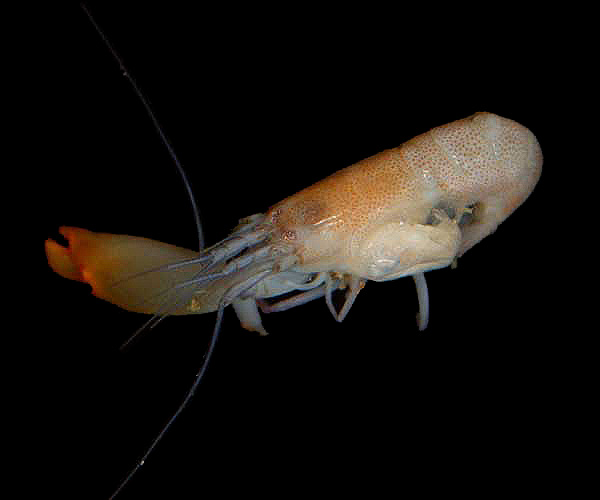
Synalpheus
View on Wikipedia
| Synalpheus | |
|---|---|

| |
| Synalpheus fritzmuelleri | |
Scientific classification 
| |
| Kingdom: | Animalia |
| Phylum: | Arthropoda |
| Class: | Malacostraca |
| Order: | Decapoda |
| Suborder: | Pleocyemata |
| Infraorder: | Caridea |
| Family: | Alpheidae |
| Genus: | Synalpheus Bate, 1888 |
| Type species | |
| Synalpheus falcatus Bate, 1888 [1]
| |
| Species | |
|
See species list | |
| Synonyms | |
|
List
| |
Synalpheus is a genus of snapping shrimp of the family Alpheidae, presently containing more than 160 species; new ones are described on a regular basis, and the exact number even of described species is disputed.
Taxonomy
[edit]Although the genus Zuzalpheus was proposed for S. gambarelloides, S. brooksi, and their closest relatives, this has not been adopted and is not considered a monophyletic clade within the genus Synalpheus.[2][3][4]
Over 160 species are recognised in the genus Synalpheus. For a complete listing, see List of Synalpheus species.
Distribution
[edit]In the narrower sense, Synalpheus occur in the eastern Pacific where they are most plentiful and probably originated, and to a lesser extent in the Atlantic and the Indian Ocean; the species placed in Zuzalpheus occur mainly in the western Atlantic where their lineage probably originated, and to a lesser extent in the eastern Atlantic and Indian Ocean, and the eastern Pacific. It may thus be that the closure of the Isthmus of Panama in the Piacenzian (about 3 million years ago) was a key factor in separating the two lineages, as species referred to Synalpheus sensu stricto are most plentiful in the western Pacific.[4]
Behaviour and ecology
[edit]Snapping
[edit]The snapping behaviour of Synalpheus is rather well studied. In Synalpheus parneomeris, peak to peak source levels of 185–190 dB re 1 μPa at 1 m were measured, depending on the size of the claw.[5]
Eusociality
[edit]The only known eusocial aquatic species occur within the genus Synalpheus. The species known to be eusocial are S. brooksi, S. chacei, S. elizabethae, S. filidigitus, S. rathbunae, S. regalis,[2] S. microneptunus,[6] and S. duffyi as well as potentially S. riosi.[7] Eusociality has evolved at least three times within Synalpheus.[3][8] It appears that there were multiple rapid radiations between 3 and 9 mya from which the ancestors of these eusocial species appeared.[8] Eusociality is thought to have arisen due to competition for space, because among the species that host Synalpheus, empty sponges are rarely found.[9] It also appears that kin selection was necessary for this evolution to occur because the only species in which eusociality has appeared are non-dispersing shrimp that hatch directly into crawling individuals.[10] Until recently, eusocial species of Synalpheus have appeared in far greater abundance than, and appear to outcompete, less social species for space in sponges.[9][11]
References
[edit]- ^ Arthur Anker; Sammy De Grave (2008). "Zuzalpheus Ríos and Duffy, 2007: a junior synonym of Synalpheus Bate, 1888 (Decapoda: Alpheidae)" (PDF). Journal of Crustacean Biology. 28 (4): 735–740. doi:10.1651/07-2969.1. S2CID 86161073.
- ^ a b Rubén Ríos & J. Emmett Duffy (2007). "A review of the sponge-dwelling snapping shrimp from Carrie Bow Cay, Belize, with description of Zuzalpheus, new genus, and six new species (Crustacea: Decapoda: Alpheidae)" (PDF). Zootaxa. 1602: 1–89. doi:10.11646/zootaxa.1602.1.1.
- ^ a b J. Emmett Duffy; Cheryl L. Morrison; Rubén Ríos (2000). "Multiple origins of eusociality among sponge-dwelling shrimps (Synalpheus)" (PDF). Evolution. 54 (2): 503–516. doi:10.1111/j.0014-3820.2000.tb00053.x. PMID 10937227. S2CID 1088840. Archived from the original (PDF) on 2003-06-07.
- ^ a b Margarita Hermoso-Salazar; Mary Wicksten; Juan J. Morrone (2008). "Phylogenetic analysis of the Paulsoni species group (Decapoda: Alpheidae) from the American Pacific, with implications for the phylogenetic classification of the genus Synalpheus" (PDF). Zootaxa. 1744: 19–30. doi:10.11646/zootaxa.1744.1.2.
- ^ W. W. L. Au; K. Banks (1998). "The acoustics of the snapping shrimp Synalpheus parneomeris in Kaneohe Bay". Journal of the Acoustical Society of America. 103 (1): 41–47. Bibcode:1998ASAJ..103...41A. doi:10.1121/1.423234.
- ^ Hultgren, Kristin M.; Macdonald III, Kenneth s; Duffy, J. Emmett (2011). "Sponge-dwelling snapping shrimps (Alpheidae: Synalpheus) of Barbados, West Indies, with a description of a new eusocial species" (PDF). Zootaxa. 2834: 1–16. doi:10.11646/zootaxa.2834.1.1.
- ^ Anker, Arthur; Toth, Eva (2008). "A preliminary revision of the Synalpheus paranuptunus Coutiere, 1909 species complex (Crustacea: Decapoda: Alpheidae)" (PDF). Zootaxa. 1915: 1–28. doi:10.11646/zootaxa.1915.1.1. S2CID 86215392.
- ^ a b Morrison, Cheryl L; Rios, Ruben; Duffy, J Emmett (May 2004). "Phylogenetic evidence for an ancient rapid radiation of Caribbean sponge-dwelling snapping shrimps (Synalpheus)". Molecular Phylogenetics and Evolution. 30 (3): 563–581. doi:10.1016/S1055-7903(03)00252-5. PMID 15012939.
- ^ Duffy, J. Emmett; Macdonald, Kenneth S. (4 November 2009). "Kin structure, ecology and the evolution of social organization in shrimp: a comparative analysis". Proceedings of the Royal Society B: Biological Sciences. 277 (1681): 575–584. doi:10.1098/rspb.2009.1483. PMC 2842683. PMID 19889706.
- ^ Duffy, J. Emmett; Macdonald III, Kenneth S.; Hultgren, Kristin M.; Chak, Tin Chi Solomon; Rubenstein, Dustin R. (13 February 2013). "Decline and local extinction of Caribbean eusocial shrimp". PLOS ONE. 8 (2) e54637. Bibcode:2013PLoSO...854637D. doi:10.1371/journal.pone.0054637. PMC 3572134. PMID 23418429.
Further reading
[edit]- Kristin M. Hultgren, Kenneth S. MacDonald III & J. Emmett Duffy (2011). "Sponge-dwelling snapping shrimps (Alpheidae: Synalpheus) of Barbados, West Indies, with a description of a new eusocial species" (PDF). Zootaxa. 2834: 1–16. doi:10.11646/zootaxa.2834.1.1.
External links
[edit]

| Topics |  | |
|---|---|---|
| Groups | ||
| In culture | ||
| Pioneers, works |
| |
| National | |
|---|---|
| Other | |
