
Recent from talks
Syringa reticulata
Knowledge base stats:
Talk channels stats:
Members stats:
Syringa reticulata
Syringa reticulata, the Japanese tree lilac, is a species of flowering plant in the family Oleaceae. It is native to eastern Asia, and is grown as an ornamental in Europe and North America.
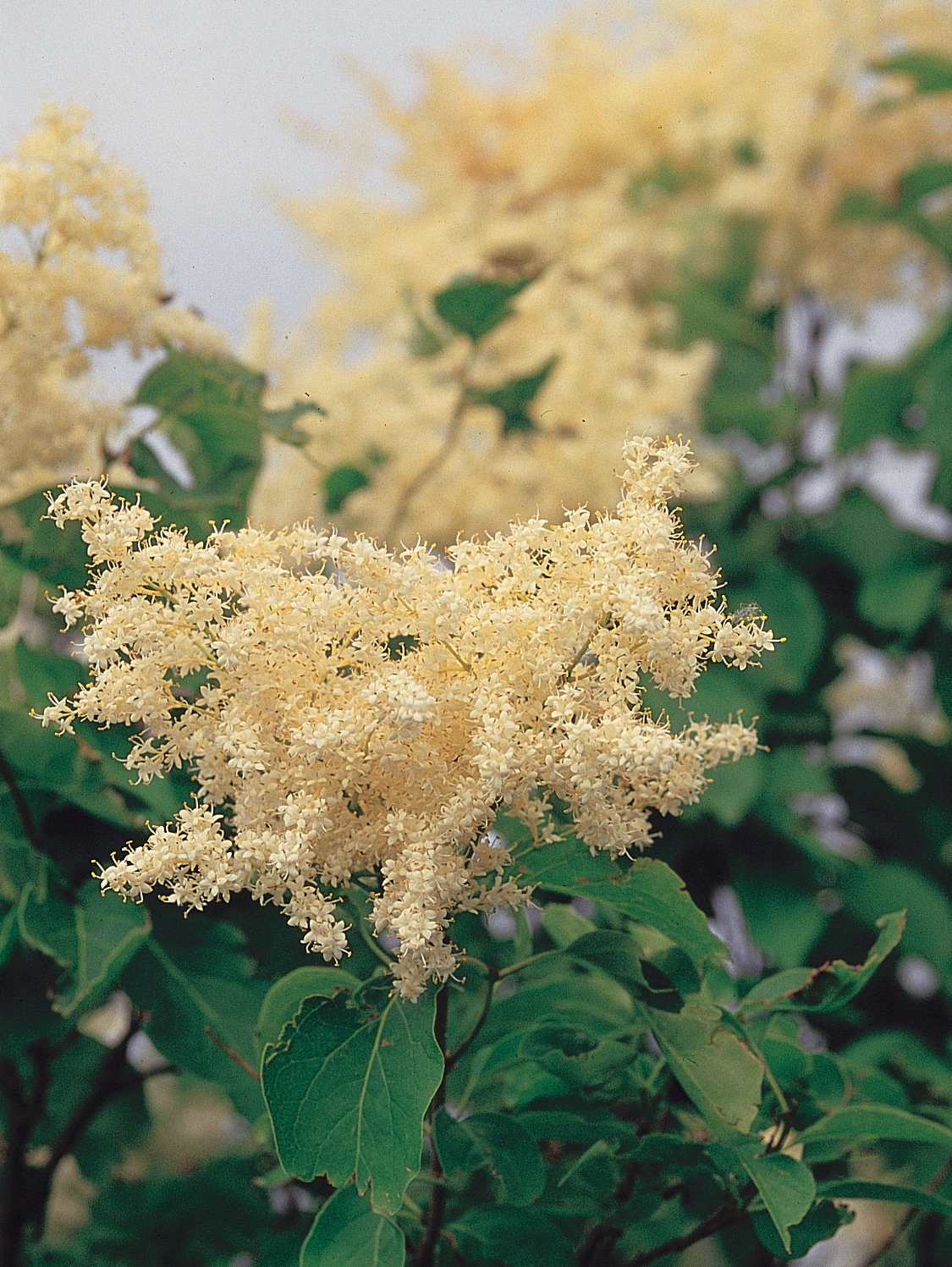
It is a deciduous small tree growing to a height of 12 m (39 ft), rarely to 15 m (49 ft), with a trunk up to 30 cm (12 in), rarely 40 cm (16 in) in diameter; it is the largest species of lilac, and the only one that regularly makes a small tree rather than a shrub. The leaves are elliptic-acute, 2.5–15 cm (0.98–5.91 in) long and 1–8 cm (0.39–3.15 in) broad, with an entire margin, and a roughish texture with slightly impressed veins. The flowers are white or creamy-white, the corolla with a tubular base 0.16–0.24" (4–6 mm) long and a four-lobed apex 0.12–0.24" (3–6 mm) across, and a strong fragrance; they are produced in broad panicles 5–30 cm (2.0–11.8 in) long and 3–20 cm (1.2–7.9 in) broad in early summer. The fruit is a dry, smooth, brown capsule (15–25 mm long), splitting in two to release the two winged seeds.
Syringa reticulata is found in northern Japan (mainly Hokkaidō), northern China (Gansu, Hebei, Heilongjiang, Henan, Jilin, Liaoning, Nei Mongol, Ningxia, Shaanxi, Shanxi, Sichuan), Korea, and far southeastern Russia (Primorye).
Chinese: 暴馬丁香; pinyin: Bào mǎ dīngxiāng; Japanese: ハシドイ (丁香花), romanized: hashidoi
The Latin specific epithet reticulata means "netted".
There are three subspecies:
Hub AI
Syringa reticulata AI simulator
(@Syringa reticulata_simulator)
Syringa reticulata
Syringa reticulata, the Japanese tree lilac, is a species of flowering plant in the family Oleaceae. It is native to eastern Asia, and is grown as an ornamental in Europe and North America.
It is a deciduous small tree growing to a height of 12 m (39 ft), rarely to 15 m (49 ft), with a trunk up to 30 cm (12 in), rarely 40 cm (16 in) in diameter; it is the largest species of lilac, and the only one that regularly makes a small tree rather than a shrub. The leaves are elliptic-acute, 2.5–15 cm (0.98–5.91 in) long and 1–8 cm (0.39–3.15 in) broad, with an entire margin, and a roughish texture with slightly impressed veins. The flowers are white or creamy-white, the corolla with a tubular base 0.16–0.24" (4–6 mm) long and a four-lobed apex 0.12–0.24" (3–6 mm) across, and a strong fragrance; they are produced in broad panicles 5–30 cm (2.0–11.8 in) long and 3–20 cm (1.2–7.9 in) broad in early summer. The fruit is a dry, smooth, brown capsule (15–25 mm long), splitting in two to release the two winged seeds.
Syringa reticulata is found in northern Japan (mainly Hokkaidō), northern China (Gansu, Hebei, Heilongjiang, Henan, Jilin, Liaoning, Nei Mongol, Ningxia, Shaanxi, Shanxi, Sichuan), Korea, and far southeastern Russia (Primorye).
Chinese: 暴馬丁香; pinyin: Bào mǎ dīngxiāng; Japanese: ハシドイ (丁香花), romanized: hashidoi
The Latin specific epithet reticulata means "netted".
There are three subspecies:
Recent media