
Recent from talks
TKS
Knowledge base stats:
Talk channels stats:
Members stats:
TKS
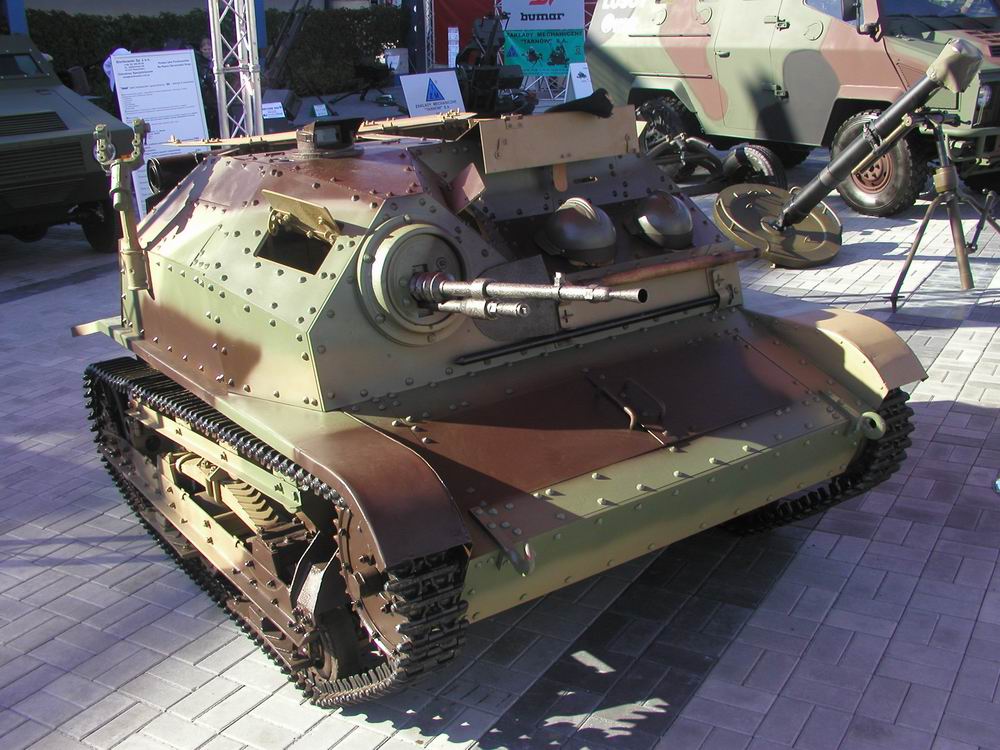
The TK (TK-3) and TKS were Polish tankettes developed during the 1930s and used in the Second World War.
The TK (also known as the TK-3) tankette was a Polish design produced from 1931 based on the chassis of the British Carden Loyd tankette, with an improved hull and more powerful engine, and armour up to 8 mm (0.31 in) thick (10 mm or 0.39 in on the TKS). In 1939, up-arming of the tankettes with nkm wz. 38 FK 20 mm (0.79 in) autocannons began, but only 24 of these were completed before the outbreak of World War II.
On 6 November 1934 Estonia purchased 6 vehicles from Poland, with the contract deal worth over 180 000 krones. The deal also included one additional tracked-lorry, and a motorcycle was given free as a bonus. After the Soviet Union occupied Estonia, these vehicles were put into service with the Red Army.[citation needed]
575 TK/TKS tankettes formed the bulk of the Polish armoured forces before the outbreak of war. They suffered heavy losses during the invasion of Poland, often being the only armoured fighting vehicles available. Their small size suited them for reconnaissance and infantry support, but with their light armament of a single machine gun they stood no chance in combat against German tanks, except against the Panzer I.
The handful of tankettes armed with 20 mm guns were more effective against enemy tanks; in one instance on 18 September 1939 a 20 mm gunned TKS commanded by Podchorąży (officer cadet) Roman Orlik destroyed two German Panzer 35(t) tanks and a Panzer IV ausf B tank which was commanded by Victor IV Albrecht von Ratibor.
After the conquest of Poland, captured tankettes were used by the German army in various support roles, mostly for training, security duties or as artillery tractors. Many captured tankettes were also used by the Luftwaffe for airfield security and snowplowing. Some were later sold to the puppet state of Croatia. In spring 1941, the National Police received 18 TK-3 tankettes, some with the 20mm gun, while in summer 1941 the Army received 18 TKS, 4 of them being sent to the Ustashe Militia.
A smaller Polish force retreated to (then neutral) Hungary from the German and Soviet troops occupying Poland. This mixed formation had 30 tracked vehicles, of which 15–20 were TKS (contemporary sources did not officially distinguish between TK-3 and TKS). These vehicles were used for training in tank driving and machine gun handling drills. By the end of the war, they were worn out due to the lack of spare parts, so there is no trace of them after early 1944. The crew was able to travel to England with the help of the Hungarian government in 1940.
Experimental models:
Hub AI
TKS AI simulator
(@TKS_simulator)
TKS
The TK (TK-3) and TKS were Polish tankettes developed during the 1930s and used in the Second World War.
The TK (also known as the TK-3) tankette was a Polish design produced from 1931 based on the chassis of the British Carden Loyd tankette, with an improved hull and more powerful engine, and armour up to 8 mm (0.31 in) thick (10 mm or 0.39 in on the TKS). In 1939, up-arming of the tankettes with nkm wz. 38 FK 20 mm (0.79 in) autocannons began, but only 24 of these were completed before the outbreak of World War II.
On 6 November 1934 Estonia purchased 6 vehicles from Poland, with the contract deal worth over 180 000 krones. The deal also included one additional tracked-lorry, and a motorcycle was given free as a bonus. After the Soviet Union occupied Estonia, these vehicles were put into service with the Red Army.[citation needed]
575 TK/TKS tankettes formed the bulk of the Polish armoured forces before the outbreak of war. They suffered heavy losses during the invasion of Poland, often being the only armoured fighting vehicles available. Their small size suited them for reconnaissance and infantry support, but with their light armament of a single machine gun they stood no chance in combat against German tanks, except against the Panzer I.
The handful of tankettes armed with 20 mm guns were more effective against enemy tanks; in one instance on 18 September 1939 a 20 mm gunned TKS commanded by Podchorąży (officer cadet) Roman Orlik destroyed two German Panzer 35(t) tanks and a Panzer IV ausf B tank which was commanded by Victor IV Albrecht von Ratibor.
After the conquest of Poland, captured tankettes were used by the German army in various support roles, mostly for training, security duties or as artillery tractors. Many captured tankettes were also used by the Luftwaffe for airfield security and snowplowing. Some were later sold to the puppet state of Croatia. In spring 1941, the National Police received 18 TK-3 tankettes, some with the 20mm gun, while in summer 1941 the Army received 18 TKS, 4 of them being sent to the Ustashe Militia.
A smaller Polish force retreated to (then neutral) Hungary from the German and Soviet troops occupying Poland. This mixed formation had 30 tracked vehicles, of which 15–20 were TKS (contemporary sources did not officially distinguish between TK-3 and TKS). These vehicles were used for training in tank driving and machine gun handling drills. By the end of the war, they were worn out due to the lack of spare parts, so there is no trace of them after early 1944. The crew was able to travel to England with the help of the Hungarian government in 1940.
Experimental models:
Recent media