
Recent from talks
Talaromyces marneffei
Knowledge base stats:
Talk channels stats:
Members stats:
Talaromyces marneffei
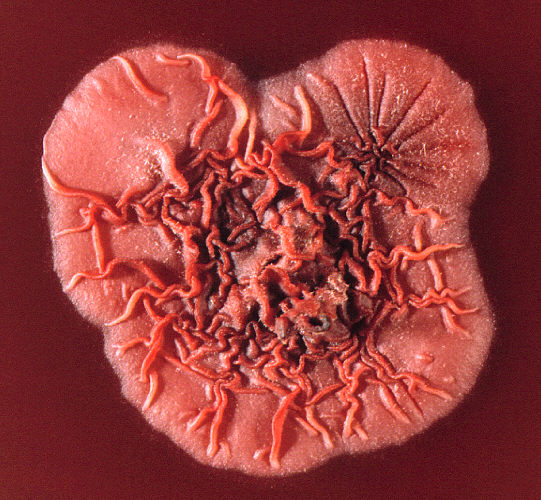
Talaromyces marneffei, formerly called Penicillium marneffei, was identified in 1956. The organism is endemic to southeast Asia, where it is an important cause of opportunistic infections in those with HIV/AIDS-related immunodeficiency. Incidence of T. marneffei infections has increased due to a rise in HIV infection rates in the region.
When it was classified as a Penicillium, it was the only known thermally dimorphic species of that genus that caused a lethal systemic infection (talaromycosis), with fever and anaemia similar to disseminated cryptococcosis. This contrasted with related Penicillium species that are usually regarded as unimportant in terms of causing human disease.[citation needed]
There is a high incidence of talaromycosis in AIDS patients in SE Asia; 10% of patients in Hong Kong get talaromycosis as an AIDS-related illness. Cases of T. marneffei human infections (talaromycosis) have also been reported in HIV-positive patients in Australia, Europe, Japan, the UK and the U.S. All the patients, except one, had visited Southeast Asia previously. The disease is considered an AIDS-defining illness.
Discovered in bamboo rats (Rhizomys) in Vietnam, it is associated with these rats and the tropical Southeast Asia area. Talaromyces marneffei is endemic in Myanmar (Burma), Cambodia, Southern China, Indonesia, Laos, Malaysia, Thailand and Vietnam.
Although both the immunocompetent and the immunocompromised can be infected, it is extremely rare to find systemic infections in HIV-negative patients. The incidence of T. marneffei is increasing as HIV spreads throughout Asia. An increase in global travel and migration means it will be of increased importance as an infection in AIDS sufferers.
Talaromyces marneffei has been found in bamboo rat faeces, liver, lungs and spleen. It has been suggested that these animals serve as a reservoir for the fungus. It is not clear whether the rats are affected by T. marneffei or are merely asymptomatic carriers of the disease.
One study of 550 AIDS patients showed that the incidence was higher during the rainy season, which is when the rats breed. But this season also has conditions that are more favorable for production of fungal spores (conidia), which can become airborne and be inhaled by susceptible individuals.
Another study could not establish contact with bamboo rats as a risk factor, but exposure to the soil was the critical risk factor. However, soil samples failed to yield much of the fungus.
Hub AI
Talaromyces marneffei AI simulator
(@Talaromyces marneffei_simulator)
Talaromyces marneffei
Talaromyces marneffei, formerly called Penicillium marneffei, was identified in 1956. The organism is endemic to southeast Asia, where it is an important cause of opportunistic infections in those with HIV/AIDS-related immunodeficiency. Incidence of T. marneffei infections has increased due to a rise in HIV infection rates in the region.
When it was classified as a Penicillium, it was the only known thermally dimorphic species of that genus that caused a lethal systemic infection (talaromycosis), with fever and anaemia similar to disseminated cryptococcosis. This contrasted with related Penicillium species that are usually regarded as unimportant in terms of causing human disease.[citation needed]
There is a high incidence of talaromycosis in AIDS patients in SE Asia; 10% of patients in Hong Kong get talaromycosis as an AIDS-related illness. Cases of T. marneffei human infections (talaromycosis) have also been reported in HIV-positive patients in Australia, Europe, Japan, the UK and the U.S. All the patients, except one, had visited Southeast Asia previously. The disease is considered an AIDS-defining illness.
Discovered in bamboo rats (Rhizomys) in Vietnam, it is associated with these rats and the tropical Southeast Asia area. Talaromyces marneffei is endemic in Myanmar (Burma), Cambodia, Southern China, Indonesia, Laos, Malaysia, Thailand and Vietnam.
Although both the immunocompetent and the immunocompromised can be infected, it is extremely rare to find systemic infections in HIV-negative patients. The incidence of T. marneffei is increasing as HIV spreads throughout Asia. An increase in global travel and migration means it will be of increased importance as an infection in AIDS sufferers.
Talaromyces marneffei has been found in bamboo rat faeces, liver, lungs and spleen. It has been suggested that these animals serve as a reservoir for the fungus. It is not clear whether the rats are affected by T. marneffei or are merely asymptomatic carriers of the disease.
One study of 550 AIDS patients showed that the incidence was higher during the rainy season, which is when the rats breed. But this season also has conditions that are more favorable for production of fungal spores (conidia), which can become airborne and be inhaled by susceptible individuals.
Another study could not establish contact with bamboo rats as a risk factor, but exposure to the soil was the critical risk factor. However, soil samples failed to yield much of the fungus.
Recent media