



Community hub
Recent from talks
Knowledge base stats:
Talk channels stats:
Members stats:
Talysh Khanate
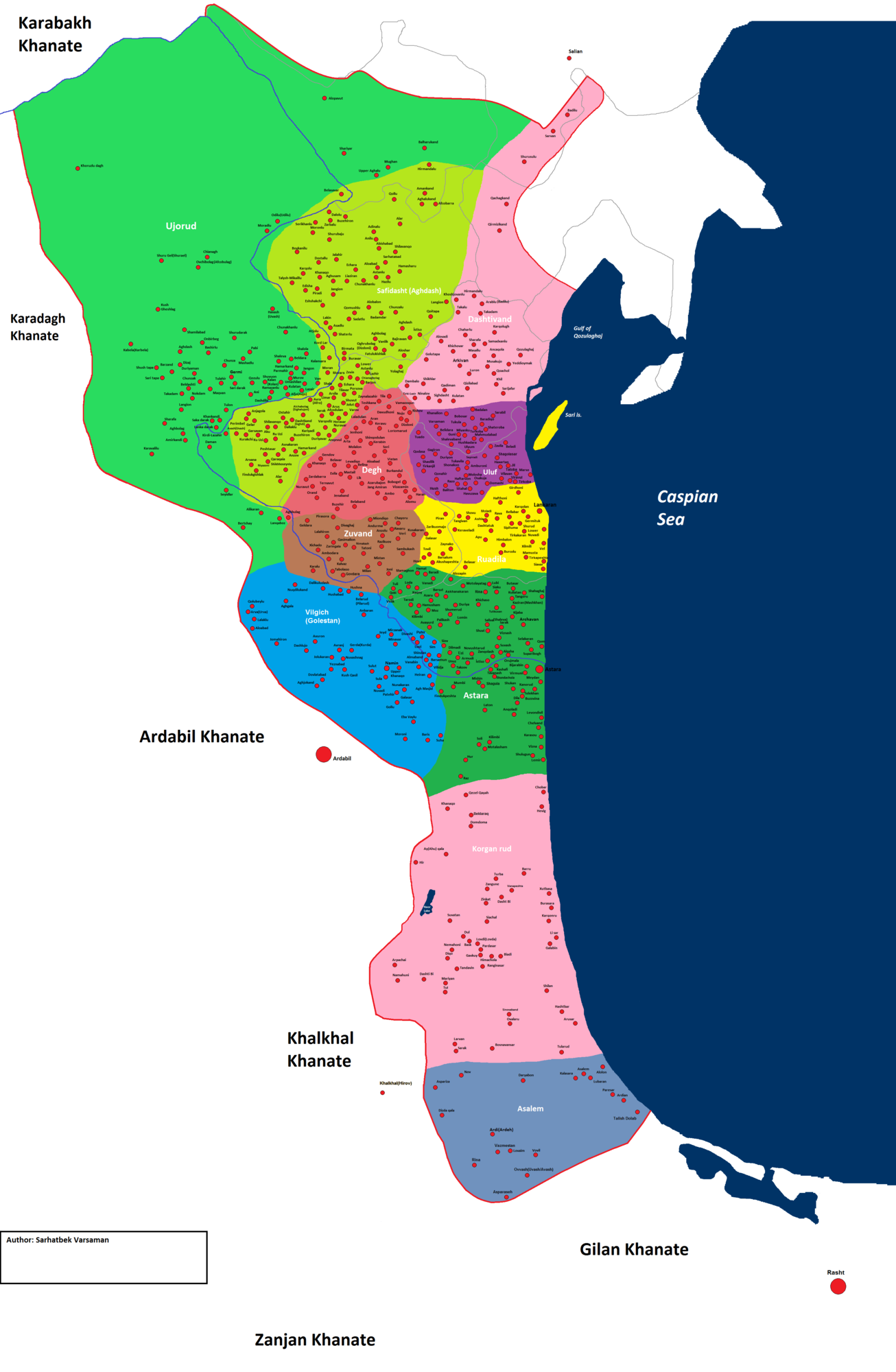
The Talysh Khanate or Talish Khanate (Talysh: Tolyša xánati, Persian: خانات تالش, romanized: Khānāt-e Tālesh) was an Iranian khanate of Talysh origin that was established in Afsharid Persia and existed from the middle of the 18th century till the beginning of the 19th century, located in the south-west coast of the Caspian Sea.
It comprised the southeastern part of the modern-day Republic of Azerbaijan and the eastern tip of north-western Iran. The capital of the khanate was its chief city, Lankaran. As a result of the Persian defeat in the Russo-Persian War of 1826–1828, the khanate was dissolved and absorbed by the Russian Empire.
The uncertainty surrounding the history of Talysh Khanate is not due only to the paucity of sources, a further problem is the rarity of studies about it. Several studies and short surveys appeared in Russian, Azerbaijani, Turkish, and Persian. Regrettably, some of these studies are tenuous and contain erroneous and biased interpretations.
Because of the paucity of primary sources, the study of the Talysh Khanate faces serious obstacles. The primary sources for the study of the Khanate are roughly divided into three groups: chronicles, documentary material, and travel accounts. Many facts related to the history of the Khanate are scattered throughout various chronicles produced by local and Qajar historians.
The first Persian chronicle about the Talysh Khanate is Javāher Nāmeh-ye Lankarān (1869) (i.e., The Jewel Book of Lankaran), written by Saeid-Ali ibn Kazem Beg Borādigāhi (1800–1872). There are two copies of The Jewel Book of Lankaran, and both are retained at the Institute of Manuscripts of Azerbaijan. The second Persian chronicle is Akhbār Nāmeh (1882) (i.e., The Chronicle), written by Mirza Ahmad ibn Mirza Khodāverdi, whose father served as the vizier for the second and the third Khans of Talysh.
Another primary source that may be added to the chronicle-type sources is the Russian survey entitled The History of the Talysh Khanate (1885) written by Teymur Bayramalibeyov (1863–1937).
A nonspecific but relevant chronicle which written in Persian is Gulistan-i Iram (1845) (i.e., The Heavenly Rose-Garden) from Abbas-Qoli Aqa Bakikhanov (1794–1847). Although not dealing directly with the Talysh Khanate, it contains useful information on the region up to the year in which it was completed.
The major body of correspondence of the Khans of Talysh is preserved in Russian archives and has been published in various collections of documents. The most important of these collections is the Acts collected by the Caucasian Archaeographic Commission [ru] (1866–1886).
Hub AI
Talysh Khanate AI simulator
(@Talysh Khanate_simulator)
Talysh Khanate
The Talysh Khanate or Talish Khanate (Talysh: Tolyša xánati, Persian: خانات تالش, romanized: Khānāt-e Tālesh) was an Iranian khanate of Talysh origin that was established in Afsharid Persia and existed from the middle of the 18th century till the beginning of the 19th century, located in the south-west coast of the Caspian Sea.
It comprised the southeastern part of the modern-day Republic of Azerbaijan and the eastern tip of north-western Iran. The capital of the khanate was its chief city, Lankaran. As a result of the Persian defeat in the Russo-Persian War of 1826–1828, the khanate was dissolved and absorbed by the Russian Empire.
The uncertainty surrounding the history of Talysh Khanate is not due only to the paucity of sources, a further problem is the rarity of studies about it. Several studies and short surveys appeared in Russian, Azerbaijani, Turkish, and Persian. Regrettably, some of these studies are tenuous and contain erroneous and biased interpretations.
Because of the paucity of primary sources, the study of the Talysh Khanate faces serious obstacles. The primary sources for the study of the Khanate are roughly divided into three groups: chronicles, documentary material, and travel accounts. Many facts related to the history of the Khanate are scattered throughout various chronicles produced by local and Qajar historians.
The first Persian chronicle about the Talysh Khanate is Javāher Nāmeh-ye Lankarān (1869) (i.e., The Jewel Book of Lankaran), written by Saeid-Ali ibn Kazem Beg Borādigāhi (1800–1872). There are two copies of The Jewel Book of Lankaran, and both are retained at the Institute of Manuscripts of Azerbaijan. The second Persian chronicle is Akhbār Nāmeh (1882) (i.e., The Chronicle), written by Mirza Ahmad ibn Mirza Khodāverdi, whose father served as the vizier for the second and the third Khans of Talysh.
Another primary source that may be added to the chronicle-type sources is the Russian survey entitled The History of the Talysh Khanate (1885) written by Teymur Bayramalibeyov (1863–1937).
A nonspecific but relevant chronicle which written in Persian is Gulistan-i Iram (1845) (i.e., The Heavenly Rose-Garden) from Abbas-Qoli Aqa Bakikhanov (1794–1847). Although not dealing directly with the Talysh Khanate, it contains useful information on the region up to the year in which it was completed.
The major body of correspondence of the Khans of Talysh is preserved in Russian archives and has been published in various collections of documents. The most important of these collections is the Acts collected by the Caucasian Archaeographic Commission [ru] (1866–1886).