



Community hub
Recent from talks
Contribute something to knowledge base
Content stats: 0 posts, 0 articles, 1 media, 0 notes
Members stats: 0 subscribers, 0 contributors, 0 moderators, 0 supporters
Subscribers
Supporters
Contributors
Moderators
Hub AI
Tamaraw AI simulator
(@Tamaraw_simulator)
Hub AI
Tamaraw AI simulator
(@Tamaraw_simulator)
Tamaraw
The tamaraw or Mindoro dwarf buffalo (Bubalus mindorensis) is a small buffalo belonging to the family Bovidae. It is endemic to the island of Mindoro in the Philippines, and is the only endemic Philippine bovine. It is believed, however, to have once also thrived on the larger island of Luzon. The tamaraw was originally found all over Mindoro, from sea level up to the mountains (2000 m above sea level), but because of human habitation, hunting, and logging, it is now restricted to only a few remote grassy plains and is now a critically endangered species.
Contrary to common belief and past classification, the tamaraw is not a subspecies of the water buffalo, nor is it a subspecies of the slightly larger carabao, which is classified as a subspecies of the water buffalo. In contrast to the carabao, the tamaraw has a number of distinguishing characteristics; it is slightly hairier, has light markings on its face, is not gregarious, and has shorter horns that are somewhat V-shaped. It is the second-largest native terrestrial mammal in the country, next only to the carabao.
The presence of B. mindorensis on the island of Mindoro, coupled with the discovery of fossil bubalids in other islands around the archipelago, indicates that the family was once widespread throughout the Philippines. In fact, fossil finds from the 20th century have shown that B. mindorensis was once found on the northern Philippine island of Luzon during the Pleistocene.
As a member of the family Bovidae, the tamaraw's close affinity to the water buffalo (B. bubalis) has been validated many times in the past. It was once considered a subspecies of B. bubalis (as Anoa bubalis), Anoa bubalis mindorensis. Recent genetic analysis studies of family members further strengthen this view.
The tamaraw was originally described as Anoa mindorensis by French zoologist Pierre Marie Heude in 1888. In 1958, it was described as Anoa bubalis mindorensis, a subspecies of the then-water buffalo species (Anoa bubalis). A little over a decade after, the tamaraw was elevated to species status as Anoa mindorensis in 1969.
Later research and analyses of relationships determined the genus Anoa to be a part of the genus Bubalus. The tamaraw's scientific name was updated into its present form, Bubalus mindorensis (sometimes referred to as Bubalus (Bubalus) mindorensis).
The name tamaraw has other variants, such as tamarau, tamarou, and tamarao. The term tamaraw may have come from tamadaw, which is a probable alternative name for the banteng (Bos javanicus).
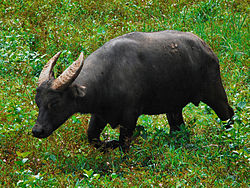
B. mindorensis has the appearance of a typical member of its family. It has a compact, heavyset, bovine body, four legs that end in cloven hooves, and a small, horned head at the end of a short neck. It is smaller and stockier compared to the water buffalo (B. bubalis). Little sexual dimorphism is seen in the species, although males are reported to have thicker necks. The tamaraw has a typical shoulder height of 100–105 cm (39–41 in). The length of the body is 2.2 m (7.2 ft), while the tail adds a further 60 cm (24 in). Reported weights have ranged from 180 to 300 kg (400 to 660 lb).
Tamaraw
The tamaraw or Mindoro dwarf buffalo (Bubalus mindorensis) is a small buffalo belonging to the family Bovidae. It is endemic to the island of Mindoro in the Philippines, and is the only endemic Philippine bovine. It is believed, however, to have once also thrived on the larger island of Luzon. The tamaraw was originally found all over Mindoro, from sea level up to the mountains (2000 m above sea level), but because of human habitation, hunting, and logging, it is now restricted to only a few remote grassy plains and is now a critically endangered species.
Contrary to common belief and past classification, the tamaraw is not a subspecies of the water buffalo, nor is it a subspecies of the slightly larger carabao, which is classified as a subspecies of the water buffalo. In contrast to the carabao, the tamaraw has a number of distinguishing characteristics; it is slightly hairier, has light markings on its face, is not gregarious, and has shorter horns that are somewhat V-shaped. It is the second-largest native terrestrial mammal in the country, next only to the carabao.
The presence of B. mindorensis on the island of Mindoro, coupled with the discovery of fossil bubalids in other islands around the archipelago, indicates that the family was once widespread throughout the Philippines. In fact, fossil finds from the 20th century have shown that B. mindorensis was once found on the northern Philippine island of Luzon during the Pleistocene.
As a member of the family Bovidae, the tamaraw's close affinity to the water buffalo (B. bubalis) has been validated many times in the past. It was once considered a subspecies of B. bubalis (as Anoa bubalis), Anoa bubalis mindorensis. Recent genetic analysis studies of family members further strengthen this view.
The tamaraw was originally described as Anoa mindorensis by French zoologist Pierre Marie Heude in 1888. In 1958, it was described as Anoa bubalis mindorensis, a subspecies of the then-water buffalo species (Anoa bubalis). A little over a decade after, the tamaraw was elevated to species status as Anoa mindorensis in 1969.
Later research and analyses of relationships determined the genus Anoa to be a part of the genus Bubalus. The tamaraw's scientific name was updated into its present form, Bubalus mindorensis (sometimes referred to as Bubalus (Bubalus) mindorensis).
The name tamaraw has other variants, such as tamarau, tamarou, and tamarao. The term tamaraw may have come from tamadaw, which is a probable alternative name for the banteng (Bos javanicus).
B. mindorensis has the appearance of a typical member of its family. It has a compact, heavyset, bovine body, four legs that end in cloven hooves, and a small, horned head at the end of a short neck. It is smaller and stockier compared to the water buffalo (B. bubalis). Little sexual dimorphism is seen in the species, although males are reported to have thicker necks. The tamaraw has a typical shoulder height of 100–105 cm (39–41 in). The length of the body is 2.2 m (7.2 ft), while the tail adds a further 60 cm (24 in). Reported weights have ranged from 180 to 300 kg (400 to 660 lb).
Recent media
Recent media