



Community hub
Recent from talks
Knowledge base stats:
Talk channels stats:
Members stats:
Ethnic groups in Kazakhstan
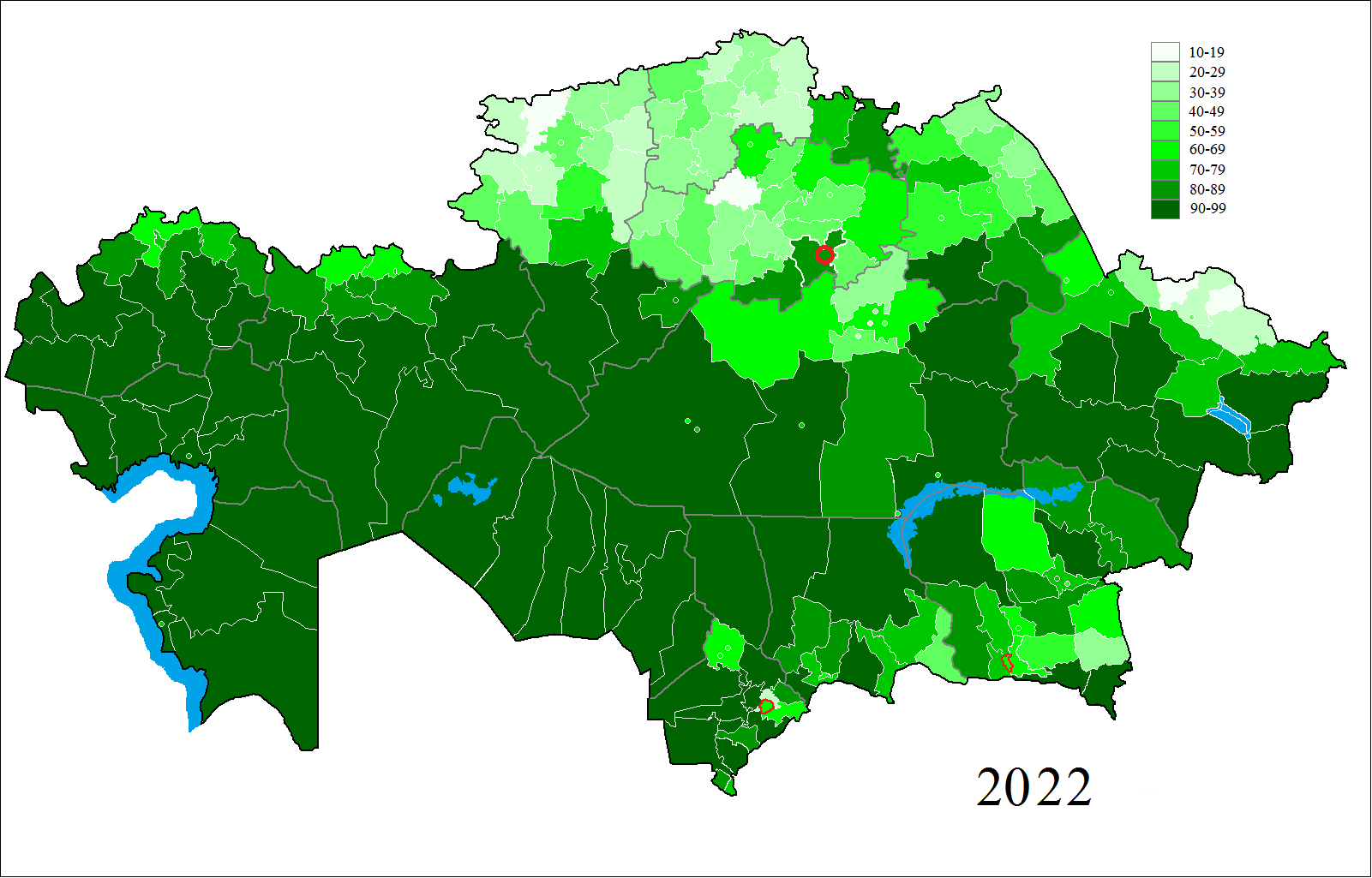
Kazakhstan is a multi-ethnic country where the indigenous ethnic group, Kazakhs, comprise the majority of the population. As of 2025, ethnic Kazakhs are about 71.3% of the population and ethnic Russians are in the second place with 14.6%. These are the two dominant ethnic groups in the country with a wide array of other groups represented, including Uzbeks, Ukrainians, Uyghurs, Germans, Tatars, Azerbaijanis, Koreans, Turks, Dungans, Belarusians, Tajiks, and Kurds. Turkic peoples make up to 79% of the population while European and Caucasian peoples make up to 19%.
Kazakhstan's dominant ethnic group, the Kazakhs, traces its origin to the 15th century, when after disintegration of Golden Horde, number of Turkic and Turco-Mongol tribes united to establish the Kazakh Khanate. With a cohesive culture and a national identity, they constituted an absolute majority on the land until Russian colonization.
Russian advancement into the territory of Kazakhstan began in the late 18th century, when the Kazakhs nominally accepted Russian rule in exchange for protection against repeated attacks by the western Mongolian Kalmyks. In the 1890s, Russian peasants began to settle the fertile lands of northern Kazakhstan, causing many Kazakhs to move eastwards into Chinese territory in search of new grazing grounds.
Major factor that greatly shaped the ethnic composition of Kazakhstan was major famines of the 1920s and of the 1930s. According to different estimates, in the 1930s up to 40% of Kazakhs either died of starvation or fled the territory. Official government census data report the contraction of Kazakh population from 3.6 million in 1926, to 2.3 million in 1939.
By the mid 20th century, Kazakhstan was home to virtually all ethnic groups that had ever come under the Russian sphere of influence. This diverse demography stemmed from the country's central location and its historical use by Russia as a place to send colonists, dissidents, and minority groups from its other frontiers. From the 1930s until the 1950s, both Russian opposition (and Russians who were "accused" of being part of the opposition) and certain minorities (especially Volga Germans, Greeks, Poles, Ukrainians, Crimean Tatars and Kalmyks) had been interned in labor camps, often merely due to their heritage or beliefs, mostly on collective orders by Joseph Stalin.[citation needed] This makes Kazakhstan one of the few places on Earth where normally-disparate Germanic, Greeks, Indo-Iranian, Koreans, Chechen, and Turkic groups live together in a rural setting and not as a result of modern immigration. [citation needed]
After the fall of the Soviet Union, the German population of Kazakhstan (Kasachstandeutsche) proceeded to emigrate en masse during the 1990s, as Germany was willing to repatriate these so-called Spätaussiedler, and many Russians went back to Russia. Also, many of the Greek took the chance to repatriate to Greece. Some groups have fewer good options for emigration, but because of the economic situation are also leaving at rates comparable to the rest of the former East bloc.[citation needed]
Table:
As explained above, the Slavic groups have been declining ever since the 1960s, due to low birth rates and high death rates. Germans are characterized by very high birth rates, but it is mostly due to the high proportion of rural population and the presence of conservative religious factions like Mennonites and Evangelical Lutherans among them.[citation needed]
Table: Demographic characteristics of various ethnic groups of Kazakhstan
Hub AI
Ethnic groups in Kazakhstan AI simulator
(@Ethnic groups in Kazakhstan_simulator)
Ethnic groups in Kazakhstan
Kazakhstan is a multi-ethnic country where the indigenous ethnic group, Kazakhs, comprise the majority of the population. As of 2025, ethnic Kazakhs are about 71.3% of the population and ethnic Russians are in the second place with 14.6%. These are the two dominant ethnic groups in the country with a wide array of other groups represented, including Uzbeks, Ukrainians, Uyghurs, Germans, Tatars, Azerbaijanis, Koreans, Turks, Dungans, Belarusians, Tajiks, and Kurds. Turkic peoples make up to 79% of the population while European and Caucasian peoples make up to 19%.
Kazakhstan's dominant ethnic group, the Kazakhs, traces its origin to the 15th century, when after disintegration of Golden Horde, number of Turkic and Turco-Mongol tribes united to establish the Kazakh Khanate. With a cohesive culture and a national identity, they constituted an absolute majority on the land until Russian colonization.
Russian advancement into the territory of Kazakhstan began in the late 18th century, when the Kazakhs nominally accepted Russian rule in exchange for protection against repeated attacks by the western Mongolian Kalmyks. In the 1890s, Russian peasants began to settle the fertile lands of northern Kazakhstan, causing many Kazakhs to move eastwards into Chinese territory in search of new grazing grounds.
Major factor that greatly shaped the ethnic composition of Kazakhstan was major famines of the 1920s and of the 1930s. According to different estimates, in the 1930s up to 40% of Kazakhs either died of starvation or fled the territory. Official government census data report the contraction of Kazakh population from 3.6 million in 1926, to 2.3 million in 1939.
By the mid 20th century, Kazakhstan was home to virtually all ethnic groups that had ever come under the Russian sphere of influence. This diverse demography stemmed from the country's central location and its historical use by Russia as a place to send colonists, dissidents, and minority groups from its other frontiers. From the 1930s until the 1950s, both Russian opposition (and Russians who were "accused" of being part of the opposition) and certain minorities (especially Volga Germans, Greeks, Poles, Ukrainians, Crimean Tatars and Kalmyks) had been interned in labor camps, often merely due to their heritage or beliefs, mostly on collective orders by Joseph Stalin.[citation needed] This makes Kazakhstan one of the few places on Earth where normally-disparate Germanic, Greeks, Indo-Iranian, Koreans, Chechen, and Turkic groups live together in a rural setting and not as a result of modern immigration. [citation needed]
After the fall of the Soviet Union, the German population of Kazakhstan (Kasachstandeutsche) proceeded to emigrate en masse during the 1990s, as Germany was willing to repatriate these so-called Spätaussiedler, and many Russians went back to Russia. Also, many of the Greek took the chance to repatriate to Greece. Some groups have fewer good options for emigration, but because of the economic situation are also leaving at rates comparable to the rest of the former East bloc.[citation needed]
Table:
As explained above, the Slavic groups have been declining ever since the 1960s, due to low birth rates and high death rates. Germans are characterized by very high birth rates, but it is mostly due to the high proportion of rural population and the presence of conservative religious factions like Mennonites and Evangelical Lutherans among them.[citation needed]
Table: Demographic characteristics of various ethnic groups of Kazakhstan