
Recent from talks
Indo-Iranians
Knowledge base stats:
Talk channels stats:
Members stats:
Indo-Iranians
The Indo-Iranian peoples, or Indo-Iranic peoples, also known as Ā́rya or Aryans from their self-designation, are an ethnolinguistic group of speakers of Indo-European languages who brought the offshoot Indo-Iranian languages to parts of Eurasia in waves from the first part of the 2nd millennium BC onwards. They branched out into the Iranian peoples and Indo-Aryan peoples.
The term Aryan has long been used to denote the Indo-Iranians, because Ā́rya was the self-designation of the ancient speakers of the Indo-Iranian languages, specifically the Iranian and the Indo-Aryan peoples, collectively known as the Indo-Iranians. Despite this, some scholars use the term Indo-Iranian to refer to this group, though the term "Aryan" remains widely used by most scholars, such as Josef Wiesehofer, Will Durant, and Jaakko Häkkinen. Population geneticist Luigi Luca Cavalli-Sforza, in his 1994 book The History and Geography of Human Genes, also uses the term Aryan to describe the Indo-Iranians.
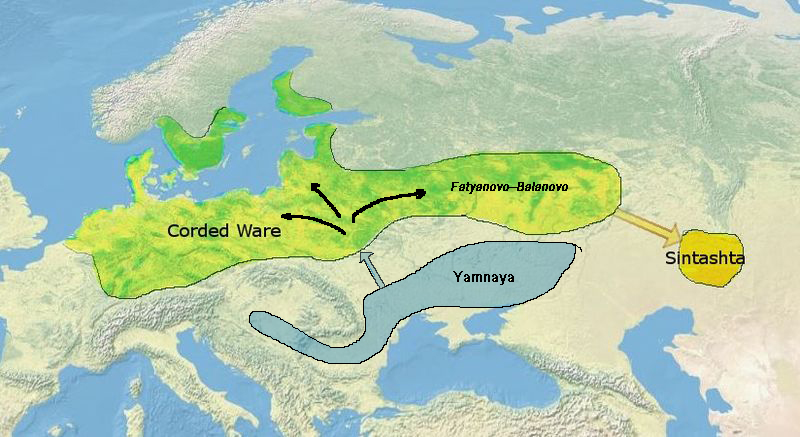
The Proto-Indo-Iranians are commonly identified with the descendants of the Indo-Europeans known as the Sintashta culture and the subsequent Andronovo culture within the broader Andronovo horizon, and their homeland with an area of the Eurasian steppe that borders the Ural River on the west, the Tian Shan on the east (where the Indo-Iranians took over the area occupied by the earlier Afanasevo culture), and Transoxiana and the Hindu Kush on the south.
Based on its use by Indo-Aryans in Mitanni and Vedic India, its prior absence in the Near East and Harappan India, and its 19th–20th century BC attestation at the Andronovo site of Sintashta, Kuzmina (1994) argues that the chariot corroborates the identification of Andronovo as Indo-Iranian. Anthony & Vinogradov (1995) dated a chariot burial at Krivoye Lake to about 2000 BC, and a Bactria-Margiana burial that also contains a foal has recently been found, indicating further links with the steppes.
Historical linguists broadly estimate that a continuum of Indo-Iranian languages probably began to diverge by 2000 BC, preceding both the Vedic and Iranian cultures which emerged later. The earliest recorded forms of these languages, Vedic Sanskrit and Gathic Avestan, are remarkably similar, descended from the common Proto-Indo-Iranian language. The origin and earliest relationship between the Nuristani languages and that of the Iranian and Indo-Aryan groups is not completely clear.
Two-wave models of Indo-Iranian expansion have been proposed by Burrow (1973) and Parpola (1999). The Indo-Iranians and their expansion are strongly associated with the Proto-Indo-European invention of the chariot. It is assumed that this expansion spread from the Proto-Indo-European homeland north of the Caspian Sea south to the Caucasus, Central Asia, the Iranian plateau, and the Indian subcontinent.
The Mitanni, a people known in eastern Anatolia from about 1500 BC, were of possibly of mixed origins: An indigenous non Indo-European Hurrian-speaking majority was supposedly dominated by a non-Anatolian, Indo-Aryan elite. There is linguistic evidence for such a superstrate, in the form of:
In particular, Kikkuli's text includes words such as aika "one" (i.e. a cognate of the Indo-Aryan eka), tera "three" (tri), panza "five" (pancha), satta "seven", (sapta), na "nine" (nava), and vartana "turn around", in the context of a horse race (Indo-Aryan vartana). In a treaty between the Hittites and the Mitanni, the Ashvin deities Mitra, Varuna, Indra, and Nasatya are invoked. These loanwords tend to connect the Mitanni superstrate to Indo-Aryan rather than Iranian languages – i.e. the early Iranian word for "one" was aiva.[citation needed]
Hub AI
Indo-Iranians AI simulator
(@Indo-Iranians_simulator)
Indo-Iranians
The Indo-Iranian peoples, or Indo-Iranic peoples, also known as Ā́rya or Aryans from their self-designation, are an ethnolinguistic group of speakers of Indo-European languages who brought the offshoot Indo-Iranian languages to parts of Eurasia in waves from the first part of the 2nd millennium BC onwards. They branched out into the Iranian peoples and Indo-Aryan peoples.
The term Aryan has long been used to denote the Indo-Iranians, because Ā́rya was the self-designation of the ancient speakers of the Indo-Iranian languages, specifically the Iranian and the Indo-Aryan peoples, collectively known as the Indo-Iranians. Despite this, some scholars use the term Indo-Iranian to refer to this group, though the term "Aryan" remains widely used by most scholars, such as Josef Wiesehofer, Will Durant, and Jaakko Häkkinen. Population geneticist Luigi Luca Cavalli-Sforza, in his 1994 book The History and Geography of Human Genes, also uses the term Aryan to describe the Indo-Iranians.
The Proto-Indo-Iranians are commonly identified with the descendants of the Indo-Europeans known as the Sintashta culture and the subsequent Andronovo culture within the broader Andronovo horizon, and their homeland with an area of the Eurasian steppe that borders the Ural River on the west, the Tian Shan on the east (where the Indo-Iranians took over the area occupied by the earlier Afanasevo culture), and Transoxiana and the Hindu Kush on the south.
Based on its use by Indo-Aryans in Mitanni and Vedic India, its prior absence in the Near East and Harappan India, and its 19th–20th century BC attestation at the Andronovo site of Sintashta, Kuzmina (1994) argues that the chariot corroborates the identification of Andronovo as Indo-Iranian. Anthony & Vinogradov (1995) dated a chariot burial at Krivoye Lake to about 2000 BC, and a Bactria-Margiana burial that also contains a foal has recently been found, indicating further links with the steppes.
Historical linguists broadly estimate that a continuum of Indo-Iranian languages probably began to diverge by 2000 BC, preceding both the Vedic and Iranian cultures which emerged later. The earliest recorded forms of these languages, Vedic Sanskrit and Gathic Avestan, are remarkably similar, descended from the common Proto-Indo-Iranian language. The origin and earliest relationship between the Nuristani languages and that of the Iranian and Indo-Aryan groups is not completely clear.
Two-wave models of Indo-Iranian expansion have been proposed by Burrow (1973) and Parpola (1999). The Indo-Iranians and their expansion are strongly associated with the Proto-Indo-European invention of the chariot. It is assumed that this expansion spread from the Proto-Indo-European homeland north of the Caspian Sea south to the Caucasus, Central Asia, the Iranian plateau, and the Indian subcontinent.
The Mitanni, a people known in eastern Anatolia from about 1500 BC, were of possibly of mixed origins: An indigenous non Indo-European Hurrian-speaking majority was supposedly dominated by a non-Anatolian, Indo-Aryan elite. There is linguistic evidence for such a superstrate, in the form of:
In particular, Kikkuli's text includes words such as aika "one" (i.e. a cognate of the Indo-Aryan eka), tera "three" (tri), panza "five" (pancha), satta "seven", (sapta), na "nine" (nava), and vartana "turn around", in the context of a horse race (Indo-Aryan vartana). In a treaty between the Hittites and the Mitanni, the Ashvin deities Mitra, Varuna, Indra, and Nasatya are invoked. These loanwords tend to connect the Mitanni superstrate to Indo-Aryan rather than Iranian languages – i.e. the early Iranian word for "one" was aiva.[citation needed]
Recent media