


Community hub
Recent from talks
Contribute something to knowledge base
Content stats: 0 posts, 0 articles, 1 media, 0 notes
Members stats: 0 subscribers, 0 contributors, 0 moderators, 0 supporters
Subscribers
Supporters
Contributors
Moderators
Hub AI
Tauroctony AI simulator
(@Tauroctony_simulator)
Hub AI
Tauroctony AI simulator
(@Tauroctony_simulator)
Tauroctony
Tauroctony is a modern name given to the central cult reliefs of the Mithraic Mysteries in the Roman Empire. The imagery depicts Mithras killing a bull, hence the name tauroctony after the Greek word tauroktonos (ταυροκτόνος, "bull killing"). A tauroctony is distinct from the sacrifice of a bull in ancient Rome called a taurobolium; the taurobolium was mainly part of the unrelated cult of Cybele.
Despite the name, the scene is symbolic, and to date there is no known physical evidence that patrons of the Roman cult ever performed such a rite. Like all Greco-Roman mysteries, the Mithraic Mysteries was limited to initiates, and there is very little known about the cult's beliefs or practices. However, several images of the bull include a dorsuale ribbon or blanket, which was a Roman convention to identify a sacrificial animal, so it is fairly certain that the killing of the bull represents a sacrificial act. Because the main bull-killing scene is often accompanied by explicit depictions of the sun, moon, and stars, it is also fairly certain that the scene has astrological connotations. However, despite dozens of theories on the subject, none has received widespread acceptance. While the basic bull-killing image appears to have been adopted from a similar depiction of Nike, and it is certain that the bull-killing symbolism and the ancillary elements together tell a story (i.e. the cult myth, the cult's mystery, told only to initiates), that story has been lost and is now unknown. Following several decades of increasingly convoluted theories, Mithraic scholarship is now generally disinclined to speculation.
Whether as a painting or as carved monument, a depiction of the tauroctony scene belonged to the standard furniture of every mithraeum. At least one depiction would be mounted on the wall at the far end of the space where ritual activity took place, often in a niche dressed to be especially cavelike. Richly furnished mithraea, such as one in Stockstadt am Main, had multiple cult reliefs.
The scenes can be roughly divided into two groups. The "simple" depictions, which include just the main bull-killing scene, and the compound depictions, in which the tauroctony is the central and largest element, but which is framed by panels that portray other scenes.
The oldest known representative of the tauroctony scene is CIMRM 593/594 from Rome, a dedication of a certain Alcimus, slave steward/bailiff (servus vilicus) of T. Claudius Livianus, who is identified with T. Iulius Aquilinus Castricius Saturninus Claudius Livianus, the praetorian prefect under Trajan. Like the other five earliest monuments of the Mithraic mysteries, it dates to around 100 CE.
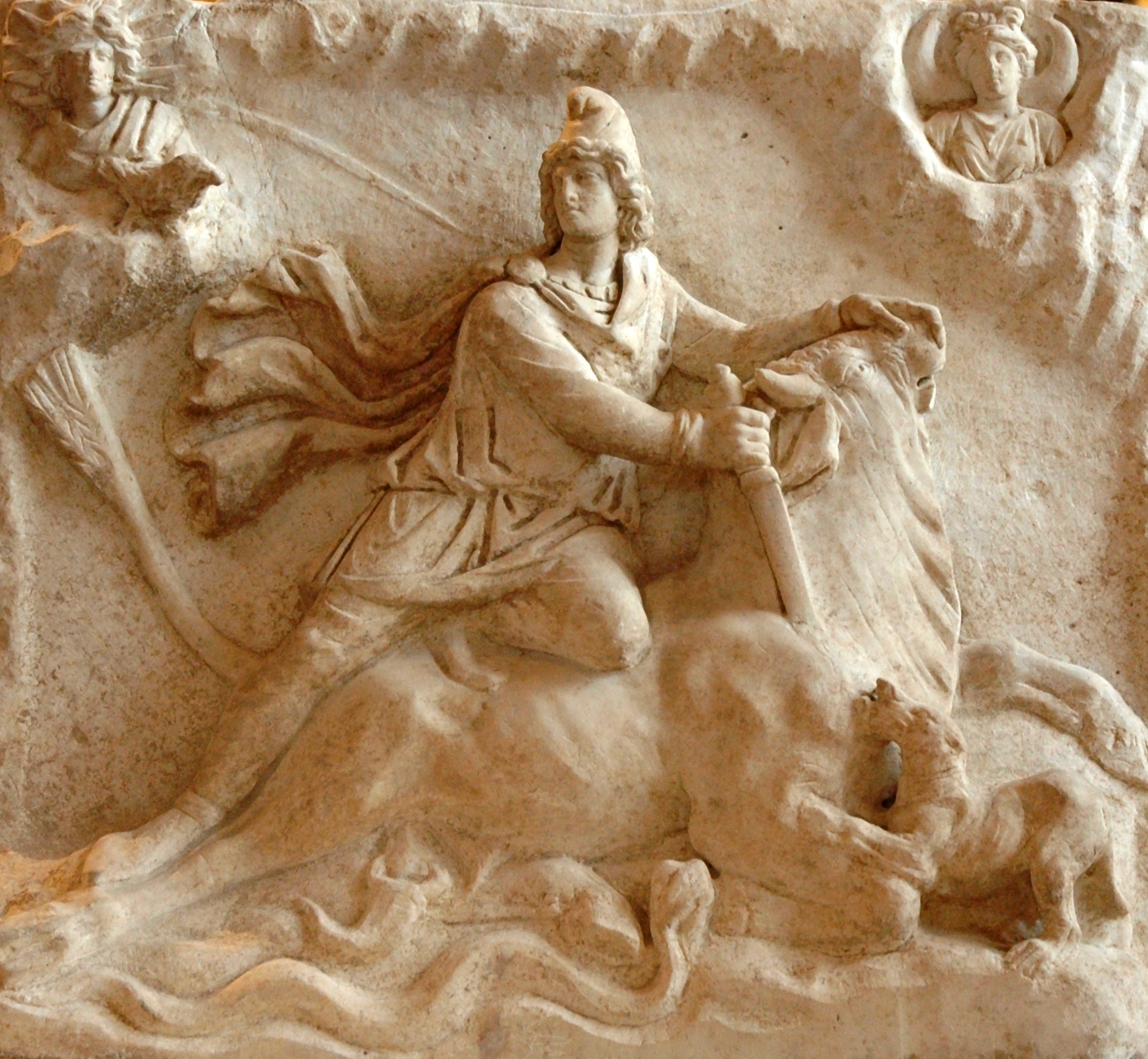
Although there are numerous minor variations, the basic features of the central tauroctony scene is highly uniform: Mithras half-straddles a bull that has been forced to the ground. The bull invariably appears in profile, facing to his left (the viewers’ right). In original (un-reconstructed) depictions, Mithras invariably has his head turned away from the bull, and in many he is looking back over his right shoulder up to Sol (statuary that shows Mithras looking at the bull are the result of Renaissance-era restorations of monuments that were missing a head). The bull is held down by Mithras' left leg, which is bent at an angle and the knee of which presses down on the bull's spine. The bull's rump and right hind leg is restrained by Mithras' right leg, which is almost fully extended.
With his left hand, Mithras pulls back the head of the bull by the nostrils or the muzzle (never by the horns, which – if at all represented – are short). In his right hand, Mithras usually holds a knife or short sword plunged into the neck/shoulder of the bull. Alternatively (CIMRM 2196), the knife is sticking into the bull's neck, and Mithras has his arm raised as if in triumph. Mithras is usually dressed in a knee-length long-sleeved tunic (tunica manicata), closed boots and breeches (anaxyrides, bracae). Mithras' cape, if he wears one, is usually spread open, as if flying. Occasionally, Mithras is nude (CIMRM 2196, 2327; 201; 1275). On his head, Mithras usually wears a phrygian cap, like the one worn by Attis. The tail of the bull occasionally appears to end in an ear of wheat. The blood from the wound is also sometimes depicted as ears of wheat, or as a cluster of grapes.
Several cult images have the bull adorned with the Roman dorsuale, sometimes decorated with embroidery. This dorsal band or blanket placed on the back of the animal is an adoption from the then-contemporary images of public sacrifice, and identifies the bull as a sacrificial beast.
Tauroctony
Tauroctony is a modern name given to the central cult reliefs of the Mithraic Mysteries in the Roman Empire. The imagery depicts Mithras killing a bull, hence the name tauroctony after the Greek word tauroktonos (ταυροκτόνος, "bull killing"). A tauroctony is distinct from the sacrifice of a bull in ancient Rome called a taurobolium; the taurobolium was mainly part of the unrelated cult of Cybele.
Despite the name, the scene is symbolic, and to date there is no known physical evidence that patrons of the Roman cult ever performed such a rite. Like all Greco-Roman mysteries, the Mithraic Mysteries was limited to initiates, and there is very little known about the cult's beliefs or practices. However, several images of the bull include a dorsuale ribbon or blanket, which was a Roman convention to identify a sacrificial animal, so it is fairly certain that the killing of the bull represents a sacrificial act. Because the main bull-killing scene is often accompanied by explicit depictions of the sun, moon, and stars, it is also fairly certain that the scene has astrological connotations. However, despite dozens of theories on the subject, none has received widespread acceptance. While the basic bull-killing image appears to have been adopted from a similar depiction of Nike, and it is certain that the bull-killing symbolism and the ancillary elements together tell a story (i.e. the cult myth, the cult's mystery, told only to initiates), that story has been lost and is now unknown. Following several decades of increasingly convoluted theories, Mithraic scholarship is now generally disinclined to speculation.
Whether as a painting or as carved monument, a depiction of the tauroctony scene belonged to the standard furniture of every mithraeum. At least one depiction would be mounted on the wall at the far end of the space where ritual activity took place, often in a niche dressed to be especially cavelike. Richly furnished mithraea, such as one in Stockstadt am Main, had multiple cult reliefs.
The scenes can be roughly divided into two groups. The "simple" depictions, which include just the main bull-killing scene, and the compound depictions, in which the tauroctony is the central and largest element, but which is framed by panels that portray other scenes.
The oldest known representative of the tauroctony scene is CIMRM 593/594 from Rome, a dedication of a certain Alcimus, slave steward/bailiff (servus vilicus) of T. Claudius Livianus, who is identified with T. Iulius Aquilinus Castricius Saturninus Claudius Livianus, the praetorian prefect under Trajan. Like the other five earliest monuments of the Mithraic mysteries, it dates to around 100 CE.
Although there are numerous minor variations, the basic features of the central tauroctony scene is highly uniform: Mithras half-straddles a bull that has been forced to the ground. The bull invariably appears in profile, facing to his left (the viewers’ right). In original (un-reconstructed) depictions, Mithras invariably has his head turned away from the bull, and in many he is looking back over his right shoulder up to Sol (statuary that shows Mithras looking at the bull are the result of Renaissance-era restorations of monuments that were missing a head). The bull is held down by Mithras' left leg, which is bent at an angle and the knee of which presses down on the bull's spine. The bull's rump and right hind leg is restrained by Mithras' right leg, which is almost fully extended.
With his left hand, Mithras pulls back the head of the bull by the nostrils or the muzzle (never by the horns, which – if at all represented – are short). In his right hand, Mithras usually holds a knife or short sword plunged into the neck/shoulder of the bull. Alternatively (CIMRM 2196), the knife is sticking into the bull's neck, and Mithras has his arm raised as if in triumph. Mithras is usually dressed in a knee-length long-sleeved tunic (tunica manicata), closed boots and breeches (anaxyrides, bracae). Mithras' cape, if he wears one, is usually spread open, as if flying. Occasionally, Mithras is nude (CIMRM 2196, 2327; 201; 1275). On his head, Mithras usually wears a phrygian cap, like the one worn by Attis. The tail of the bull occasionally appears to end in an ear of wheat. The blood from the wound is also sometimes depicted as ears of wheat, or as a cluster of grapes.
Several cult images have the bull adorned with the Roman dorsuale, sometimes decorated with embroidery. This dorsal band or blanket placed on the back of the animal is an adoption from the then-contemporary images of public sacrifice, and identifies the bull as a sacrificial beast.
Recent media
Recent media