



Community hub
Recent from talks
Knowledge base stats:
Talk channels stats:
Members stats:
Tautavel Man
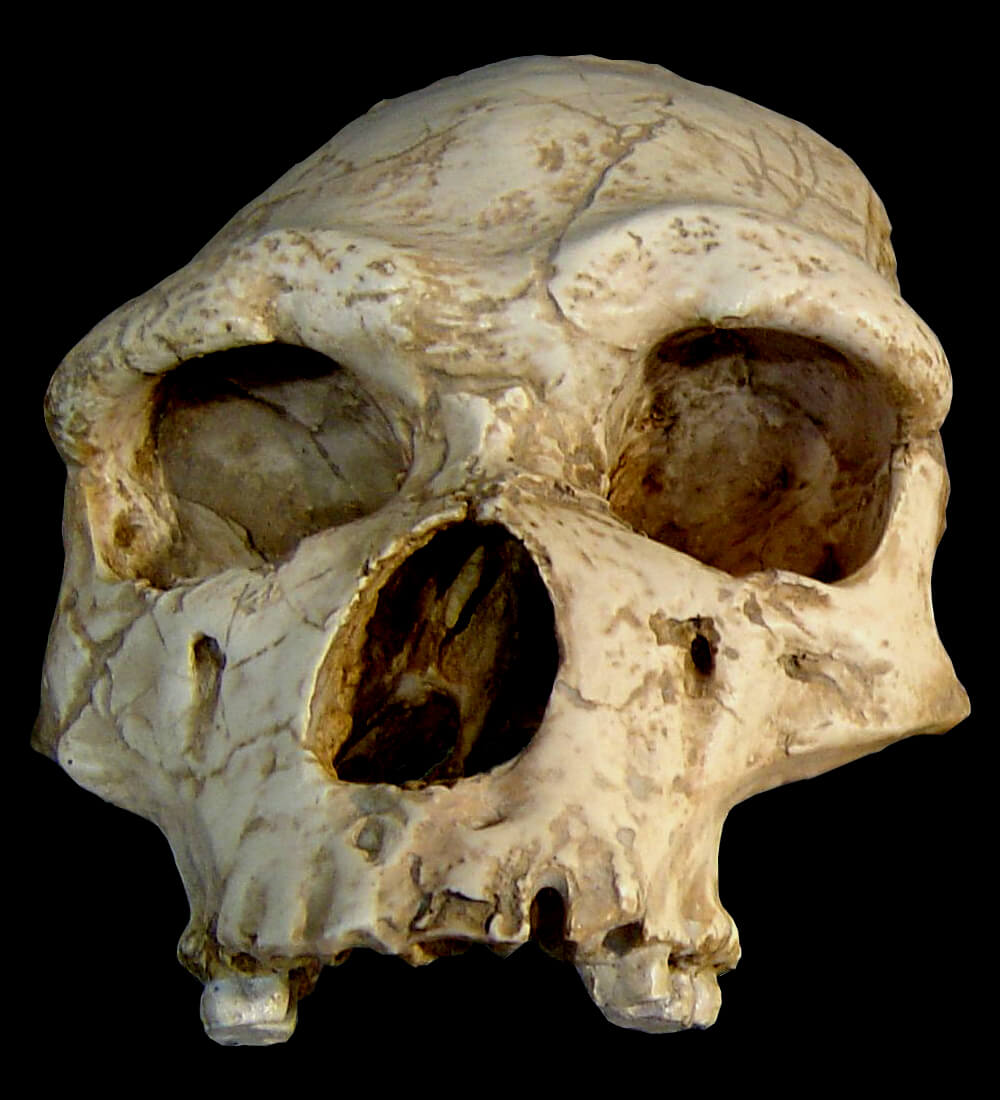
Tautavel Man refers to the archaic humans which—from approximately 550,000 to 400,000 years ago—inhabited the Caune de l’Arago, a limestone cave in Tautavel, France. They are generally grouped as part of a long and highly variable lineage of transitional morphs which inhabited the Middle Pleistocene of Europe, and would eventually evolve into the Neanderthals (Homo neanderthalensis or H. sapiens neanderthalensis). They have been variably assigned to either H. (s.?) heidelbergensis, or as a European subspecies of H. erectus as H. e. tautavelensis. The skull is reconstructed based on the specimens Arago 21 and 47 (probably male), and it is, to a degree, more characteristic of what might be considered a typical H. erectus (sensu stricto) morphology than a typical H. heidelbergensis morphology. The brain capacity is 1,166 cc. They seem to have had an overall robust skeleton. Average height may have been 166 cm (5 ft 5 in).
The Caune de l'Arago opens on a cliffside 80 m (260 ft) above a river, overlooking the Tautavel plain, with a plateau above, and mountainous terrain to the sides. During and after human occupation, the area swung from temperate and humid forestland, to cold and dry steppeland. Stratigraphically, humans are present from beds Q–C. Bed G, dating to roughly 455,000 years old during a forested event, has yielded the most remains. They seem to have hunted a variety of animals, including red deer, fallow deer, argali, tahr, horse, reindeer, beaver, and the extinct narrow-nosed rhinoceros, among others. They made Acheulean stone tools, but mainly produced smaller retouched tools such as scrapers, rather than more iconic macro-tools such as bifaces (hand axes). In beds G and F, they may have been practicing ritual cannibalism. Evidence of fire is absent until bed C (400,000 years ago).
Animal fossils were first reported from the Caune de l’Arago in 1828 by French geologist Marcel de Serres, who considered them antediluvian remains (before the Great Flood in the biblical chronology). In 1963, French archaeologist Jean Abélanet recovered stone tools, which inspired French archaeologist Henry de Lumley to continue excavation for human remains. He found such remains in 1964, and recovered the first face (Arago 21) in 1971. He and fellow archaeologist Marie-Antoinette de Lumley (his wife) formally described the remains that same year. They dated them to the Riss glaciation—that is, predating the European Neanderthals (H. neanderthalensis or H. sapiens neanderthalensis).
They and subsequent researchers made several parallels between the Arago material and Homo erectus (both sensu stricto Asian specimens and sensu lato specimens beyond Asia) as well as to Neanderthals. Similarly, these fossils were initially postulated to represent an intermediate form between H. erectus and Neanderthals, and were commonly referred to as "Pre-Neanderthals" to avoid assigning them to a specific species. Nonetheless, in 1979, the de Lumley's suggested the name "H. e. tautavelensis", but subsequent authors preferred to classify the remains into the then strictly Middle Pleistocene European H. heidelbergensis, described from the German Mauer 1 mandible in 1908. H. heidelbergensis is typically defined as the direct ancestor of Neanderthals.
The skull of the Tautavel inhabitants can only be reconstructed using the crushed (and thus distorted) partial face Arago 21 and the partial parietal bone Arago 47. The actual shape of the skull before crushing was speculated using the skulls of contemporaneous European humans (that is, H. heidelbergensis). It is possible Arago 21 and 47 represent the same individual. Several such reconstructions were done in the 1980s, with the conclusion of strong affinities to H. heidelbergensis. The first reconstruction was done by French moulder René David, with the oversight of Mrs. de Lumley, and was completed in 1982. Other reconstructions were made in 1982 and again in 1986 by Italian palaeontologist Antonio Ascenzi; in 1982 and again in 1984 by French anthropologist Éliane Spitery; in 1986 by Czech palaeoanthropologist Emanuel Vlček; in 1982 and again in 1991 by French palaeoanthropologist Dominique Grimaud-Hervé; in 2005 by French anthropologist Gaspard Guipert (digitally uncrushing and reconstructing the skull); and most recently by Mrs. de Lumley in 2015. Like his predecessors, Guipert decided to relegate the material to H. heidelbergensis, and defined H. heidelbergensis as a highly polymorphic (variable) species. In 2015, Mrs. de Lumley redescribed the Arago material, and decided to consider H. e. tautavelensis as a completely distinct and valid subspecies (diverging from H. heidelbergensis and the Neanderthal line) by using a much stricter definition of H. heidelbergensis and focusing on the parallels between the Tautavel remains and H. erectus s. s. The Tautavel remains are quite similar to other archaic human remains from Europe which have variously been classified as H. erectus or H. heidelbergensis depending on the definition of these species: Ceprano, Italy; Galería, Spain; Swanscombe, England; Vértesszőlős, Hungary; and Petralona, Greece.
By 2014, a total of 148 human bones had been recovered from the Caune de l'Arago, including 123 teeth, 5 jawbones, 9 upper limb elements, and 19 lower limb elements. These represent 18 adults and 12 juveniles, 30 individuals in total. Based on dental development, about 30% of the specimens died between the ages of 7 and 12, 37% between 18 and 30, 30% between 30 and 40, and 3% over 40. This would give an average life expectancy (assuming the individual survived infancy) of 20–25 years. The perceived infant mortality rate (from ages 1–6) is 11%, which is conspicuously low. If especially robust bones are assumed to be males, then females slightly outnumber males, but the proportion is roughly equally. All the non-tooth skull specimens (Arago 21, 47, and 45) are assumed to be male. For the jawbone specimens, only Arago 13 is assumed to be male, and the others (Arago 2, 89, 119, 130, and 131) are assumed to be female. The iliac specimens (a hip bone), Arago 44 and 121, are female.
The reconstructed skull of Tautavel Man (based on Arago 21 and 47) shares many similarities with that of H. erectus s. s. These include: strongly defined brows, a receding forehead, a relatively low face, a depression between the eyebrows, post-orbital constriction, strongly defined ridges below the eye sockets, a weak chin (with developed prognathism), strong and thick jaws, U-shaped tooth rows, and marked sexual dimorphism (with males notably more robust than females). However, it differs in having a wider base, more forwardly oriented cheek bones, more massive supraorbital trigons (the triangles on the frontal bone formed by the brows and the two temporal lines), and a more defined post-orbital constriction. According to Mrs. de Lumley, they differ from the roughly contemporaneous H. heidelbergensis by retaining basal (archaic) characteristics, including a longer skull, more defined brow ridge, more receding forehead, less defined post-orbital constriction, less developed prognathism, and smaller brain capacity—that is, by being somewhat more H. erectus grade than H. neanderthalensis grade. The Arago 21 face probably belonged to a 20-year-old, as indicated by the state of the fronto-pariental suture; based on its robustness, it is assumed to be male.
The reconstructed Tautavel skull measures 199 mm (7.8 in) along its long axis. This maximum measurement is similar to that of H. erectus from Sangiran and longer than the Sima de los Huesos (SH) hominins (which are typically assigned to H. heidelbergensis), but shorter than that of Neanderthals, whose braincase was further developed. The length of the short axis is 144 mm (5.7 in), which is typical of contemporaneous and more ancient H. erectus s. s. and within the exceptionally wide range reported for the SH hominins, but is narrower than more recent hominins, including more recent H. erectus s. s. For comparison, the dimensions of a modern human skull average 176 mm × 145 mm (6.9 in × 5.7 in) for men and 171 mm × 140 mm (6.7 in × 5.5 in) for women. Like H. erectus s. s., the Tautavel face strongly projects from back to front, with the face-to-skull-base length ratio (ratio between the distance from the face to the base of the skull, versus the length of the base of the skull itself) being 48.1%. In comparison, this ratio is 44% in Neanderthals, and 38% in modern humans. As for the mandibles, the robust male jawbones align more closely to H. erectus s. s., whereas the more gracile female ones cluster closer to the Mauer mandible, the SH hominins, and Neanderthals. This demonstrates rather strong jaw musculature in the Tautavel inhabitants, as well as pronounced sexual dimorphism. The Tautavel mandibles all have strongly developed mandibular tori (ridges bordering the tongue in the cheek), subhorizontal mylohyoid lines (ridges running on the exterior of the body of the mandible), deep and narrow submandibular fovea (below the mylohyoid lines), and a narrow and convex plane which merges into the tori. The teeth are proportionally quite large for a Middle Pleistocene European human, notably the P4 (2nd premolar) and M2 (2nd molar). The cusps of the molars retain an anterior fovea, a mesial and distal trigonid crest, a cusp of Carabelli, and one or two accessory cusps, which are basal traits.
Hub AI
Tautavel Man AI simulator
(@Tautavel Man_simulator)
Tautavel Man
Tautavel Man refers to the archaic humans which—from approximately 550,000 to 400,000 years ago—inhabited the Caune de l’Arago, a limestone cave in Tautavel, France. They are generally grouped as part of a long and highly variable lineage of transitional morphs which inhabited the Middle Pleistocene of Europe, and would eventually evolve into the Neanderthals (Homo neanderthalensis or H. sapiens neanderthalensis). They have been variably assigned to either H. (s.?) heidelbergensis, or as a European subspecies of H. erectus as H. e. tautavelensis. The skull is reconstructed based on the specimens Arago 21 and 47 (probably male), and it is, to a degree, more characteristic of what might be considered a typical H. erectus (sensu stricto) morphology than a typical H. heidelbergensis morphology. The brain capacity is 1,166 cc. They seem to have had an overall robust skeleton. Average height may have been 166 cm (5 ft 5 in).
The Caune de l'Arago opens on a cliffside 80 m (260 ft) above a river, overlooking the Tautavel plain, with a plateau above, and mountainous terrain to the sides. During and after human occupation, the area swung from temperate and humid forestland, to cold and dry steppeland. Stratigraphically, humans are present from beds Q–C. Bed G, dating to roughly 455,000 years old during a forested event, has yielded the most remains. They seem to have hunted a variety of animals, including red deer, fallow deer, argali, tahr, horse, reindeer, beaver, and the extinct narrow-nosed rhinoceros, among others. They made Acheulean stone tools, but mainly produced smaller retouched tools such as scrapers, rather than more iconic macro-tools such as bifaces (hand axes). In beds G and F, they may have been practicing ritual cannibalism. Evidence of fire is absent until bed C (400,000 years ago).
Animal fossils were first reported from the Caune de l’Arago in 1828 by French geologist Marcel de Serres, who considered them antediluvian remains (before the Great Flood in the biblical chronology). In 1963, French archaeologist Jean Abélanet recovered stone tools, which inspired French archaeologist Henry de Lumley to continue excavation for human remains. He found such remains in 1964, and recovered the first face (Arago 21) in 1971. He and fellow archaeologist Marie-Antoinette de Lumley (his wife) formally described the remains that same year. They dated them to the Riss glaciation—that is, predating the European Neanderthals (H. neanderthalensis or H. sapiens neanderthalensis).
They and subsequent researchers made several parallels between the Arago material and Homo erectus (both sensu stricto Asian specimens and sensu lato specimens beyond Asia) as well as to Neanderthals. Similarly, these fossils were initially postulated to represent an intermediate form between H. erectus and Neanderthals, and were commonly referred to as "Pre-Neanderthals" to avoid assigning them to a specific species. Nonetheless, in 1979, the de Lumley's suggested the name "H. e. tautavelensis", but subsequent authors preferred to classify the remains into the then strictly Middle Pleistocene European H. heidelbergensis, described from the German Mauer 1 mandible in 1908. H. heidelbergensis is typically defined as the direct ancestor of Neanderthals.
The skull of the Tautavel inhabitants can only be reconstructed using the crushed (and thus distorted) partial face Arago 21 and the partial parietal bone Arago 47. The actual shape of the skull before crushing was speculated using the skulls of contemporaneous European humans (that is, H. heidelbergensis). It is possible Arago 21 and 47 represent the same individual. Several such reconstructions were done in the 1980s, with the conclusion of strong affinities to H. heidelbergensis. The first reconstruction was done by French moulder René David, with the oversight of Mrs. de Lumley, and was completed in 1982. Other reconstructions were made in 1982 and again in 1986 by Italian palaeontologist Antonio Ascenzi; in 1982 and again in 1984 by French anthropologist Éliane Spitery; in 1986 by Czech palaeoanthropologist Emanuel Vlček; in 1982 and again in 1991 by French palaeoanthropologist Dominique Grimaud-Hervé; in 2005 by French anthropologist Gaspard Guipert (digitally uncrushing and reconstructing the skull); and most recently by Mrs. de Lumley in 2015. Like his predecessors, Guipert decided to relegate the material to H. heidelbergensis, and defined H. heidelbergensis as a highly polymorphic (variable) species. In 2015, Mrs. de Lumley redescribed the Arago material, and decided to consider H. e. tautavelensis as a completely distinct and valid subspecies (diverging from H. heidelbergensis and the Neanderthal line) by using a much stricter definition of H. heidelbergensis and focusing on the parallels between the Tautavel remains and H. erectus s. s. The Tautavel remains are quite similar to other archaic human remains from Europe which have variously been classified as H. erectus or H. heidelbergensis depending on the definition of these species: Ceprano, Italy; Galería, Spain; Swanscombe, England; Vértesszőlős, Hungary; and Petralona, Greece.
By 2014, a total of 148 human bones had been recovered from the Caune de l'Arago, including 123 teeth, 5 jawbones, 9 upper limb elements, and 19 lower limb elements. These represent 18 adults and 12 juveniles, 30 individuals in total. Based on dental development, about 30% of the specimens died between the ages of 7 and 12, 37% between 18 and 30, 30% between 30 and 40, and 3% over 40. This would give an average life expectancy (assuming the individual survived infancy) of 20–25 years. The perceived infant mortality rate (from ages 1–6) is 11%, which is conspicuously low. If especially robust bones are assumed to be males, then females slightly outnumber males, but the proportion is roughly equally. All the non-tooth skull specimens (Arago 21, 47, and 45) are assumed to be male. For the jawbone specimens, only Arago 13 is assumed to be male, and the others (Arago 2, 89, 119, 130, and 131) are assumed to be female. The iliac specimens (a hip bone), Arago 44 and 121, are female.
The reconstructed skull of Tautavel Man (based on Arago 21 and 47) shares many similarities with that of H. erectus s. s. These include: strongly defined brows, a receding forehead, a relatively low face, a depression between the eyebrows, post-orbital constriction, strongly defined ridges below the eye sockets, a weak chin (with developed prognathism), strong and thick jaws, U-shaped tooth rows, and marked sexual dimorphism (with males notably more robust than females). However, it differs in having a wider base, more forwardly oriented cheek bones, more massive supraorbital trigons (the triangles on the frontal bone formed by the brows and the two temporal lines), and a more defined post-orbital constriction. According to Mrs. de Lumley, they differ from the roughly contemporaneous H. heidelbergensis by retaining basal (archaic) characteristics, including a longer skull, more defined brow ridge, more receding forehead, less defined post-orbital constriction, less developed prognathism, and smaller brain capacity—that is, by being somewhat more H. erectus grade than H. neanderthalensis grade. The Arago 21 face probably belonged to a 20-year-old, as indicated by the state of the fronto-pariental suture; based on its robustness, it is assumed to be male.
The reconstructed Tautavel skull measures 199 mm (7.8 in) along its long axis. This maximum measurement is similar to that of H. erectus from Sangiran and longer than the Sima de los Huesos (SH) hominins (which are typically assigned to H. heidelbergensis), but shorter than that of Neanderthals, whose braincase was further developed. The length of the short axis is 144 mm (5.7 in), which is typical of contemporaneous and more ancient H. erectus s. s. and within the exceptionally wide range reported for the SH hominins, but is narrower than more recent hominins, including more recent H. erectus s. s. For comparison, the dimensions of a modern human skull average 176 mm × 145 mm (6.9 in × 5.7 in) for men and 171 mm × 140 mm (6.7 in × 5.5 in) for women. Like H. erectus s. s., the Tautavel face strongly projects from back to front, with the face-to-skull-base length ratio (ratio between the distance from the face to the base of the skull, versus the length of the base of the skull itself) being 48.1%. In comparison, this ratio is 44% in Neanderthals, and 38% in modern humans. As for the mandibles, the robust male jawbones align more closely to H. erectus s. s., whereas the more gracile female ones cluster closer to the Mauer mandible, the SH hominins, and Neanderthals. This demonstrates rather strong jaw musculature in the Tautavel inhabitants, as well as pronounced sexual dimorphism. The Tautavel mandibles all have strongly developed mandibular tori (ridges bordering the tongue in the cheek), subhorizontal mylohyoid lines (ridges running on the exterior of the body of the mandible), deep and narrow submandibular fovea (below the mylohyoid lines), and a narrow and convex plane which merges into the tori. The teeth are proportionally quite large for a Middle Pleistocene European human, notably the P4 (2nd premolar) and M2 (2nd molar). The cusps of the molars retain an anterior fovea, a mesial and distal trigonid crest, a cusp of Carabelli, and one or two accessory cusps, which are basal traits.