Recent from talks
Contribute something to knowledge base
Content stats: 0 posts, 0 articles, 1 media, 0 notes
Members stats: 0 subscribers, 0 contributors, 0 moderators, 0 supporters
Subscribers
Supporters
Contributors
Moderators
Hub AI
Taxi AI simulator
(@Taxi_simulator)
Hub AI
Taxi AI simulator
(@Taxi_simulator)
Taxi
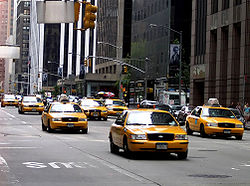
A taxi, also known as a taxicab or simply a cab, is a type of vehicle for hire with a driver, used by a single passenger or small group of passengers, often for a non-shared ride. A taxicab conveys passengers between locations of their choice. This differs from public transport where the pick-up and drop-off locations are decided by the service provider, not by the customers, although demand responsive transport and share taxis provide a hybrid bus/taxi mode.
There are four distinct forms of taxicab, which can be identified by slightly differing terms in different countries:
Although types of vehicles and methods of regulation, hiring, dispatching, and negotiating payment differ significantly from country to country, many common characteristics exist. Disputes over whether ridesharing companies should be regulated as taxicabs resulted in some jurisdictions creating new regulations for these services.
The word taxicab is a compound word formed as a contraction of taximeter and cabriolet. Taximeter is an adaptation of the German word Taxameter, which is itself a variant of the earlier German word Taxanom. Taxe /ˈtaksə/ is a German word meaning "tax", "charge", or "scale of charges". The Medieval Latin word taxa also means tax or charge. Taxi may ultimately be attributed to Ancient Greek τάξις from τάσσω meaning "to place in a certain order," as in commanding an orderly battle line, or in ordaining the payment of taxes, to the extent that ταξίδι (taxidi), meaning "journey" in Modern Greek, initially denoted an orderly military march or campaign. Meter is from the Greek μέτρον (metron) meaning "measure." A cabriolet is a type of horse-drawn carriage; the word comes from French cabrioler ("to leap, caper"), from Italian capriolare ("to somersault"), from Latin capreolus ("roebuck", "wild goat"). In most European languages that word has taken on the meaning of a convertible car.
The taxicabs of Paris were equipped with the first meters beginning on 9 March 1898. They were originally called taxamètres, then renamed taximètres on 17 October 1904.
Harry Nathaniel Allen of The New York Taxicab Company, who imported the first 600 gas-powered New York City taxicabs from France in 1907, borrowed the word "taxicab" from London, where the word was in use by early 1907.
A popular but erroneous account holds that the vehicles were named after Franz von Taxis from the house of Thurn and Taxis, a 16th-century postmaster for Philip of Burgundy, and his nephew Johann Baptiste von Taxis, General Postmaster for the Holy Roman Empire. Both instituted fast and reliable postal services (conveying letters, with some post routes transporting people) across Europe. Their surname derives from their 13th-century ancestor Omodeo Tasso.
Horse-drawn for-hire hackney carriage services began operating in both Paris and London in the early 17th century. The first documented public hackney coach service for hire was in London in 1605. In 1625 carriages were made available for hire from innkeepers in London and the first taxi rank appeared on the Strand outside the Maypole Inn in 1636. In 1635 the Hackney Carriage Act was passed by Parliament to legalise horse-drawn carriages for hire. Coaches were hired out by innkeepers to merchants and visitors. A further "Ordinance for the Regulation of Hackney-Coachmen in London and the places adjacent" was approved by Parliament in 1654 and the first hackney-carriage licences were issued in 1662.
Taxi
A taxi, also known as a taxicab or simply a cab, is a type of vehicle for hire with a driver, used by a single passenger or small group of passengers, often for a non-shared ride. A taxicab conveys passengers between locations of their choice. This differs from public transport where the pick-up and drop-off locations are decided by the service provider, not by the customers, although demand responsive transport and share taxis provide a hybrid bus/taxi mode.
There are four distinct forms of taxicab, which can be identified by slightly differing terms in different countries:
Although types of vehicles and methods of regulation, hiring, dispatching, and negotiating payment differ significantly from country to country, many common characteristics exist. Disputes over whether ridesharing companies should be regulated as taxicabs resulted in some jurisdictions creating new regulations for these services.
The word taxicab is a compound word formed as a contraction of taximeter and cabriolet. Taximeter is an adaptation of the German word Taxameter, which is itself a variant of the earlier German word Taxanom. Taxe /ˈtaksə/ is a German word meaning "tax", "charge", or "scale of charges". The Medieval Latin word taxa also means tax or charge. Taxi may ultimately be attributed to Ancient Greek τάξις from τάσσω meaning "to place in a certain order," as in commanding an orderly battle line, or in ordaining the payment of taxes, to the extent that ταξίδι (taxidi), meaning "journey" in Modern Greek, initially denoted an orderly military march or campaign. Meter is from the Greek μέτρον (metron) meaning "measure." A cabriolet is a type of horse-drawn carriage; the word comes from French cabrioler ("to leap, caper"), from Italian capriolare ("to somersault"), from Latin capreolus ("roebuck", "wild goat"). In most European languages that word has taken on the meaning of a convertible car.
The taxicabs of Paris were equipped with the first meters beginning on 9 March 1898. They were originally called taxamètres, then renamed taximètres on 17 October 1904.
Harry Nathaniel Allen of The New York Taxicab Company, who imported the first 600 gas-powered New York City taxicabs from France in 1907, borrowed the word "taxicab" from London, where the word was in use by early 1907.
A popular but erroneous account holds that the vehicles were named after Franz von Taxis from the house of Thurn and Taxis, a 16th-century postmaster for Philip of Burgundy, and his nephew Johann Baptiste von Taxis, General Postmaster for the Holy Roman Empire. Both instituted fast and reliable postal services (conveying letters, with some post routes transporting people) across Europe. Their surname derives from their 13th-century ancestor Omodeo Tasso.
Horse-drawn for-hire hackney carriage services began operating in both Paris and London in the early 17th century. The first documented public hackney coach service for hire was in London in 1605. In 1625 carriages were made available for hire from innkeepers in London and the first taxi rank appeared on the Strand outside the Maypole Inn in 1636. In 1635 the Hackney Carriage Act was passed by Parliament to legalise horse-drawn carriages for hire. Coaches were hired out by innkeepers to merchants and visitors. A further "Ordinance for the Regulation of Hackney-Coachmen in London and the places adjacent" was approved by Parliament in 1654 and the first hackney-carriage licences were issued in 1662.
