Community hub
Recent from talks
Contribute something
Nothing was collected or created yet.
Taylor-Schechter 12.182
View on Wikipedia
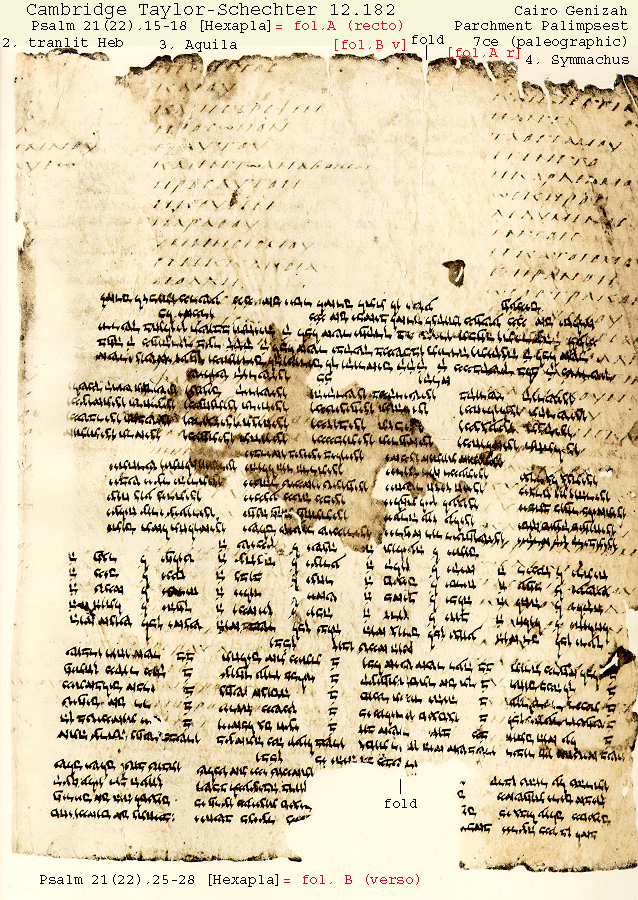
The siglum Taylor-Schechter 12.182 (T-S 12.182; also referenced as TM nr. 62326; LDAB id: 3490; Rahlfs 2005) designates a manuscript written on parchment in codex form.[1] This is a palimpsest of a copy of Origen's work called the Hexapla. The manuscript is dated to 7th-century AD,[2] and is the oldest of the hexapla manuscripts.[3] The hexapla was completed before 240 AD.
History
[edit]The fragments comes from Egypt, were published by C. Taylor in his work Hebrew-Greek Cairo Genizah Palimpsests, Cambridge, 1900, pp. 54–65.[4]
Description
[edit]This is palimpsest in codex form written on parchment. It contains Psalms 22 (LXX 21): 15-18 fol. A recto, 19-24 and 25-28 fol. B verso, and the middle columns, 2-5 columns of the Hexapla.[5][6]
Tetragrammaton ΠΙΠΙ
[edit]The manuscript is written in koine Greek, and the divine name is notable, it contains the tetragrammaton in Greek characters "Pipi" (ΠΙΠΙ). According to Jerome, some septuagint manuscripts had the Divine Name written in this way. Jerome mentions that some Greek manuscripts contain the Hebrew letters for YHWH (yodh he waw he; יהוה),[7] and that this could mislead some Greek readers to read YHWH as PIPI (ΠΙΠΙ; pi iota pi iota), since Hebrew YHWH (written right to left) looks like Greek PIPI (written left to right).[8] According to Pavlos D. Vasileiadis and Nehemiah Gordon, the manuscript has "the nomen sacrum κ[ύριε] with a supralinear Hebrew yod for יהוה (YHWH), followed by πιπι. This transitional combination represents the Tetragrammaton in Ps 22:20 [LXX 21:20] in three separate ways in the Septuagint column of Origen’s Hexapla, preserved in a palimpsest in the Cairo Genizah."[9]
Actual location
[edit]Today it is kept at the Library of the University of Cambridge as a part of the Taylor-Schechter Cairo Genizah Collection (Cambridge University Library T-S 12.182).
See also
[edit]References
[edit]- ^ "Trismegistos 62326 = LDAB 3490". Retrieved 2022-01-20.
- ^ R. Jenkins, in: A. Salvesen, Origen's hexapla and fragments, Tübingen 1998, p. 88-102
- ^ Kantor, B. (2019-03-01). "The Oldest Fragment of Origen's Hexapla: T-S 12.182". Taylor-Schechter Fragment of the Month. Taylor-Schechter Genizah Research Unit, Cambridge University Library. doi:10.17863/CAM.45329.
{{cite journal}}: Cite journal requires|journal=(help) - ^ Charles Taylor (1900). Hebrew-Greek Cairo Genizah palimpsests from the Taylor-Schechter collection. Cambridge: Oxford University. pp. 1–50.
- ^ "Chronological List of Early Papyri and MSS for LXX/OG Study (plus the same MSS in Canonical Order appended)". Retrieved 2015-03-24.
- ^ Ernst Wurthwein; Alexander Achilles Fischer (2014). Alexander Achilles Fischer (ed.). The Septuagint: The Hexapla of Origen. Translated by Erroll F. Rhodes. Wm. B. Eerdmans Publishing. p. 111. ISBN 9780802866806.
{{cite book}}:|work=ignored (help) - ^ Prologus Galeatus
- ^ Letter 25 to Marcellus
- ^ Vasileiadis, Pavlos; Gordon, Nehemia (2019). "Transmission of the Tetragrammaton in Judeo-Greek and Christian Sources ("Η Μεταβίβαση του Τετραγράμματου στις Ιουδαιο-Ελληνικές και Χριστιανικές Πηγές")". Cahiers Accademia. 18: 25. ISSN 1296-7645.
Sources
[edit]- Taylor, Charles (1900). Hebrew-Greek Cairo Genizatt Palimpsests from the Taylor-Schechter Collection including a Fragment of the Twenty Second Psalm According to the Origen's Hexapla. Cambridge University Press.
External links
[edit]- Cambridge University Library T-S 12.182 on Cambridge Digital Library
- 'The oldest fragment of Origen's Hexapla: T-S 12.182', Genizah Research Unit's Fragment of the Month
- "The Hexapla". Artefacts of Ancient Judaism. Archived from the original on 2015-04-16. Retrieved 2015-03-09. A description of T-S 12.182
- Image 1
- University Library Taylor-Schechter Collection 12.182.jpg Image 2