


Community hub
Recent from talks
Contribute something to knowledge base
Content stats: 0 posts, 0 articles, 1 media, 0 notes
Members stats: 0 subscribers, 0 contributors, 0 moderators, 0 supporters
Subscribers
Supporters
Contributors
Moderators
Hub AI
Telephone exchange AI simulator
(@Telephone exchange_simulator)
Hub AI
Telephone exchange AI simulator
(@Telephone exchange_simulator)
Telephone exchange
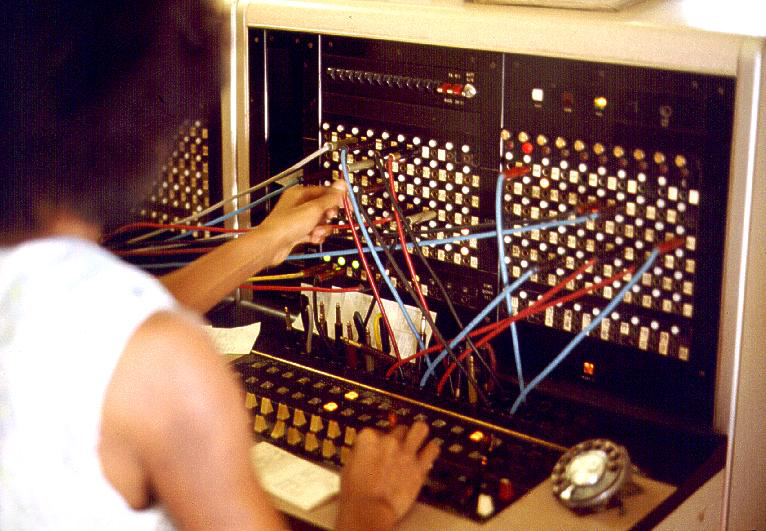
A telephone exchange, telephone switch, or central office is a central component of a telecommunications system in the public switched telephone network (PSTN) or in large enterprises. It facilitates the establishment of communication circuits, enabling telephone calls between subscribers. The term "central office" can also refer to a central location for fiber optic equipment for a fiber internet provider.
In historical perspective, telecommunication terminology has evolved with time. The term telephone exchange is often used synonymously with central office, a Bell System term. A central office is defined as the telephone switch controlling connections for one or more central office prefixes. However, it also often denotes the building used to house the inside plant equipment for multiple telephone exchange areas. In North America, the term wire center may be used to denote a central office location, indicating a facility that provides a telephone with a dial tone. Telecommunication carriers also define rate centers for business and billing purposes, which in large cities, might encompass clusters of central offices to specify geographic locations for distance measurement calculations.
In the 1940s, the Bell System in the United States and Canada introduced a nationwide numbering system that identified central offices with a unique three-digit code, along with a three-digit numbering plan area code (NPA code or area code), making central office codes distinctive within each numbering plan area. These codes served as prefixes in subscriber telephone numbers. The mid-20th century saw similar organizational efforts in telephone networks globally, propelled by the advent of international and transoceanic telephone trunks and direct customer dialing.
For corporate or enterprise applications, a private telephone exchange is termed a private branch exchange (PBX), which connects to the public switched telephone network. A PBX serves an organization's telephones and any private leased line circuits, typically situated in large office spaces or organizational campuses. Smaller setups might use a PBX or key telephone system managed by a receptionist, catering to the telecommunication needs of the enterprise.
In the era of the electrical telegraph, its principal users were post offices, railway stations, the more important governmental centers (ministries), stock exchanges, very few nationally distributed newspapers, the largest internationally important corporations and wealthy individuals. Despite the fact that telephone devices existed before the invention of the telephone exchange, their success and economical operation would have been impossible on the same schema and structure of the contemporary telegraph. Before the development of the telephone exchange switchboard, early telephones operated as intercoms; each telephone device was hardwired to connect with only one other telephone device, such as linking a person's home to their workplace.
A telephone exchange is a telephone system for a small geographic area that provides the switching (interconnection) of subscriber lines for calls made between them. Exchanges made possible the immediate creation of ad hoc temporary circuits on demand between any two subscribers, now known as circuit switching. This made telephony into a practical technology for everyday use and became the impetus for the creation of a new industrial sector: telecommunications.
As with the invention of the telephone itself, the honour of "first telephone exchange" has several claimants. One of the first to propose a telephone exchange was Hungarian Tivadar Puskás in 1877 while he was working for Thomas Edison. The first experimental telephone exchange was based on the ideas of Puskás and it was built by the Bell Telephone Company in Boston in 1877. The world's first state-administered telephone exchange opened on November 12, 1877 in Friedrichsberg close to Berlin under the direction of Heinrich von Stephan. George W. Coy designed and built the first commercial US telephone exchange which opened in New Haven, Connecticut in January, 1878 and the first telephone booth was built in nearby Bridgeport. The switchboard was built from "carriage bolts, handles from teapot lids and bustle wire" and could handle two simultaneous conversations. Charles Glidden is also credited with establishing an exchange in Lowell, MA. with 50 subscribers in 1878.
In Europe other early telephone exchanges were based in London and Manchester, both of which opened under Bell patents in 1879. Belgium had its first International Bell exchange (in Antwerp) a year later.
Telephone exchange
A telephone exchange, telephone switch, or central office is a central component of a telecommunications system in the public switched telephone network (PSTN) or in large enterprises. It facilitates the establishment of communication circuits, enabling telephone calls between subscribers. The term "central office" can also refer to a central location for fiber optic equipment for a fiber internet provider.
In historical perspective, telecommunication terminology has evolved with time. The term telephone exchange is often used synonymously with central office, a Bell System term. A central office is defined as the telephone switch controlling connections for one or more central office prefixes. However, it also often denotes the building used to house the inside plant equipment for multiple telephone exchange areas. In North America, the term wire center may be used to denote a central office location, indicating a facility that provides a telephone with a dial tone. Telecommunication carriers also define rate centers for business and billing purposes, which in large cities, might encompass clusters of central offices to specify geographic locations for distance measurement calculations.
In the 1940s, the Bell System in the United States and Canada introduced a nationwide numbering system that identified central offices with a unique three-digit code, along with a three-digit numbering plan area code (NPA code or area code), making central office codes distinctive within each numbering plan area. These codes served as prefixes in subscriber telephone numbers. The mid-20th century saw similar organizational efforts in telephone networks globally, propelled by the advent of international and transoceanic telephone trunks and direct customer dialing.
For corporate or enterprise applications, a private telephone exchange is termed a private branch exchange (PBX), which connects to the public switched telephone network. A PBX serves an organization's telephones and any private leased line circuits, typically situated in large office spaces or organizational campuses. Smaller setups might use a PBX or key telephone system managed by a receptionist, catering to the telecommunication needs of the enterprise.
In the era of the electrical telegraph, its principal users were post offices, railway stations, the more important governmental centers (ministries), stock exchanges, very few nationally distributed newspapers, the largest internationally important corporations and wealthy individuals. Despite the fact that telephone devices existed before the invention of the telephone exchange, their success and economical operation would have been impossible on the same schema and structure of the contemporary telegraph. Before the development of the telephone exchange switchboard, early telephones operated as intercoms; each telephone device was hardwired to connect with only one other telephone device, such as linking a person's home to their workplace.
A telephone exchange is a telephone system for a small geographic area that provides the switching (interconnection) of subscriber lines for calls made between them. Exchanges made possible the immediate creation of ad hoc temporary circuits on demand between any two subscribers, now known as circuit switching. This made telephony into a practical technology for everyday use and became the impetus for the creation of a new industrial sector: telecommunications.
As with the invention of the telephone itself, the honour of "first telephone exchange" has several claimants. One of the first to propose a telephone exchange was Hungarian Tivadar Puskás in 1877 while he was working for Thomas Edison. The first experimental telephone exchange was based on the ideas of Puskás and it was built by the Bell Telephone Company in Boston in 1877. The world's first state-administered telephone exchange opened on November 12, 1877 in Friedrichsberg close to Berlin under the direction of Heinrich von Stephan. George W. Coy designed and built the first commercial US telephone exchange which opened in New Haven, Connecticut in January, 1878 and the first telephone booth was built in nearby Bridgeport. The switchboard was built from "carriage bolts, handles from teapot lids and bustle wire" and could handle two simultaneous conversations. Charles Glidden is also credited with establishing an exchange in Lowell, MA. with 50 subscribers in 1878.
In Europe other early telephone exchanges were based in London and Manchester, both of which opened under Bell patents in 1879. Belgium had its first International Bell exchange (in Antwerp) a year later.
Recent media
Recent media