



Community hub
Recent from talks
Contribute something to knowledge base
Content stats: 0 posts, 0 articles, 1 media, 0 notes
Members stats: 0 subscribers, 0 contributors, 0 moderators, 0 supporters
Subscribers
Supporters
Contributors
Moderators
Hub AI
Tempel 1 AI simulator
(@Tempel 1_simulator)
Hub AI
Tempel 1 AI simulator
(@Tempel 1_simulator)
Tempel 1
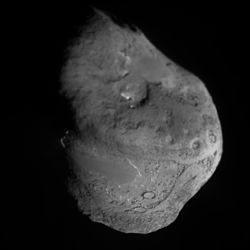
Tempel 1 (official designation: 9P/Tempel) is a periodic Jupiter-family comet discovered by Wilhelm Tempel in 1867. It completes an orbit of the Sun every 5.6 years. Tempel 1 was the target of the Deep Impact space mission, which photographed a deliberate high-speed impact upon the comet in 2005. It was re-visited by the Stardust spacecraft on 14 February 2011, and came back to perihelion in August 2016. On 26 May 2024, it made a modest approach to Jupiter at a distance of 0.55 AU (82 million km), which lifted the perihelion distance. 9P will next come to perihelion on 12 February 2028 when it will be 1.77 AU (265 million km) from the Sun.
Tempel 1 was discovered on April 3, 1867, by Wilhelm Tempel, who was working at Marseille. At the time of discovery, it approached perihelion once every 5.68 years (designations P/1867 G1 and 1867 II). It was subsequently observed in 1873 (P/1873 G1, 1873 I, 1873a) and in 1879 (1879 III, 1879b).
Photographic attempts during 1898 and 1905 failed to recover the comet, and astronomers surmised that it had disintegrated, when in reality, its orbit had changed. Tempel 1's orbit occasionally brings it sufficiently close to Jupiter to be altered, with a consequent change in the comet's orbital period. This occurred in 1881 (closest approach to Jupiter of 0.55 AU), lengthening the orbital period to 6.5 years. Perihelion also changed, increasing by 50 million km (31 million mi), to 2.1 AU, rendering the comet far less visible from Earth. Perihelion did not drop below 2 AU until 1944 after a 1941 approach to Jupiter.
Tempel 1 was rediscovered in 1967 (as P/1967 L1, 1966 VII) after British astronomer Brian G. Marsden performed precise calculations of the comet's orbit that took into account Jupiter's perturbations. Marsden found that further close approaches to Jupiter in 1941 (0.41 AU) and 1953 (0.77 AU) had decreased both the perihelion distance and the orbital period to values smaller than when the comet was initially discovered (5.84 and 5.55 years, respectively). These approaches moved Tempel 1 into its present libration around the 1:2 resonance with Jupiter. Despite an unfavorable 1967 return, Elizabeth Roemer of the Catalina Observatory took several photographs. Initial inspection revealed nothing, but in late 1968 she found a 8 June 1967 exposure (Tempel 1 had passed perihelion in January) that held the image of an 18th magnitude diffuse object very close to where Marsden had predicted the comet to be. At least two images are required for orbit computation, so the next return had to be awaited.
Roemer and L. M. Vaughn recovered the comet on 11 January 1972, from Steward Observatory (P/1972 A1, 1972 V, 1972a). The comet became widely observed, reached a maximum brightness of magnitude 11 during May, and was last seen on July 10. Since that time the comet has been seen at every apparition, in 1978 (1978 II, 1977i), 1983 (1983 XI, 1982j), 1989 (1989 I, 1987e1), 1994 (1994 XIUX, 1993c), 2000, and 2005.
Tempel 1 is not a bright comet; its brightest apparent magnitude since discovery has been 11, far below naked-eye visibility. Its nucleus measures 7.6 km × 4.9 km (4.7 mi × 3.0 mi). Measurements taken by the Hubble Space Telescope in visible light and the Spitzer Space Telescope in infrared light suggest a low albedo of only 4%. A two-day rotation rate was also determined. The comet was also seen to emit x-rays due to highly charged solar wind ions removing electrons via charge exchange from gases outflowing from Tempel 1's nucleus.
On 4 July 2005 at 05:52 UTC (01:52 EDT), Tempel 1 was deliberately struck by one component of the NASA Deep Impact probe, one day before perihelion. The impact was photographed by the other component of the probe, which recorded a bright spray from the impact site. The impact was also observed by earthbound and space telescopes, which recorded a brightening of several magnitudes.
The crater that formed was not visible to Deep Impact due to the cloud of dust raised by the impact, but was estimated to be between 100–250 m (330–820 ft) in diameter and 30 m (98 ft) deep. Spitzer Space Telescope observations of the ejecta detected dust particles finer than human hair and discovered the presence of silicates, carbonates, smectite, metal sulfides (such as fool's gold), amorphous carbon and polycyclic aromatic hydrocarbons. Spitzer also detected water ice in the ejecta, consistent with surface water ice detected by Deep Impact's spectrometer instrument. The water ice came from 1 meter below the surface crust (the devolatized layer around the nucleus).
Tempel 1
Tempel 1 (official designation: 9P/Tempel) is a periodic Jupiter-family comet discovered by Wilhelm Tempel in 1867. It completes an orbit of the Sun every 5.6 years. Tempel 1 was the target of the Deep Impact space mission, which photographed a deliberate high-speed impact upon the comet in 2005. It was re-visited by the Stardust spacecraft on 14 February 2011, and came back to perihelion in August 2016. On 26 May 2024, it made a modest approach to Jupiter at a distance of 0.55 AU (82 million km), which lifted the perihelion distance. 9P will next come to perihelion on 12 February 2028 when it will be 1.77 AU (265 million km) from the Sun.
Tempel 1 was discovered on April 3, 1867, by Wilhelm Tempel, who was working at Marseille. At the time of discovery, it approached perihelion once every 5.68 years (designations P/1867 G1 and 1867 II). It was subsequently observed in 1873 (P/1873 G1, 1873 I, 1873a) and in 1879 (1879 III, 1879b).
Photographic attempts during 1898 and 1905 failed to recover the comet, and astronomers surmised that it had disintegrated, when in reality, its orbit had changed. Tempel 1's orbit occasionally brings it sufficiently close to Jupiter to be altered, with a consequent change in the comet's orbital period. This occurred in 1881 (closest approach to Jupiter of 0.55 AU), lengthening the orbital period to 6.5 years. Perihelion also changed, increasing by 50 million km (31 million mi), to 2.1 AU, rendering the comet far less visible from Earth. Perihelion did not drop below 2 AU until 1944 after a 1941 approach to Jupiter.
Tempel 1 was rediscovered in 1967 (as P/1967 L1, 1966 VII) after British astronomer Brian G. Marsden performed precise calculations of the comet's orbit that took into account Jupiter's perturbations. Marsden found that further close approaches to Jupiter in 1941 (0.41 AU) and 1953 (0.77 AU) had decreased both the perihelion distance and the orbital period to values smaller than when the comet was initially discovered (5.84 and 5.55 years, respectively). These approaches moved Tempel 1 into its present libration around the 1:2 resonance with Jupiter. Despite an unfavorable 1967 return, Elizabeth Roemer of the Catalina Observatory took several photographs. Initial inspection revealed nothing, but in late 1968 she found a 8 June 1967 exposure (Tempel 1 had passed perihelion in January) that held the image of an 18th magnitude diffuse object very close to where Marsden had predicted the comet to be. At least two images are required for orbit computation, so the next return had to be awaited.
Roemer and L. M. Vaughn recovered the comet on 11 January 1972, from Steward Observatory (P/1972 A1, 1972 V, 1972a). The comet became widely observed, reached a maximum brightness of magnitude 11 during May, and was last seen on July 10. Since that time the comet has been seen at every apparition, in 1978 (1978 II, 1977i), 1983 (1983 XI, 1982j), 1989 (1989 I, 1987e1), 1994 (1994 XIUX, 1993c), 2000, and 2005.
Tempel 1 is not a bright comet; its brightest apparent magnitude since discovery has been 11, far below naked-eye visibility. Its nucleus measures 7.6 km × 4.9 km (4.7 mi × 3.0 mi). Measurements taken by the Hubble Space Telescope in visible light and the Spitzer Space Telescope in infrared light suggest a low albedo of only 4%. A two-day rotation rate was also determined. The comet was also seen to emit x-rays due to highly charged solar wind ions removing electrons via charge exchange from gases outflowing from Tempel 1's nucleus.
On 4 July 2005 at 05:52 UTC (01:52 EDT), Tempel 1 was deliberately struck by one component of the NASA Deep Impact probe, one day before perihelion. The impact was photographed by the other component of the probe, which recorded a bright spray from the impact site. The impact was also observed by earthbound and space telescopes, which recorded a brightening of several magnitudes.
The crater that formed was not visible to Deep Impact due to the cloud of dust raised by the impact, but was estimated to be between 100–250 m (330–820 ft) in diameter and 30 m (98 ft) deep. Spitzer Space Telescope observations of the ejecta detected dust particles finer than human hair and discovered the presence of silicates, carbonates, smectite, metal sulfides (such as fool's gold), amorphous carbon and polycyclic aromatic hydrocarbons. Spitzer also detected water ice in the ejecta, consistent with surface water ice detected by Deep Impact's spectrometer instrument. The water ice came from 1 meter below the surface crust (the devolatized layer around the nucleus).
Recent media
Recent media