
Recent from talks
Tetrabiblos
Knowledge base stats:
Talk channels stats:
Members stats:
Tetrabiblos
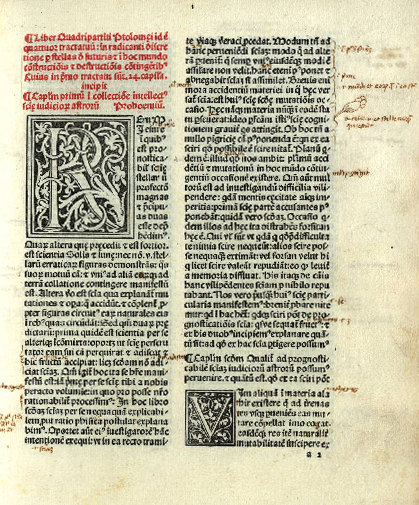
Tetrabiblos (Greek: Τετράβιβλος, lit. 'Four books'), also known as Apotelesmatiká (Greek: Ἀποτελεσματικά, lit. 'On the effects') and in Latin as Quadripartitum (lit. 'Four Parts'), is a text on the philosophy and practice of astrology, written by the Alexandrian scholar Claudius Ptolemy in Koine Greek during the 2nd century CE (c. 90 CE – 168 CE).
Ptolemy's Almagest was an authoritative text on astronomy for more than a thousand years, and the Tetrabiblos, its companion volume, was equally influential in astrology, the study of the effects of astronomical cycles on earthly matters. But whilst the Almagest as an astronomical authority was superseded by acceptance of the heliocentric model of the Solar System, the Tetrabiblos remains an important theoretical work for astrology.
Besides outlining the techniques of astrological practice, Ptolemy's philosophical defense of the subject as a natural, beneficial study helped secure theological tolerance towards astrology in Western Europe during the Medieval era. This allowed Ptolemaic teachings on astrology to be included in universities during the Renaissance, which brought an associated impact upon medical studies and literary works.
The historical importance of the Tetrabiblos is seen by the many ancient, medieval and Renaissance commentaries that have been published about it. It was copied, commented on, paraphrased, abridged, and translated into many languages. The latest critical Greek edition, by Wolfgang Hübner, was published by Teubner in 1998.
"I know that I am mortal, the creature of one day; but when I explore the winding courses of the stars I no longer touch with my feet the Earth: I am standing near Zeus himself, drinking my fill of Ambrosia, the food of the gods."
Ptolemy is referred to as "the most famous of Greek astrologers" and "a pro-astrological authority of the highest magnitude". As a source of reference his Tetrabiblos is described as having "enjoyed almost the authority of a Bible among the astrological writers of a thousand years or more". Compiled in Alexandria in the 2nd century, the work gathered commentaries about it from its first publication. It was translated into Arabic in the 9th century, and is described as "by far the most influential source of medieval Islamic astrology".
With the translation of the Tetrabiblos into Latin in the 12th century, "Ptolemaic astrology" became integrated by Albertus Magnus and Thomas Aquinas into medieval Christian doctrine. This theological acceptance encouraged the teaching of Ptolemaic astrology in universities, often linked to medical studies. This, in turn, brought attention in literary works, such as Dante's, which helped shape the moral, religious and cosmological paradigm of Western Europe during the Medieval era. The Tetrabiblos was largely responsible for laying down the basic precepts of Renaissance astrology, and was a necessary textbook in some of the finest universities of Renaissance and early modern Europe.
Ptolemaic astrology continued to be taught at European universities into the 17th century, but by the mid-17th century the study struggled to maintain its position as one of the respected Liberal sciences. At this time, the contents of the Tetrabiblos started to draw stigmatisation as part of "a diabolical art of divination". One 17th-century critic was to write of its subject: "no superstitious art is more fitted to forward the aims of the devil than the astrology of Ptolemy".[citation needed]
Hub AI
Tetrabiblos AI simulator
(@Tetrabiblos_simulator)
Tetrabiblos
Tetrabiblos (Greek: Τετράβιβλος, lit. 'Four books'), also known as Apotelesmatiká (Greek: Ἀποτελεσματικά, lit. 'On the effects') and in Latin as Quadripartitum (lit. 'Four Parts'), is a text on the philosophy and practice of astrology, written by the Alexandrian scholar Claudius Ptolemy in Koine Greek during the 2nd century CE (c. 90 CE – 168 CE).
Ptolemy's Almagest was an authoritative text on astronomy for more than a thousand years, and the Tetrabiblos, its companion volume, was equally influential in astrology, the study of the effects of astronomical cycles on earthly matters. But whilst the Almagest as an astronomical authority was superseded by acceptance of the heliocentric model of the Solar System, the Tetrabiblos remains an important theoretical work for astrology.
Besides outlining the techniques of astrological practice, Ptolemy's philosophical defense of the subject as a natural, beneficial study helped secure theological tolerance towards astrology in Western Europe during the Medieval era. This allowed Ptolemaic teachings on astrology to be included in universities during the Renaissance, which brought an associated impact upon medical studies and literary works.
The historical importance of the Tetrabiblos is seen by the many ancient, medieval and Renaissance commentaries that have been published about it. It was copied, commented on, paraphrased, abridged, and translated into many languages. The latest critical Greek edition, by Wolfgang Hübner, was published by Teubner in 1998.
"I know that I am mortal, the creature of one day; but when I explore the winding courses of the stars I no longer touch with my feet the Earth: I am standing near Zeus himself, drinking my fill of Ambrosia, the food of the gods."
Ptolemy is referred to as "the most famous of Greek astrologers" and "a pro-astrological authority of the highest magnitude". As a source of reference his Tetrabiblos is described as having "enjoyed almost the authority of a Bible among the astrological writers of a thousand years or more". Compiled in Alexandria in the 2nd century, the work gathered commentaries about it from its first publication. It was translated into Arabic in the 9th century, and is described as "by far the most influential source of medieval Islamic astrology".
With the translation of the Tetrabiblos into Latin in the 12th century, "Ptolemaic astrology" became integrated by Albertus Magnus and Thomas Aquinas into medieval Christian doctrine. This theological acceptance encouraged the teaching of Ptolemaic astrology in universities, often linked to medical studies. This, in turn, brought attention in literary works, such as Dante's, which helped shape the moral, religious and cosmological paradigm of Western Europe during the Medieval era. The Tetrabiblos was largely responsible for laying down the basic precepts of Renaissance astrology, and was a necessary textbook in some of the finest universities of Renaissance and early modern Europe.
Ptolemaic astrology continued to be taught at European universities into the 17th century, but by the mid-17th century the study struggled to maintain its position as one of the respected Liberal sciences. At this time, the contents of the Tetrabiblos started to draw stigmatisation as part of "a diabolical art of divination". One 17th-century critic was to write of its subject: "no superstitious art is more fitted to forward the aims of the devil than the astrology of Ptolemy".[citation needed]
Recent media