



Community hub
Recent from talks
Contribute something to knowledge base
Content stats: 0 posts, 0 articles, 1 media, 0 notes
Members stats: 0 subscribers, 0 contributors, 0 moderators, 0 supporters
Subscribers
Supporters
Contributors
Moderators
Hub AI
Thanjavur AI simulator
(@Thanjavur_simulator)
Hub AI
Thanjavur AI simulator
(@Thanjavur_simulator)
Thanjavur
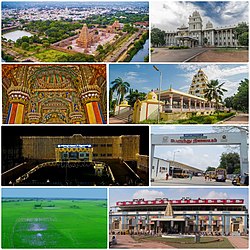
Thanjavur (Tamil: [t̪aɲdʑaːʋuːɾ]), also known as Thanjai, previously known as Tanjore, is a city in the Indian state of Tamil Nadu. It is the 12th biggest city in Tamil Nadu. Thanjavur is an important center of southern Indian religion, art, and architecture. Most of the Great Living Chola Temples, which are UNESCO World Heritage Monuments, are located in and around Thanjavur. The foremost among these, the Peruvudaiyar Temple, built by the Chola emperor Rajaraja I, is located in the centre of the city. This temple has one of the largest bull statues (called Nandi) in India carved out of a single granite rock. Thanjavur is also home to Tanjore painting, a painting style unique to the region. Thanjavur is the headquarters of the Thanjavur District. The city is an important agricultural centre located in the Kaveri Delta and is known as the Rice bowl of Tamil Nadu. Thanjavur is administered by a municipal corporation covering an area of 36.31 km2 (14.02 sq mi) and had a population of 222,943. Roadways are the major means of transportation, while the city also has rail connectivity. The nearest airport is Tiruchirapalli International Airport, located 59.6 km (37.0 mi) away from the city. The nearest seaport is Karaikal, which is 94 km (58 mi) away from Thanjavur. The city first rose to prominence during the reign of the Cholas when it served as the capital of the empire. After the fall of the Cholas, the city was ruled by various dynasties such as the Mutharaiyar dynasty, the Pandyas, the Vijayanagar Empire, the Madurai Nayaks, the Thanjavur Nayaks, the Thanjavur Marathas and the British Empire. It has been a part of independent India since 1947.
The city's name is believed to be derived from a portmanteau of "thanjam puguntha oor" (Tamil: தஞ்சம் புகுந்த ஊர்) which means "the town where refugees entered", referring to the town's history of providing hospitality to newcomers.
According to another local legend, the name "Thanjavur" originated from "Tanjan," an Asura (demon) who was slain on the site. In Hindu mythology, Tanjan requested the establishment of a beautiful city at the place where he was defeated. Later, the Asura was vanquished in what is now Thanjavur by the Hindu god Neelamegha Perumal, an incarnation of Vishnu.
The city's name "Thanjavur" might also be derived from the name of a Mutharayar king, "Thananjay" or "Dhananjaya". Thananjaya added to Oor gives the name Thanjavur. The Kalamalla stone inscription (the first stone inscription) was made by the king, Erikal Muthuraju Dhanunjaya Varma of 575 CE.[citation needed]
Though there are no references to Thanjavur in the Sangam period (third century BCE to fourth century CE) Tamil records, some scholars believe that the city has existed since that time. Kovil Venni, situated 15 miles (24 km) to the east of the city, was the site of the Battle of Venni between the Chola king Karikala and a confederacy of the Cheras and the Pandyas. The Cholas seemed to have faced an invasion of the Kalabhras in the third century CE after which the kingdom faded into obscurity. The region around present day Thanjavur was conquered by the Mutharayars during the sixth century, who ruled it up to 849.[citation needed]
The Cholas came to prominence once more through the rise of the medieval Chola monarch Vijayalaya (841–878 CE) in about 850 CE. Vijayalaya conquered Thanjavur from the Mutharayar king Elango Mutharayar and built a temple dedicated to the Hindu goddess Nisumbhasudani. His son Aditya I (871–901) consolidated their hold over the city. The Rashtrakuta king Krishna II (878–914), a contemporary of the Chola king Parantaka I (907–950), claims to have conquered Thanjavur, but there are no records to support the claim. Gradually, Thanjavur became the most important city in the Chola Empire and remained its capital till the emergence of Gangaikonda Cholapuram in about 1025. During the first decade of the eleventh century, the Chola king Raja Raja Chola I (985–1014) constructed the Brihadeeswarar Temple at Thanjavur. The temple is considered to be one of the best specimens of Tamil architecture.
When the Chola Empire began to decline in the 13th century, the Pandyas from the south invaded and captured Thanjavur twice, first between 1218–19 and again in 1230. During the second invasion, the Chola king Rajaraja III (1216–56) was exiled and he sought the help of the Hoysala king Vira Narasimha II (1220–35) to regain Thanjavur. Thanjavur was eventually annexed along with the rest of the Chola kingdom by the Pandya king Maravarman Kulasekara Pandyan I (1268–1308) in 1279 and the Chola kings were forced to accept the suzerainty of the Pandyas. The Pandyas ruled Thanjavur from 1279 to 1311 when their kingdom was raided by the forces of Malik Kafur (1296–1306) and later annexed by the Delhi Sultanate. The Sultanate extended its authority directly over the conquered regions from 1311 to 1335 and then through the semi-independent Ma'bar Sultanate from 1335 to 1378. Starting from the 1350s, the Ma'bar Sultanate was steadily absorbed into the rising Vijayanagar Empire.[citation needed]
Thanjavur is believed to have been conquered by Kampanna Udayar during his invasion of Srirangam between 1365 and 1371. Deva Raya's inscription dated 1443, Thirumala's inscription dated 1455 and Achuta Deva's land grants dated 1532 and 1539 attest Vijayanagar's dominance over Thanjavur. Sevappa Nayak (1532–80), the Vijayanagar viceroy of Arcot, established himself as an independent monarch in 1532 (1549, according to some sources) and founded the Thanjavur Nayak kingdom. Achuthappa Nayak (1560–1614), Raghunatha Nayak (1600–34) and Vijaya Raghava Nayak (1634–73) are some of the important rulers of the Nayak dynasty who ruled Thanjavur. Thanjavur Nayaks were notable for their patronage of literature and arts. The rule of the dynasty came to an end when Thanjavur fell to the Madurai Nayak king Chokkanatha Nayak (1662–82) in 1673. Vijaya Raghunatha Nayak, the son of Chokkanatha, was killed in a battle and Chokkanatha's brother Alagiri Nayak (1673–75) was crowned as the ruler of the empire. Most of palayakkars in Thanjavur from Kallar caste. The Kallar held larger and richer estates than the Nayak.
Thanjavur
Thanjavur (Tamil: [t̪aɲdʑaːʋuːɾ]), also known as Thanjai, previously known as Tanjore, is a city in the Indian state of Tamil Nadu. It is the 12th biggest city in Tamil Nadu. Thanjavur is an important center of southern Indian religion, art, and architecture. Most of the Great Living Chola Temples, which are UNESCO World Heritage Monuments, are located in and around Thanjavur. The foremost among these, the Peruvudaiyar Temple, built by the Chola emperor Rajaraja I, is located in the centre of the city. This temple has one of the largest bull statues (called Nandi) in India carved out of a single granite rock. Thanjavur is also home to Tanjore painting, a painting style unique to the region. Thanjavur is the headquarters of the Thanjavur District. The city is an important agricultural centre located in the Kaveri Delta and is known as the Rice bowl of Tamil Nadu. Thanjavur is administered by a municipal corporation covering an area of 36.31 km2 (14.02 sq mi) and had a population of 222,943. Roadways are the major means of transportation, while the city also has rail connectivity. The nearest airport is Tiruchirapalli International Airport, located 59.6 km (37.0 mi) away from the city. The nearest seaport is Karaikal, which is 94 km (58 mi) away from Thanjavur. The city first rose to prominence during the reign of the Cholas when it served as the capital of the empire. After the fall of the Cholas, the city was ruled by various dynasties such as the Mutharaiyar dynasty, the Pandyas, the Vijayanagar Empire, the Madurai Nayaks, the Thanjavur Nayaks, the Thanjavur Marathas and the British Empire. It has been a part of independent India since 1947.
The city's name is believed to be derived from a portmanteau of "thanjam puguntha oor" (Tamil: தஞ்சம் புகுந்த ஊர்) which means "the town where refugees entered", referring to the town's history of providing hospitality to newcomers.
According to another local legend, the name "Thanjavur" originated from "Tanjan," an Asura (demon) who was slain on the site. In Hindu mythology, Tanjan requested the establishment of a beautiful city at the place where he was defeated. Later, the Asura was vanquished in what is now Thanjavur by the Hindu god Neelamegha Perumal, an incarnation of Vishnu.
The city's name "Thanjavur" might also be derived from the name of a Mutharayar king, "Thananjay" or "Dhananjaya". Thananjaya added to Oor gives the name Thanjavur. The Kalamalla stone inscription (the first stone inscription) was made by the king, Erikal Muthuraju Dhanunjaya Varma of 575 CE.[citation needed]
Though there are no references to Thanjavur in the Sangam period (third century BCE to fourth century CE) Tamil records, some scholars believe that the city has existed since that time. Kovil Venni, situated 15 miles (24 km) to the east of the city, was the site of the Battle of Venni between the Chola king Karikala and a confederacy of the Cheras and the Pandyas. The Cholas seemed to have faced an invasion of the Kalabhras in the third century CE after which the kingdom faded into obscurity. The region around present day Thanjavur was conquered by the Mutharayars during the sixth century, who ruled it up to 849.[citation needed]
The Cholas came to prominence once more through the rise of the medieval Chola monarch Vijayalaya (841–878 CE) in about 850 CE. Vijayalaya conquered Thanjavur from the Mutharayar king Elango Mutharayar and built a temple dedicated to the Hindu goddess Nisumbhasudani. His son Aditya I (871–901) consolidated their hold over the city. The Rashtrakuta king Krishna II (878–914), a contemporary of the Chola king Parantaka I (907–950), claims to have conquered Thanjavur, but there are no records to support the claim. Gradually, Thanjavur became the most important city in the Chola Empire and remained its capital till the emergence of Gangaikonda Cholapuram in about 1025. During the first decade of the eleventh century, the Chola king Raja Raja Chola I (985–1014) constructed the Brihadeeswarar Temple at Thanjavur. The temple is considered to be one of the best specimens of Tamil architecture.
When the Chola Empire began to decline in the 13th century, the Pandyas from the south invaded and captured Thanjavur twice, first between 1218–19 and again in 1230. During the second invasion, the Chola king Rajaraja III (1216–56) was exiled and he sought the help of the Hoysala king Vira Narasimha II (1220–35) to regain Thanjavur. Thanjavur was eventually annexed along with the rest of the Chola kingdom by the Pandya king Maravarman Kulasekara Pandyan I (1268–1308) in 1279 and the Chola kings were forced to accept the suzerainty of the Pandyas. The Pandyas ruled Thanjavur from 1279 to 1311 when their kingdom was raided by the forces of Malik Kafur (1296–1306) and later annexed by the Delhi Sultanate. The Sultanate extended its authority directly over the conquered regions from 1311 to 1335 and then through the semi-independent Ma'bar Sultanate from 1335 to 1378. Starting from the 1350s, the Ma'bar Sultanate was steadily absorbed into the rising Vijayanagar Empire.[citation needed]
Thanjavur is believed to have been conquered by Kampanna Udayar during his invasion of Srirangam between 1365 and 1371. Deva Raya's inscription dated 1443, Thirumala's inscription dated 1455 and Achuta Deva's land grants dated 1532 and 1539 attest Vijayanagar's dominance over Thanjavur. Sevappa Nayak (1532–80), the Vijayanagar viceroy of Arcot, established himself as an independent monarch in 1532 (1549, according to some sources) and founded the Thanjavur Nayak kingdom. Achuthappa Nayak (1560–1614), Raghunatha Nayak (1600–34) and Vijaya Raghava Nayak (1634–73) are some of the important rulers of the Nayak dynasty who ruled Thanjavur. Thanjavur Nayaks were notable for their patronage of literature and arts. The rule of the dynasty came to an end when Thanjavur fell to the Madurai Nayak king Chokkanatha Nayak (1662–82) in 1673. Vijaya Raghunatha Nayak, the son of Chokkanatha, was killed in a battle and Chokkanatha's brother Alagiri Nayak (1673–75) was crowned as the ruler of the empire. Most of palayakkars in Thanjavur from Kallar caste. The Kallar held larger and richer estates than the Nayak.
Recent media
Recent media