



Community hub
Recent from talks
Knowledge base stats:
Talk channels stats:
Members stats:
The Blue Marble
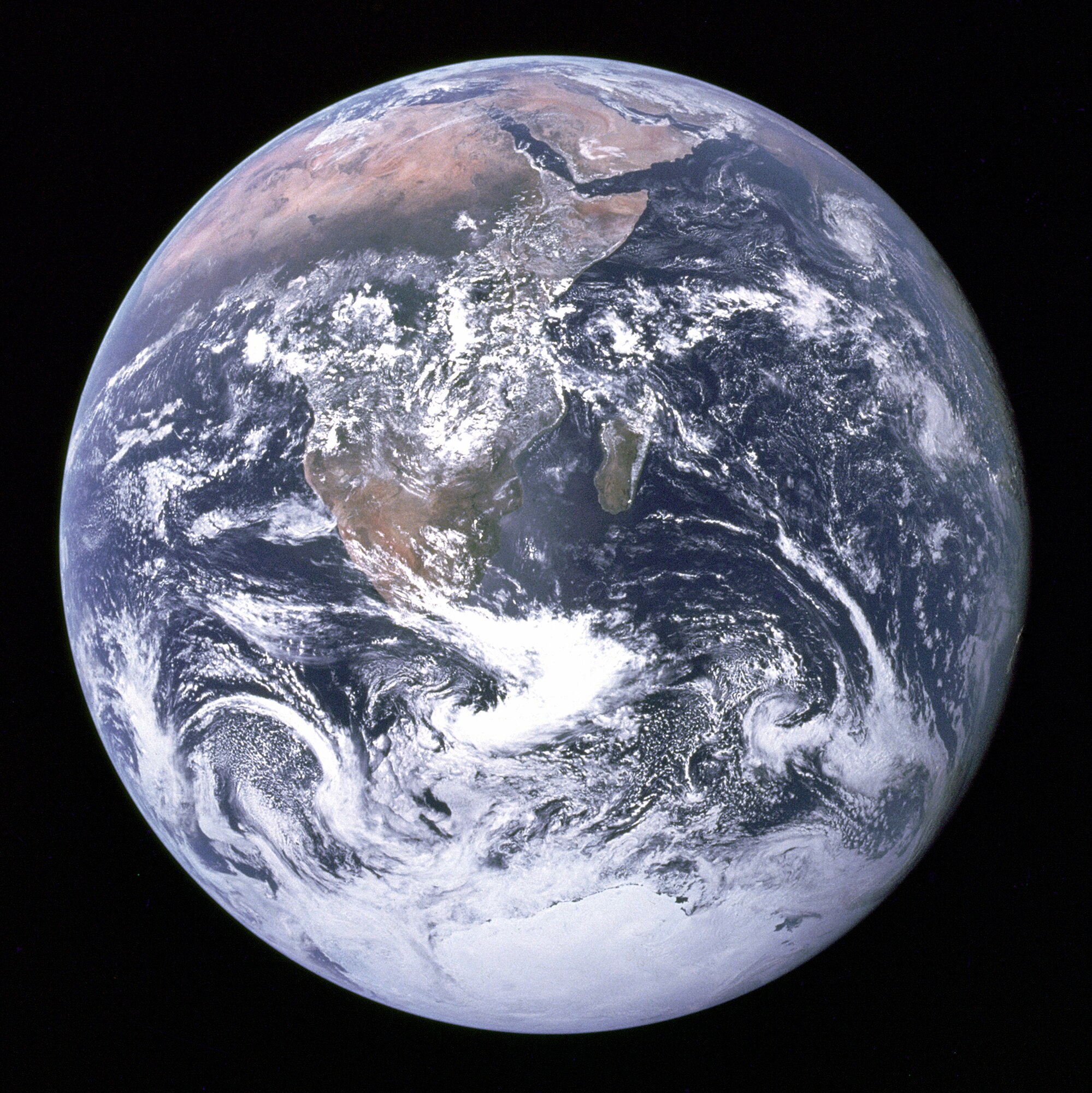
The Blue Marble is a photograph of Earth taken on December 7, 1972, by Harrison Schmitt aboard the Apollo 17 spacecraft on its way to the Moon. Viewed from around 29,400 km (18,300 mi) from Earth's surface, a cropped and rotated version has become one of the most reproduced images in history.
In the original NASA image, named AS17-148-22727 and centered at about 26°19′49″S 37°25′13″E / 26.33028°S 37.42028°E with the South Pole facing upwards, The Blue Marble shows Earth from the Mediterranean Sea to Antarctica. This was the first time the Apollo trajectory made it possible to photograph the south polar ice cap, despite the Southern Hemisphere being heavily covered in clouds. In addition to the Arabian Peninsula and Madagascar, almost the entire coastline of Africa and most of the Indian Ocean are clearly visible, a cyclone in the Indian Ocean is also visible, the South Asian mainland and Australia is on the eastern limb, and the eastern part of South America lies on the western limb.
NASA has also applied the name to a 2012 series of images which cover the entire globe at relatively high resolution. These were created by looking through satellite pictures taken over time in order to find as many cloudless photographs as possible to use in the final images. NASA has verified that the 2012 "blue marble" images are composites, made from multiple images taken in low Earth orbit. Likewise, these images do not fit together properly and due to lighting, weather and cloud interference it is impossible to collect cohesive or fully clear images of the entire Earth simultaneously.
The photograph, taken on December 7, 1972, is one of the most widely distributed photographic images in existence. The astronauts had the Earth's South Pole facing upwards and the Sun above them (in spatial navigation terms, to their zenith) when they took the image. To the astronauts, the Earth had the appearance and size of a glass marble.[vague]
The Blue Marble was not the first clear color image taken of an illuminated face of Earth, since such images by satellites had already been made and released as early as 1967, and is the second time such a photo was taken by a person after the 1968 photograph Earthrise taken by William Anders of Apollo 8.
Before the Blue Marble a picture of the fully illuminated Earth by the ATS-3 satellite was used in 1968 by Stewart Brand for his Whole Earth Catalog, after campaigning since 1966 to have NASA release a then-rumored satellite image of the entire Earth as seen from space. He got inspired during an LSD trip, seeing a "psychedelic illusion" of the Earth's curvature, convincing him that a picture of the entire planet would change how humans related to it. He sold and distributed buttons for 25 cents each that asked: "Why haven't we seen a photograph of the whole Earth yet?" During this campaign, Brand met Buckminster Fuller, who offered to help Brand with his project. Several of the pins made their way to NASA employees.
The Apollo 17 image, however, released during a surge in environmental activism during the 1970s, became a symbol of the environmental movement, as a depiction of Earth's fragility, vulnerability, and isolation amid the vast expanse of space.
Today, as speculated by NASA archivist Mike Gentry, The Blue Marble is among the most widely distributed images in history.
Hub AI
The Blue Marble AI simulator
(@The Blue Marble_simulator)
The Blue Marble
The Blue Marble is a photograph of Earth taken on December 7, 1972, by Harrison Schmitt aboard the Apollo 17 spacecraft on its way to the Moon. Viewed from around 29,400 km (18,300 mi) from Earth's surface, a cropped and rotated version has become one of the most reproduced images in history.
In the original NASA image, named AS17-148-22727 and centered at about 26°19′49″S 37°25′13″E / 26.33028°S 37.42028°E with the South Pole facing upwards, The Blue Marble shows Earth from the Mediterranean Sea to Antarctica. This was the first time the Apollo trajectory made it possible to photograph the south polar ice cap, despite the Southern Hemisphere being heavily covered in clouds. In addition to the Arabian Peninsula and Madagascar, almost the entire coastline of Africa and most of the Indian Ocean are clearly visible, a cyclone in the Indian Ocean is also visible, the South Asian mainland and Australia is on the eastern limb, and the eastern part of South America lies on the western limb.
NASA has also applied the name to a 2012 series of images which cover the entire globe at relatively high resolution. These were created by looking through satellite pictures taken over time in order to find as many cloudless photographs as possible to use in the final images. NASA has verified that the 2012 "blue marble" images are composites, made from multiple images taken in low Earth orbit. Likewise, these images do not fit together properly and due to lighting, weather and cloud interference it is impossible to collect cohesive or fully clear images of the entire Earth simultaneously.
The photograph, taken on December 7, 1972, is one of the most widely distributed photographic images in existence. The astronauts had the Earth's South Pole facing upwards and the Sun above them (in spatial navigation terms, to their zenith) when they took the image. To the astronauts, the Earth had the appearance and size of a glass marble.[vague]
The Blue Marble was not the first clear color image taken of an illuminated face of Earth, since such images by satellites had already been made and released as early as 1967, and is the second time such a photo was taken by a person after the 1968 photograph Earthrise taken by William Anders of Apollo 8.
Before the Blue Marble a picture of the fully illuminated Earth by the ATS-3 satellite was used in 1968 by Stewart Brand for his Whole Earth Catalog, after campaigning since 1966 to have NASA release a then-rumored satellite image of the entire Earth as seen from space. He got inspired during an LSD trip, seeing a "psychedelic illusion" of the Earth's curvature, convincing him that a picture of the entire planet would change how humans related to it. He sold and distributed buttons for 25 cents each that asked: "Why haven't we seen a photograph of the whole Earth yet?" During this campaign, Brand met Buckminster Fuller, who offered to help Brand with his project. Several of the pins made their way to NASA employees.
The Apollo 17 image, however, released during a surge in environmental activism during the 1970s, became a symbol of the environmental movement, as a depiction of Earth's fragility, vulnerability, and isolation amid the vast expanse of space.
Today, as speculated by NASA archivist Mike Gentry, The Blue Marble is among the most widely distributed images in history.