Hubbry Logo
The Bong ConnectionThe Bong ConnectionMain
Open search
The Bong Connection
Community hub
The Bong Connection
logo
8 pages, 0 posts
0 subscribers
Be the first to start a discussion here.
The Bong Connection
The Bong Connection
from Wikipedia

The Bong Connection
Directed byAnjan Dutt
Produced byJoy Ganguly
StarringRaima Sen
Shayan Munshi
Parambrata
Music byNeel Dutta
Distributed byMoviex Entertainment
Release date
  • 2006 (2006)
Running time
131 minutes
CountryIndia
LanguagesBengali
English
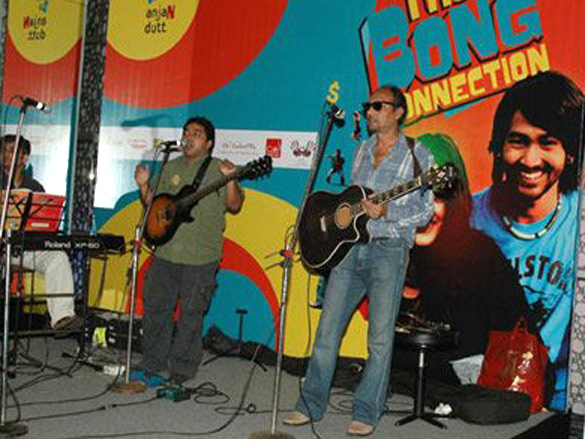
Anjan Dutt and Neel Dutt in premiere function of film

The Bong Connection is a 2006 Bengali-English language Indian film starring Raima Sen, Shayan Munshi and Parambrata Chatterjee and directed by Anjan Dutt. The movie, which is based on the lives of Bengalis in the U.S. and Kolkata, was screened at the Museum of Modern Art in New York City in 2005.

Plot

[edit]

The story revolves around two young men, Apu (Parambrata Chatterjee) and Andy (Shayan Munshi). Apu is leaving for the U.S. He promises his girlfriend, Sheela (Raima Sen) that he will come back soon and take her to the U.S.

Andy, a second-generation Bengali born and brought up in New York City, has dreams of becoming a musician and working in films. He comes to Kolkata to pursue his passion and stays at the house of his paternal uncle and grandfather. In Kolkata he meets Sheela, befriends her and falls in love with her.

Meanwhile, Apu, arrives in the U.S. and struggles to find his way in an alien nation. In the process he befriends Rita (played by Peeya Rai Chowdhary) whose parents want to get her married to Apu. The rest of the movie revolves around the socio-comic adventures of Apu and Andy as they struggle to find their calling in life.

The movie featured an appearance by Kolkata alt-rock band Cassini's Division.

Cast

[edit]

Reception

[edit]

Khalid Mohamed of Hindustan Times gave the film two out of five stars, writing, "Quite a guzzle puzzle, this".[1] Rajeev Masand gave it the same rating and concluded, "it’s not entirely unwatchable, but it’s not a film you’re going to remember even five minutes after you’ve left the cinema."[2] The Times of India, however, was highly positive of the film, writing, "It’s a delightful canvas of introspective comment which captures the psyche of the young Bengalis, even as it brings forth stirring performances by all the characters."[3]

Sequel

[edit]

References

[edit]
[edit]
Revisions and contributorsEdit on WikipediaRead on Wikipedia
from Grokipedia
The Bong Connection is a 2006 Indian bilingual in Bengali and English, directed by . The story centers on two young Bengali men—Apu, raised in and working in IT with dreams of success , and Andy, a Bengali brought up in America—who each travel to the city associated with the other's background to pursue their aspirations and navigate the cultural disconnects of their heritages. Through their journeys, the examines the experiences of the Bengali amid India's IT-driven brain drain and liberalization era. Starring as Apu and as Andy, the cast also includes as Sheela, , , , and Peeya Rai Chowdhuri in key supporting roles. Blending elements of drama and comedy, it delves into themes of identity crises, the pain of cultural estrangement for abroad, and the enduring influence of Rabindranath Tagore's music as a bridge to roots. The , featuring Tagore-inspired tunes, underscores the narrative's focus on heritage and nostalgia.

Production

Development

The development of The Bong Connection stemmed from director Anjan Dutt's interest in exploring the cultural identity and experiences of the Bengali diaspora, drawing on his own time spent in the United States to infuse the film with insights into life and the tensions between traditional Bengali roots and modern global influences. Dutt envisioned the story as a satirical yet celebratory look at young navigating these clashes, structured around interwoven dual narratives of characters adapting to contrasting environments in and New York. The script was written solely by Dutt, building on his prior directorial work (2004) and marking his breakthrough into crossover cinema that blended Bengali and English elements to reflect contemporary . Following the modest success of his debut feature, Dutt refined the screenplay to emphasize themes of identity and relocation, aiming to create what he described as the first true "crossover Bengali film." Producer Joy B. Ganguly, through his company Moxie Entertainment, played a key role in shaping the project's bilingual format—combining Bengali and English dialogue—to target a worldwide Bengali audience, including the communities in the U.S. and U.K. Ganguly's involvement focused on independent funding sources, enabling a low-budget approach that prioritized authentic over high production values. Pre-production advanced rapidly after Dutt's 2004 film, with commencing in late January 2006 to capture real locations in and (standing in for New York). The film's estimated budget hovered around ₹1 , reflecting its status as an independent venture that relied on efficient, on-location shooting rather than elaborate sets or extensive effects.

Filming

Principal photography for The Bong Connection commenced in 2006, with principal filming occurring across in and in , , to juxtapose the vibrancy of traditional Bengali urban life with the dynamics of Bengali immigrant communities abroad. The production utilized various locales in to capture authentic everyday settings, while served as the stand-in for the American portions of the story, focusing on areas reflective of experiences. This international scope allowed the film to visually underscore its themes of cultural displacement and connection. The shoot presented several logistical challenges, particularly given the film's modest budget, which necessitated careful coordination for travel, permits, and crew management between continents. As a bilingual production in Bengali and English, the team had to navigate seamless integration of dialogue across scenes, ensuring natural delivery while maintaining narrative flow. Additionally, achieving cultural authenticity in set design and casting locals for background roles was essential to portray genuine Bengali experiences in both contexts, though this added complexity to the on-location work. Technically, the film was shot on Super 35mm, with cinematographer employing techniques to highlight the vivid colors of 's streets and the more subdued tones of Houston's suburban immigrant enclaves, thereby emphasizing the cultural contrasts central to the story. Post-production, including editing by , was handled in , where the final cut was refined to a runtime of 131 minutes to balance the parallel narratives effectively.

Narrative and cast

Plot

The Bong Connection follows two parallel narratives centered on young Bengali men navigating life across continents, exploring their personal ambitions and cultural displacements. Apu, portrayed by , is an IT professional from who relocates to , , for a job, leaving behind his girlfriend , played by , with a promise to return after achieving success. Meanwhile, Andy, played by , a second-generation Bengali-American musician raised in New York, embarks on a journey to to immerse himself in the city's vibrant artistic heritage and pursue his passion for music. Apu encounters significant cultural shock in the United States, grappling with feelings of alienation, identity conflicts, and the pressures of adapting to a fast-paced, impersonal environment while trying to maintain his . In contrast, Andy experiences a form of reverse upon arriving in , diving into the local music scene—including an appearance by the alt-rock band Cassini's Division—but facing challenges in reconciling his Western upbringing with the city's chaotic yet inspiring artistic pulse. These experiences highlight the protagonists' struggles with relationships and self-discovery in unfamiliar settings. The stories intertwine through the shared theme of "" (Bengali) identity, as both Apu and Andy confront the tensions of being rooted in one culture while living in another, leading to moments of personal growth and reflection on their connections to home. Cassini's Division serves as a musical motif linking Andy's to Kolkata's contemporary creative landscape, underscoring the film's exploration of and belonging without resolving into overt analysis.

Cast and characters

The principal cast of The Bong Connection features emerging and established Bengali actors portraying characters that embody the tensions of cultural displacement and identity among the diaspora. plays Andy, a second-generation Bengali musician raised in New York who returns to grappling with his disconnected roots and a passion for authentic artistic expression. portrays Apu, an ambitious IT professional from who ventures to the , navigating the conflicts between professional aspirations and his traditional cultural heritage. stars as Sheela, the vibrant young woman in who becomes Andy's romantic counterpart, representing grounded familial ties amid global shifts. depicts Rita, the spirited and unconventional Indian expatriate in the U.S. who challenges Apu's conventional worldview. Supporting roles enrich the ensemble with depictions of extended Bengali family and community dynamics. Veteran actor appears as Andy's grandfather, embodying generational wisdom and cultural continuity in . plays Gary, Apu's boss in the U.S., offering a lens into the settled immigrant experience. Other notable performers include as a family matriarch and in a familial role, alongside the alt-rock band Cassini's Division, which contributes to the film's musical and youthful energy. Director cast a mix of rising talents to ensure authenticity in representing Bengali diaspora narratives, drawing on actors' personal connections to the themes. For instance, Munshi's own years living in New York informed his portrayal of Andy's cultural estrangement. The characters collectively archetype first-generation immigrants like Apu, who bridge homeland and abroad, and second-generation figures like Andy, who reclaim lost heritage.

Music

Composition

The music for The Bong Connection was composed by , the son of director , marking one of his early major film scoring projects. Dutt's score blends elements of traditional Bengali folk music with Western rock influences and contemporary fusion styles, reflecting the film's central theme of cultural clashes between Bengali heritage and modern diaspora life. This approach incorporates experimental rearrangements of compositions, such as a lounge-infused version of "Pagla Hawar Badol Dine," alongside original tracks that mix , blues-rock, and innovative vocal styles to create a "glocal" . The composer's intent was to evoke feelings of and cultural displacement. Background themes and songs were crafted to parallel the protagonists' emotional journeys, underscoring moments of longing for roots amid adaptation to new environments. Recording took place in early at Studio Vibrations in , shortly after principal filming wrapped in 2005, emphasizing live instrumentation with collaborators including percussionist Bikram Ghosh to authentically capture the "Bong" cultural essence. This involved sessions with and local musicians, ensuring the score's organic fusion while integrating it seamlessly into key scenes, such as those highlighting Andy's rock-infused musical aspirations in America and Apu's homesick reflections. The music thus ties into broader experiences by sonically bridging generational and geographical divides.

Track listing

The soundtrack album for The Bong Connection, composed by , features seven tracks that blend traditional Bengali music with fusion elements, and was released on December 30, 2007, by , available on CD and digital platforms. Most tracks include lyrics by or are adaptations of Rabindranath Tagore's works, with vocals by various artists including . The album highlights key songs such as the title track "The Bong Connection Blues," an original fusion piece, alongside the "Apu's Theme."
No.TitleSinger(s)DurationLyrics
1Pagla Hawar Badol Dine, 5:16
2Majhi ReShaan5:26
3The Bong Connection BluesPervez Quadir, 3:55,
4Sujan Majhi Re (Club Mix)Dibyendu4:34
5Tumi Na Thakle, 4:25
6Apu's Theme (instrumental)3:23Instrumental
7Pagla Hawar Badol Dine (Remix), 5:16

Release

Premiere and distribution

The Bong Connection had its world premiere at the Bangla Sanskriti Sammelan, the 26th , in , , on June 26, 2006, where large portions of the film had been shot earlier that year. It was subsequently screened as a festival entry at the Osian's-Cinefan Festival of Asian Cinema in on July 22, 2006. The film received further international exposure at the in December 2006. Theatrical release in followed in November 2006, focusing primarily on theaters in , with limited screenings in multiplexes in and to target urban youth and the "" demographic. Internationally, it was distributed to Bengali communities in the United States through targeted channels. The film was produced by Moxie Entertainment in a bilingual format. Marketing efforts centered on Bengali film festivals and print advertisements in community publications. As of 2025, the film is available for streaming on platforms including Prime Video and .

Box office performance

The Bong Connection achieved modest success domestically in , drawing a strong audience in and reflecting robust local support, but exhibited limited appeal beyond the region, particularly struggling to engage non-Bengali viewers in major urban centers. Internationally, the film registered modest performance in Bengali diaspora circuits across the US and UK. Its release occurred amid a crowded market schedule, yet favorable word-of-mouth propelled extended screenings in targeted niche segments.

Themes

Cultural identity

The Bong Connection delves into the essence of "Bong" identity by portraying stereotypical cultural markers that anchor Bengali heritage amid globalization. Food plays a central role, with characters nostalgically debating the superior taste of ilish maach from the Padma versus the Ganga rivers, evoking a deep-seated attachment to culinary traditions like macher jhol as symbols of homeland comfort and collective memory. Literary references, particularly to Rabindranath Tagore's Nobel Prize and his enduring influence, reinforce the intellectual pride inherent in Bengali self-image, often invoked in conversations that blend reverence with everyday discourse. The tradition of adda—informal intellectual chats—is depicted through group discussions on Kolkata's quirks, from pollution to cultural icons like Satyajit Ray's films, illustrating how these social rituals sustain community bonds and cultural continuity. The film contrasts the chaotic vibrancy of Kolkata, rendered as a "doomed Titanic" teeming with bhadralok stuck in a Tagore-era time warp, against the assimilation pressures of diaspora life in America. In the Bong ghetto of the US, characters grapple with rootlessness, generational clashes, and a hybrid identity marked by cultural ghettoization, where Bengali pride coexists with a lack of drive for productivity and groupism that hinders full integration. This tension is exemplified in the parallel journeys of Apu, who flees Kolkata's perceived decline for the American Dream, and Andy, a second-generation immigrant seeking roots in India, highlighting the liminal existence of Bengalis navigating tradition and modernity. Director crafts this portrayal as an homage to , extending the narrative of Ray's iconic Apu from Aparajito into a contemporary context, where the character embodies the unvanquished yet unassimilated spirit of young Bengalis confronting global cultural shifts. Through gentle satire on quirks like debating historical figures such as , Dutt critiques the essentialist representations of Bengali identity while celebrating its resilient, introspective core. The film's dual-city setup amplifies this exploration, using the characters' cross-continental movements to underscore the persistent pull of cultural essence despite geographical divides.

Diaspora experiences

The film portrays the dilemmas faced by first-generation Bengali immigrants through the character of Apu, who experiences profound homesickness for , exacerbated by nostalgia for cultural elements like and cinema. This longing is compounded by racial microaggressions, such as subtle prejudices encountered in everyday interactions, including advice from peers to avoid certain groups, highlighting the alienating aspects of life in the . Additionally, Apu grapples with intense pressure to achieve the "" in a high-stakes tech job, viewing opportunities abroad as essential for prosperity amid perceptions of stagnation back home. Second-generation , exemplified by Andy, navigate acute identity crises, feeling neither fully integrated in the nor at home in , often described as existing in a liminal space of hybrid identities. This manifests as a of rootlessness, where despite material success, individuals perceive themselves as "second-class ," torn between and the demands of their adopted environment. Andy's pursuit of artistic expression, such as through , underscores the struggle to reconcile Western influences with traditional Bengali roots, reflecting broader generational disconnects where first-generation dilemmas remain inexplicable to the young. The Bong Connection situates these personal struggles within the larger wave of Bengali migration to the during the 2000s, fueled by the IT boom that drew skilled professionals from , including many from , seeking economic advancement and contributing to a growing community. This era saw a surge in upper-middle-class relocating for tech opportunities, fostering themes of contra-acculturation—resistance to full assimilation—and a pervasive of displacement in a globalized world. The narrative captures the resulting hybrid identities, where immigrants oscillate between loyalty to their origins and adaptation to new realities, often questioning the cost of such mobility. Gender dynamics in the are highlighted through female characters like , who plays a supportive yet challenging role in sustaining family and emotional ties amid migration's upheavals, often bearing the unseen burdens of long-distance relationships and cultural adaptation. 's experiences, for instance, illustrate women's adversities in foreign lands, including the of maintaining connections across divides, which underscores their pivotal yet underrepresented contributions to immigrant resilience. While male protagonists' journeys dominate, these portrayals subtly reveal how women navigate survival pressures, blending traditional expectations with the demands of life.

Reception and legacy

Critical response

The Bong Connection received mixed reviews from critics, who praised its heartfelt exploration of Bengali experiences and cultural authenticity while critiquing its uneven pacing and predictable narrative elements. of awarded it 2 out of 5 stars, describing the film as a "guzzle puzzle" due to its lumbering screenplay, excessive commentary on issues like dollar-greed and homophobia, and artsy handheld shots that overwhelmed the story, though he commended the innovative music by and the likeable performance of Parambrata Chattopadhyay as the Apu. Similarly, highlighted the film's ambitious scope in addressing prejudice, alienation, and but faulted its plodding direction and that felt like "leftovers from American TV," noting that the moving climax arrived too late to salvage the overall disconnection. On a more positive note, lauded the film as a "delightful of introspective comment" that effectively captured the psyche of young through stirring performances across the cast. Variety emphasized its entertaining self-irony and satirical take on life, praising the young cast's vitality—particularly Shayan Munshi's romantic charm and Parambrata Chatterjee's portrayal of confusion—the confident , outstanding , and modern fusion , which together lent a resonant, global appeal through its bilingual "Binglish" style despite a slow start and some trite subplots. Critics commonly highlighted strengths in the film's humor, , and authentic depictions of Bengali identity abroad, but pointed to weaknesses in its predictable plot structure and excessive length, which diluted the emotional impact for some viewers. Audience reception echoed this niche appreciation, with an rating of 6.7 out of 10 based on over 700 user votes.

Sequel

The Bongs Again is a 2017 Indian bilingual Bengali-English film directed by Anjan Dutt, functioning as a thematic sequel to The Bong Connection. Produced by Himanshu Dhanuka and Joy Ganguly, the film explores similar motifs of Bengali diaspora and cultural identity but shifts the narrative perspective to young women navigating family legacies across continents. The plot centers on two protagonists in their mid-20s: Sara, a British-Indian woman who travels from to to uncover her biological mother's identity, and Oli, a Kolkata native who journeys to in search of her absent father. This structure emphasizes female-led stories of root-seeking and , contrasting with the original film's focus on male characters' identity crises. The narrative highlights contemporary lifestyles among cosmopolitan Calcuttans and non-resident Indian , blending humor and introspection on belonging. Unlike the original, the sequel features an entirely new cast, with portraying Oli, Neha Panda as Sara, in a supporting role, and , while makes a as Jerry. No actors from The Bong Connection return, allowing for fresh interpretations of the director's recurring themes. Filmed bilingually to appeal to both Indian and international audiences, The Bongs Again premiered theatrically on January 13, 2017, in . It garnered mixed critical and audience reception, evidenced by an user rating of 5.7 out of 10 based on 96 votes and a 2.4 out of 5 average on Times of India from 48 reviews, praising its light-hearted take on but noting screenplay inconsistencies. While not a direct storyline continuation, the film maintains the "" branding and Dutt's stylistic blend of music, wit, and emotional depth to revisit themes of cultural displacement, offering an updated lens on Bengali experiences abroad without recapping prior events.

References

Add your contribution
Related Hubs
User Avatar
No comments yet.