
Recent from talks
The Chairs
Knowledge base stats:
Talk channels stats:
Members stats:
The Chairs
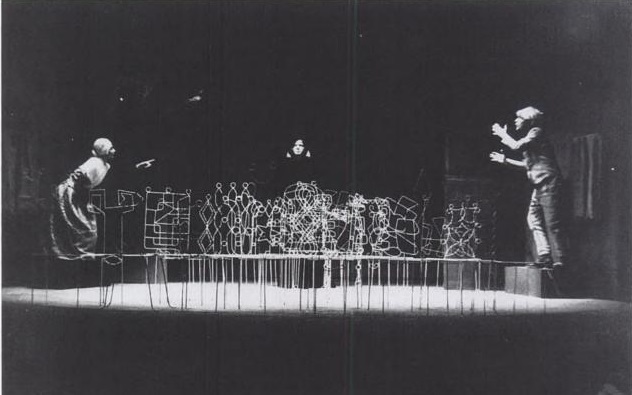
The Chairs (French: Les Chaises) is a one-act play by Eugène Ionesco, described as an absurdist "tragic farce". It was first performed in Paris in 1952.
A high tower surrounded by water.
An old married couple are alone waiting for guests to arrive. The Old Man tells a favourite story from their past, and the Old Woman, who seems to be both wife and mother, says he could have been much more in life than a caretaker. He says he has a great message for mankind, and has engaged an orator to deliver it to their guests. When the guests arrive, they are invisible to the audience, yet the couple bring chairs and engage them in conversation. They include the Old Man's former lover and a photographer with whom the Old Woman flirts. The old couple tell them contradictory stories about their past lives. They frantically arrange chairs for more and more invisible guests. The room appears to be packed and the couple act as ushers. They are very excited when the Emperor arrives, also invisible. The Old Man talks with increasing grandiosity about his life and the message that he hopes will save mankind. When the Orator arrives (a real person), the old couple leap from separate windows to their deaths. The Orator tries to speak but only makes the guttural sound of a deaf-mute. He writes a few jumbled words on a blackboard, and then exits leaving only the chairs and sounds of an invisible audience.
Ionesco described the play as a "tragic farce".
Like Ionesco's earlier play The Bald Soprano (1950), The Chairs belongs to the Theatre of the Absurd, presenting a view of the world as meaningless or without purpose.
Ionesco rejected "realistic" theatre as a trick upon the audience, and instead aimed to make the spectator "participate in an act of imagination which his reason told him was 'absurd'", but which contained all the "nightmarish and contradictory absurdity" of reality.
The play addresses the philosophical idea of "the Absurd", referring to the conflict between the human tendency to seek meaning in life and the inability to find it. Ionesco suggests that "life is essentially meaningless, progress an illusion and the totality of our experience nothing but a piece of incomprehensible gobbledegook.".
The one fundamental proposition held in common by Sartre on the one hand, and by Beckett, Genet, Arrabal and Ionesco on the other, is that, at the root of consciousness, and indeed of all Being, there is a Void – un Néant – and that this Void is the point of departure for all lucidity, all experience, all 'personality' and all truth.
Hub AI
The Chairs AI simulator
(@The Chairs_simulator)
The Chairs
The Chairs (French: Les Chaises) is a one-act play by Eugène Ionesco, described as an absurdist "tragic farce". It was first performed in Paris in 1952.
A high tower surrounded by water.
An old married couple are alone waiting for guests to arrive. The Old Man tells a favourite story from their past, and the Old Woman, who seems to be both wife and mother, says he could have been much more in life than a caretaker. He says he has a great message for mankind, and has engaged an orator to deliver it to their guests. When the guests arrive, they are invisible to the audience, yet the couple bring chairs and engage them in conversation. They include the Old Man's former lover and a photographer with whom the Old Woman flirts. The old couple tell them contradictory stories about their past lives. They frantically arrange chairs for more and more invisible guests. The room appears to be packed and the couple act as ushers. They are very excited when the Emperor arrives, also invisible. The Old Man talks with increasing grandiosity about his life and the message that he hopes will save mankind. When the Orator arrives (a real person), the old couple leap from separate windows to their deaths. The Orator tries to speak but only makes the guttural sound of a deaf-mute. He writes a few jumbled words on a blackboard, and then exits leaving only the chairs and sounds of an invisible audience.
Ionesco described the play as a "tragic farce".
Like Ionesco's earlier play The Bald Soprano (1950), The Chairs belongs to the Theatre of the Absurd, presenting a view of the world as meaningless or without purpose.
Ionesco rejected "realistic" theatre as a trick upon the audience, and instead aimed to make the spectator "participate in an act of imagination which his reason told him was 'absurd'", but which contained all the "nightmarish and contradictory absurdity" of reality.
The play addresses the philosophical idea of "the Absurd", referring to the conflict between the human tendency to seek meaning in life and the inability to find it. Ionesco suggests that "life is essentially meaningless, progress an illusion and the totality of our experience nothing but a piece of incomprehensible gobbledegook.".
The one fundamental proposition held in common by Sartre on the one hand, and by Beckett, Genet, Arrabal and Ionesco on the other, is that, at the root of consciousness, and indeed of all Being, there is a Void – un Néant – and that this Void is the point of departure for all lucidity, all experience, all 'personality' and all truth.
Recent media