


Community hub
Recent from talks
Contribute something
Nothing was collected or created yet.
Cleaner
View on Wikipedia
.jpg)
A cleaner, cleanser or cleaning operative is a type of industrial or domestic worker who is tasked with cleaning a space. A janitor (Scotland, United States and Canada), also known as a custodian, Facility Operator, porter or caretaker, is a person who cleans and might also carry out maintenance and security duties. A similar position, but usually with more managerial duties and not including cleaning, is occupied by building superintendents in the United States and Canada and by site managers in schools in the United Kingdom.
According to the Cambridge English dictionary a "cleaner" is "a person whose job is to clean houses, offices, public places, etc.:";[1] the Collins dictionary states that: "A cleaner is someone who is employed to clean the rooms and furniture inside a building."[2] However, a cleaner does not always have to be employed and perform work for pay, such as in the case of volunteer work or community service. "Cleaner" may also refer to cleaning agents e.g. oven cleaner, or devices used for cleaning, e.g. vacuum cleaner.[2][3]

Cleaning operatives may specialize in cleaning particular things or places, such as window cleaners, housekeepers, janitors, crime scene cleaners and so on.[4] Cleaning operatives often work when the people who otherwise occupy the space are not around. They may clean offices at night or houses during the workday.
Etymology
[edit]The word janitor derives from the Latin "ianitor",[5] meaning doorkeeper or porter, itself from "ianua", meaning door, entrance or gate.[6]
Its first recorded use meaning "caretaker of a building, man employed to see that rooms are kept clean" was in 1708.[6]
Demography
[edit]Between 17% and 23% of the total illegal immigrant population living in the United States work in the cleaning industry[7] (and growing at a rate of 1/2% to 1/3% per year). In addition to this population offering an abundant source of inexpensive labor,[8] janitorial work is mostly undertaken at night, making it an appealing option for janitorial companies to employ illegal workers[9][10] seeking clandestine employment.
In the Netherlands, the number of cleaning companies grew from 5,000 in 2003 to 8,000 in 2008.[11]
Pay scale
[edit]According to the U.S. Bureau of Labor Statistics, in 2023 the median pay of a janitor working in the US was $16.84 per hour.[12]
Outsourcing
[edit]Cleaning is one of the most commonly outsourced services.[13] Some of the reasons for this include:
- Basic cleaning tasks are standardised, with little variation among different enterprises.
- The nature of the job and required standard of performance can be clearly defined and specified in a contract, unlike more technical or professional jobs for which such specification is harder to develop.
- Some organizations prefer to outsource work unrelated to their core business in order to save additional salaries and benefits required to manage the work.
- Some organizations may feel uncomfortable dealing with labour relations related to low wage employees; by outsourcing, these labor relations issues are transferred to a contractor whose staff are comfortable and experienced in dealing with these issues, and their approach can benefit from economies of scale.
- If a janitor is unavailable due to sickness or leave, a contractor which employs many janitors can easily assign a substitute. A small organisation which employs one or a few janitors directly will have much more trouble with this.
Occupation classification: types of cleaning operatives
[edit]
The cleaning industry is quite big as different types of cleaning are required for different objects and different properties. For example, cleaning an office space requires the services of a commercial cleaner, whereas cleaning a house requires a residential cleaner or residential cleaning service. Depending on the task, even these categories can be subdivided even further. For example, end-of-lease cleaning, carpet cleaning, upholstery cleaning, window cleaning, car cleaning services, etc. Cleaners often specialize in a specific cleaning sector or even a specific task in a cleaning sector, and one cannot expect a window cleaner to be able or willing to clean a carpet.
For example, according to International Standard Classification of Occupations and European Skills, Competences, Qualifications and Occupations, the profession of a cleaner can be divided into:[14]
- 9112.6 - train cleaner: "Train cleaners keep the interiors of trains tidy and clean. They clean out the bins in the different compartments, and perform other cleaning activities such as hoovering, mopping and deep cleaning."[14]
- 9123.1 - window cleaner: "Window cleaners use cleaning tools such as sponges and detergents to clean windows, mirrors and other glass surfaces of buildings, both on the interior and exterior. They use specific ladders to clean taller buildings, using safety belts for support."[14]
- 9122.1 - vehicle cleaner: "Vehicle cleaners clean and polish surfaces of external parts and interiors of vehicles."[14]
- 9111.1 - domestic cleaner: "Domestic cleaners perform all necessary cleaning activities in order to clean their clients' houses. They vacuum and sweep floors, wash dishes, launder clothes, dust, scrub and polish surfaces and disinfect equipment and materials."[14]
- 9129.2 - sewerage cleaner: "Sewerage cleaners maintain and clean sewerage systems and their pipes within communities. They remove blockages that stop the sewerage flow to ensure the smooth running of the systems."[14]
- 9112.2 - building cleaner: "Building cleaners maintain the cleanliness and overall functionality of various types of buildings such as offices, hospitals and public institutions. They perform cleaning duties like sweeping, vacuuming and mopping floors, empty trash and check security systems, locks and windows. Building cleaners check air conditioning systems and notify the appropriate persons in case of malfunctions or problems."[14]
- 9112.3 - furniture cleaner: "Furniture cleaners maintain furniture items by removing dust, applying furniture polish, cleaning stains and maintaining colouring."[14]
- 5153.1.1 - amusement park cleaner: "Amusement park cleaners work to keep the amusement park clean and take on small repairs. Amusement park cleaners usually work at night, when the park is closed, but urgent maintenance and cleaning is done during the day."[14]
- 8160.10 - cacao beans cleaner: "Cacao beans cleaners operate machines for the removal of foreign materials such as stones, string and dirt from cacao beans. They operate silos as to move beans from there to hoppers. They direct the cleaned beans to specified silos. They operate air-cleaning system in order to remove further foreign materials."[14]
- 7133.2 - building exterior cleaner: "Building exterior cleaners remove dirt and litter from a building's exterior, as well as perform restoration tasks. They ensure the cleaning methods are compliant with safety regulations, and monitor the exteriors to ensure they are in proper condition."[14]
- 9129.1 - drapery and carpet cleaner: "Drapery and carpet cleaners clean draperies and carpets for their clients by removing stains, dust or odors. They do this by applying chemical and repellent solutions and with the use of brushes or mechanical equipment."[14]
- 9112.5 - toilet attendant: "Toilet attendants clean and maintain toilet facilities in accordance with company standards and policies. They use cleaning equipment to clean mirrors, floors, toilets and sinks. They perform the cleaning activities before, during and after operational service hours. Toilet attendants refill the facility with supplies as needed and maintain records of their daily operations."[14]
- 9129 - Other cleaning workers: cleaning workers not classified[14]
In addition:
- 9112.1 - Aircraft Groomer can clean in airplanes: "Aircraft groomers clean aircraft cabins and airplanes after usage. They vacuum or sweep the interior of cabin, brush debris from seats, and arrange seat belts. They clean trash and debris from seat pockets and arranged in-flight magazines, safety cards, and sickness bags. They also clean galleys and lavatories."[14]
- 8157.1.1 - Laundry ironer: "Laundry ironers re-shape clothing items and linen and remove creases from them by using irons, presses and steamers. They clean and maintain the ironing and drying area and organise the items accordingly."[14]
- 9129.3 - Swimming Facility Attendant: "Swimming facility attendants handle the daily activities of a swimming facility such as a swimming pool, beach and lake. They clean the facility, maintain a good attitude towards the clients and ensure the overall safety within the facility."[15]
- 9129.2 Sewerage Cleaner: "Sewerage cleaners maintain and clean sewerage systems and their pipes within communities. They remove blockages that stop the sewerage flow to ensure the smooth running of the systems."[16]
- Charity / free social cleaning: Cleaning can be done freely, free of charge and without employment e.g. social cleaning of the forest from garbage.
- Cleaning by convicts: Cleaning is sometimes done by convicts for rehabilitation or leniency purposes; cleaning as a substitute punishment. However, on the other hand in some cases, cleaners are checked against criminal records.[17]
-
 A cleaner using a mechanical sweeper to clean the street
 -
 A cleaner shoveling snow off from the sidewalks.
 -
 A Worker is cleaning pool at Kowloon Park
 -
 Cleaner cleaning the floor in the bathroom.
 -
 Cleaning the sidewalk from fallen leaves.
 -
 Train window cleaning.


_9.8.2009.JPG)
Office cleaning
[edit]Office cleaning staff perform many of the same duties as janitors. However the tasks are divided among different members. Additional tasks can include:
- watering plants (pruning as well)
- cleaning sinks, refrigerators, microwave ovens, toasters in office kitchens, and clearing recycling / garbage bins
- dusting furniture, computer equipment (monitors and desk area, but excluding keyboards), and tables
Occupational tasks
[edit]Most of the work performed by janitors and building cleaners is indoors. Office and school buildings are usually cleaned when they are vacant, so most of the office janitorial staff work during the evening. The work can be physically taxing and sometimes dirty and unpleasant.[18] General janitor duties often include the following tasks:
- Cleaning and restocking bathrooms
- Cleaning floors (mopping, sweeping, polishing)
- Stripping and waxing floors using a floor buffer or Swing Machine
- Cleaning carpeting (vacuuming and/or extraction)
- Cleaning stainless steel and other special surfaces
- Clearing the lunch room/kitchen
- Cleaning tables in cubicles, meeting rooms, etc.
- Window washing
- Scrubbing concrete
- Emptying trash and recycling bins
- Unlocking and locking buildings at the beginning and end of the day
- Operation of building systems (turning on and off lights, setting thermostats, etc.) In some places, this may include testing/maintaining/setting building safety/security systems (fire alarms, burglar alarms, surveillance cameras, etc.)
- If the building is fitted with a Boiler system, then they may have to perform regular maintenance such as adding water softener salt, filling the feed tank, or ensuring the pressure is within regulation
- Cleaning air-conditioner vents
- Crime scene cleaning (requires being fully certified and pay scale starts from $300.00 to $700.00+ an hour[19][20])
- Room and event setups (tables and chairs, audio video equipment, etc.) (college/schools, etc.)
- Raising and lowering flags (schools)
- Removing graffiti or other forms of vandalism
- Minor maintenance work, such as: changing light bulbs and filters, replacing ceiling tiles, doing small repairs, fixing small leaks, performing testing and monitoring of building equipment, etc. In some places, other people may do these maintenance tasks.
- Outdoor work, such as: cleaning walkways, litter pickup, mowing lawns, tending to landscape plantings, leaf cleanup, snow removal, etc. In some places, groundskeepers or a separate company may do outdoor work.
- Porterage (internal deliveries; movement of equipment or people in hospitals, colleges, etc.)
Typical cleaning equipment
[edit]The following are some items used by cleaning staff: However, the equipment depends on the situation and the type of cleaning.
- Broom/dustpan
- Bucket
- Cleaning agents
- Swing Machine/Burnisher
- Garbage bag
- Hand feather duster and/or microfiber floor duster
- Mop and mop bucket cart
- Towels
- Vacuum cleaner
- Wet floor sign
in addition: ladder, rake, bags for leaves.
Not always, but depending on the situation, (for example during cleaning dusty or dangerous substances or places, window cleaning at high heights, being on a busy street or in factories) items used by cleaning staff can include safety equipment such as:
-
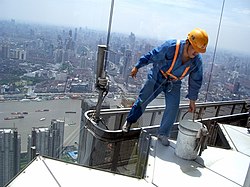 Window cleaner climbing out of a scaffold equipped with height harness and a fitted hardhat.
 -
 Cleaning a building in mask, overalls and gloves to prevent exposure to dust.
 -
 Washing and disinfection of the street during the COVID-19 pandemic with overalls, gloves, mask, and protective boots as protection against biohazards.


_Higieniza%C3%A7%C3%A3o_entrada_esta%C3%A7%C3%A3o_da_CPTM_(49784811813).jpg)
Hazards
[edit]The exposure of a cleaner to hazards depends on the activity performed and the situation for example: allergens, dust, biohazards, fall, possibility of contact with electric shock, slipping on a slippery surface, so safety equipment should be adapted to the situation.
In addition: On the whole it is not recommended to perform this work for a person with severe allergies.
Working conditions
[edit] |
The 2000 film Bread and Roses by British director Ken Loach depicted the struggle of cleaners in Los Angeles, California, for better pay and working conditions and for the right to join a union. In an interview with the BBC in 2001, Loach stated that thousands of cleaners from around 30 countries have since contacted him with tales similar to the one told in the film.
See also
[edit]- Building superintendent
- Charwoman
- Cleaning company
- Concierge
- Housekeeping
- Maid — In American English, the term "maid" is often used for any woman who cleans a home or hotel[21]
- Property caretaker
- Sexton (office)
References
[edit]
- ^ "Cambridge Dictionary - Cleaner". www.dictionary.cambridge.org. Retrieved 2023-04-14.
- ^ a b "Collinsdictionary - cleaner". www.collinsdictionary.com/. Retrieved 2023-04-14.
- ^ "Definition of cleaner | Dictionary.com". www.dictionary.com. Retrieved 2023-04-14.
- ^ "Working at height whilst window cleaning". Health and Safety Executive. 9 May 2022.
- ^ janitor, Wiktionary, 2021-08-31, retrieved 2022-01-02
- ^ a b "janitor". Online Etymology Dictionary. Retrieved 2022-01-02.
- ^ Weltin, Dan (2010-05-21). "Immigration Reform: There's Always An Excuse". Cleanlink.com. Retrieved 2011-11-13.
- ^ Mollenkamp, Becky (2011-04-11). "Illegal Subcontracting Bad Apples: Illegal subcontracting's continuing impact on the BSC industry". Cleanlink.com. Retrieved 2011-04-11.
- ^ Ridgely, Lisa (2010-03-01). "Overdue Diligence: How BSCs can avoid hiring legal workers". Cleanlink.com. Retrieved 2010-04-01.
- ^ Miriam, Jordan (2011-08-15). "Immigration Audits Drive Illegal Workers Underground: ABM Caught for Employing illegal immigrants". online.wsj.com. Retrieved 2011-08-15.
- ^ Data from the employers' organisation in The Netherlands provided by EU-OSHA's Focal Point Literature review - The occupational safety and health of cleaning workers EU-OSHA - European Agency for Safety and Health at Work
- ^ "Janitors and Building Cleaners". Bureau of Labor Statistics. Retrieved 2024-07-22.
- ^ Torrington, Derek; Hall, Laura; Taylor, Stephen (2008). Contracts, Contractors and Consultants. Financial Times Prentice Hall. ISBN 9780273710752.
- ^ a b c d e f g h i j k l m n o p "European Skills, Competences, Qualifications and Occupations". European Union. Retrieved 2023-04-14.
- ^ "swimming facility attendant". esco.ec.europa.eu. Retrieved 2025-03-27.
- ^ "sewerage cleaner". esco.ec.europa.eu. Retrieved 2025-03-27.
- ^ "Government of the United Kingdom" (PDF). Government of the United Kingdom. Retrieved 2023-04-14.
- ^ "Janitors and Building Cleaners : Occupational Outlook Handbook: : U.S. Bureau of Labor Statistics".
- ^ Morreale, Don (July 6, 2012). "Crime Scene Cleaners mops up after mayhem". The Denver Post. Archived from the original on April 8, 2013.
- ^ Facts about Crime Scene Cleaners! by Documents & Resources for Small Business Professionals DOCSTOC News Source, Fed 12, 2013
- ^ "Definition of maid | Dictionary.com". www.dictionary.com. Retrieved 2023-04-14.
Further reading
[edit]- Wedgwood, Hensleigh (1855). "On False Etymologies". Transactions of the Philological Society (6).
Cleaner
View on GrokipediaDefinition and Scope
Role in Society and Economy
Cleaners maintain essential hygiene standards in residential, commercial, and public environments, thereby mitigating health risks associated with pathogens, allergens, and contaminants. This function supports public health by reducing infection transmission rates, as evidenced by heightened demand for disinfection services during outbreaks like COVID-19, where professional cleaning helped curb community spread.[10] In urban settings, street and sidewalk cleaning prevents hazards such as slips from debris or ice, enhancing pedestrian safety and enabling economic activity in public spaces.[11] Economically, the cleaning services sector forms a significant industry, with the global market valued at USD 415.93 billion in 2024 and projected to expand to USD 616.98 billion by 2030 at a compound annual growth rate of 6.9%.[10] This growth reflects rising urbanization, stricter hygiene regulations, and outsourcing trends, contributing to GDP through service provision and related supply chains. In the United States, the sector employed approximately 2.4 million janitors and building cleaners in 2022, accounting for roles in education, healthcare, and services to buildings, where it represented the largest occupational group in some sub-industries.[12] [13] Employment in this field offers accessible entry for low-skilled workers, including immigrants, with median hourly wages of USD 16.84 in 2023, though projected job growth remains modest at 2% through 2034 due to automation and efficiency gains.[2] [1] The occupation's undervaluation in societal terms has been highlighted by analyses like a 2009 New Economics Foundation report, which estimated that hospital cleaners generate £10 in societal value per £1 paid by preventing costly infections, contrasting with sectors like banking that may extract value without equivalent health contributions.[14] However, such valuations rely on subjective metrics of "well-being" rather than direct market outputs, underscoring cleaners' foundational role in enabling higher-productivity activities across economies.[15] In developing regions, informal cleaning labor further bolsters local economies by sustaining habitable conditions amid rapid infrastructure strain.[16]Distinction from Related Occupations
The occupation of cleaner, encompassing roles focused on removing dirt, debris, and contaminants from buildings, vehicles, or public spaces, differs from maids and housekeeping cleaners in the intensity and nature of tasks. Maids and housekeeping cleaners, classified separately under SOC 37-2012 by the U.S. Bureau of Labor Statistics, primarily service guest accommodations in hotels, motels, and similar establishments through lighter duties like bed-making, linen changes, and surface dusting to prepare rooms for occupants. In contrast, building cleaners under SOC 37-2011 execute heavier cleaning operations, such as shampooing carpets, washing walls, stripping floors, and handling industrial waste removal, often in non-residential or institutional settings without direct guest interaction.[2] Cleaners are also set apart from janitors and custodians by the degree of ancillary maintenance responsibilities. While terms like janitor and custodian are frequently used interchangeably with building cleaner—particularly in the BLS classification that groups them for keeping structures orderly through sweeping, mopping, and rubbish disposal—custodians in educational or healthcare facilities often incorporate routine upkeep like boiler tending, minor repairs, or snow removal, extending beyond pure sanitation to ensure operational continuity.[2] [17] Janitors, by comparison, emphasize facility-wide cleaning protocols, including restroom disinfection and debris clearance, but may notify supervisors for repairs rather than performing them, distinguishing the role from more skilled maintenance trades.[18] In broader international contexts, as outlined in the International Labour Organization's ISCO-08, cleaners fall under elementary occupations like domestic, hotel, or office cleaners (group 911), who handle general cleaning in enclosed environments, versus specialized hand-cleaning workers (group 912) for vehicles, windows, or laundry, or refuse workers focused on waste collection and street sweeping. This separates cleaners from sanitation or refuse workers, whose duties center on public outdoor areas, hazardous waste handling, or municipal debris management, often requiring equipment operation like sweepers rather than manual interior scrubbing. Housekeeping services, meanwhile, prioritize aesthetic and hygiene standards in transient spaces, whereas cleaners address persistent grime accumulation in fixed, high-traffic zones, reflecting differences in environmental demands and skill specialization.[19]Historical Development
Pre-Industrial and Domestic Origins
In ancient civilizations, cleaning practices originated as essential domestic activities performed by family members or enslaved individuals to maintain habitable living spaces. Archaeological evidence reveals that prehistoric humans swept dirt and debris from dwellings using basic tools like sticks and animal bones, a method persisting into early agrarian societies.[20] The Babylonians advanced these efforts around 2800 BC with the creation of a soap-like substance from fats boiled with ashes, as documented in excavated clay tablets, enabling more effective removal of oils and grime from bodies and surfaces.[21] In classical antiquity, households in Egypt, Greece, and Rome delegated cleaning to slaves or lower-status servants, who handled tasks such as scrubbing floors with water and abrasives, dusting furnishings, and disposing of waste in urban latrines or cesspits. These roles, while not exclusively dedicated to cleaning, formed the basis of labor specialization within domestic settings, where hygiene directly influenced health amid dense populations and rudimentary sanitation.[22] Affluent estates featured dedicated spaces like Roman domus atriums, cleaned daily to prevent accumulation of dust from open designs and foot traffic.[23] Medieval European households continued this domestic paradigm, with peasant women primarily responsible for sweeping packed-earth or stone floors, laundering linens in streams, and managing hearth ash using brooms of bundled twigs—tasks exacerbated by the absence of piped water or chemical agents.[24] In feudal manors, servants performed analogous duties on a larger scale, including scouring wooden tables with sand or urine-based solutions and emptying chamber pots, often under hierarchical structures where cleaning ranked among the most menial labors.[25] Public cleaning remained negligible, limited to occasional communal efforts or penalties imposed on vagrants in towns, underscoring the occupation's roots in private, unpaid or indentured domestic service rather than formalized trades.[24] By the early modern period, such as in England between 1660 and 1750, domestic service expanded as a structured occupation for unmarried women from rural backgrounds, who comprised a significant portion of the female workforce and executed comprehensive cleaning regimens in urban and gentry homes. These included blacking grates, polishing metals with vinegar, and beating carpets to combat soot from coal fires, reflecting causal links between rising urban density and the demand for dedicated hygiene maintenance.[26] Such roles prefigured professional cleaners by institutionalizing cleaning as a distinct, low-status vocation tied to household economies, distinct from artisanal crafts.[25]Industrialization and Professionalization
The Industrial Revolution, from the late 18th to the 19th century, transformed cleaning from a domestic chore performed by household servants into a specialized occupation driven by urbanization and factory expansion. Rapid migration to cities created overcrowded living conditions and industrial sites laden with machinery-generated filth, necessitating dedicated cleaning crews to maintain operational hygiene and prevent health hazards like disease outbreaks from poor sanitation. In Britain and later in the United States, this shift marked the beginnings of professional cleaning services, as businesses outsourced sanitation to wage workers rather than relying on informal labor, laying the groundwork for commercial cleaning firms.[27][28] Technological innovations accelerated industrialization by mechanizing cleaning processes and standardizing practices. The 19th-century industrialization of soap production provided scalable, effective cleaning agents, replacing rudimentary methods with chemical-based solutions suited for large-scale grime removal in factories and urban infrastructure. By the early 1900s, the introduction of powered vacuums—such as Hubert Cecil Booth's 1901 patented suction device in Britain—enabled efficient dust extraction, reducing reliance on manual sweeping and brooms while increasing productivity for cleaners handling vast commercial spaces. These tools facilitated the growth of specialized cleaning roles, distinguishing janitors and scrubbers in industrial settings from general domestics.[20][29] Professionalization emerged through formalized training, equipment standardization, and early trade organizations, elevating the occupation's status amid expanding demand from offices and public buildings. Commercial cleaning companies proliferated in Britain as the origin point for such services, evolving from ad-hoc hires to structured enterprises by the mid-20th century, though roots trace to 19th-century industrial needs. In the U.S., the profession gained structure with associations promoting safety protocols and efficiency, reflecting causal links between economic growth, hygiene regulations, and workforce specialization that persist in modern cleaning operations.[29][30]Post-War Expansion and Technological Shifts
Following World War II, the cleaning profession expanded rapidly due to economic prosperity and increased urbanization in Western countries. The post-war construction boom resulted in a proliferation of office buildings, schools, hospitals, and suburban homes, generating sustained demand for professional janitorial and maintenance services.[31][28] Military service during the war had accustomed many individuals to elevated hygiene standards, fostering expectations for cleaner public and commercial spaces upon demobilization.[32] In the 1950s, the janitorial supply sector grew substantially, supported by institutional budgets allocated for enhanced cleaning operations, including the procurement of mechanized tools that improved efficiency over manual methods.[33] This period marked the transition from in-house, ad-hoc cleaning to formalized services, as businesses and institutions outsourced tasks to specialized firms amid labor shortages from women entering the formal workforce and the decline of traditional domestic servants.[34] By the 1960s, contract cleaning emerged as a mature industry segment, with companies offering standardized services to commercial clients, reflecting broader professionalization and scalability in response to expanding urban infrastructure.[35] Technological advancements further transformed the profession, shifting it toward mechanization and chemical reliance. Electric-powered vacuums and floor polishers became widespread in the 1950s, enabling cleaners to cover larger areas with less physical exertion compared to broom-and-mop techniques predominant before the war.[36] The introduction of synthetic detergents and specialized chemical agents post-1945 enhanced cleaning efficacy on diverse surfaces, reducing time and labor while addressing the hygiene needs of modern facilities.[37][38] These innovations, coupled with early automated equipment like powered sweepers, allowed cleaners to handle increased workloads from post-war building growth, though they also introduced requirements for training in safe chemical handling and equipment operation.[33]Demographics and Workforce Characteristics
Global and Regional Composition
The global cleaning workforce is characterized by a high proportion of women, with surveys of over 2,500 workers across 32 countries indicating nearly 70% female representation, reflecting the occupation's alignment with caregiving and service roles often filled by women due to economic necessities and limited alternatives in labor markets.[39] Immigrants constitute about 25% of the surveyed global sample, while people of color account for 20%, underscoring the sector's role as an entry point for migrants and ethnic minorities facing barriers in higher-skilled jobs.[39] These demographics arise from causal factors such as low entry barriers, flexible hours suiting family responsibilities, and wage suppression in outsourced services, though union-affiliated surveys like those from UNI Global Union may emphasize vulnerabilities to advocate for labor reforms.[39] Regionally, composition varies by economic development and cultural norms. In Europe, the workforce features a high ratio of women, part-time workers, and diverse ethnic backgrounds, with the United Kingdom alone employing around 500,000 cleaners, disproportionately female, ethnic minorities, and migrants due to reliance on agency outsourcing and immigration for low-wage labor.[40] [41] The European Facilities Companies Institute notes this diversity stems from sector expansion post-industrialization, filling gaps in native labor participation amid aging populations and stringent regulations.[41] In North America, gender segregation is pronounced: janitors and building cleaners are majority male (over 70% in the U.S.), often involving physical tasks like maintenance, while maids and housekeeping cleaners are 85% female, concentrated in hospitality and residential settings.[42] [43] U.S. data from the Bureau of Labor Statistics shows ethnic minorities, particularly Hispanics (over 60% in house cleaning), overrepresented due to immigration patterns and educational mismatches.[44] In Asia and Africa, the workforce is larger but largely informal, with women dominating domestic cleaning (around 80% globally per ILO estimates for domestic roles including cleaners), exacerbated by poverty-driven migration from rural areas and limited formal protections. Sanitation and street cleaning in these regions skew male, involving hazardous manual labor, as evidenced by ILO reports on developing world conditions where informality hides scale but reveals dignity deficits from caste or economic exclusion.[45] Regional data gaps persist, as informal employment evades official tallies, biasing formal statistics toward urban, regulated segments.[46]Employment Statistics and Trends
In 2023, the United States employed approximately 2,172,500 janitors and cleaners, excluding maids and housekeeping cleaners, according to Bureau of Labor Statistics data from May of that year.[47] Adding maids and housekeeping cleaners, whose full-time employment numbered around 834,000, brings the total for core cleaning occupations to over 3 million workers.[48] Globally, precise figures for all cleaners are elusive due to inconsistent occupational classifications across countries, but the International Labour Organization estimates 75.6 million domestic workers aged 15 and older as of 2021, with cleaning comprising a primary task for many, particularly the 81% in informal employment.[49] Commercial and industrial cleaning bolsters these numbers, supported by a global services market valued at USD 415.93 billion in 2024 and projected to expand at a 6.9% compound annual growth rate through 2030.[10] Employment trends indicate modest growth tempered by technological and structural shifts. In the U.S., janitors and building cleaners face a projected 3% increase in employment from 2023 to 2033, below the average for all occupations, yet generating about 351,300 annual openings primarily from high turnover rather than net expansion.[50] Automation, including robotic sweepers and AI-optimized scheduling, is curbing labor demands for repetitive tasks like floor scrubbing and dust collection, allowing workers to shift toward supervisory or specialized roles while potentially displacing low-skill positions.[51] [52] Outsourcing to specialized firms continues to rise, with the outsourced cleaning services market expected to grow from USD 60.3 billion in 2024 to USD 100.2 billion by 2033, driven by efficiency gains and businesses' preference for scalable professional operations over in-house staff.[53] Persistent challenges include labor shortages exacerbated by low wages and demanding conditions, prompting adoption of automation to fill gaps without proportional hiring increases. Post-2020 hygiene protocols from the COVID-19 pandemic temporarily boosted demand, but long-term trajectories favor productivity enhancements over headcount growth, with indirect job creation in tech maintenance offsetting some automation losses.[54] High informal and migrant participation sustains supply in domestic segments, though formal commercial roles show greater stability amid regulatory scrutiny.[55]Immigration and Skill Levels
In developed countries, the cleaning occupation is characterized by low skill requirements, typically necessitating no formal education or advanced training for entry-level roles. According to U.S. Bureau of Labor Statistics (BLS) data, no minimum education was required for 65.2 percent of building and grounds cleaning and maintenance workers, with a high school diploma sufficient for the remaining 34.1 percent as of recent occupational surveys.[56] Globally, most cleaning positions demand only basic physical fitness, attention to detail, and rudimentary knowledge of cleaning techniques, often acquired through on-the-job experience rather than certifications.[57] This low barrier to entry aligns with classifications such as ANZSCO skill level 5 in systems like New Zealand's, where tasks involve straightforward, routine duties without complex problem-solving.[58] The minimal skill demands make cleaning an attractive sector for low-skilled immigrants, who fill labor gaps in physically intensive, low-wage jobs shunned by native workers. In the United States, foreign-born and Hispanic workers predominate; BLS estimates from 2017 indicate 31.7 percent of custodians and building cleaners and 49.4 percent of maids and housekeepers were Latino, many of whom are immigrants or first-generation.[59] Unauthorized immigrants comprise about 24 percent of maids and housekeeping cleaners, contributing to high-growth occupations amid overall foreign-born labor force participation at 19.2 percent in 2024.[60][61] In specific regions like New York State, immigrants account for 83 percent of house cleaners, reflecting concentration in domestic services where U.S.-born workers are underrepresented relative to other sectors.[62] European cleaning workforces similarly rely heavily on non-native labor, driven by shortages and the sector's undesirable conditions. Eurostat data show around 3.5 million documented cleaners across the EU, but undocumented migrants—often from Eastern Europe, Africa, or Asia—supplement this, particularly in domestic roles where over 8 million workers are employed, 91 percent women and many migrants.[63][64] In the UK, immigrants dominate the cleaning sector, facing low wages and high turnover, while in Sweden and Finland, post-2004 EU expansion brought East European migrants into industrial cleaning.[65][66] Non-EU immigrants filled over 50 percent of new jobs created in Europe from 2019 to 2024, including service roles like cleaning, underscoring immigration's role in addressing demographic and preference-based labor imbalances.[67]Economic Aspects
Compensation and Pay Scales
In the United States, the median annual wage for building and grounds cleaning and maintenance occupations, which includes janitors and cleaners, stood at $36,790 in May 2024, below the national median of $49,500 across all occupations. [68] For janitors and cleaners excluding maids and housekeeping, the median hourly wage was $17.27, equating to $35,930 annually, with the lowest 10% earning less than $27,570 and the highest 10% over $49,040. [69] Wages vary by sector, with industrial cleaning averaging $15.58 per hour and commercial services often starting at $10-12 per hour for entry-level roles. [70] [71] In Europe, pay scales reflect national economic differences and regulations. In Germany, the average gross annual salary for janitors is €33,432 (approximately $36,000 USD), or €16 per hour, with bonuses averaging €381. [72] The United Kingdom reports an average of £28,315 annually (about $36,000 USD) for janitors. [73] In Sweden, monthly earnings average SEK 24,500 (roughly SEK 294,000 yearly, or $28,000 USD), while in Spain's Madrid region, it is €21,000 annually. [74] [75] Globally, cleaner wages are typically low, often near or below national averages, particularly for domestic and informal workers who earn less than half the typical wage in many countries. [76] In developing economies, monthly pay can range from $100-300, influenced by local minimums and outsourcing, while specialized roles like industrial or high-rise cleaning command premiums up to 20-30% higher due to hazard exposure. [77] Trends show modest increases tied to inflation and labor shortages, with U.S. janitorial wages rising 4.2% in the past year, though real gains lag productivity in low-skill sectors. [78]Outsourcing Dynamics and Efficiency Gains
Outsourcing in the cleaning industry involves organizations contracting specialized firms to handle janitorial and maintenance tasks, shifting from in-house operations to third-party providers for greater operational agility. This model gained momentum post-2020 amid elevated sanitation demands, with the contract cleaning services sector expanding from $251.3 billion in 2020 to a projected $329.4 billion by 2026, achieving a compound annual growth rate of 4.8%.[79] Businesses adopt outsourcing to circumvent internal hiring challenges, including high turnover rates in low-wage cleaning roles and fluctuating demand tied to occupancy levels, enabling scalable service levels without permanent staff overheads.[80] Core dynamics center on performance-based contracts that specify metrics like square footage cleaned per hour or compliance with hygiene standards, often incorporating penalties for substandard work to align incentives. In the U.S., facility managers increasingly report outsourcing cleaning to access expertise in regulatory adherence, such as OSHA guidelines on hazardous materials, while transferring risks like worker injuries to insurers of the service provider.[81] The outsourced cleaning services market, valued at $60.3 billion in 2024, is forecasted to reach $100.2 billion by 2033, propelled by corporate emphasis on core competencies over ancillary functions.[82] Efficiency gains primarily arise from cost containment, as outsourcing averts expenses on recruitment, training, equipment depreciation, and employee benefits, which can constitute 20-40% of in-house budgets according to facility management analyses.[83] A 2015 cost-benefit study at Mahalapye hospital in Botswana calculated a benefit-cost ratio of 1.06 for outsourcing cleaning, yielding net savings of six cents per dollar invested through reduced direct labor and supply costs.[84] Similarly, U.S. janitorial outsourcing lowers fixed overheads, allowing predictable budgeting via fixed-fee structures and freeing internal resources for revenue-generating activities.[85] Beyond financial metrics, outsourcing enhances operational efficiency via specialized protocols and technology adoption, such as automated floor scrubbers, which in-house teams may underutilize due to skill gaps.[86] However, quality outcomes depend on vendor selection; a 2019 analysis of 130 English NHS trusts found contracting out cleaning achieved cost reductions but inconsistent improvements in hygiene effectiveness, underscoring the need for rigorous oversight.[87] Labor market effects include wage compression for outsourced workers, with empirical evidence from U.S. data indicating diminished rents particularly for higher-skilled janitors, reflecting competitive bidding pressures.[88] Collectively, these factors yield efficiency through specialization and risk distribution, though sustained gains require vigilant contract management to counter potential quality dilution from cost-focused providers.[89]Market Size and Growth Projections
The global cleaning services market was valued at approximately USD 424 billion in 2024.[16] Independent estimates place the figure slightly lower at USD 416 billion for the same year.[10] These valuations encompass residential, commercial, industrial, and specialized cleaning segments, with commercial services accounting for the largest share due to demand from offices, healthcare facilities, and hospitality sectors. Projections indicate steady expansion, driven by urbanization, heightened hygiene standards following the COVID-19 pandemic, and increased outsourcing by businesses seeking cost efficiencies. The market is forecasted to reach USD 452 billion in 2025 and grow to USD 734 billion by 2032, reflecting a compound annual growth rate (CAGR) of 7.2%.[16] Alternative forecasts project USD 617 billion by 2030 at a 6.9% CAGR from 2025 onward.[10] In the United States, the janitorial services subsector alone generated USD 108 billion in revenue in 2025, with overall industry growth supported by post-pandemic recovery in commercial spaces.[90] Regional dynamics contribute to these trends: North America and Europe dominate due to established infrastructure and regulatory emphasis on cleanliness, while Asia-Pacific exhibits the fastest growth from rapid industrialization and rising middle-class demand for residential services.[10] Challenges such as labor shortages and rising costs may temper projections, yet technological integrations like automated cleaning equipment are expected to sustain momentum.[71]Classification and Types
Domestic and Residential Cleaners
Domestic and residential cleaners perform housekeeping tasks in private households, focusing on maintaining cleanliness in living spaces such as kitchens, bathrooms, bedrooms, and common areas. Typical duties include dusting surfaces, vacuuming carpets, mopping hard floors, sanitizing fixtures, emptying trash, and occasionally handling laundry or organizing closets, tailored to the specific needs and schedules of homeowners. These workers often operate independently or via agencies, emphasizing adaptability to varied home layouts and personal preferences, which distinguishes their role from standardized commercial cleaning protocols.[91][44][92] Globally, domestic workers—including those specializing in residential cleaning—total approximately 75.6 million as of recent estimates, comprising 4.5% of the employed workforce, with over 76% being women and a significant portion migrants facing vulnerabilities like irregular hours and limited legal protections. In the United States, the broader category of maids and housekeeping cleaners, encompassing residential positions, employed about 990,000 individuals in 2023, with median annual wages around $28,600 reflecting the labor-intensive nature and entry-level requirements of the work. Employment in this sector correlates with rising demand from dual-income families, driving market growth at a projected 5.6% CAGR through 2030 in regions like the U.S., though many roles remain informal and underserved by formal labor standards.[55][46][43] Residential cleaning often involves solo or small-team operations in isolated settings, heightening risks of physical strain from repetitive motions and exposure to household chemicals, while economic pressures lead to high turnover and reliance on part-time or gig-based arrangements. Data indicate that a substantial share of these workers lack access to social security, with 90% globally unprotected in some analyses, underscoring systemic challenges in formalizing the sector despite its essential role in supporting household productivity.[93][94][10]Commercial and Institutional Cleaners
, elementary and secondary schools (315,720), and general medical and surgical hospitals (81,040). The commercial segment dominates the janitorial services market, comprising about 89.8% of revenue in 2024, driven by demand from businesses requiring consistent maintenance amid high foot traffic. Institutional cleaning often involves deeper interventions with stronger agents and compliance with regulatory codes, distinguishing it from basic commercial routines.[2] [98] [99]