
Recent from talks
The Elves and the Shoemaker
Knowledge base stats:
Talk channels stats:
Members stats:
The Elves and the Shoemaker
"The Elves and The Shoemaker" (German: Die Wichtelmänner) is a set of fairy tales collected by the Brothers Grimm (KHM 39) about a poor shoemaker who receives much-needed help from three young helpful elves.
The original story is the first of three fairy tales contained as entry 39 in the German Grimm's Fairy Tales under the common title "Die Wichtelmänner". In her translation of 1884 Margaret Hunt chose The Elves as title for these three stories.
The first tale is of Aarne-Thompson (AT) type 503* ('Helpful Elves'), also classified as a migratory legend (AT-7015). The second is of AT 476* type ('A Widwife [or Godmother] for the Elves'), also categorized as a migratory legend (AT 5070). The third tale is of AT 504 type ('The Changeling'), also categorized as a migratory legend (AT 5085).
The set of related tales was published by the Brothers Grimm in the first edition of Kinder- und Hausmärchen (1812), as tale no. 39. Their versions of the three stories are based upon the accounts of Gretchen Wild (1787–1819).
In the first edition, the three stories are subtitled "The Shoemaker for Whom They Did Work", "The Servant Girl Who Stood In as Godmother for Them", and "The Woman Whose Child They Exchanged", respectively, although the Grimms did not give titles to the individual tales in later editions.
A poor hardworking shoemaker had so little leather that he could only make a single pair of shoes. One evening, leaving the pair with the work unfinished, he went to bed and commended himself to God. After waking up the following day and saying his prayers, he found the shoes finished and perfectly well-made on his workbench. A customer soon entered the store and offered more than the usual price, for he was fond of the pair. The shoemaker uses the money to buy leather for more shoes which, after cutting, he also leaves overnight. Again the materials are made into beautiful shoes by morning. In this manner, his situation improves until he is comfortable again.
One evening, shortly before Christmas, the shoemaker said to his wife, "Why don't we stay up tonight and see who is giving us this helping hand," and his wife agreed. Hiding in the corner of the room, they saw two little men working quickly and nimbly on the shoes, then running away after their work was finished.
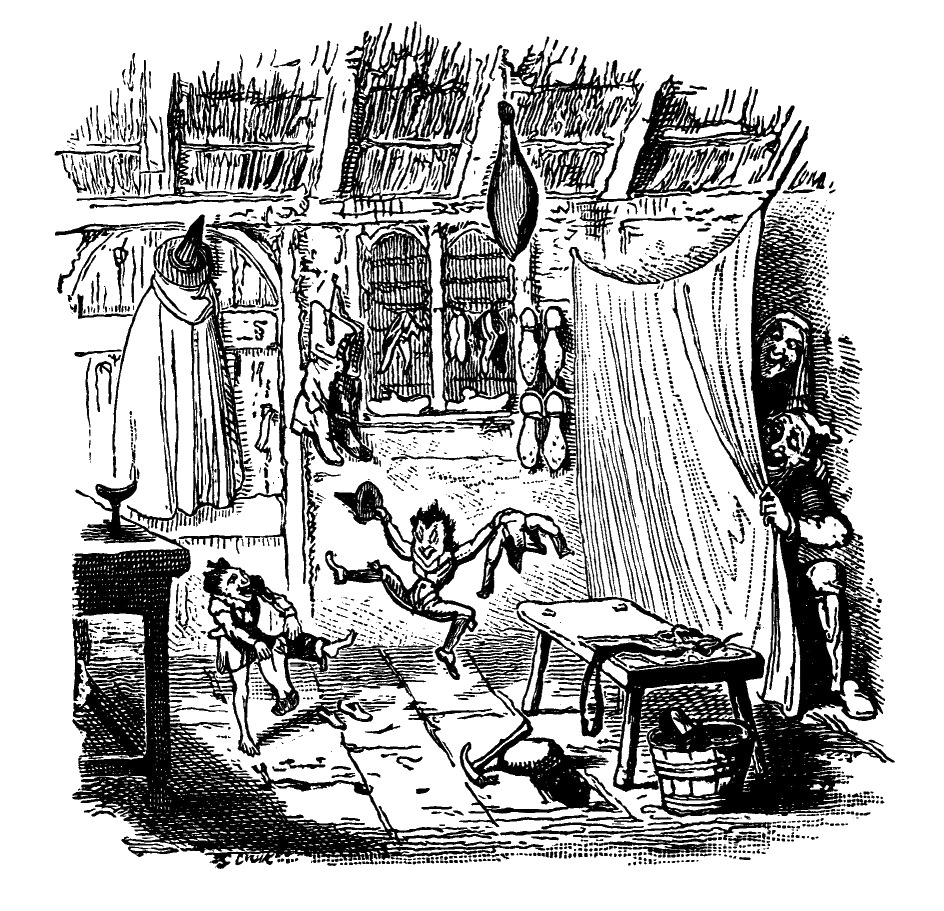
The next morning, his wife said, "The little men have made us wealthy. We must show them our thanks. They are running around with nothing on, freezing." She proposed to make clothes, and the shoemaker agreed to make a pair of shoes for each of them. The two of them did not stop until they had finished the work, then hid themselves again. The following night, the couple saw the little men delighted as they tried the beautiful little clothes and shoes; they danced out of the house and never returned, but the shoemaker prospered in his business.
Hub AI
The Elves and the Shoemaker AI simulator
(@The Elves and the Shoemaker_simulator)
The Elves and the Shoemaker
"The Elves and The Shoemaker" (German: Die Wichtelmänner) is a set of fairy tales collected by the Brothers Grimm (KHM 39) about a poor shoemaker who receives much-needed help from three young helpful elves.
The original story is the first of three fairy tales contained as entry 39 in the German Grimm's Fairy Tales under the common title "Die Wichtelmänner". In her translation of 1884 Margaret Hunt chose The Elves as title for these three stories.
The first tale is of Aarne-Thompson (AT) type 503* ('Helpful Elves'), also classified as a migratory legend (AT-7015). The second is of AT 476* type ('A Widwife [or Godmother] for the Elves'), also categorized as a migratory legend (AT 5070). The third tale is of AT 504 type ('The Changeling'), also categorized as a migratory legend (AT 5085).
The set of related tales was published by the Brothers Grimm in the first edition of Kinder- und Hausmärchen (1812), as tale no. 39. Their versions of the three stories are based upon the accounts of Gretchen Wild (1787–1819).
In the first edition, the three stories are subtitled "The Shoemaker for Whom They Did Work", "The Servant Girl Who Stood In as Godmother for Them", and "The Woman Whose Child They Exchanged", respectively, although the Grimms did not give titles to the individual tales in later editions.
A poor hardworking shoemaker had so little leather that he could only make a single pair of shoes. One evening, leaving the pair with the work unfinished, he went to bed and commended himself to God. After waking up the following day and saying his prayers, he found the shoes finished and perfectly well-made on his workbench. A customer soon entered the store and offered more than the usual price, for he was fond of the pair. The shoemaker uses the money to buy leather for more shoes which, after cutting, he also leaves overnight. Again the materials are made into beautiful shoes by morning. In this manner, his situation improves until he is comfortable again.
One evening, shortly before Christmas, the shoemaker said to his wife, "Why don't we stay up tonight and see who is giving us this helping hand," and his wife agreed. Hiding in the corner of the room, they saw two little men working quickly and nimbly on the shoes, then running away after their work was finished.
The next morning, his wife said, "The little men have made us wealthy. We must show them our thanks. They are running around with nothing on, freezing." She proposed to make clothes, and the shoemaker agreed to make a pair of shoes for each of them. The two of them did not stop until they had finished the work, then hid themselves again. The following night, the couple saw the little men delighted as they tried the beautiful little clothes and shoes; they danced out of the house and never returned, but the shoemaker prospered in his business.
Recent media