



Community hub
Recent from talks
Knowledge base stats:
Talk channels stats:
Members stats:
The Emperor Jones
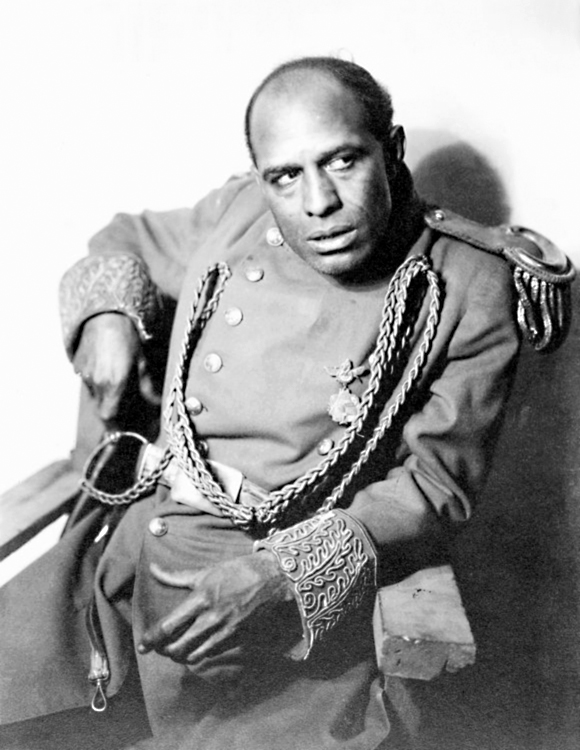
The Emperor Jones is a 1920 tragic play by American dramatist Eugene O'Neill that tells the tale of Brutus Jones, a resourceful, self-assured African American and a former Pullman porter, who kills another black man in a dice game, is jailed, and later escapes to a small, backward Caribbean island where he sets himself up as emperor. The play recounts his story in flashbacks as Brutus makes his way through the jungle in an attempt to escape former subjects who have rebelled against him.
Originally called The Silver Bullet, the play is one of O'Neill's major experimental works, mixing expressionism and realism, and the use of an unreliable narrator and multiple points of view. It was also an oblique commentary on the U.S. occupation of Haiti after bloody rebellions there, an act of imperialism that was much condemned in O'Neill's radical political circles in New York. The Emperor Jones draws on O'Neill's own hallucinatory experience hacking through the jungle while prospecting for gold in Honduras in 1909, as well as the brief, brutal presidency of Haiti's Vilbrun Guillaume Sam.
The Emperor Jones was O'Neill's first big box-office hit. It established him as a successful playwright, after he won the Pulitzer Prize for Drama for his first play, the much less well-known Beyond the Horizon (1920). The Emperor Jones was included in Burns Mantle's The Best Plays of 1920–1921.
The Emperor Jones is about Brutus Jones, a Black American Pullman porter who escapes to an island in the West Indies. In two years, Jones makes himself "Emperor" of the place. A native tried to shoot Jones, but the gun misfired; thereupon Jones announced that he was protected by a charm and that only silver bullets could harm him.
When the play begins, he has been Emperor long enough to amass a fortune by imposing heavy taxes on the islanders and carrying on all sorts of large-scale corruption. Rebellion is brewing. The islanders are whipping up their courage to a fighting point by calling on the local gods and demons of the forest. From the deep of the jungle, the steady beat of a big drum sounded by them is heard, increasing its tempo towards the end of the play and showing the rebels' presence dreaded by the Emperor. It is the equivalent of the heart-beat which assumes a higher and higher pitch; while coming closer it denotes the premonition of approaching punishment and the climactic recoil of internal guilt of the hero; he wanders and falters in the jungle, present throughout the play with its primeval terror and blackness.
The play is virtually a monologue for its leading character, Jones, in a Shakespearean range from regal power to the depths of terror and insanity, comparable to Lear or Macbeth. Scenes 2 to 7 are from the point of view of Jones, and no other character speaks. The first and last scenes are essentially a framing device with a character named Smithers, a white trader who appears to be part of illegal activities. In the first scene, Smithers is told about the rebellion by an old woman, and then has a lengthy conversation with Jones. In the last scene, Smithers converses with Lem, the leader of the rebellion. Smithers has mixed feelings about Jones, though he generally has more respect for Jones than for the rebels. During the final scene, Jones is killed by a silver bullet, which was the only way that the rebels believed Jones could be killed, and the way in which Jones planned to kill himself if he was captured.
The Little Formless Fears; Jeff; The Negro Convicts; The Prison Guard; The Planters; The Auctioneer; The Slaves; The Congo Witch-Doctor; The Crocodile God
The expansive personality and style of speech seen in Brutus Jones was modeled on Adam Scott, an African-American and close friend of O'Neill's. Scott tended bar at O'Neill's favorite tavern, at the rear of Holt's Grocery on Main Street, in his hometown of New London, Connecticut. In their biography of O'Neill, Arthur and Barbara Gelb report that,
Hub AI
The Emperor Jones AI simulator
(@The Emperor Jones_simulator)
The Emperor Jones
The Emperor Jones is a 1920 tragic play by American dramatist Eugene O'Neill that tells the tale of Brutus Jones, a resourceful, self-assured African American and a former Pullman porter, who kills another black man in a dice game, is jailed, and later escapes to a small, backward Caribbean island where he sets himself up as emperor. The play recounts his story in flashbacks as Brutus makes his way through the jungle in an attempt to escape former subjects who have rebelled against him.
Originally called The Silver Bullet, the play is one of O'Neill's major experimental works, mixing expressionism and realism, and the use of an unreliable narrator and multiple points of view. It was also an oblique commentary on the U.S. occupation of Haiti after bloody rebellions there, an act of imperialism that was much condemned in O'Neill's radical political circles in New York. The Emperor Jones draws on O'Neill's own hallucinatory experience hacking through the jungle while prospecting for gold in Honduras in 1909, as well as the brief, brutal presidency of Haiti's Vilbrun Guillaume Sam.
The Emperor Jones was O'Neill's first big box-office hit. It established him as a successful playwright, after he won the Pulitzer Prize for Drama for his first play, the much less well-known Beyond the Horizon (1920). The Emperor Jones was included in Burns Mantle's The Best Plays of 1920–1921.
The Emperor Jones is about Brutus Jones, a Black American Pullman porter who escapes to an island in the West Indies. In two years, Jones makes himself "Emperor" of the place. A native tried to shoot Jones, but the gun misfired; thereupon Jones announced that he was protected by a charm and that only silver bullets could harm him.
When the play begins, he has been Emperor long enough to amass a fortune by imposing heavy taxes on the islanders and carrying on all sorts of large-scale corruption. Rebellion is brewing. The islanders are whipping up their courage to a fighting point by calling on the local gods and demons of the forest. From the deep of the jungle, the steady beat of a big drum sounded by them is heard, increasing its tempo towards the end of the play and showing the rebels' presence dreaded by the Emperor. It is the equivalent of the heart-beat which assumes a higher and higher pitch; while coming closer it denotes the premonition of approaching punishment and the climactic recoil of internal guilt of the hero; he wanders and falters in the jungle, present throughout the play with its primeval terror and blackness.
The play is virtually a monologue for its leading character, Jones, in a Shakespearean range from regal power to the depths of terror and insanity, comparable to Lear or Macbeth. Scenes 2 to 7 are from the point of view of Jones, and no other character speaks. The first and last scenes are essentially a framing device with a character named Smithers, a white trader who appears to be part of illegal activities. In the first scene, Smithers is told about the rebellion by an old woman, and then has a lengthy conversation with Jones. In the last scene, Smithers converses with Lem, the leader of the rebellion. Smithers has mixed feelings about Jones, though he generally has more respect for Jones than for the rebels. During the final scene, Jones is killed by a silver bullet, which was the only way that the rebels believed Jones could be killed, and the way in which Jones planned to kill himself if he was captured.
The Little Formless Fears; Jeff; The Negro Convicts; The Prison Guard; The Planters; The Auctioneer; The Slaves; The Congo Witch-Doctor; The Crocodile God
The expansive personality and style of speech seen in Brutus Jones was modeled on Adam Scott, an African-American and close friend of O'Neill's. Scott tended bar at O'Neill's favorite tavern, at the rear of Holt's Grocery on Main Street, in his hometown of New London, Connecticut. In their biography of O'Neill, Arthur and Barbara Gelb report that,