Hubbry Logo
search
logo
2176457

The Locust

logo
Community Hub0 Subscribers
Read side by side
from Wikipedia

The Locust was an American hardcore punk band from San Diego, California, known for their mix of grindcore aggression and new wave experimentation.[1]

Key Information

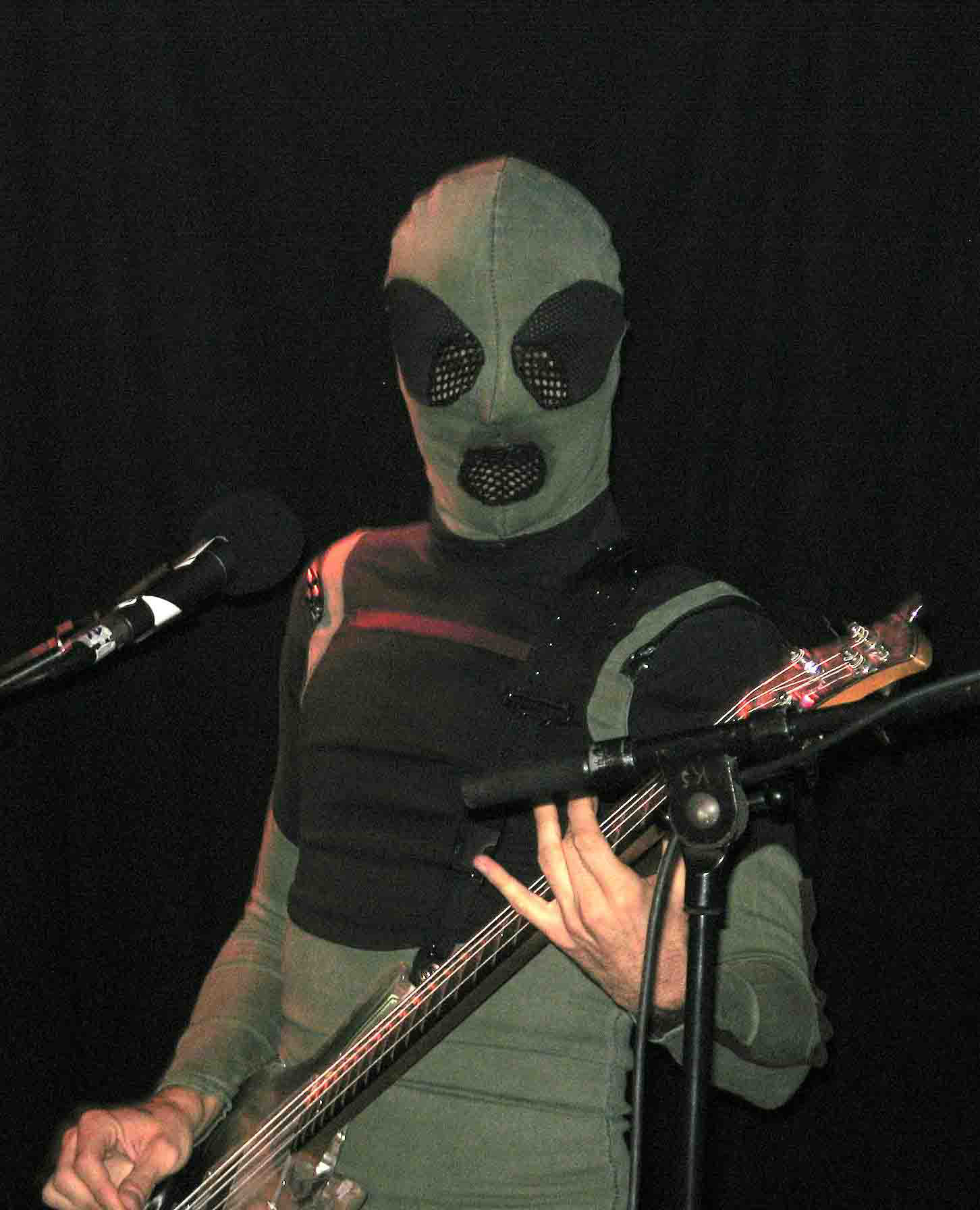
The band has been noted for their use of insect costumes when performing live.

History

[edit]

Prior to The Locust founding members Justin Pearson and Dylan Scharf were in the hardcore punk band Struggle together, formed in late 1990.[2] The band only lasted three years. Despite this they had opportunities to share musical space with other significant bands with similar ideological perspectives such as Born Against, Downcast, Bikini Kill, and Econochrist.[2] The band disbanded in 1994.

The Locust formed in 1994 by Pearson, Scharf, Bobby Bray, Dave Warshaw, and Dave Astor. The band was initially a powerviolence project whose first release was a split with genre pioneers Man Is the Bastard in 1995. Later releases incorporated synthesizers and became increasingly theatrical.[3] The band regularly played shows in all-ages punk clubs in Los Angeles and San Diego,[4] usually donning insect costumes.[3]

In September 1998, The Locust released their first full-length album, The Locust, through Gold Standard Laboratories.

On June 24, 2003, The Locust released their second full-length album, Plague Soundscapes, through ANTI-.[5]

On March 20, 2007, The Locust released their third and ultimately final full-length album, New Erections, through ANTI-.[6] After a lengthy touring schedule following the release of New Erections, The Locust went on hiatus.[7]

On May 18, 2010, The Locust released an archive recording of their Peel Session recorded 9 years prior in 2001, simply named The Peel Sessions, released through Radio Surgery.[7] This 16-track recording was the first time Gabe Serbian had started playing drums for The Locust, finalizing the lineup of Bobby Bray, Joey Karam, Justin Pearson and Gabe Serbian that would stay the same for the rest of their time together.[7]

On July 31, 2012, The Locust released a compilation album, Molecular Genetics from the Gold Standard Labs, through ANTI-.[8] The album contains all the band's material released on the Gold Standard Laboratories label which is all their material from 1997 to 2002.[9]

In 2013, The Locust returned from hiatus and in 2019 they were added to the Desert Daze 2019 festival line up. Bassist Justin Pearson confirmed that the band would add more shows after this, with new material and new costumes.[10]

On May 1, 2022, the band announced the death of drummer Gabe Serbian that had occurred the day before.[11] The band have since announced on their Instagram account that they can no longer be active in the wake of Serbian's death, and that no further albums or live performances will occur under the Locust name.[12] The final piece recorded by the group was a remix of the Danny Elfman solo track "Cruel Compensation" which appears on the remix album Bigger. Messier.

Style and influences

[edit]

The Locust were known for their unique mix of grindcore speed and aggression, complexity, and new wave weirdness.[1] The band's musical genre is typically described as grindcore,[1][13][14] hardcore punk,[15] powerviolence,[16] mathcore[17] and noise rock.[18]

About the band's aesthetic, vocalist/bassist Justin Pearson has said, "I wanted to change the way people perceive music, or maybe just destroy it in general."[19] The Locust's music is complex, dynamic and fast-paced, often featuring abrupt and inconsistent time-signature changes. These erratic elements are, according to vocalist/guitarist Bobby Bray, "a reflection of perhaps how our brains have to function in order to be able to do anything in the Western societies we live in."[20] Stylus described the band's sound as "Relentless blitzkriegs of high velocity noise, skinny tie keyboards and bloody screaming that often last less than a minute, Locust songs are tightly-wound, dynamic and bizarre expressions of frustration and hatred whose intensity and creativity are currently unparalleled in punk rock."[1] The New York Times stated "If noise-rock had superheroes, the Locust would surely be among them."[21] The band was praised by Dave Lombardo of Slayer, who said "There's a band called The Locust. Their drummer is named Gabe Serbian, and their music hits me now like D.R.I. hit me in the early '80s."[22]

The Locust have had a unique stage presence: costumed in skin-tight, full body nylon suits (which the band refer to as uniforms). The last 5 different suits were designed and made by Ben Warwas.[23] Unlike most bands, which normally have the drums set up behind the other members, the four members of The Locust usually all positioned in a line at the front of the stage. The group recommended that in order to get the full impact of the music, one should see them live.

The Locust boycotted Clear Channel Communications and refused to play in any Clear Channel-owned venues.[24] This boycott affected a 2005 tour with Fantômas, as well as another tour with Yeah Yeah Yeahs. They also had a policy of only playing all-ages shows.

Equipment

[edit]

Karam plays an assortment of analog synthesizers, including various Moog models[25] and a patch-panel modular synth. Bray plays a Gibson SG, and Pearson plays a see-through body Dan Armstrong bass made by Ampeg.[26] Serbian played Ludwig drums with Paiste cymbals.

Controversies

[edit]

Pearson appeared as a "rock-star slut" in an episode of The Jerry Springer Show. It culminated in a French kiss with Scott Beiben, owner of the record label Bloodlink.[27] Pearson wore a T-shirt for The Locust during the appearance.[28] Pearson later stated "I was beat up during a commercial break by one of the 'security guards' pretty bad for blowing snot on the carpet."[28]

The Locust have been accused of encouraging the use of drugs because the band sold vanity mirrors as merchandise: fans and others mistook the mirrors as being intended for use as a surface from which one could snort cocaine.[29] In an interview with Scene Point Blank Justin Pearson was asked "You guys make Locust compacts, modeled after cocaine mirrors. Do you feel it's irresponsible to sell these to your younger fans?"[29] Pearson responded "I'm not sure what you are talking about. I have never done cocaine and we never modeled any sort of merchandising product or idea after cocaine mirrors. However we did have vanity mirrors. In case you were not aware, they could be used for a variety of things such as make-up application, picking food out of your teeth, popping zits, fixing your bangs, etc. About the second part of your question, we are not responsible for anyone besides ourselves. We are a band and in no way are we a babysitting service."[29]

The Locust organized a number of "gender-baiting incidents", including Pearson and Serbian staging a fake same-sex marriage while on tour in Hawaii.[27]

In media

[edit]
  • "Nice Tranquil Thumbs in Mouth" and "An Extra Piece of Dead Meat" are featured in the film Cecil B. Demented.[30]
  • In the 2011 cult film Margaret, a poster featuring the cover of Safety Second, Body Last can be seen in various scenes set in the protagonist's bedroom.
  • The Hold Steady song “Girls Like Status” includes the lyric “She said that she was coming but she mostly made hard, fast noises It kinda sounded like The Locust”

Members

[edit]

Final lineup

[edit]
  • Bobby Bray – guitar, vocals (1994–2022)
  • Justin Pearson – bass, vocals (1994–2022)
  • Joey Karam – keyboards, vocals (1997–2022)
  • Gabe Serbian – guitar, vocals (1998–2001), drums (2001–2022; his death)

Previous members

[edit]
  • Dylan Scharf – guitar, vocals (1994–1996)
  • Dave Warshaw – keyboards, vocals (1994–1996)
  • Dave Astor – drums (1994–2001)
  • Jimmy LaValle – keyboards, vocals (1996–1998)

Timeline

[edit]

Discography

[edit]

Albums

[edit]

Compilations

[edit]
  • Molecular Genetics from the Gold Standard Labs (2012, ANTI-)

Live albums

[edit]
  • The Peel Sessions (2010, Radio Surgery)

EPs

[edit]

Splits

[edit]
  • Split with Man Is the Bastard (1995, King of the Monsters)
  • Split with Jenny Piccolo (1996, Three One G)
  • Split with Arab on Radar (2000, Gold Standard Laboratories)
  • Split with Melt-Banana (2002, Gold Standard Laboratories)

Compilation appearances

[edit]
  • "Red" on Cry Now, Cry Later Volume 4 (1996, Theologian Records)
  • "Emaciation Fuckers" on Fiesta Comes Alive! (1997, Slap A Ham Records)
  • "Cattle Mutilation" on Benefit 7" for Project Vida (1997, Lengua Armada Discos)
  • "Ass Gravity" on The 51 Comp (1997, Join The Team Player Records)
  • "Inbred America" on Bread: The Edible Napkin (1997, No Idea Records)
  • "Kill Roger Hedgecock" on Israfel (1997, Ape Records)
  • "Do You Dig Deep Graves" on Bllleeeeaaauuurrrrgghhh!: A Music War (1998, Slap A Ham Records)
  • "Skin Graft at Seventy-Five Miles Per Hour" on Bottlenekk Wholesale Distribution Sampler No. 1: Fall 1998 (1998, Bottlenekk Wholesale Distribution)
  • "Prepare to Qualify" on Audio Terrorism: The Soundtrack for Weirdness and Blind Hostility (1998, Heart plug Records/Chaotic Noise Productions/Satan's Pimp)
  • "Dog Without A Collar" on Reality Part 3 (1999, Deep Six Records)
  • "Nice Tranquil Thumb In Mouth" on Music from the Motion Picture Cecil B. Demented (2000, RCA Victor)
  • "Keep Off The Tracks" on Songs of the Dead II: Idle Hands (2000, And Here My Troubles Began)
  • "Straight From The Horse's Mouth" on KXLU 88.9 FM Los Angeles Live Volume Five (2000, KXLU)
  • "Priest with the Sexually Transmitted Diseases, Get Out Of My Bed" on Looking for the Perfect Glass: California Post Punk (U.S. Pop Life Vol. 11) (2001, Contact Records)
  • "The Perils of Believing in Round Squares" on Troubleman Mixtape (2001, Troubleman Unlimited)
  • "Glueing Carpet To Your Genitals Does Not Make You A Cantaloupe" on 2001 Sampler (2001, Mordam Records)
  • "Turning Your Merchandise Into A Ripped Wall of Mini-Abs" on This Is Radio Cookie Scene 11/2001 (2001, Cookie Scene)
  • "Flash's Theme" on Dynamite With A Laserbeam: Queen As Heard Through The Meat Grinder of Three One G (2002, Three One G)
  • "Glueing Carpet To Your..." on Audioflashcard (2002, Gold Standard Laboratories)
  • "How To Become A Virgin" on Oops! The Tour Sampler (2002)
  • "Perils of Believing in Round Squares" on Our Birthday Your Present (2003, Gold Standard Laboratories)
  • "Identity Exchange Program, Rectum Return Policy" on Rock Sound Volume 65 (2003, Rock Sound)
  • "Identity Exchange Program, Rectum Return Policy" on Speciale Punk Rock 17 (2003, Rock Sound)
  • "Identity Exchange Program, Rectum Return Policy" on Rock Sound Musica Com Atitude Volume 12 (2003, Rock Sound)
  • "Identity Exchange Program, Rectum Return Policy" on Soundcheck #59 (2003, Close-Up Magazine)
  • "Pulling the Christmas Pig by the Wrong Pair of Ears" on Keeper Metal CD Sampler 2 (2003, Keeper Music)
  • "The Half Eaten Sausage Would Like To See You In His Office" on Gravity Video 2 Soundtrack (2003, Gravity)
  • "Identity Exchange Program, Rectum Return Policy" on Music with Attitudes: Volume 50 (2003, Rock Sound)
  • "File Under 'Soft Core Seizures'" on Pushing Product (Winter 2003/2004) (2003, Vice Records)
  • "Identity Exchange Program, Rectum Return Policy" on Anti- (2004, Anti-/Sinedin Music)
  • "Stucco Obelisks Labeled As Trees" on This Is Circumstantial Evidence (2004, Three One G)
  • "Teenage Mustache" on Hellfest Vol. III (2004, High Roller Studio)
  • "Get Off The Cross, The Wood Is Needed" on Burn My Eye! (2004, Burn My Eye/Plastic Donkey/Rimbaud Records)
  • "Live in Japan" on Lab Results Volume One (2006, Gold Standard Laboratories)
  • "Live from the Russian Compound" on Punk is Dead (2006, Buddyhead)
  • "We Have Reached An Official Verdict: Nobody Gives A Shit" on Sound Check No. 95 (2007, Rock Sound)
  • "We Have Reached An Official Verdict: Nobody Gives A Shit" on Ox-Compilation #71 (2007, Ox Fanzine)
  • "We Have Reached An Official" on Epitaph - Spring Sampler 2007 (2007, Epitaph Records)
  • "Red" on Three One G 2007 (2007, Three One G)
  • "We Have Reached An Official Verdict: Nobody Gives A Shit" on Rock Sound Volume 109 (2007, Rock Sound)
  • "We Have Reached An Official Verdict" on Rock Sound Volume 119 (2007, Rock Sound)
  • "Tower of Mammal" on Hit's A Sony Music Express Vol.49 March 2007 (2007, Sony Records International)
  • "Summer Rain" on Summer 2007 Chrysalis Music Sampler (2007, Chrysalis Music Group)
  • "Aotkpta" on Hit's A Sony Music Express Vol.60 March 2008 (2008, Sony Records International)
  • "Untitled" on A Few My Nephew (2008)
  • "Strike Back (DJ Yoz Remix)" on Ultimate Hardstyle Volume 3 (2012, LW Recordings)
  • "Sever The Toes" on It's Gonna Blow: San Diego's Music Underground 1986-1996 (2014, Billingsgate Media)

References

[edit]
[edit]
Revisions and contributorsEdit on WikipediaRead on Wikipedia
from Grokipedia
The Locust was an American hardcore punk band formed in San Diego, California, in 1994, blending grindcore aggression with powerviolence brevity and experimental new wave elements in their music and performances.[1][2] The band's core lineup eventually stabilized around vocalist and bassist Justin Pearson, guitarist and vocalist Bobby Bray, guitarist and keyboardist Joseph Karam, and drummer Gabe Serbian, following initial personnel shifts from its origins in the local powerviolence scene.[3][1] Renowned for chaotic live shows featuring insect costumes, frenetic energy, and satirical commentary on consumerism and society through hyper-short songs often under a minute long, The Locust cultivated a cult following in underground music circuits.[4][5] Key releases include their self-titled debut album in 1998 on Gold Standard Laboratories, Plague Soundscapes in 2003 via Anti- Records, and New Erections in 2007, which showcased their evolving sonic extremity and production polish.[6][7] The group effectively disbanded in April 2022 following the sudden death of drummer Gabe Serbian, with surviving members expressing no intention to continue under the name.[2][8]

History

Formation and early career (1996–2000)

The Locust formed in San Diego, California, in 1995 amid the city's DIY punk and powerviolence scenes, with bassist and vocalist Justin Pearson and guitarist and vocalist Bobby Bray as core founders emerging from earlier local acts like Swing Kids, which blended post-hardcore and experimental elements.[5][9] The initial lineup included Pearson, Bray, guitarist and vocalist Dylan Scharf, keyboardist Dave Warshaw, and drummer Dave Astor, reflecting the fluid personnel common in the underground hardcore milieu.[10] Early membership shifts incorporated Joey Karam on keyboards and vocals by 1997, stabilizing the group's sound around aggressive, chaotic compositions.[11] The band's first output was a split 10-inch EP with Man Is The Bastard, issued in 1995 via King of the Monsters Records, marking their entry into the grindcore-adjacent powerviolence circuit.[5] This was followed by the self-released 7-inch EP Follow the Flock, Step in Shit in 1996 and additional splits, including a 5-inch picture disc with Jenny Piccolo on Three One G Records.[12] In 1998, they released their self-titled debut full-length through Gold Standard Laboratories, a 16-minute collection of ultra-brief tracks averaging under a minute each, which exhausted its 2,000-copy initial pressing shortly after distribution.[5][1] From 1996 onward, The Locust conducted grassroots tours across the United States, playing intimate DIY venues and fostering connections within the powerviolence and noise rock communities.[11] In response to early media and audience fixation on their "regular" onstage appearance, the band introduced insect-themed uniforms and masks as a deliberate performative element by the late 1990s, exaggerating the motif to mock consumerism, identity politics in music, and superficial critiques of punk aesthetics.[13][1]

Major releases and tours (2001–2009)

The Locust released the EP Flight of the Wounded Locust in 2001 via Gold Standard Laboratories, marking their final recording as a five-piece ensemble before streamlining to a core quartet.[5] This release featured blistering, concise tracks consistent with the band's established approach to brevity and aggression.[14] In June 2003, the band issued Plague Soundscapes on Anti-, a full-length album comprising 24 songs, many lasting under 30 seconds, with lyrics employing satire directed at consumerism and institutional authority.[15][16] The album represented their first major-label-adjacent effort through the independent imprint, yet retained a self-reliant production model via direct collaboration with engineer Alex Newport.[17] Tours supporting the release spanned the United States, including a performance at Hellfest 2K3 in Syracuse, New York, on July 6, 2003, where the band's high-energy, confrontational sets drew both acclaim and disruption.[18] New Erections followed on March 20, 2007, again through Anti-, incorporating expanded electronic textures while preserving the group's rapid-fire compositional structure across 17 tracks.[19] The album's promotion involved the New Erections Tour, encompassing at least 30 documented U.S. concerts from March 2007 onward, such as a date at The Roxy in Boston on April 12, 2007.[20][21] International outreach continued, building on prior European visits, though the band prioritized domestic circuits amid growing member commitments to side endeavors like Justin Pearson's Three One G label, which facilitated releases for affiliated acts.[5] Throughout 2001–2009, The Locust sustained lineup stability around principals Justin Pearson, Joey Karam, Gabe Serbian, and Brian Seckinger, enabling consistent output and touring without reliance on mainstream distribution channels.[5] This era underscored their adherence to an autonomous operational framework, contrasting with commodified punk scenes by emphasizing direct fan engagement and limited-run physical media over broad commercial metrics.[22]

Hiatus, final activities, and disbandment (2010–present)

Following the extensive touring in support of their 2007 album New Erections, The Locust entered an indefinite hiatus around 2009, with no new studio recordings produced thereafter.[23] [5] During this period, the band issued limited archival material, including a split release compiling earlier tracks with Jenny Piccolo and a four-track EP from 2001, as well as their 2001 BBC Peel Session recording released on May 18, 2010.[5] These outputs represented archival efforts rather than fresh creative work, reflecting the practical challenges of sustaining the band's high-intensity grindcore style amid shifting personal commitments.[5] Band members pursued separate endeavors, with bassist and vocalist Justin Pearson forming Dead Cross in 2015 alongside Mike Patton and others, releasing albums in 2017 and 2020 that echoed elements of The Locust's chaotic energy but adapted to broader crossover audiences.[24] Such side projects highlighted the fragmentation of the original San Diego punk scene, where aging musicians (many in their 40s by the 2010s) prioritized sustainable collaborations over the physical demands of The Locust's frenetic performances.[24] The death of drummer Gabe Serbian on April 30, 2022, at age 44—announced by the band via social media—effectively precluded any possibility of reunion or continuation.[25] [26] Serbian's role as a core multi-instrumentalist was irreplaceable, as evidenced by the band's explicit statement that his absence rendered further activity untenable, leading to de facto disbandment without plans for new releases or tours.[2] This outcome underscored the causal dependency on full original lineup integrity for the band's viability, rather than substitutable personnel or nostalgic revivals.[2]

Musical style and influences

Core stylistic elements

The Locust's music fundamentally derives from grindcore's emphasis on brevity and intensity, featuring songs typically lasting 20 to 60 seconds, as exemplified by their self-titled debut album's 23 tracks spanning just 21 minutes.[27] This structure employs relentless blast beats on drums and high-pitched, screamed vocals delivering rapid-fire assaults, often critiquing perceived societal pathologies like consumerism and alienation, though such brevity limits depth and echoes grindcore pioneers Napalm Death's 1987 album Scum, which packed 28 tracks into 33 minutes without claiming novel radicalism.[28] The band's purported innovations lie less in these aggressive foundations—precedents established in the 1980s UK grind scene—than in superficial departures that prioritize disorientation over substantive evolution. A distinctive element involves integrating keyboards and synthetic dissonance to inject new wave and synth-pop inflections into the chaos, creating a parody-like tension between mechanical sterility and visceral fury, as heard in Plague Soundscapes (2003) tracks such as "How to Build a Pessimist," where electronic stabs underscore themes of manufactured despair amid grinding riffs.[29] This fusion yields a sound that reviewers have termed a "mish-mash of grindcore, punk, and new wave," memorable for its eccentricity but critiqued for relying on shock through abrupt shifts rather than coherent artistry.[1] Lyrically, content revolves around anti-consumerist satire and existential absurdity—e.g., "Recyclable Body Fluids in Human Form" lampoons commodified humanity—yet detractors argue this devolves into incoherent provocation, prioritizing grotesque imagery over incisive analysis, as initial listens evoke mere "shock value" without enduring critique.[30][31] Such elements, while blending aggression with electronic parody, ultimately extend rather than originate from grindcore's chaotic precedents, tempering claims of stylistic revolution.

Equipment, production techniques, and innovations

The Locust employed a combination of conventional punk instrumentation and analog synthesizers to achieve their signature chaotic density. Bassist Justin Pearson utilized Ampeg Dan Armstrong and Rickenbacker basses, amplified through Ampeg SVT-VR heads and SVT-810E cabinets, often processing the signal with effects pedals such as Line 6 FM4 filter modelers, EarthQuaker Devices Bit Commander and Disaster Transport Delay, and modded ZVEX Fuzz Factory units to treat the bass as a modular synthesizer-like element.[32][33] Keyboardist Joseph Karam relied on analog synthesizers, including vintage Moog models and modular systems, which were prominently featured in studio recordings around 2003.[34] Production techniques emphasized rapid execution to capture raw aggression, with early albums recorded in single-day sessions at local studios to minimize over-polishing and preserve the band's high-speed instrumentation, such as 16th-note patterns on kick and snare drums played at extreme tempos.[35][17] Later releases, including Plague Soundscapes (2003), benefited from extended sessions—up to 10 days—and collaboration with producer Alex Newport, whose familiarity with the band's approach ensured techniques like close miking and minimal processing retained the abrasive, unrefined edge distinct from mainstream metal's compressed clarity.[35][36] By New Erections (2007), modular synth integration intensified, using analog patching for erratic, swarm-mimicking textures amid grindcore blasts, as credited in album production notes.[34][37] Innovations centered on analog modular synthesis within a lo-fi punk framework, as seen in Safety Second, Body Last (2005) and New Erections, where unstable synth voicings causally contributed to the dense, insectile sonic overload, diverging from digital-heavy contemporaries by prioritizing tactile analog instability over quantized precision.[34][38] This approach evolved minimally post-2000, retaining analog cores despite label affiliations like Ipecac Recordings, which provided budgets for refined yet deliberately unpolished outputs without shifting to predominant digital workflows.[39][35]

Live performances

Performance aesthetics and stage presence

The Locust's performances featured distinctive insect-inspired costumes, including insectile nylon suits and bug-eyed masks, which became a hallmark of their stage presence from the late 1990s onward.[40] These outfits, often in matching green spandex evoking bathroom stalls, evolved from earlier elements like furry vests and goggles to full-body ensembles designed to inject irony and absurdity into their visual aesthetic.[41] Band member Justin Pearson explained that the attire addressed criticisms of their otherwise conventional appearance—such as jeans and t-shirts—aiming to elevate the overall experience while keeping the focus on the music, as "who wants to look at four dudes playing music?"[41] The costumes contributed to a theatrical immersion that aligned with the band's chaotic, high-energy sets, positioning instruments at the stage's forefront to create a unified wall of sound and disorientation.[40] This approach innovated within the hardcore punk scene by blending grindcore aggression with surreal, provocative visuals, fostering a sense of dehumanized collectivity among performers. However, the emphasis on such spectacle has drawn critique for potentially overshadowing musical execution, with some viewing the elaborate garb as a distraction that amplified provocation over substance.[42] Performances typically unfolded in DIY and independent venues, eschewing larger corporate stages like those controlled by Clear Channel, to maintain an underground ethos. The resulting intimacy often spurred intense audience responses, including mosh pits and physical violence, as documented in footage from early 2000s tours, paradoxically heightening disruption despite the band's calculated uniformity on stage.[41] This led to occasional venue restrictions due to property damage from crowd energy, underscoring the trade-off between innovative aesthetics and practical liabilities in their live presentations.

Notable tours and audience interactions

The Locust's tours supporting their 2003 album Plague Soundscapes marked a period of intensified international activity, including U.S. performances such as the July 6, 2003, show at the New York State Fairgrounds in Syracuse and the July 25, 2003, appearance at Fireside Bowl in Chicago.[18] [43] These runs extended to Europe in 2004, highlighted by the April 16 concert at The Forum in London, where the band's frenetic delivery drew a mix of enthusiasm and tension from audiences accustomed to less experimental grindcore acts.[44] The tours, encompassing at least seven documented dates, showcased the group's ability to sustain high-velocity performances across continents, fostering a dedicated following through relentless energy that contrasted with more conventional punk circuits.[45] Live sets during this era typically featured a barrage of brief tracks delivered in under 30 minutes, creating an explosive atmosphere that invigorated core fans while occasionally alienating those unprepared for the onslaught's duration and density.[46] Crowd dynamics often reflected this divide, with genuine engagement noted in reviews of shared bills, such as the February 2004 Dillinger Escape Plan co-headline in Tampa, where vocalist Mike Patton's interactions complemented The Locust's intensity without overshadowing it.[47] However, protective measures like deploying umbrellas over equipment during the London show elicited boos, underscoring causal tensions between the band's experimental safeguards and audience expectations for unbridled chaos.[48] These interactions, while building a cult status among grindcore enthusiasts who valued the social experimentation embedded in the performances, drew criticisms of perceived elitism toward casual participants, as the emphasis on controlled aggression sometimes escalated minor conflicts rather than diffusing them.[49] The Locust's approach ultimately reinforced their niche appeal, prioritizing ideological consistency over broad accessibility in live settings.

Controversies

Major incidents and public backlash

In 1999, members of The Locust, including vocalist and bassist Justin Pearson, participated in a hoax on The Jerry Springer Show by fabricating a story of a tumultuous four-way romantic entanglement for the March 29 episode titled "Secrets Come Out!".[50] Participants, who included Pearson alongside Allysia Edwards, Scott Beibin, and Christine Hollander, staged physical altercations and a kiss between Pearson and Beibin, culminating in Pearson expelling a "snot rocket" that disrupted the broadcast and prompted a commercial break.[50] The stunt was intended as a prank to mock sensationalist media and, according to Beibin, challenge homophobic norms, though Pearson emphasized it as non-political entertainment aligned with punk disruption rather than structured activism.[50] Producers expressed outrage over the mucus incident, with security personnel reportedly assaulting Pearson backstage, but no formal fines or legal repercussions materialized despite threats of $10,000 penalties for detected fabrications; the episode gained notoriety in punk circles as a subversive exploit without broader public exposure as deceit.[50] During a March 2003 U.S. tour, The Locust's van suffered a slashed tire, an act Pearson attributed to escalating hostility from detractors offended by the band's stage uniforms, keyboard incorporation, and provocative lyrics, which he sarcastically suggested warranted more thorough vandalism for impact.[22] This incident reflected recurrent confrontations, including thrown bottles, barstools, equipment theft, and physical attacks on members by straight-edge groups, intoxicated attendees, and self-styled "tough-guy" hardcore fans, often stemming from onstage taunts met with retorts like Pearson's 2002 remark at New York's Knitting Factory—"Hey, that’s funny, you know what else is really funny? 911"—in response to audience jeers labeling the band sellouts.[22][51] Such exchanges provoked self-inflicted escalations, with no documented venue bans or lawsuits ensuing, though they fueled perceptions of the band as elitist agitators alienating segments of the scene.[22] Purists within hardcore and punk communities criticized The Locust's expansive merchandise tables—stocked with items like coffee mugs, belt buckles, aprons, and soap—as emblematic of commercial sellout, contradicting DIY ethos and prioritizing profit over authenticity.[51] Detractors further accused the band of gatekeeping the genre, claiming their confrontational style and unconventional elements, such as members donning women's clothing onstage, rendered hardcore inaccessible to broader or less aggressive participants, like "fat kids."[51] While some framed these tactics as artistic boundary-pushing against norms, others viewed them as immature provocations inviting backlash without commensurate accountability, exacerbating divides rather than fostering unity.[51] The band dismissed such critiques defiantly, maintaining their approach as unapologetic punk expression amid persistent scene friction.[22]

Political positions and ideological critiques

The Locust's lyrics and public statements frequently incorporated critiques of consumerism, ideological conformity, and societal dehumanization, aligning with anarcho-punk traditions in the San Diego hardcore scene. Tracks such as "AOTKPTA" from the 2003 album Plague Soundscapes satirize "pseudo politico" figures and "ideological leper[s]" spilling "guts out on the sidewalk," evoking disdain for hollow political posturing and systemic exploitation.[52] Frontman Justin Pearson, a key lyricist, emphasized the band's political orientation in interviews, drawing from "social politics, culture, economics" to challenge normative structures.[53][54] This rhetoric extended to personal advocacy, with Pearson crediting veganism as a transformative ethical stance adopted in the mid-1990s, influencing band-associated themes of animal rights and anti-exploitation.[55] The band promoted DIY ethos through Pearson's Three One G label, founded in 1997 to circumvent industry commodification, yet released Plague Soundscapes via Ipecac Recordings, an independent imprint with broader distribution networks.[56] Such moves prompted observations of tension between anti-capitalist rhetoric and pragmatic market engagement, where ideological purity yields to causal necessities like wider accessibility, rather than absolute rejection of commercial infrastructure. The Locust also boycotted venues owned by conglomerates like Clear Channel, citing their representation of "multi conglomerate corporation" interests intertwined with conservative cultural agendas.[57] Supporters within punk communities lauded these positions for subverting capitalist norms and fostering radical inquiry, viewing the band's chaotic aesthetic as a deliberate assault on complacency.[41] Detractors, however, critiqued the output as veering into nihilism, prioritizing disorder over viable alternatives; Pearson himself rejected punk's "nihilism" as outdated and unproductive, signaling internal awareness of such charges.[53] This duality reflects broader ideological friction in anarcho-punk, where performative critique risks undermining substantive impact absent concrete policy engagement.

Band members

Final and core lineup

The Locust's core lineup, which stabilized around 2001 and remained consistent until 2022, featured Justin Pearson on bass and vocals, Gabe Serbian on drums, Bobby Bray on guitar and vocals, and Joey Karam on keyboards and vocals.[5][58] This configuration underpinned the band's recordings and performances from albums like Ironic T-Shirt Contest (2001) onward, enabling a signature blend of grindcore precision and electronic chaos through members' interchangeable instrumental proficiency during live sets.[5] Pearson, as the band's founder and primary songwriter, provided conceptual direction that maintained thematic and sonic continuity across releases, while Serbian's drumming delivered the relentless, polyrhythmic drive central to the group's intensity.[5] Bray and Karam's contributions on guitar and keyboards added layers of dissonance and synthetic elements, fostering the tight cohesion that defined the band's output despite its frenetic style.[58] Serbian's death on April 30, 2022, from fentanyl poisoning marked the end of this lineup and effectively concluded the band's activities.[25]

Former members and lineup changes

The Locust's original lineup formed in 1994 with Justin Pearson on bass and vocals, Bobby Bray on guitar and vocals, Dylan Scharf on guitar and vocals, Dave Warshaw on keyboards and vocals, and Dave Astor on drums.[10][40] Scharf and Warshaw departed in 1996, prompting the band to recruit Jimmy LaValle as a temporary keyboardist to maintain their evolving sound during early recordings and performances.[59][60] Joseph Karam joined in 1997 on keyboards and vocals, providing continuity for the band's incorporation of electronic and noise elements into their powerviolence framework, as evidenced by credits on subsequent releases like the 1998 self-titled album.[1] Gabe Serbian entered as second guitarist in 1998, enabling a dual-guitar assault that intensified their chaotic, short-burst compositions while allowing for layered experimentation. Dave Astor exited in 2001 after contributing drums to early material, including the debut album and EPs, with Serbian shifting to drums to sustain the band's relentless tempo demands.[36] These pre-2002 shifts, documented through recording credits and personnel listings, facilitated a transition from initial five-piece instability to a more defined quartet configuration, refining the integration of synth-driven abstraction without diluting core aggression.[1][10]

Timeline of personnel shifts

The Locust formed in 1994 with an initial lineup consisting of bassist/vocals Justin Pearson, guitarist/vocals Dylan Scharf, drummer Dave Astor, guitarist/vocals Bobby Bray, and keyboardist/vocals Dave Warshaw.[1][2] By 1995–1996, Scharf departed, and keyboardist Jimmy LaValle briefly participated, as documented in a live recording featuring Pearson, Bray, Astor, and LaValle; Warshaw also exited around this period, reducing the core to Pearson, Bray, and Astor.[61] In 1997, Joey Karam joined on keyboards/vocals, expanding the group.[1] Gabe Serbian joined as second guitarist in 1998, forming a quintet—Pearson, Bray, Serbian, Karam, and Astor—that recorded the band's self-titled debut album released that year.[62][25] Following extensive touring in the early 2000s, Astor departed in 2001; Serbian then transitioned from guitar to drums, locking in the four-piece configuration of Pearson (bass/vocals), Bray (guitar/vocals), Karam (keyboards/vocals), and Serbian (drums/vocals).[36][63] This lineup remained unchanged through subsequent releases, including the 2003 album Plague Soundscapes and later works, demonstrating extended stability until Serbian's death on April 30, 2022, which led to the band's disbandment.[5][64]

Discography

Studio albums

The Locust's debut studio album, The Locust, was released in September 1998 by Gold Standard Laboratories and consists of 22 tracks spanning approximately 18 minutes.[65][66] Their second studio album, Plague Soundscapes, followed on June 13, 2003, via Anti-, featuring 23 tracks in about 21 minutes.[16][15] The band's third and final studio album, New Erections, appeared on March 20, 2007, also through Anti-, with 11 tracks totaling roughly 23 minutes.[19][67]

EPs, splits, and compilations

The Locust's early output emphasized short-form releases, including splits with affiliated powerviolence acts and standalone EPs that captured their raw, chaotic sound. Their debut recording was a split 10-inch EP with Man Is the Bastard Noise, released in 1995 on King of the Monsters Records, featuring four tracks by The Locust alongside noise experiments from the collaborators.[5] This was followed in 1996 by a split 5-inch picture disc EP with Jenny Piccolo on Three One G Records, containing two Locust tracks—"Follow the Flock, Step in Shit" and "Coffin Nails"—that exemplified their frenetic, keyboard-infused grindcore style.[59][68] In 2004, Three One G issued Follow the Flock, Step in Shit as a square-shaped 3-inch CD EP, compiling the two tracks from the Jenny Piccolo split plus "Red" (originally from the 1997 punk anthology Cry Now Cry Later Vol. 4), totaling under four minutes of material.[12][69] This release served as a retrospective of their formative era, highlighting unreissued rarities without new compositions.[70] Later short-form efforts included the 2005 split 7-inch Safety Second, Body Last with Holy Fever on Six Weeks Records, featuring two Locust tracks that maintained their signature brevity and intensity amid lineup stability.[71] Post-hiatus, archival compilations emerged, such as the 2012 Molecular Genetics from the Gold Standard Labs on Anti- Records, which aggregated early demos, outtakes, and B-sides from their Gold Standard Laboratories period, providing a comprehensive overview of pre-2003 material.[71] The Locust also contributed tracks to various punk and hardcore anthologies, including appearances on El Guapo (1997) and Reality Part #2 (1998), underscoring their integration into Southern California underground scenes.[10]

Legacy and impact

Influence on punk and hardcore subgenres

The Locust's integration of grindcore aggression with new wave synthesizers and punk brevity distinguished them within powerviolence and early hardcore scenes, influencing subsequent acts to experiment beyond traditional structures. Their 1998 self-titled debut album, clocking in at 16.5 minutes across 28 tracks, exemplified ultra-short song formats averaging under one minute, a hallmark that reinforced the high-speed, fragmented ethos of powerviolence while paving the way for noise-infused grindcore bands.[1] This hybrid approach, blending blast beats with keyboard melodies, impacted groups like The Armed, who adopted similar chaotic noise layered with synth elements in modern hardcore.[1] Members' subsequent projects extended this influence into noise and grind subgenres. Justin Pearson, a core Locust bassist and vocalist, co-founded Dead Cross in 2015, where grindcore traces from The Locust informed tracks like "Divine Filth," characterized by abrupt shifts and intensity.[72] Similarly, Deaf Club, featuring Pearson alongside grindcore veterans, perpetuates a technical, absurd hardcore style akin to Locust's controlled chaos, drawing parallels to Discordance Axis while avoiding rigid genre confines.[73] These offshoots demonstrate causal continuity in pushing boundaries of speed and experimentation within underground hardcore.[73] The band's theatrical elements, including full insect costumes during performances, introduced performative absurdity to hardcore stages, subtly affecting subgenres like experimental noise punk. However, this emphasis on gimmickry—criticized by purists as "false grindcore"—limited broader adoption, confining their impact to niche circles rather than mainstream punk evolutions.[1][73] Scene analyses note that while innovative, the overt theatricality and sonic extremity hindered emulation by more conventional hardcore acts, underscoring a trade-off between innovation and accessibility.[46]

Cultural reception and criticisms

The Locust achieved cult status in underground punk and hardcore circles for their innovative blend of grindcore speed, mathcore complexity, and new wave experimentation, which critics described as novel, memorable, and a disruption to conventional genre boundaries.[1][74] Their confrontational live shows, featuring visual uniforms and chaotic energy, were lauded as intentional shocks that challenged audiences and blurred lines between music and performance art.[75][40] This reception aligned with avant-garde noise traditions, earning comparisons to pioneers like John Zorn.[76] The band's ties to Three One G Records, established by bassist Justin Pearson in 1994 as a DIY outlet for harsh, experimental hardcore, underscored their commitment to independent operations, with the label enduring 31 years by prioritizing boundary-pushing releases over commercial viability.[77][78][79] Criticisms focused on perceived nihilism and inaccessibility, with some portraying their output as deliberately incomprehensible or gimmicky, straddling art and noise at the expense of musical coherence.[40] Hardcore traditionalists derided them as elitist deviants from genre norms, despising their rejection of straightforward aggression in favor of theatrical absurdity.[80][81] Detractors within the scene accused the band of hypocrisy, noting anti-consumerist aesthetics juxtaposed with merchandise sales through labels and online platforms.[82][83] While punk adherents celebrated their anarchy as radical critique, broader dismissals framed such antics as juvenile escapism, counterproductive to substantive reform efforts.[41]

Recent developments and tributes

Gabe Serbian, longtime drummer for The Locust, died on April 30, 2022, at the age of 44.[84] The band announced the news via a Facebook post, stating, "It's with heavy hearts that we have to share the passing of Gabe Serbian on April 30th, 2022. This world will miss Gabe as a friend, family member, musician, and artist."[85] Bandmate Justin Pearson shared a personal tribute on Instagram, expressing, "I wish I understood even a fraction of why things are the way they are."[64] In response to Serbian's death, The Locust released a limited-edition tribute T-shirt in June 2022, with $10 from each sale directed to his family to assist with funeral and living expenses.[86] Pearson also launched a GoFundMe campaign on behalf of Serbian's wife and two children, raising funds for their support amid the sudden loss.[62] Additional tributes included plans to display one of Serbian's signature stage uniforms—reflecting the band's insect-themed performance aesthetic and his admiration for artist Guy Debord's influences—at a San Diego museum exhibit in late 2022.[87] No official statements have emerged regarding a Locust reunion or continuation following Serbian's passing, despite occasional member collaborations in other projects like Deaf Club (featuring Pearson) or ventures involving ex-members with drummers such as Dave Lombardo.[88] The band's prior indefinite hiatus after 2010, combined with the logistical and emotional void left by Serbian's irreplaceable role in their chaotic live dynamic and multi-instrumental contributions, has effectively stalled any revival prospects.[25] Fan and peer interest persists through archival discussions and side-project nods to The Locust's style, underscoring Serbian's enduring impact without prospects for new band activity.[89]

References

User Avatar
No comments yet.