


Community hub
Recent from talks
Contribute something
Nothing was collected or created yet.
The Peanuts
View on Wikipedia
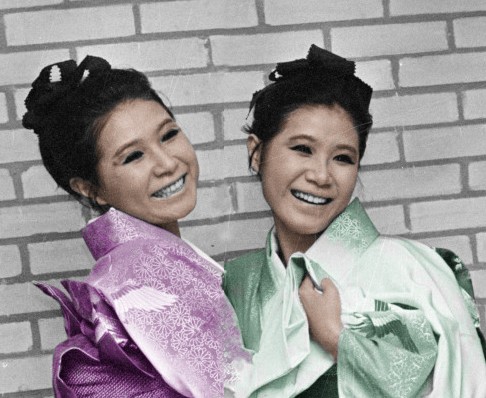
The Peanuts (ザ・ピーナッツ, Za Pīnattsu) were a Japanese vocal group consisting of twin sisters Emi (伊藤エミ, Itō Emi) and Yumi Itō (伊藤ユミ, Itō Yumi).[2] They were born in Nagoya, Japan on April 1, 1941.[1] As identical twins they had voices only slightly apart in timbre, which resulted in their singing together sounding like a solo artist utilizing double tracking or reverb.
Key Information


Early life
[edit]Emi and Yumi were born identical twins to Hideyo and Tsukiko Ito on Tuesday April 1, 1941 in the city of Tokoname in Aichi Prefecture. Emi was older than her twin sister Yumi.
Career
[edit]While still in high school, the twins performed at a Nagoya night club as 'The Ito Sisters', and were discovered by Watanabe Productions founder Shin Watanabe. They were brought to Tokyo in 1958 where they became the first clients for Watanabe Productions.[3] In 1959, the Peanuts became a hit at the Nichigeki theater.[4] That same year, they released their first recording, Kawaii Hana ("Cute Flower").[5] In their early years they sang Japanese covers of standards, foreign hits, and Japanese folk songs; then they began singing originals, written by their producer, Hiroshi Miyagawa, and such songwriters as Koichi Sugiyama and Rei Nakanishi. They were the first to perform "Koi no Vacance".
The twins embarked on a brief acting career appearing as Mothra's twin fairies, known as the Shobijin, in the 1961 film Mothra, and the 1964 films Mothra vs. Godzilla and Ghidorah, the Three-Headed Monster. In the audio commentary for the DVD of Mothra vs. Godzilla, it is noted that director Ishirō Honda recalled the Itos' professionalism. Though not primarily actresses, the twins were surprisingly skilled, learned their lines without trouble, and always worked on time, despite their busy schedule.[citation needed]
Emi had a mole near her left eye. To preserve their image as identical, Yumi would have a mole drawn near her left eye.[6]

Foreign performances
[edit]They appeared in the United States on The Ed Sullivan Show on April 3, 1966, performing "Lover Come Back to Me".[7][8]
Unusual for Japanese singers at the time, the duo had success in Germany, as well as in Austria. In 1963 Caterina Valente was in Japan where the duo caught her attention. Valente invited them to Germany. On the occasion of the 1964 Summer Olympics in Tokyo, Michael Pfleghar produced the opening ceremonies, where both were also invited, and the musical director Heinz Kiessling produced German-language recordings with them, including "Souvenirs from Tokyo". In 1965, Pfleghar cast them in two other shows "The Smile in the West" and "Schlager-Festspiele". In total, they released eight singles in the German language between 1964 and 1967. In 1965 "Souvenirs from Tokyo" reached No. 18 on the Austrian charts and spent 2 weeks at No. 40 on the German Billboard charts. In 1967 "Bye, Bye Yokohama" spent 4 weeks on the Germany charts, rising to No. 30.[9] In 1966, the duo also performed at the Olympia in Paris.[8]
Retirement and death
[edit]The pair retired from performing in April 1975, with a farewell concert tour running from March 21st-April 5th 1975, after Emi married fellow Nabepro star Kenji Sawada.[5] Emi and Kenji eventually divorced in 1987. After retiring from music, Yumi went on to start another career in fashion design, but never married. The duo is remembered most for its versions of European songs and for a handful of Japanese pop songs, such as "Furimukanaide" ("Don't Turn Around").
Emi Itō died from cancer on June 15, 2012, at the age of 71.[10] Yumi died on May 18, 2016, at the age of 75.[11]
Discography
[edit]- 可愛いピーナッツ (Cute Peanuts) (1959)
- ピーナッツ民謡お国めぐり (Peanut Folk Song Country Tour) (1960)
- ヒットパレード (The Hit Parade) (1960)
- 夢で会いましょう (I'll See You in My Dreams) (1961)
- ヒットパレード第2巻 (The Hit Parade Vol. 2) (1962)
- ヒットパレード第3巻 (The Hit Parade Vol. 3) (1962)
- フォークソング (The Folk Songs) (1963)
- 人気の基準 (Popular Standards) (1963
- ヒットパレード (The Hit Parade) (1963)
- ヒットパレード第4巻 (The Hit Parade Vol. 4) (1964)
- ヒットパレード第5巻 (The Hit Parade Vol. 5) (1964)
- ヒットパレード第6巻 (The Hit Parade Vol. 6) (1965)
- Souvenirs aus Tokio (1965)
- ヒットパレード第6巻 – ヨーロッパ周辺 (The Hit Parade Vol. 6 – Around Europe) (1966)
- ザ・ピーナッツ・デラックス (The Peanuts Deluxe) (1967)
- ゴールデンデラックス (Golden Deluxe) (1968)
- フィーリング・グッド – ピーナッツの新しい次元 (Feelin' Good – New Dimension of the Peanuts) (1970)
- ザ・ピーナッツ・ダブル・デラックス (The Peanuts Double Deluxe) (1971)
- ザ・ピーナッツ・ベスト・アルバム (The Peanuts Best Album) (1971)
- 華麗なるフランシス・レイ・サウンド ザ・ピーナッツ最新映画主題歌を歌う (Brilliant Frances Ray Sound – The Peanuts Sing the Latest Movie Theme Song) (1971)
- 世界の女たち (Women in the world) (1972)
- スーパーディスク 20 Superdisc 20 (1972)
- ザ・ピーナッツ・オン・ステージ (The Peanuts On Stage) (1972)
- ザ・ピーナッツ・ベスト20/指輪のあとに (The Peanuts Best 20/After the Ring) (1973)
- 情熱の砂漠 (Passion Desert) (1973)
- スーパーディスク 20 (Superdisc 20) (1973)
- 気になる噂/ベスト・オブ・ザ・ピーナッツ (ki ni naru uwasa/Best Of The Peanuts) (1974)
- ザ・ピーナッツベスト20 (The Peanuts Best 20) (1974)
- 永遠の (Eternal!) (1975)
- ザ・ピーナッツ・ベスト20 (The Peanuts – Best 20) (1975)
- ザ・ピーナッツ (Big Star Series – The Peanuts) (1976)
- ザ・ピーナッツ (Big Star W Series – The Peanuts) (1977)
- ピーナッツオリジナル (The Peanuts Original) (1978)
- ピーナッツポップス (The Peanuts Pops) (1978)
- ピーナッツラブ (The Peanuts Love) (1978)
- ベストスターWデラックス (Best Star W Deluxe) (1979)
- スーパースター・ベスト・アルバム ザ・ピーナッツ (Super Star Best Album – The Peanuts) (1979)
- 記念碑 (Monument) (1980)
- ザ・ピーナッツ・ベスト (The Peanuts Best) (1980)
- ピーナッツの歴史第一巻 (The Peanuts History Vol. 1) (1983)
- ピーナッツの歴史2巻 (The Peanuts History Vol. 2) (1983)
- ザ・ピーナッツ・ベスト (The Peanuts Best) (1984)
- ザ・ピーナッツ・オン・ステージ (The Peanuts On Stage) (1984)
- ザ・ピーナッツ・ベスト・アルバム (The Peanuts Best Album) (1985)
- D.C.恋のフーガ (D.C. koi no fuuga) (1987)
- D.C. (Retro) (1988)
Kōhaku Uta Gassen appearances
[edit]Kōhaku Uta Gassen is an annual New Year's Eve television special produced by Japanese public broadcaster NHK.
| Year | # | Song | No. | VS | Remarks |
|---|---|---|---|---|---|
| 1959 (Showa 34)/10th | 1 | Jounetsu No Hana (情熱の花) | 7/25 | Hiroshi Wada & Mahina Stars | |
| 1960 (Showa 35)/11th | 2 | Kanashiki Juurokusai (悲しき16才) | 11/27 | Hiroshi Wada & Mahina Stars (2) | |
| 1961 (Showa 36)/12th | 3 | Suku Suku (スク・スク) | 19/25 | Dark Ducks | |
| 1962 (Showa 37)/13th | 4 | Furimukanaide (ふりむかないで) | 5/25 | Dark Ducks (2) | |
| 1963 (Showa 38)/14th | 5 | Koi No Vacation (恋のバカンス) | 22/25 | Duke Aces | |
| 1964 (Showa 39)/15th | 6 | Una Sera Di Tokyo (ウナ・セラ・ディ東京) | 24/25 | Kyu Sakamoto | Second Finale |
| 1965 (Showa 40)/16th | 7 | Rock And Roll Music (ロック・アンド・ロール・ミュージック) | 21/25 | Duke Aces (2) | |
| 1966 (Showa 41)/17th | 8 | Rome No Ame (ローマの雨) | 16/25 | Jackey Yoshikawa and His Blue Comets | |
| 1967 (Showa 42)/18th | 9 | Koi No Fugue (恋のフーガ) | 22/23 | Ai Jyoji | Second Finale (2) |
| 1968 (Showa 43)/19th | 10 | Glass No Shiro (ガラスの城) | 6/23 | Teruhiko Saigō | |
| 1969 (Showa 44)/20th | 11 | Una Sera Di Tokyo (2) | 20/23 | Frank Nagai | |
| 1970 (Showa 45)/21st | 12 | Tokyo No Hito (東京の女) | 3/24 | Nomura Masaki | |
| 1971 (Showa 46)/22nd | 13 | San Francisco No Hito (サンフランシスコの女) | 18/25 | Masaaki Sakai | |
| 1972 (Showa 47)/23rd | 14 | Sayonara Wa Totsuzenni (さよならは突然に) | 11/23 | Billy BanBan | |
| 1973 (Showa 48)/24th | 15 | Una Sera Di Tokyo (3) | 12/22 | Tsunehiko Kamijō | |
| 1974 (Showa 49)/25th | 16 | Boogie Woogie Bugle Boy (ブギウギ・ビューグル・ボーイ) | 20/25 | Akira Fuse |
References
[edit]- ^ a b Ryfle 1998, p. 101.
- ^ Real names Hideyo (伊藤日出代, Itō Hideyo) and Tsukiko Itō (伊藤月子, Itō Tsukiko) respectively.
- ^ Ryfle & Godziszewski 2009, 23:03.
- ^ Ryfle & Godziszewski 2009, 23:14.
- ^ a b Martin, Ian. "Yumi Ito of The Peanuts was a muse to both moth and men". Japan Times. Retrieved July 27, 2016.
- ^ Ryfle & Godziszewski 2009, 26:50.
- ^ "April 3, 1966: Stiller and Meara, The Peanuts, Eydie Gorme, Robert Horton". Japan Times. TV.com. Archived from the original on February 15, 2019. Retrieved June 14, 2017.
- ^ a b "Billboard Magazine, April 1966". April 23, 1966. p. 41. Retrieved April 9, 2019.
- ^ "Billboard Magazine, April 1977". April 30, 1977. p. 64. Retrieved April 9, 2019.
- ^ Yomiuri Shimbun online Archived June 27, 2012, at archive.today at www.yomiuri.co.jp (accessed July 5, 2012)
- ^ Yahoo!Japan headlines[permanent dead link] at http://headlines.yahoo.co.jp/ (accessed July 11, 2016)
Sources
[edit]- Ryfle, Steve (1998). Japan's Favorite Mon-Star: The Unauthorized Biography of the Big G. ECW Press. ISBN 1550223488.
- Ryfle, Steve; Godziszewski, Ed (2009). Mothra Audio Commentary (DVD). Sony.
External links
[edit]- Nippop Profile | The Peanuts
- Extensive discography (in Japanese)
| International | |
|---|---|
| National | |
| Artists | |
| Other | |

The Peanuts
View on GrokipediaEarly Life and Formation
Birth and Family
Charles Monroe Schulz was born on November 26, 1922, at home in Minneapolis, Minnesota, to Carl Fredrick Schulz, a barber of German descent, and Dena Bertina Schulz (née Halverson), a homemaker of Norwegian heritage.[4] An only child, he was nicknamed "Sparky" by an uncle two days after his birth, inspired by the horse Sparkplug from the comic strip Barney Google.[5] The family soon relocated to St. Paul, Minnesota, where Schulz spent most of his childhood in a modest, working-class environment.[6] Schulz's early years were shaped by his parents' encouragement of his artistic interests. His mother, Dena, introduced him to comics and supported his drawing hobby, while his father emphasized the value of hard work through his barber shop.[4] The family faced challenges, including the Great Depression, but maintained a stable home. Schulz attended local schools, including Richardson Elementary and Central High School in St. Paul, graduating in 1940.[7] His childhood affinity for cartooning was influenced by popular strips like Dick Tracy and Buck Rogers, fostering a lifelong passion for sequential art.[8]Discovery and Debut
Schulz's path to cartooning began after high school with a correspondence course from Art Instruction Schools in Minneapolis.[4] Interrupted by World War II, he was drafted into the U.S. Army in 1943, serving as an infantry squad leader in Europe and earning the Combat Infantryman Badge before being discharged in 1945.[6] Returning home, he worked odd jobs, including lettering for the St. Paul Pioneer Press, while submitting cartoons to magazines.[7] In 1947, Schulz created his first weekly comic panel, Li'l Folks, for the Pioneer Press's women's section, featuring children in everyday scenarios—early prototypes of Peanuts characters.[9] The feature gained local notice, leading United Feature Syndicate to approach him in 1948, though initial syndication offers were limited. After refinements, the strip was renamed Peanuts (to avoid conflict with another "Little Folks" feature) and accepted for daily syndication. Peanuts debuted on October 2, 1950, in seven U.S. newspapers, including the Washington Post and Minneapolis Tribune, introducing Charlie Brown, Shermy, and Patty in a four-panel format.[10] Drawn from Schulz's experiences with loneliness, childhood insecurities, and simple joys, the strip's philosophical humor and relatable characters marked the beginning of its rise to cultural prominence.[5]Career
Domestic Rise
The Peanuts experienced rapid domestic success in Japan following their 1959 debut, dominating the hit charts with their distinctive twin harmonies and contributing to the evolution of kayōkyoku, a genre blending Western pop influences with Japanese sensibilities.[11] Their breakthrough came with early singles following their debut, such as "Kawaii Hana" (1959), a cover of the jazz standard "Petite Fleur" that showcased their harmonious style and climbed chart positions, followed by the 1963 smash hit "Koi no Vacance," a cover-inspired track that won the Japan Record Award and sold millions, solidifying their status as pop icons.[11] Over their career, they released 80 singles and 50 LPs, amassing over 10 million records sold domestically.[11] Central to their style was the development of close twin harmonies on Japanese adaptations of European songs, particularly from French, Italian, and German repertoires, where they often retained portions of the original lyrics for an exotic, continental flavor. This approach, featuring overlapping voices that diverged before resolving in unison, set them apart in the kayōkyoku landscape and resonated with Japan's post-war youth culture embracing global modernity.[11] Major live performances further built their fanbase among young audiences, including extended theater runs at Tokyo's Nichigeki Music Hall starting in 1959, where they captivated crowds with energetic sets of covers and originals. These appearances, combined with frequent TV spots, amplified their visibility and helped cultivate a dedicated domestic following.[1] Their television prominence was highlighted by the first Kōhaku Uta Gassen appearance in 1959, marking an early milestone, with a total of 16 performances through 1974; notable songs included "Koi no Vacance" in 1963 and various European covers like "Una Sera di Tokyo" in later years, reinforcing their role as staples of Japan's year-end music tradition.[11]Film and Media Roles
The twin sisters Emi and Yumi Itō, performing as the vocal duo The Peanuts, entered Japanese cinema through their casting as the Shobijin—tiny twin fairies and priestesses of the kaiju Mothra—in Toho Studios' 1961 film Mothra, directed by Ishirō Honda. In this role, they portrayed ethereal messengers who communicate telepathically with the giant moth, while also performing the film's signature theme song, "Mosura no Uta" (Mothra's Song), composed by Yūji Koseki, which became a cultural staple in the kaiju genre.[12] The duo reprised their Shobijin roles in two subsequent Toho productions: Mothra vs. Godzilla (1964), again directed by Honda, where they sang "Seinaru Izumi" (Sacred Springs) to invoke Mothra's aid against Godzilla, and Ghidorah, the Three-Headed Monster (1964), directed by Ishirō Honda, featuring performances of Mothra's theme with bilingual elements adapted for international distribution, including English lyrical interpretations. These appearances solidified their integration of vocal harmony with dramatic acting, as the Shobijin's songs served pivotal narrative functions in summoning allies against extraterrestrial threats.[13][14][15] Their Shobijin portrayals across these Toho kaiju films dramatically elevated The Peanuts' profile, transforming them from rising musical stars into multimedia icons whose ethereal stage presence and synchronized singing captivated audiences, blending pop music with cinematic spectacle in post-war Japan's entertainment landscape. This fusion not only amplified their domestic popularity but also contributed to the global appeal of Toho's monster universe.[16] Beyond film, The Peanuts extended their media presence through early television appearances in Japan, where their harmonious performances on variety shows complemented their burgeoning acting careers, often stemming from the success of their domestic hit singles that caught the attention of filmmakers. Internationally, they showcased their versatility on U.S. television, performing "Lover Come Back to Me" on The Ed Sullivan Show on April 3, 1966, marking a significant crossover moment.[17][2]International Engagements
The Peanuts ventured into international markets during the mid-1960s, leveraging their distinctive close-harmony vocals to appeal to global audiences beyond Japan. Their efforts included television appearances and recordings in foreign languages, marking them as pioneers among Japanese artists seeking overseas recognition.[18] A significant milestone was their performance on the U.S. television variety show The Ed Sullivan Show on April 3, 1966, where the duo sang the English-language jazz standard "Lover Come Back to Me." This appearance introduced their synchronized harmony style to American viewers, showcasing their ability to perform Western repertoire with poise and precision.[18][19] To penetrate the European market, The Peanuts released eight singles in German between 1964 and 1967 under the moniker Die Peanuts, produced by Columbia Records. Notable releases included "Souvenirs aus Tokio" (1964), "Happy Yokohama" (1964), "Heut' Abend" (1965), "Aha" (1966), and "Bye, Bye Yokohama" (1967), which adapted their pop sound to Schlager influences popular in Germany.[20][21][22][23][24] Among these, "Souvenirs aus Tokio" achieved moderate success, peaking at No. 18 on the Austrian singles chart in 1965.[25] The duo's international work highlighted both challenges and successes in adapting their signature twin-harmony technique—rooted in Japanese enka and kayōkyoku—for non-Japanese listeners. English-language tracks like "Lover Come Back to Me" and German adaptations required nuanced pronunciation and stylistic shifts while preserving their ethereal, intertwined vocals, contributing to their cross-cultural appeal.[18] Their domestic popularity facilitated these opportunities, enabling broader global exposure through media and recordings.[26]Later Years
Retirement
In the 1980s and 1990s, Charles M. Schulz continued producing the Peanuts comic strip daily, despite emerging health challenges. In 1981, he underwent quadruple bypass heart surgery following a heart attack, from which he recovered sufficiently to resume work.[27] By the 1990s, Schulz developed an essential tremor in his hands, which affected his drawing but was managed with medication; he drew every strip himself without assistants.[10] Schulz's health deteriorated further in late 1999 when he suffered strokes and was diagnosed with metastatic colon cancer. On December 14, 1999, he announced his retirement from the strip, stating he could no longer continue due to his condition.[4] The final daily Peanuts strip was published on January 3, 2000, featuring a farewell message to readers. The last Sunday strip appeared on February 13, 2000.[28] Schulz passed away from a heart attack on February 12, 2000, at his home in Santa Rosa, California, at the age of 77, just hours before his final strip was published.[4]Post-Retirement Activities
Following Schulz's death, no new comic strips were produced, but the Peanuts characters continued to appear in reruns and new adaptations managed by his family and Peanuts Worldwide LLC, a joint venture formed in 2010 that gave the Schulz family majority control.[29] His widow, Jean Schulz, and son Craig have overseen the franchise, including new animated specials such as Happiness Is a Warm Blanket, Charlie Brown (2011) and the 2015 feature film The Peanuts Movie, as well as the Apple TV+ series launched in 2021.[30] The Charles M. Schulz Museum and Research Center, opened in 2002 in Santa Rosa, preserves his legacy through exhibits of original artwork and hosts annual events. Jean Schulz has remained active in promoting Peanuts, including its 75th anniversary celebrations in 2025.[31]Legacy and Influence
Musical Impact
The Peanuts, consisting of twin sisters Emi and Yumi Itō, pioneered the use of twin harmony within kayōkyoku, Japan's popular song genre during the post-war period, by blending synchronized vocal lines with subtle dissonances to create emotional depth. Their technique involved overlapping voices that diverged into parallel thirds or sixths for building tension, often employing harmonic minor scales, before resolving into tight unison for resolution, which added a distinctive ethereal quality to their performances. This approach, influenced by Western vocal groups like The Brothers Four, marked a stylistic innovation in Japanese pop by introducing polished, crooner-style blending that emphasized clarity and emotional resonance over solo virtuosity.[11][32] Over their career from 1959 to 1975, The Peanuts released approximately 50 albums and 80 singles, achieving sales exceeding 10 million records and establishing a benchmark for duo acts in kayōkyoku. Hits such as "Furimukanaide" (1962), composed by Hiroshi Miyagawa, exemplified their adaptation of European melodic structures through its waltz-like rhythm and lyrical introspection, which resonated widely and earned accolades at the Japan Record Awards. Their prolific output helped solidify kayōkyoku's evolution toward more sophisticated arrangements, incorporating multilingual elements in Japanese, English, French, and Indonesian to appeal to diverse audiences.[11] In the post-war era, The Peanuts played a pivotal role in popularizing world music covers in Japan by reinterpreting Afro-Caribbean, Latin American, and European standards, such as "El Manisero" and French chansons, through innovative arrangements that fused mambo rhythms with baroque influences. This not only broadened kayōkyoku's sonic palette but also facilitated cultural exchange, with their covers gaining traction in international markets. Their harmonious style and global-oriented repertoire contributed to the template for subsequent J-pop duos by establishing synchronized female idol acts that combined vocal precision with multimedia appeal.[11][32]Cultural Significance
The Peanuts achieved iconic status in kaiju film history through their portrayals of the Shobijin, the diminutive twin priestesses who summon Mothra in films such as Mothra (1961), Mothra vs. Godzilla (1964), and Ghidorah, the Three-Headed Monster (1964).[11] Their performances symbolized innocence and harmony in post-war Japan, embodying aspirations for a peaceful, non-aligned identity amid Cold War tensions and decolonization movements, as the Shobijin's songs in Indonesian evoked Third World solidarity.[11] As pioneers of Japan's idol system under Watanabe Productions, The Peanuts paved the way for female duos and harmonious acts in the 1970s and 1980s by demonstrating the commercial viability of meticulously trained, synchronized performers blending Western pop with Japanese kayōkyoku.[11] Their twin dynamic and polished stage presence influenced subsequent groups, establishing a template for idol aesthetics that emphasized visual appeal, vocal harmony, and media integration.[16] The duo's glamorous, Western-influenced image—featuring European-style dresses and cosmopolitan songs—mirrored Japan's 1960s economic boom, or "income-doubling" era, when rapid industrialization and consumer culture propelled them to stardom on television programs like Soap Bubble Holiday, reaching households as TV ownership surged to over 90% by 1964.[11] Following Emi Itō's death from cancer on June 15, 2012, and Yumi Itō's death on May 18, 2016, The Peanuts received posthumous recognition through tributes, including the release of their best-of compilation The Peanuts Original Songs on September 7, 2016, and the tribute album THE PEANUTS -TRIBUTE SONGS- featuring covers by contemporary female artists such as Momoiro Clover Z and Ishikawa Hitomi.[33][34] Their international performances, such as at the 1964 Tokyo Olympics and European tours, further enhanced Japan's global image as a modern cultural exporter.[16]Works
Discography
The Peanuts' recorded output spans from 1959 to 1988, encompassing over 40 albums and more than 50 singles, issued primarily by King Records.[18] Their discography reflects a prolific career in kayōkyoku and pop, with releases including studio albums, live recordings, and EPs that captured their signature close-harmony style.[35] The duo's debut album, Cute Peanuts (可愛いピーナッツ), released in 1959, marked their entry into the music scene with a collection of light pop and standards.[36] Subsequent key albums include The Hit Parade Vol. 2 (1962), 祇園小唄 (The Folk Songs) (1963), and Just Now (1973), showcasing their versatility in covering international hits, folk tunes, and original material.[36] A significant live album, Monument The Peanuts Last Live (1980), documented their final performances before retirement.[36] Among their singles, "Koi no Vacances" (恋のバカンス), released in 1963, became a major success, topping the Japanese charts and establishing their popularity.[35] Another notable release, "Futari de Wakare o" (二人で別れを), issued in 1965, highlighted their emotional ballad style and contributed to their string of hits during the mid-1960s.[35] Post-1975, following the duo's retirement from performing, their catalog saw numerous reissues and compilations to preserve their legacy. The 1985 compilation The Peanuts Best Hits Collection (情熱の花/ザ・ピーナッツ・ベスト・ヒット集) gathered their most popular tracks.[35] In 2016, Original Songs was released as a best album featuring remastered versions of their signature recordings, including "Koi no Vacances" and "Mothra no Uta."[37]Television Appearances
The Peanuts, the Japanese twin duo consisting of sisters Emi and Yumi Itō, made their television debut in 1959 and quickly became fixtures on Japanese broadcast media, leveraging their harmonious vocals and synchronized performances to captivate audiences during the early years of widespread TV adoption in Japan. Their most prominent television engagements were on NHK's annual Kōhaku Uta Gassen, a New Year's Eve music competition pitting red (female) and white (male) teams against each other, where they appeared consecutively for 16 years from the 10th edition in 1959 to the 25th in 1974.[38][39] This streak marked them as the first sibling duo to participate and established a record for group acts on the red team at the time.[38] During their Kōhaku tenure, The Peanuts performed a selection of their major hits, adapting them to the show's competitive format that emphasized live singing and visual appeal. Notable performances included "Furimukanaide" in the 13th edition (1962), a landmark Japanese pop song that showcased their emotive delivery and became one of the program's early highlights for Western-influenced kayōkyoku, and "Koi no Vacances" in the 14th edition (1963), which highlighted their playful, vacation-themed choreography and contributed to the show's growing popularity as a year-end spectacle.[38][40][38][41] Their final Kōhaku appearance in 1974 featured "Boogie Woogie Bugle Boy," a nod to their international influences and energetic style, performed just before their retirement announcement.[42] Beyond Kōhaku, The Peanuts maintained regular spots on variety and music programs that defined 1960s Japanese television, including anchoring Fuji TV's The Hit Parade from 1959 to 1970, Japan's inaugural rock and roll-focused show that blended live performances with audience interaction to promote emerging pop acts. They also appeared frequently on NTV's Shabondama Holiday, a lighthearted variety series where their dance routines and comedic skits alongside acts like the Crazy Cats added to the program's family-oriented appeal.[43] Guest roles on music specials, such as those produced by NET (now TV Asahi), further solidified their presence, often featuring medleys of their hits in elaborate sets that mirrored the era's shift toward glamorous broadcasting. These engagements exposed them to millions, accelerating their domestic stardom through repeated airings on public and commercial networks. The duo's television performances evolved significantly from their debut to retirement, reflecting broader changes in Japanese media production and their own artistic maturation. Early appearances, such as their 1959 Kōhaku debut with "Jōnetsu no Hana," featured simple staging with matching dresses in pastel tones and minimal choreography, emphasizing vocal purity in line with post-war austerity.[38] By the mid-1960s, they introduced innovative elements to Kōhaku, including the show's first use of colored spotlights and synchronized fan dances during songs like "Koi no Vacances," which enhanced visual dynamism and set precedents for future acts.[44][38] Later performances in the 1970s incorporated bolder costumes—such as sequined gowns and feathered accessories—and more theatrical staging, like backdrop projections evoking international tours, adapting to color television's rise and the duo's global experiences.[44] These changes not only kept their act fresh but also influenced Kōhaku's production standards, transitioning from static broadcasts to spectacle-driven events.[38] Through their unwavering Kōhaku participation, The Peanuts played a key role in embedding the program into Japan's New Year's traditions, transforming it from a modest 1951 radio-TV hybrid into a national ritual watched by over 80% of households by the 1960s.[45] Their annual red-team contributions, blending hit songs with festive energy, helped symbolize renewal and cultural unity during the economic boom, making the show an indispensable part of Toshikoshi (year-end) viewing alongside family gatherings and temple visits.[38] This consistency elevated Kōhaku as a platform for pop icons, ensuring its status as a cornerstone of Japanese end-of-year customs that persists today.[46]References
- https://wikizilla.org/wiki/Emi_Ito_and_Yumi_Ito
- https://wikizilla.org/wiki/Sacred_Springs