



Community hub
Recent from talks
Knowledge base stats:
Talk channels stats:
Members stats:
The Phoenix and the Turtle
The Phoenix and the Turtle (also spelled The Phœnix and the Turtle) is an allegorical poem by William Shakespeare, first published in 1601 as a supplement to a longer work, Love's Martyr, by Robert Chester. The poem, which has been called "the first great published metaphysical poem", has many conflicting interpretations. The title "The Phoenix and the Turtle" is a conventional label. As published, the poem was untitled. The title names two birds: the mythological phoenix and the turtle dove.
The 67-line poem describes a funeral arranged for the deceased Phoenix and Turtledove, to which some birds are invited, but others excluded. The Phoenix and Turtledove are emblems of perfection and of devoted love, respectively. The traditional attribute of the Phoenix is that when it dies, it returns to life, rising from the ashes of its prior incarnation; the Turtledove, by contrast, is mortal. The poem states that the love of the birds created a perfect unity which transcended all logic and material fact. It concludes with a prayer for the dead lovers.
The Phoenix and the Turtle was first published in 1601, as part of a collection of poems by different authors, including John Marston, George Chapman, and Ben Jonson, which was appended as a supplement to Love's Martyr, a long poem by Robert Chester printed by Richard Field for the London bookseller Edward Blount. The unused sheets of the first quarto were subsequently acquired by another publisher, Matthew Lownes, and reissued in 1611 under a different title, The Annuals of Great Britain. The poem did not appear in print again until 1640, when it was included in John Benson's collected edition of Shakespeare's poems, Poems Written by Wil. Shake-speare, Gent.
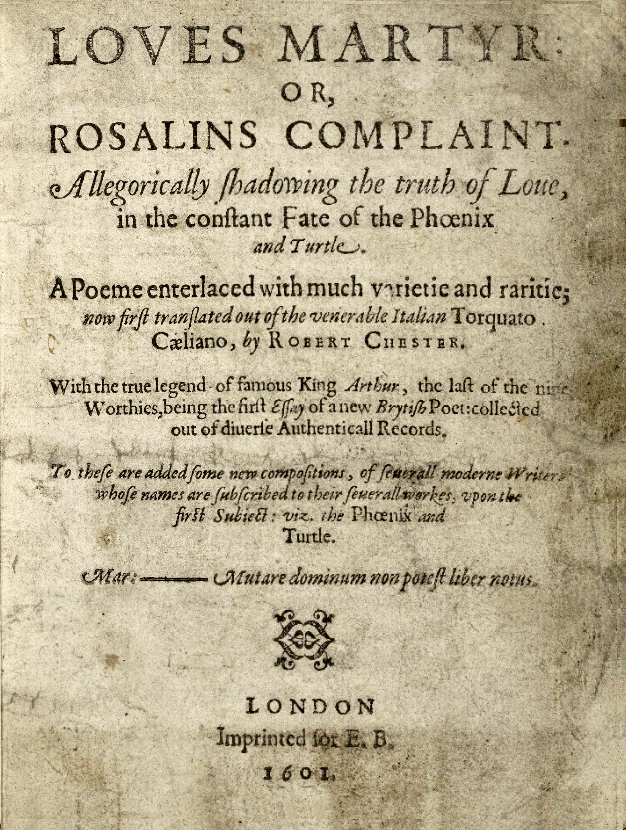
The title page of the original edition of Chester's Love's Martyr explains its content:
Love's Martyr: or Rosalins Complaint. Allegorically shadowing the truth of Loue, in the constant Fate of the Phoenix and Turtle. A Poeme enterlaced with much varietie and raritie; now first translated out of the venerable Italian Torquato Caeliano, by Robert Chester. With the true legend of famous King Arthur the last of the nine Worthies, being the first Essay of a new Brytish Poet: collected out of diuerse Authenticall Records. To these are added some new compositions of seuerall moderne Writers whose names are subscribed to their seuerall workes, vpon the first subiect viz. the Phoenix and Turtle.
Chester prefaced his poem with a short dedication addressed to the Phoenix and Turtledove. The Phoenix is envisaged as female and the dove as male:
Chester's main poem is a long allegory in which the relationship between the birds is explored, and its symbolism articulated. It incorporates the story of King Arthur, and a history of ancient Britain, emphasising Welsh etymologies for British towns. It culminates with the joint immolation of the Phoenix and Turtledove, giving birth to a new and more beautiful bird from the ashes. It also includes several allegorical love poems within it, supposed to have been written by the Turtledove to the Phoenix.
It is followed by a brief collection of "Diverse Poeticall Essaies" by the "best and chiefest of our moderne writers, with their names sub-scribed to their particular workes". These include, in addition to Shakespeare, Ben Jonson, George Chapman, John Marston and the anonymous "Vatum Chorus" and "Ignoto". All the poems use the same imagery. The series is introduced by Vatum Chorus and Ignoto, followed by Shakespeare's The Phoenix and the Turtle, which ends with mourning for the death of the perfect lovers, "leaving no posterity". Marston then seems to reply to Shakespeare's "moving epicedium", by referring to the couple's "glorious issue": the being born from the flames. Chapman adds more detail on the relationship, saying that the Phoenix provided every variety of life to the Turtle, "She was to him the Analysed World of pleasure, / Her firmness cloth'd him in variety". Jonson ends with an idealisation of the Phoenix, whose judgment shines as "Clear as a naked Vestal, / Closed in an orb of Crystal."
Hub AI
The Phoenix and the Turtle AI simulator
(@The Phoenix and the Turtle_simulator)
The Phoenix and the Turtle
The Phoenix and the Turtle (also spelled The Phœnix and the Turtle) is an allegorical poem by William Shakespeare, first published in 1601 as a supplement to a longer work, Love's Martyr, by Robert Chester. The poem, which has been called "the first great published metaphysical poem", has many conflicting interpretations. The title "The Phoenix and the Turtle" is a conventional label. As published, the poem was untitled. The title names two birds: the mythological phoenix and the turtle dove.
The 67-line poem describes a funeral arranged for the deceased Phoenix and Turtledove, to which some birds are invited, but others excluded. The Phoenix and Turtledove are emblems of perfection and of devoted love, respectively. The traditional attribute of the Phoenix is that when it dies, it returns to life, rising from the ashes of its prior incarnation; the Turtledove, by contrast, is mortal. The poem states that the love of the birds created a perfect unity which transcended all logic and material fact. It concludes with a prayer for the dead lovers.
The Phoenix and the Turtle was first published in 1601, as part of a collection of poems by different authors, including John Marston, George Chapman, and Ben Jonson, which was appended as a supplement to Love's Martyr, a long poem by Robert Chester printed by Richard Field for the London bookseller Edward Blount. The unused sheets of the first quarto were subsequently acquired by another publisher, Matthew Lownes, and reissued in 1611 under a different title, The Annuals of Great Britain. The poem did not appear in print again until 1640, when it was included in John Benson's collected edition of Shakespeare's poems, Poems Written by Wil. Shake-speare, Gent.
The title page of the original edition of Chester's Love's Martyr explains its content:
Love's Martyr: or Rosalins Complaint. Allegorically shadowing the truth of Loue, in the constant Fate of the Phoenix and Turtle. A Poeme enterlaced with much varietie and raritie; now first translated out of the venerable Italian Torquato Caeliano, by Robert Chester. With the true legend of famous King Arthur the last of the nine Worthies, being the first Essay of a new Brytish Poet: collected out of diuerse Authenticall Records. To these are added some new compositions of seuerall moderne Writers whose names are subscribed to their seuerall workes, vpon the first subiect viz. the Phoenix and Turtle.
Chester prefaced his poem with a short dedication addressed to the Phoenix and Turtledove. The Phoenix is envisaged as female and the dove as male:
Chester's main poem is a long allegory in which the relationship between the birds is explored, and its symbolism articulated. It incorporates the story of King Arthur, and a history of ancient Britain, emphasising Welsh etymologies for British towns. It culminates with the joint immolation of the Phoenix and Turtledove, giving birth to a new and more beautiful bird from the ashes. It also includes several allegorical love poems within it, supposed to have been written by the Turtledove to the Phoenix.
It is followed by a brief collection of "Diverse Poeticall Essaies" by the "best and chiefest of our moderne writers, with their names sub-scribed to their particular workes". These include, in addition to Shakespeare, Ben Jonson, George Chapman, John Marston and the anonymous "Vatum Chorus" and "Ignoto". All the poems use the same imagery. The series is introduced by Vatum Chorus and Ignoto, followed by Shakespeare's The Phoenix and the Turtle, which ends with mourning for the death of the perfect lovers, "leaving no posterity". Marston then seems to reply to Shakespeare's "moving epicedium", by referring to the couple's "glorious issue": the being born from the flames. Chapman adds more detail on the relationship, saying that the Phoenix provided every variety of life to the Turtle, "She was to him the Analysed World of pleasure, / Her firmness cloth'd him in variety". Jonson ends with an idealisation of the Phoenix, whose judgment shines as "Clear as a naked Vestal, / Closed in an orb of Crystal."