



Community hub
0 subscribers7 pages, 0 posts
Recent from talks
All channels
Be the first to start a discussion here.
Be the first to start a discussion here.
Be the first to start a discussion here.
Be the first to start a discussion here.
Contribute something
Welcome to the community hub built to collect knowledge and have discussions related to The Reptile House E.P..
Nothing was collected or created yet.
The Reptile House E.P.
View on Wikipediafrom Wikipedia
| The Reptile House E.P. | ||||
|---|---|---|---|---|
 | ||||
| EP by | ||||
| Released | 16 May 1983 | |||
| Recorded | 1983 | |||
| Genre | ||||
| Length | 25:12 | |||
| Label |
| |||
| Producer | Andrew Eldritch | |||
| The Sisters of Mercy chronology | ||||
| ||||
The Reptile House E.P. is the second independent EP by the Sisters of Mercy, released on 12" vinyl in May 1983 on the band's own label, Merciful Release. The EP was never released as a stand-alone CD, but was included on the Some Girls Wander by Mistake collection.
The EP was the band's second release in the US, issued by Brain Eater Records (of Island Park, New York) on 10 July 1983.[1] Brain Eater had previously issued the band's "Alice" EP earlier that year. The EP was rereleased on vinyl on April 22, 2023 (Record Store Day).[2]
Artist's commentary
[edit]- Andrew Eldritch (1983/92): "I thought 'The Reptile House' was our finest hour yet because it was the most serious record we ever made, but it was also the most perverse. Everything about that record is perverse. It's really slow, it's really long, and I just love the way all the lead lines are hidden in the mix, involved in all the effects, completely submerged, you really have to fight with that record. And the last track starts like it's gonna be a sort of pop number and the voice just slithers back into the mix and the tune distorts itself, and then that's finished you just get a reprise of the beginning which brings you right back full circle. It's a very perverse record. It's part of the concept of the thing, that there's no escape from The Reptile House. But a lot of this does go over people's heads, they just think,'Ah yeah, a long, slow record!'"[3] “On records like 'Reptile House' or 'Temple of Love' they [Gary Marx and Craig Adams] didn't even play. They weren't into recording that much, they just wanted to play live. They were sleeping in some corner until I woke them up after I had played and recorded everything on my own. When they asked me how their guitar and bass parts had turned out, I used to say to them they performed very well. Gary didn't even listen to 'The Reptile House EP' until it had been released on vinyl and I handed it to him with the words, 'This is our new record, you'll like it!'"[4]
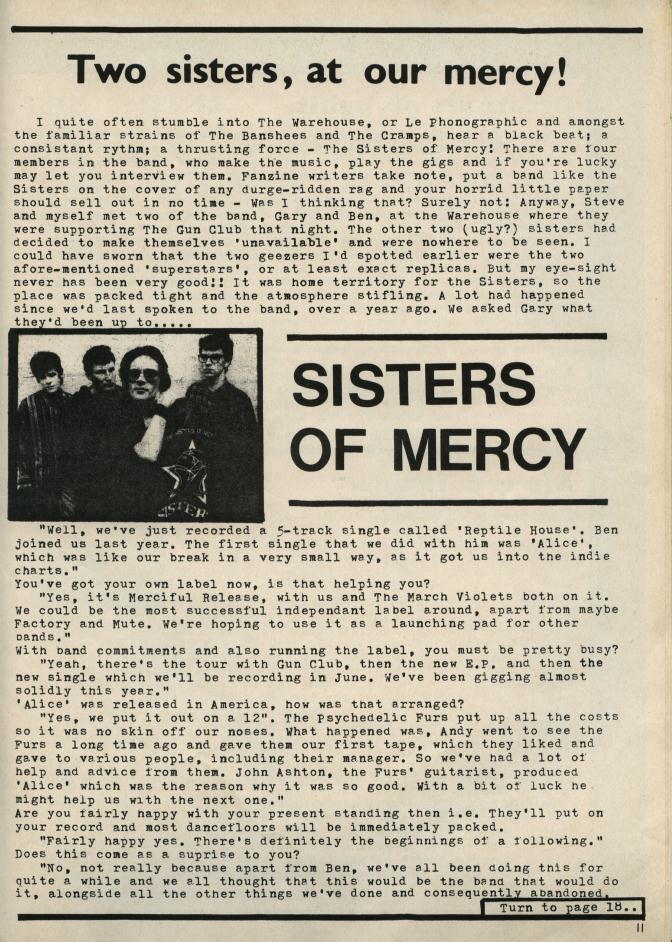
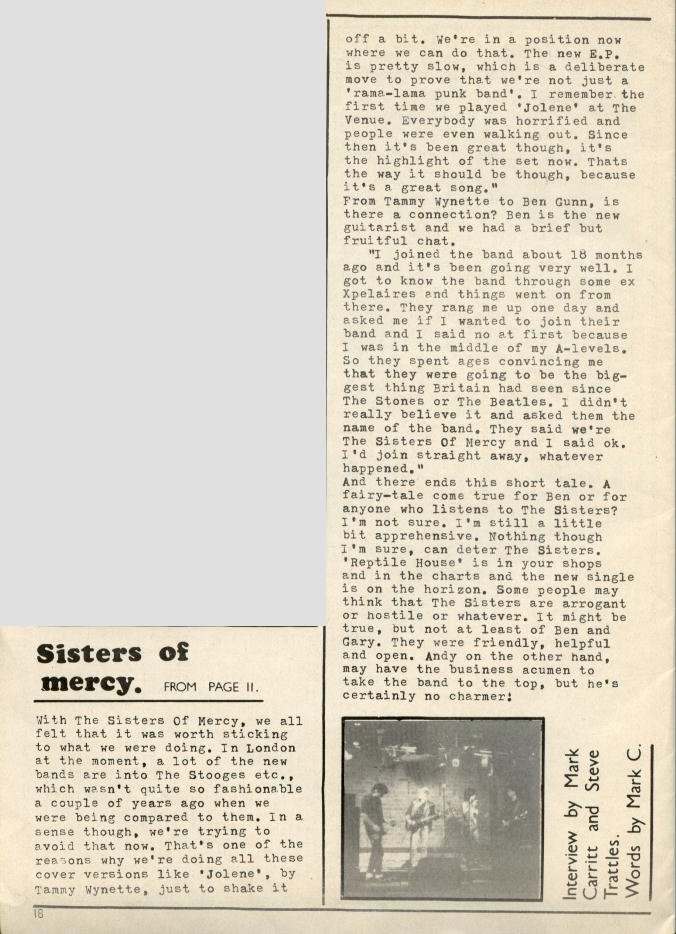
- Gary Marx (1983): "The new EP is pretty slow, which is a deliberate move to prove what we're not just a rama-lama punk band."[5][6]
Track listing
[edit]All tracks are written by Andrew Eldritch.
| No. | Title | Length |
|---|---|---|
| 1. | "Kiss the Carpet" (labeled as "Kiss" in the track listing) | 5:55 |
| 2. | "Lights" | 5:51 |
| 3. | "Valentine" | 4:44 |
| 4. | "Fix" | 3:41 |
| 5. | "Burn" | 4:49 |
| 6. | "Kiss the Carpet (Reprise)" (omitted from track listing) | 0:36 |
Personnel
[edit]- Andrew Eldritch – vocals, guitar
- Craig Adams – bass guitar
- Ben Gunn – guitar
- Gary Marx – guitar
- Doktor Avalanche (drum machine) – drums
Charts
[edit]| Chart (2023) | Peak position |
|---|---|
| Hungarian Albums (MAHASZ)[7] | 28 |
| Scottish Albums (OCC)[8] | 87 |
| UK Physical Albums (OCC)[9] | 91 |
References
[edit]- ^ Release date according to United States Copyright Office website
- ^ "RSD '23 Special Release: The Sisters of Mercy - the Reptile House".
- ^ Andrew Eldritch interview, WNYU-FM radio, New York, 19 September 1983
- ^ Marcel Anders: Andrew Eldritch interview, Visions magazine, Germany, 1992
- ^ "Two sisters, at our mercy! (part one)". Ultimatesistersguide.org. Retrieved 2014-05-22.
- ^ "Two sisters, at our mercy! (part two)". Ultimatesistersguide.org. Retrieved 2014-05-22.
- ^ "Album Top 40 slágerlista – 2023. 17. hét" (in Hungarian). MAHASZ. Retrieved 5 May 2023.
- ^ "Official Scottish Albums Chart Top 100". Official Charts Company. Retrieved 29 April 2023.
- ^ "Official Physical Albums Chart Top 100: 28 April 2023 – 04 May 2023". Official Charts Company. Retrieved 29 April 2023.

The Reptile House E.P.
View on Grokipediafrom Grokipedia
Background and Production
Conception and Development
The Reptile House E.P. represented the second independent release by the English rock band The Sisters of Mercy, following their debut EP Alice, released in March 1983. Issued on the band's self-founded Merciful Release label, it emerged during a period of intense creative activity in Leeds' post-punk and emerging goth scenes, where economic hardship under Thatcherism fostered a strong DIY ethos among local musicians. Bands like The Sisters rehearsed in makeshift spaces such as damp cellars and shared venues like The Phono, emphasizing self-reliance through independent labels, fanzines, and minimal resources to produce and distribute music outside major industry structures.[4][5] The EP's development occurred within the band's core lineup at the time: Andrew Eldritch on vocals and guitar, Gary Marx and Ben Gunn on guitars, Craig Adams on bass, and the Roland TR-808 drum machine credited as Doktor Avalanche. However, the recording was primarily handled by Eldritch and Gunn. This configuration reflected the group's early experimental approach, with Eldritch exerting significant creative control as the primary songwriter and producer. Operating from their base at 7 Village Place in Leeds—a multifunctional hub for rehearsals, label operations, and social gatherings—the band cultivated an insular, academic environment that prioritized precision over punk's raw immediacy.[4][6][7] Andrew Eldritch envisioned The Reptile House E.P. as a substantial artistic statement, emphasizing slow, sparse compositions that subverted rock and punk conventions through deliberate pacing and layered, often subtle guitar lines. Former members have recalled Eldritch's methodical process, spending days refining elements like guitar overdubs to create a dense yet restrained sound, drawing thematic influences from literature and film to explore heavy concepts such as romance intertwined with violence. This approach tested the band's resolve, particularly in live settings where the material's brooding tempo challenged audience expectations in the energetic post-punk milieu.[7]Recording Process
The Reptile House E.P. was produced entirely by Andrew Eldritch in early 1983, with pre-production handled using a Portastudio at the band's headquarters in Leeds before principal recording took place at KG Music Studios in Bridlington.[7] Eldritch oversaw all aspects of the sessions, emphasizing a minimalistic setup that relied heavily on the drum machine—Doktor Avalanche, a Roland TR-808 programmed by the band—to drive the rhythm section, allowing for a stark, mechanical pulse that defined the EP's foundation.[7] The production incorporated reverb-heavy guitar layers from Eldritch and Ben Gunn, combined with deliberately slow tempos to cultivate a claustrophobic, immersive atmosphere, achieved through experimentation with noise gates, delays, and multi-tracking on the limited studio equipment.[7] Gunn contributed guitars to the sessions before departing during a U.S. tour in late 1983 amid growing tensions.[7] Tracks were sequenced to evoke a cohesive "mini-album" experience despite the EP format, flowing from the brooding opener "Kiss the Carpet" through atmospheric interludes to the closing reprise of that track as a haunting coda, reinforcing thematic unity.[2] The process faced challenges from lineup instability, including Gunn's imminent exit, and the band's deliberate rejection of major label overtures to retain full creative control via their independent Merciful Release imprint.[7]Musical Style and Content
Musical Characteristics
The Reptile House E.P. features predominant slow to mid-tempos, often ranging from 74 to 135 BPM across its tracks, which contrasts with the faster rhythms of contemporary punk influences and imparts a hypnotic, dirge-like quality to the overall sound.[8][9] This deliberate pacing creates a creeping, lethargic atmosphere that draws listeners into a nocturnal, immersive experience, emphasizing mood over urgency.[3][10] Central to the EP's sonic backbone is the heavy reliance on the Doktor Avalanche drum machine, providing a mechanical, rhythmic foundation that underscores the tracks with unyielding, echoing beats. Layered atop this are the reverberant, rattling guitars from Gary Marx and Ben Gunn, which weave sparse, atmospheric textures rather than driving riffs, complemented by Craig Adams's minimal bass lines that add depth without overcrowding the mix.[2][4][11] This instrumentation evokes a sense of enclosure and tension, mirroring the EP's titular "reptile house" theme through its muffled, creeping progression. The production emphasizes atmospheric elements, with buried melodies emerging from layers of reverb and echo, fostering a raw yet enveloping goth rock aesthetic that positions the EP as a pivotal bridge between post-punk's angular urgency and the genre's emerging dark romanticism.[12][13] These choices laid foundational influences for the band's subsequent album First and Last and Always, refining the hypnotic interplay of machine-driven rhythm and sonic haze into a more polished goth framework.[14]Lyrical Themes
The lyrics of The Reptile House E.P. delve into motifs of isolation, decay, and urban alienation, capturing a sense of emotional and societal entrapment amid post-industrial Britain's gloom. Andrew Eldritch's writing evokes a confined, primal underbelly of human experience, mirroring the EP's titular "reptile house"—a zoo enclosure symbolizing the caged elemental evil within the mind. These themes manifest through fragmented imagery of societal breakdown, where individuals grapple with disconnection in a decaying urban landscape, as seen in the broader introspective and detached tone across the tracks.[15][16] In "Fix," addiction and entrapment dominate, with lines like "Love for the fix for the fabrication / Love for the corpse for the corporation" juxtaposing personal dependency against corporate and political decay, using ribald rhymes to underscore a love-hate bind in modern life.[17] Similarly, "Burn" channels destructive passion through repetitive invocations of fire and chaos in the "reptile house," such as "Burn me a fire in the reptile house / In the colour and the carnage, fall me down," portraying an overwhelming, consuming intensity that crashes relationships and self-perception.[18] "Valentine" amplifies urban alienation and decay, depicting famine-stricken masses "on their knees" and "eating each other" amid war and media violence—"A people fed on famine / A people on their knees"—with literary nods to T.S. Eliot's themes of societal despair, possibly alluding to the Falklands War and 1981 Royal Wedding's hollow spectacle.[19][15] "Lights" explores themes of elusive connections and nocturnal disorientation in the city, with lyrics like "There's a light that's burning / In the city tonight" evoking fleeting hopes amid shadows and isolation.[20] Eldritch employs a cryptic, poetic style laced with religious undertones, favoring restraint and implication over explicit narrative; verses build minimalistic tension through stark imagery, erupting into intense, repetitive choruses that heighten emotional isolation without resolution.[16] In "Valentine," sacrifice emerges subtly in the valentine as a redemptive figure amid violence—"Waiting for another war and / Waiting for my valentine"—evoking kneeling supplication and hollow smiles in a bureaucratized world of "cancer for my education."[19] This approach, rich in layered references, distinguishes the EP's lyrics from generic goth vagueness, prioritizing interpretive depth.[16] Literary influences infuse the EP's druggy, introspective haze, with Eldritch's fragmented narratives drawing parallels to William Burroughs' raw style, contributing to the sense of disorientation in tracks like "Kiss the Carpet," where amphetamine metaphors blend with surreal domestic collapse—"She got red eyes / She wear dust / I kissed, I kissed the carpet."[16][21] The slow pacing of the music further amplifies this moody restraint, allowing lyrical confinement to linger.[16]Release and Commercial Performance
Original Release
The Reptile House E.P. was first released on 16 May 1983 in the United Kingdom through the band's independent label, Merciful Release, bearing the catalog number MR023 and issued exclusively as a 12-inch vinyl EP.[1] The first run included an insert lyric sheet printed with the label's Leeds address.[22] This format emphasized the EP's status as a collector's item within the post-punk and goth underground, aligning with the band's control over their early output following the completion of recording sessions earlier that year. A United States edition followed on 10 July 1983, distributed by the independent label Brain Eater Records, marking the EP's initial transatlantic availability without major label involvement.[22] The cover artwork consisted of a stark black-and-white photograph depicting a reptile enclosure, visually reinforcing the EP's evocative title and themes of confinement and otherworldliness.[1] Promotion for the original release eschewed traditional singles or advertising campaigns, instead positioning the EP as a "mini-album" to generate buzz among independent music scenes and goth enthusiasts.[2] Support came primarily through the band's live performances on the UK goth circuit, where tracks from the EP were integrated into sets at clubs and venues frequented by the subculture. The release received no mainstream radio airplay, consistent with the Sisters of Mercy's deliberate anti-commercial approach that prioritized artistic autonomy over broader accessibility.[4]Reissues and Chart Performance
The Reptile House E.P. was first issued on CD in 1992 as part of the compilation album Some Girls Wander by Mistake, which gathered the band's early independent releases from 1980 to 1983, including all six tracks from the EP.[23] No standalone CD edition of the EP has been released to date, maintaining its primary association with vinyl and later digital formats. Marking the EP's 40th anniversary, a limited-edition reissue appeared on April 22, 2023, exclusively for Record Store Day, pressed on smoky grey vinyl at 4,500 copies worldwide.[24] Distributed by Warner Music under the Parlophone imprint, the reissue replicated the original 12-inch, 45 RPM format and included a poster insert featuring lyrics and artwork.[2] This marked the first vinyl pressing since the 1983 original, which had long been out of print and highly sought after by collectors.[25] The 2023 reissue renewed interest in the EP, contributing to its entry on several European album charts that year, peaking at number 28 on the Hungarian Albums Chart, number 87 on the Scottish Albums Chart, and number 91 on the UK Physical Albums Chart, though it did not chart upon its initial 1983 release. Since the early 2010s, the EP has been widely available on major digital streaming platforms such as Spotify and Apple Music, enhancing its reach to contemporary audiences beyond physical media.Reception and Legacy
Critical Reviews
Upon its 1983 release, The Reptile House E.P. received praise in music publications for its evolving sound and atmospheric qualities, marking a refinement from the band's earlier work. In a Trouser Press review, the EP was noted for its improved production and clearer group identity, incorporating danceable rhythms within a doom-rock framework that extended the band's reach beyond initial post-punk roots.[26] A contemporary assessment in New Musical Express by Mat Snow evoked the EP's somber, evocative tone, opening with imagery of "DEEP IN the woods a funeral is swinging," highlighting its funereal pace and depth as a pioneering effort in gothic rock.[27] Reviewers positioned it as a goth trailblazer, with later analyses crediting its role in defining the genre's sonic palette. Retrospective critiques have acclaimed the EP as a cornerstone of gothic music, with Dave Thompson's book The Dark Reign of Gothic Rock describing it as encapsulating "all that Gothic Rock would ever become," serving as a blueprint for countless subsequent bands through its meticulous construction.[28] Thompson highlights Andrew Eldritch's innovative use of the Roland TR-606 drum machine—dubbed "Doktor Avalanche"—with extensive EQ tweaking to craft distinctive, brooding percussion that influenced the genre's mechanical edge.[29] Views on the EP's accessibility remain mixed, with some critics interpreting its deliberate slowness and immersion as pretentious, while others view it as an intentional anti-punk declaration emphasizing mood over velocity; AllMusic assigns it an 8.8/10 rating, commending its enveloping atmospheric immersion.[30] The 2023 Record Store Day reissue on smoky gray vinyl, limited to 4,500 copies, underscored its enduring appeal, with outlets like Post-Punk.com noting its timeless influence on industrial and post-punk acts.[6][2]Cultural Impact
The Reptile House E.P. is widely regarded as a cornerstone of goth rock, its dark, mechanical sound encapsulating the genre's core elements and serving as a blueprint for future developments. Music historian Dave Thompson has described the EP as distilling "all that gothic rock would ever become" into its six tracks, highlighting how it influenced the atmospheric intensity and thematic depth that defined the subgenre. This influence extended to later acts, including The Mission, formed in 1986 by former Sisters of Mercy members Wayne Hussey and Craig Adams, who drew on the EP's brooding style to shape their own gothic rock sound.[16][31] Among fans, the EP holds a favored status as one of The Sisters of Mercy's most cherished releases, often praised for representing the band's raw early aesthetic, with the title "Reptile House" evolving into shorthand for their inaugural goth phase. Its role in genre evolution is evident in how it bridged post-punk's angular energy with emerging industrial and goth hybrids, fostering a sonic template for underground experimentation. Tracks such as "Fix" have seen covers by various artists in niche scenes, sustaining its resonance in alternative music circles.[3] The EP's modern relevance was revitalized by its 2023 reissue on vinyl for Record Store Day, marking the 40th anniversary and prompting fresh tributes in music publications that underscored its enduring impact on goth subculture. This edition, featuring the original lineup's contributions, reignited discussions of its pioneering role, drawing new and longtime listeners to its shadowy allure.[6][25]Track Listing and Credits
Track Listing
The Reptile House E.P. consists of six tracks released on 12-inch vinyl, divided between Side A and Side B, with a total runtime of 25:38. The EP features no additional B-sides or alternate mixes in its original format. All tracks were written by Andrew Eldritch.[3] The final track, "Kiss the Carpet (Reprise)", serves as a short instrumental fade-out.[4]| Side | Track | Title | Writer(s) | Duration |
|---|---|---|---|---|
| A | 1 | "Kiss the Carpet" | Eldritch | 5:55 |
| A | 2 | "Lights" | Eldritch | 5:51 |
| B | 1 | "Valentine" | Eldritch | 4:44 |
| B | 2 | "Fix" | Eldritch | 3:42 |
| B | 3 | "Burn" | Eldritch | 4:50 |
| B | 4 | "Kiss the Carpet (Reprise)" | Eldritch | 0:36 |