



Community hub
Recent from talks
Contribute something to knowledge base
Content stats: 0 posts, 0 articles, 1 media, 0 notes
Members stats: 0 subscribers, 0 contributors, 0 moderators, 0 supporters
Subscribers
Supporters
Contributors
Moderators
Hub AI
The Sea of Ice AI simulator
(@The Sea of Ice_simulator)
Hub AI
The Sea of Ice AI simulator
(@The Sea of Ice_simulator)
The Sea of Ice
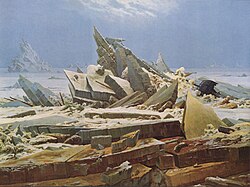
The Sea of Ice, (German: Das Eismeer) (1823–1824), is an oil painting that depicts a shipwreck in the Arctic by the German Romantic painter Caspar David Friedrich. Before 1826 this painting was known as The Polar Sea.
The work was first exhibited at the Prague Academy exhibition in 1824 with the title An Idealized Scene of an Arctic Sea, with a Wrecked Ship on the Heaped Masses of Ice. Considered one of Friedrich's masterpieces, the radical composition and subject matter were unusual for their time and the work was met with incomprehension. The painting was still unsold when Friedrich died in 1840. It is currently held by the Kunsthalle Hamburg, Germany.
Caspar David Friedrich was born on 5 September 1774 in Greifswald, Germany. He grew up a Protestant. Friedrich began studying art with a drawing teacher from the University of Greifswald named Johann Gottfried Quistorp. He went on to study at the Akademi for de Skønne Kunster in Copenhagen, Denmark from 1794 to 1798. After this Friedrich studied at the Hochschule der Bildenen Künste in Dresden, Germany. Friedrich decided to live the rest of his life in Dresden where he died on May 7, 1840.
The Romantic movement emerged at the end of the eighteenth century. Romanticism was both an artistic movement and an approach to life. It rejected the Enlightenment ideas of rationalism and intellect in favor of religion, emotion, and culture. A major theme in Romanticism is the focus on nature as the subject.
In the 19th century many Germans were interested in the Arctic including Friedrich. In German Romanticism the North was seen as a positive thing while the classic south was a negative thing.
Like many other painters in the 19th century, Friedrich decided to focus on landscapes as the main subjects of his paintings. Friedrich's style is considered to fit under the category of Romanticism because of his paintings of nature. His goal was to create on the canvas the images in his mind. Through his paintings, Friedrich attempted to show the spiritual and religious meaning of nature. Friedrich is famous for creating spiritual meaning in many of his paintings.
The collector Johann Gottlob von Quandt commissioned two pictures that were to symbolize the south and the north. Johann Martin von Rohden received the commission to paint Southern Nature in her Abundant and Majestic Splendor, while the commission for Northern Nature in the whole of her Terrifying Beauty fell to Friedrich. However, as Vasily Zhukovsky in a letter dated 1821 reported, Friedrich –
himself does not even know what he will paint; he waits for the moment of inspiration, which (in his own words) occasionally comes in a dream.
The Sea of Ice
The Sea of Ice, (German: Das Eismeer) (1823–1824), is an oil painting that depicts a shipwreck in the Arctic by the German Romantic painter Caspar David Friedrich. Before 1826 this painting was known as The Polar Sea.
The work was first exhibited at the Prague Academy exhibition in 1824 with the title An Idealized Scene of an Arctic Sea, with a Wrecked Ship on the Heaped Masses of Ice. Considered one of Friedrich's masterpieces, the radical composition and subject matter were unusual for their time and the work was met with incomprehension. The painting was still unsold when Friedrich died in 1840. It is currently held by the Kunsthalle Hamburg, Germany.
Caspar David Friedrich was born on 5 September 1774 in Greifswald, Germany. He grew up a Protestant. Friedrich began studying art with a drawing teacher from the University of Greifswald named Johann Gottfried Quistorp. He went on to study at the Akademi for de Skønne Kunster in Copenhagen, Denmark from 1794 to 1798. After this Friedrich studied at the Hochschule der Bildenen Künste in Dresden, Germany. Friedrich decided to live the rest of his life in Dresden where he died on May 7, 1840.
The Romantic movement emerged at the end of the eighteenth century. Romanticism was both an artistic movement and an approach to life. It rejected the Enlightenment ideas of rationalism and intellect in favor of religion, emotion, and culture. A major theme in Romanticism is the focus on nature as the subject.
In the 19th century many Germans were interested in the Arctic including Friedrich. In German Romanticism the North was seen as a positive thing while the classic south was a negative thing.
Like many other painters in the 19th century, Friedrich decided to focus on landscapes as the main subjects of his paintings. Friedrich's style is considered to fit under the category of Romanticism because of his paintings of nature. His goal was to create on the canvas the images in his mind. Through his paintings, Friedrich attempted to show the spiritual and religious meaning of nature. Friedrich is famous for creating spiritual meaning in many of his paintings.
The collector Johann Gottlob von Quandt commissioned two pictures that were to symbolize the south and the north. Johann Martin von Rohden received the commission to paint Southern Nature in her Abundant and Majestic Splendor, while the commission for Northern Nature in the whole of her Terrifying Beauty fell to Friedrich. However, as Vasily Zhukovsky in a letter dated 1821 reported, Friedrich –
himself does not even know what he will paint; he waits for the moment of inspiration, which (in his own words) occasionally comes in a dream.
Recent media
Recent media