Hubbry Logo
GreifswaldGreifswaldMain
Open search
Greifswald
Community hub
Greifswald
logo
8 pages, 0 posts
0 subscribers
Be the first to start a discussion here.
Greifswald
Greifswald
from Wikipedia

Greifswald (German pronunciation: [ˈɡʁaɪfsvalt] ; Low German: Griepswold), officially the University and Hanseatic City of Greifswald (German: Universitäts- und Hansestadt Greifswald) is the fourth-largest city in the German state of Mecklenburg-Western Pomerania after Rostock, Schwerin and Neubrandenburg. In 2021 it surpassed Stralsund for the first time, and became the largest city in the Pomeranian part of the state. It sits on the River Ryck, at its mouth into the Danish Wiek, a sub-bay of the Bay of Greifswald, which is itself a sub-bay of the Bay of Pomerania of the Baltic Sea.

Key Information

It is the seat of the district of Western Pomerania-Greifswald, and is located roughly in the middle between the two largest Pomeranian islands of Rügen and Usedom. The closest larger cities are Stralsund, Rostock, Szczecin and Schwerin. It lies west of the River Zarow, the historical cultural and linguistic boundary between West (west of the river) and Central Pomerania (east of the river). The city derives its name from the dukes of Pomerania, the House of Griffin, and thus ultimately from the Pomeranian Griffin, and its name hence translates as "Griffin's Forest".

The University of Greifswald, which was founded in 1456, is the second-oldest university in the Baltic Region after the University of Rostock. The city is well-known for the ruins of Eldena Abbey (formerly Hilda Abbey), a frequent subject of the paintings of Caspar David Friedrich, who was born in the city when it was part of Swedish Pomerania. Greifswald is the seat of the Pomeranian State Museum (Pommersches Landesmuseum). The recently built Ryck Barrier (Rycksperrwerk) protects the city from exceptionally high tides and storm surges moving up from the Baltic.

The city's population was listed at 59,332 in 2021, including many of the 12,500 students and 5,000 employees of the University of Greifswald. Greifswald draws international attention due to the university, its surrounding BioCon Valley, the Nord Stream 1 gas pipeline which ends at nearby Lubmin, and the Wendelstein 7-X nuclear fusion projects.

Geography

[edit]

Greifswald is located in the northeast of Germany, approximately equidistant from Germany's two largest islands, Rügen and Usedom. The city is situated at the south end of the Bay of Greifswald, the historic centre being about five kilometres (three miles) up the river Ryck that crosses the city. The area around Greifswald is mainly flat, and hardly reaches more than 20 m above sea level. Two islands, Koos and Riems, are also part of Greifswald. Three of Germany's fourteen national parks can be reached by car in one hour or less from Greifswald.

Greifswald is also roughly equidistant from Germany's two largest cities, Berlin (240 km or 150 mi) and Hamburg (260 km or 160 mi). The nearest larger cities are Stralsund and Rostock.

The coastal part of Greifswald at the mouth of the Ryck, named Greifswald-Wieck, evolved from a fishing village. Today it provides a small beach, a marina and the main port for Greifswald.

Climate

[edit]

Greifswald features an oceanic climate with some humid continental influence. Summers are pleasantly warm, although chilly at night. Due to its coastal location, heatwaves in Greifswald tend to be less extreme than other nearby locations inland. Winters are mild to cold, with occasional cold fronts coming in from Scandinavia or Siberia. Precipitation is spread throughout the year and comparatively low by German standards, while sunshine hours are above the German average.

Climate data for Greifswald (1991–2020 normals, extremes since 1975)
Month Jan Feb Mar Apr May Jun Jul Aug Sep Oct Nov Dec Year
Record high °C (°F) 15.1
(59.2)
18.4
(65.1)
21.2
(70.2)
28.6
(83.5)
32.1
(89.8)
36.6
(97.9)
35.6
(96.1)
36.5
(97.7)
30.4
(86.7)
25.7
(78.3)
19.1
(66.4)
14.1
(57.4)
36.6
(97.9)
Mean maximum °C (°F) 9.7
(49.5)
10.9
(51.6)
15.8
(60.4)
21.8
(71.2)
25.9
(78.6)
28.9
(84.0)
30.0
(86.0)
30.5
(86.9)
25.1
(77.2)
19.7
(67.5)
14.1
(57.4)
10.3
(50.5)
32.3
(90.1)
Mean daily maximum °C (°F) 3.3
(37.9)
4.2
(39.6)
7.5
(45.5)
12.5
(54.5)
16.9
(62.4)
20.3
(68.5)
22.7
(72.9)
22.8
(73.0)
18.5
(65.3)
13.2
(55.8)
7.5
(45.5)
4.2
(39.6)
12.8
(55.0)
Daily mean °C (°F) 1.1
(34.0)
1.6
(34.9)
4.0
(39.2)
8.1
(46.6)
12.4
(54.3)
15.9
(60.6)
18.1
(64.6)
18.0
(64.4)
14.2
(57.6)
9.6
(49.3)
5.2
(41.4)
2.2
(36.0)
9.2
(48.6)
Mean daily minimum °C (°F) −1.2
(29.8)
−1.0
(30.2)
0.6
(33.1)
3.9
(39.0)
7.7
(45.9)
11.2
(52.2)
13.7
(56.7)
13.5
(56.3)
10.3
(50.5)
6.3
(43.3)
2.7
(36.9)
0.0
(32.0)
5.6
(42.1)
Mean minimum °C (°F) −9.7
(14.5)
−8.6
(16.5)
−5.4
(22.3)
−1.8
(28.8)
2.0
(35.6)
6.4
(43.5)
9.6
(49.3)
8.8
(47.8)
5.1
(41.2)
−0.2
(31.6)
−3.5
(25.7)
−7.6
(18.3)
−12.9
(8.8)
Record low °C (°F) −23.1
(−9.6)
−23.2
(−9.8)
−19.1
(−2.4)
−6.7
(19.9)
−1.8
(28.8)
3.0
(37.4)
7.0
(44.6)
5.2
(41.4)
2.0
(35.6)
−4.6
(23.7)
−12.1
(10.2)
−17.4
(0.7)
−23.2
(−9.8)
Average precipitation mm (inches) 45.7
(1.80)
36.9
(1.45)
39.0
(1.54)
32.3
(1.27)
52.3
(2.06)
60.5
(2.38)
67.1
(2.64)
71.7
(2.82)
52.3
(2.06)
49.9
(1.96)
43.3
(1.70)
48.4
(1.91)
599.4
(23.60)
Average precipitation days (≥ 0.1 mm) 16.6 15.1 13.4 11.2 12.5 13.2 14.4 13.4 12.8 15.7 15.7 17.1 171.2
Average snowy days (≥ 1.0 cm) 8.6 9.8 5.0 0.4 0 0 0 0 0 0 1.2 5.2 30.2
Average relative humidity (%) 85.8 83.2 79.2 74.9 74.5 73.9 74.8 76.1 80.1 83.6 87.4 87.6 80.1
Mean monthly sunshine hours 47.4 67.5 127.2 196.6 243.7 239.0 242.4 217.2 162.2 110.2 50.7 35.7 1,739.7
Source 1: World Meteorological Organization[3]
Source 2: Infoclimat[4]

History

[edit]

Early history

[edit]

Greifswald was founded in 1199 when Cistercian monks founded the Eldena Abbey.[5] In 1250, Wartislaw III, Duke of Pomerania, granted town privileges to Greifswald according to the Lübeck law.[5]

Middle Ages and Reformation

[edit]
Medieval Fangenturm (Prisoners' Tower), Greifswald
Eldena Abbey was founded in 1199. Today only its ruins remain.
The eastern side of the historic city centre (seen from the cathedral tower)

In medieval times, the site of Greifswald was an unsettled woodland which marked the border between the Danish Principality of Rügen and the Pomeranian County of Gützkow, which at that time was also under Danish control. In 1199, the Rugian Prince Jaromar I allowed Danish Cistercian monks to build Hilda Abbey, now Eldena Abbey, at the mouth of the River Ryck. Among the lands granted the monks was a natural salt evaporation pond a short way up the river, a site also crossed by an important south–north via regia trade route. This site was named Gryp(he)swold(e), which is the Low German precursor of the city's modern name – which means "Griffin's Forest." Legend says the monks were shown the best site for settlement by a mighty griffin living in a tree that supposedly grew on what became Greifswald's oldest street, the Schuhagen. The town's construction followed a scheme of rectangular streets, with church and market sites reserved in central positions. It was settled primarily by Germans in the course of the Ostsiedlung, but settlers from other nations and Wends from nearby were attracted, too.

The salt trade helped Eldena Abbey to become an influential religious center, and Greifswald became a widely known market. When the Danes had to surrender their Pomeranian lands south of the Ryck, after losing the Battle of Bornhöved in 1227, the town succeeded to the Pomeranian dukes. In 1241, the Rugian prince Wizlaw I and the Pomeranian duke Wartislaw III both granted Greifswald market rights. In 1250, the latter granted the town a charter under Lübeck law, after he had been permitted to acquire the town site as a fief from Eldena Abbey in 1248.

When Jazco of Salzwedel from Gützkow founded a Franciscan friary within the walls of Greifswald, the Cistercians at Eldena lost much of their influence on the city's further development. Just beyond Greifswald's western limits, a town-like suburb (Neustadt) arose, separated from Greifswald by a ditch. In 1264, Neustadt was incorporated and the ditch was filled in.

Eldena Abbey and the major buildings of Greifswald were erected in the North German Brick Gothic (Backsteingotik) style, found along the entire southern coast of the Baltic.

Due to a steady population increase, Greifswald became at the end of the 13th century one of the earliest members of the Hanseatic League, which further increased its trade and wealth. After 1296, Greifswald's citizens no longer needed to serve in the Pomeranian army, and Pomeranian dukes did not reside in the city.

In 1456, Greifswald's mayor Heinrich Rubenow laid the foundations of one of the oldest universities in the world, the University of Greifswald, which was one of the first in Germany, and was, successively, the single oldest in Sweden and Prussia.

In the course of Reformation, Eldena Abbey ceased to function as a monastery. Its possessions fell to the Pomeranian dukes; the bricks of its Gothic buildings were used by the locals for other construction. Eldena lost its separate status and was later absorbed into the town of Greifswald. The religious houses within the town walls, the priories of the Blackfriars (Dominicans) in the northwest and the Greyfriars (Franciscans) in the southeast, were secularized. The buildings of the Dominicans (the "black monastery") were turned over to the university; the site is still used as part of the medical campus. The Franciscan friary ("the "grey monastery") and its succeeding buildings are now the Pomeranian State Museum.

During the Thirty Years' War, Greifswald was occupied by (Catholic) Imperial forces from 1627 to 1631,[6] and thereafter, under the Treaty of Stettin (1630), by (Protestant) Swedish forces.[7]

1631/48—1815: Sweden

[edit]
Bay of Greifswald
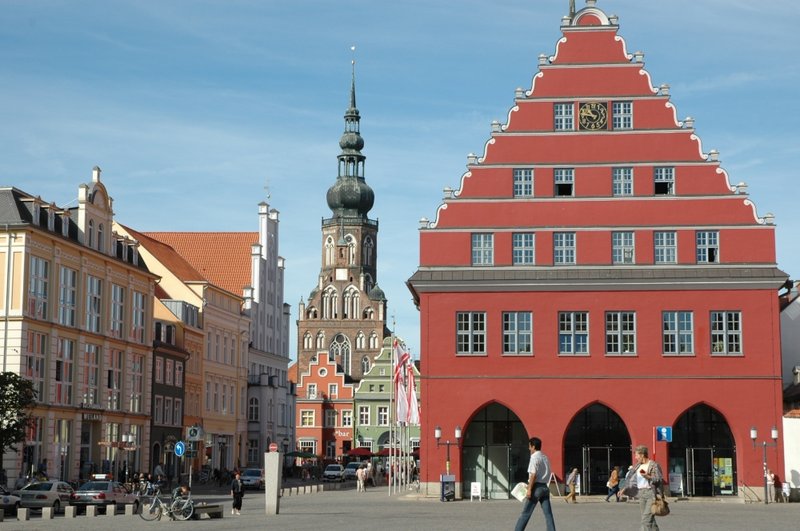
Greifswald's lively market square (Marktplatz)

During the Thirty Years' War, Swedish forces entered the Duchy of Pomerania in 1630.[6] Greifswald was besieged by Swedish troops on 12 June 1631[6] and surrendered on 16 June.[6] Gustavus Adolphus of Sweden had returned from Brandenburg to supervise the siege, and upon his arrival received the university's homage for the liberation from Catholic forces.[6] After the Thirty Years' War (1618–1648), Greifswald and the region surrounding it became part of the Kingdom of Sweden. Swedish Pomerania, as it was then called, remained part of the Swedish kingdom until 1815,[8] when it became part of the Kingdom of Prussia as the Province of Pomerania. In 1871, it devolved to Germany.

The Thirty Years' War had caused starvation throughout Germany, and by 1630 Greifswald's population had shrunk by two-thirds. Many buildings were left vacant and fell into decay. Soon, other wars followed: the Swedish-Polish War and the Swedish-Brandenburg War both involved the nominally Swedish town of Greifswald. In 1659 and 1678, Brandenburgian troops bombarded the town. The first bombardment hit mainly the northeast part of town, wrecking 16 houses. The second bombardment leveled 30 houses and damaged hundreds more all over the city. Cannonballs of this second bombardment can still be seen in the walls of St Mary's Church.

During the Great Northern War (1700–1721, Greifswald was compelled to house soldiers. While besieging neighboring Stralsund, Russian tsar Peter the Great allied with George I of Great Britain in the Treaty of Greifswald. Large fires in 1713 and 1736 destroyed houses and other buildings, including City Hall. The Swedish government had issued decrees in 1669 and 1689 absolving anyone of taxes who built or rebuilt a house. These decrees remained essentially in force, under Prussian administration, until 1824.[9]

In 1763, Greifswald Botanic Garden was founded.

The central market square (Marktplatz)

1815 – today: Germany

[edit]
Caspar David Friedrich (1774–1840) depicted his hometown in several paintings; this is Wiesen bei Greifswald (Meadows near Greifswald), 1820.
Woman at the 'fishers well', by Jo Jastram in the 20th century

During the 19th century, Greifswald attracted many Polish students.[10] After Breslau (now Wrocław, Poland) and Berlin, Greifswald hosted the third-largest group of Polish students in Germany.[11]

About 1900, the town – for the first time since the Middle Ages – expanded significantly beyond the old town walls. Also, a major railway connected Greifswald to Stralsund and Berlin; a local railway line further connected Greifswald to Wolgast.

The city survived World War II without much destruction, even though it housed a large German Army (Wehrmacht) garrison. During the war, in May 1940, the Stalag II-C prisoner-of-war camp was relocated to Greifswald from Dobiegniew, and it housed French, Belgian, Serbian and Soviet POWs with many sent to forced labor detachments in the region.[12] In the spring of 1945, the camp was evacuated to the west.[12] In April 1945, German Army Colonel (Oberst) Rudolf Petershagen defied orders and surrendered the city to the Red Army without a fight.

From 1949 to 1990, Greifswald was part of the German Democratic Republic (DDR). During this time, most historical buildings in the medieval parts of the city were neglected and a number of old buildings were pulled down. The population increased significantly, because of the construction of a nominal 1760 MW Soviet-made nuclear power plant in Lubmin, which was closed in the early 1990s. New suburbs were erected in the monolithic industrial socialist style (see Plattenbau). They still house most of the city's population.[citation needed] These new suburbs were placed east and southeast of central Greifswald, shifting the former town center to the northwestern edge of the modern town.

Reconstruction of the old town began in the late 1980s. Nearly all of it has been restored. Before that almost all of the old northern town adjacent to the port was demolished and subsequently rebuilt. The historic marketplace is considered one of the most beautiful in northern Germany. The town attracts many tourists, due in part to its proximity to the Baltic Sea.

Greifswald's greatest population was reached in 1988, with about 68,000 inhabitants, but it decreased afterward to 55,000, where it has now stabilized. Reasons for this included migration to western German cities as well as suburbanisation. However, the number of students quadrupled from 3,000 in 1990 to more than 11,000 in 2007 and the university employs 5,000 people; nearly one in three people in Greifswald are linked in some way to higher education.

Despite its relatively small population, Greifswald retains a supra-regional relevance linked to its intellectual role as a university town and to the taking of the central functions of the former Prussian Province of Pomerania after World War II, such as the seat of the bishop of the Pomeranian Lutheran Church, the state archives (Landesarchiv) and the Pomeranian Museum (Pommersches Landesmuseum). Three courts of the state of Mecklenburg-Vorpommern are also based at Greifswald:

Administrative division

[edit]
District
(modern)
District
(historical)
Amalgamation Size
(ha)
Population
„Innenstadt“
(downtown)
Innenstadt 87.0 3.883
Steinbeckervorstadt 349.6 163
Fleischervorstadt 52.7 2.911
Nördliche Mühlenvorstadt 173.8 4.097
Südliche Mühlenvorstadt,
Obstbausiedlung
108.1 4.650
Fettenvorstadt,
Stadtrandsiedlung
657.3 2.853
Industriegebiet 634.7 583
„Schönwalde I
und Südstadt“
Schönwalde I,
Südstadt
132.1 12.583
„Schönwalde II“ Schönwalde II 88.0 9.994
Groß Schönwalde 1974 580.8 749
„Ostseeviertel“ Ostseeviertel 219.7 8.577
„Wieck“ Ladebow 1939 544.4 499
Wieck 1939 44.2 395
„Eldena“ Eldena 1939 675.5 1.994
„Friedrichshagen“ Friedrichshagen 1960 436.5 196
„Riems“ Riems,
Insel Koos
233.6 814
(Size and population data as of 2002)

Economy

[edit]
The energy sector is important to the city's economy. Even the church in the Wieck district of Greifswald has solar panels on its roof.
Shops on the High Street (or Main Street): Greifswald is a shopping destination for the entire region.

Greifswald and Stralsund are the largest cities in the Vorpommern part of Mecklenburg-Vorpommern. Of great importance to the city's economy is the local university with its 12,000 students and nearly 5,000 employees in addition to many people employed at independent research facilities such as the Friedrich Loeffler Institute and spin-off firms.

Greifswald is also the seat of the diocese of the Pomeranian Evangelical Church as well as the seat of the state's chief constitutional court, and chief financial court.

Tourism plays a vital role as Greifswald is situated between the islands of Rügen and Usedom on the popular German Baltic coast, which brings in many tourists.

One of Europe's largest producers of photovoltaic modules, Berlin-based Solon SE, has a production site in Greifswald. The world's third-largest producer of yachts worldwide, HanseYachts, is based in Greifswald. In the energy sector, an offshore natural gas pipeline from Russia to Germany, Nord Stream 1, stops in Lubmin (near Greifswald). Riemser Arzneimittel is a pharmaceutical company based on the island of Riems, which is part of the city of Greifswald. Siemens Communications F & E produces goods here as well.

In a 2008 study,[13] Greifswald was declared Germany's most dynamic city. According to another 2008 study, Greifswald is the "youngest city" in Germany having the highest percentage of heads of household under 30 years of age.[14]

Politics

[edit]

The current mayor of Greifswald is Stefan Fassbinder (Greens) since 2015. The most recent mayoral election was held on 12 June 2022, with a runoff held on 26 June, and the results were as follows:

Candidate Party First round Second round
Votes % Votes %
Stefan Fassbinder Greens/SPD/Left 9,351 48.5 9,329 56.1
Madeleine Tolani Christian Democratic Union 6,385 33.1 7,308 43.9
Ina Schuppa-Wittfoth dieBasis 1,569 8.1
Konstantin Zirwick Free Democratic Party 529 2.8
Daniel Küther Independent 520 2.7
Gamal Khalil Independent 511 2.6
Lea Alexandra Siewert Independent 399 2.1
Valid votes 19,264 99.4 16,637 99.3
Invalid votes 114 0.6 121 0.7
Total 19,378 100.0 16,758 100.0
Electorate/voter turnout 47,409 40.9 47,290 35.4
Source: City of Greifswald (1st round, 2nd round)

The most recent city council election was held on 9 June 2024, and the results were as follows:

Party Votes % +/- Seats +/-
Christian Democratic Union (CDU) 17,490 20.1 Increase 0.5 9 Steady 0
Alternative for Germany (AfD) 14,155 16.2 Increase 4.5 7 Increase 2
Alliance 90/The Greens (Grüne) 11,470 13.2 Decrease 4.6 6 Decrease 2
The Left (Die Linke) 8,001 9.2 Decrease 5.2 4 Decrease 2
Social Democratic Party (SPD) 7,644 8.8 Decrease 1.9 4 Decrease 1
Sahra Wagenknecht Alliance (BSW) 5,966 6.8 New 3 New
Animal Protection Party (Tierschutz) 4,871 5.6 Increase 0.7 2 Steady 0
Initiative Referendum Greifswald (IBG) 4,823 5.5 New 2 New
Citizens' List Greifswald (BG) 3,856 4.4 Decrease 0.7 2 Steady 0
Free Democratic Party (FDP) 2,431 2.8 Decrease 2.3 1 Decrease 1
Alternative List (AL) 1,633 1.9 Decrease 0.5 1 Steady 0
Alliance of the Civic Centre (AdbM) 1,286 1.5 New 1 New
Die PARTEI 1,117 1.3 New 1 New
Volt Germany (Volt) 1,079 1.2 New 0 New
Free Voters (FW) 500 0.6 New 0 New
German Communist Party (DKP) 97 0.1 New 0 New
Independents 781 0.9 New 0 New
Valid votes 87,200 100.0
Invalid ballots 1,109 3.7
Total ballots 30,007 100.0 43 ±0
Electorate/voter turnout 47,059 63.8 Increase 7.6
Source: City of Greifswald

Twin towns – sister cities

[edit]

Greifswald is twinned with:[15]

Friendly cities

[edit]

Greifswald has friendly relations with:[16]

Education

[edit]

University

[edit]
University of Greifswald.
The city's public library.

Founded in 1456, the University of Greifswald is one of the oldest universities in both Germany and Europe. Currently, about 12,300 students study at five faculties: theology, law/economics, medicine, humanities and social sciences, and mathematics/natural sciences.

The university co-operates with many research facilities, such as:

Secondary schools

[edit]

Culture

[edit]

Museums, exhibitions, and cultural events

[edit]
Theater Vorpommern (Theater of Hither Pomerania)
Pommersches Landesmuseum (Pomeranian State Museum)

Greifswald has a number of museums and exhibitions, most notably the Pomeranian State Museum (German: Pommersches Landesmuseum): history of Pomerania and arts, including works by Caspar David Friedrich, a native of Greifswald. The University of Greifswald also has a large number of collections, some of which are on display for the public.

Events and attractions hosted in Greifswald include:

  • Theater Vorpommern: theatre, orchestra and opera
  • Stadthalle Greifswald: medium-sized convention centre
  • Festspiele Mecklenburg-Vorpommern: Greifswald is one of several sites of the state's classical music festival
  • Nordischer Klang is the largest festival of Nordic culture outside of the Nordic countries themselves
  • Bach festival
  • Eldena Jazz Evenings
  • Gaffelrigg summer fair
  • Museumshafen: historic ships in the "museum port"
  • regular literary events in the Koeppenhaus
  • St. Spiritus cultural centre
  • Greifswald International Students Festival (GrIStuF e. V.)
  • Radio 98eins (open radio)
  • Greifswald Night of Music (Greifswalder Musiknacht)
  • Greifswald long-ship festival (Greifswalder Drachenbootfest)

Cinemas

[edit]

Art house is shown regularly at the film club "Casablanca",[17] which has existed since 1992. It puts its focus on the heritage of 35mm films. The Koeppenhaus shows art house cinema as part of its special programmes. The cinema initiative "KinoAufSegeln"[18] screening art house open air on the site of the Greifswalder Museumswerft, Greifswald's shipyard museum. It exists since 2015. All three are active members of the Verband für Filmkommunikation (Association for Film Communication) of Mecklenburg-Vorpommern, the umbrella organisation of art house cinemas and film clubs.

Sightseeing

[edit]
Tower of St.-Nikolai

Medieval churches

[edit]

Among Greifswald's brick gothic churches is the Dom St. Nikolai (St. Nicholas collegiate church) in the city center, which, with its 100 meters (330 ft) tall tower, is the symbol of the city. The exact date of its founding is unknown, but the original church dates from the late 13th century. The tower was built, and an organ installed in the church, in the late 14th century. In the mid-17th century, when Greifswald was part of Swedish Pomerania, severe storm damage was repaired with support from the Swedish Crown. Neglect during the early DDR period necessitated extensive refurbishment, completed in 1989, the last full year of the DDR.

The St.-Marien-Kirche (St. Mary's Church), built adjacent to the Old Town marketplace in the mid-13th century, contains ground-level brick walls four and one-half meters (14 ft) thick. Medieval murals depicting scenes from the Passion of Christ were restored in 1977–84. The church organ, known as the Marienorgel (St. Mary's Organ), was installed by the Stralsund organ builder Friedrich Mehmel in 1866, replacing an earlier instrument. It features 37 registers.

St.-Jacobi-Kirche

On the west side of the Old Town stands the St.-Jacobi-Kirche (St. James's Church), dating from the early 13th century. In 1400 it was rebuilt to contain a nave and two transepts, requiring the addition of four buttresses. The original half-timbered tower, heavily damaged in a 1955 fire, was rebuilt in brick.

Stolpersteine

[edit]
Synagogue memorial plaque

Stolpersteine, part of the European Stolperstein (literally "stumbling stone") memorial project, are scattered around Greifswald. The brass plaques, engraved with the names of Jewish residents who were murdered in the Holocaust, are embedded in the sidewalk in front of houses where they once lived. Some of the Stolpersteine in Greifswald mark the nationwide November 9, 1938, Kristallnacht pogroms in which members of the Nazi SA and SS murdered many German Jews, vandalized Jewish property and burned down synagogues – including the Greifswald Synagogue, dating from 1787. In 2012 all the 13 Stolpersteine were stolen, presumably by pro-Nazi extremists. The following year (2013) they were replaced.[19][20]

A memorial plaque was installed on the site of the synagogue in 2008 in a ceremony attended by German Chancellor Angela Merkel.

Objects named after Holocaust perpetrators

[edit]

Transport

[edit]
Greifswald is crossed by the Ryck river that flows into the Bay of Greifswald.

According to a 2009 study, 44% of all people in Greifswald use their bicycle for daily transport within the city, which, at the time, was the highest rate in Germany.[25] There are also public local and regional bus operators. Local buses are run by SWG (Stadtwerke Greifswald).

Greifswald is situated at an equal distance of about 250 km (160 mi) to Germany's two largest cities, Berlin and Hamburg, which can be reached via the Autobahn 20 by car in about two hours. There are also train connections to and from Hamburg (via Stralsund and Rostock), and Berlin. The popular summer tourist destinations Usedom and Rügen can be reached both by car and train.

Greifswald railway station connects Greifswald with Stralsund, Züssow, Usedom, Angermünde, Eberswalde, Berlin and Szczecin (through Pasewalk). The station is also served by ICE and EuroCity services to cities in Germany and the Czech Republic.

The nearest airports to the city are Berlin Brandenburg Airport and Solidarity Szczecin–Goleniów Airport.

Greifswald has a port on the Baltic Sea as well as several marinas. The historic city centre is about 3 kilometres (2 miles) off the shore, and can be reached by yachts and small boats on the river Ryck. The Bay of Greifswald is a popular place for sailing and surfing, with Germany's two largest islands, Rügen and Usedom, just off the coast.

Notable people

[edit]
Caspar David Friedrich (painted by Gerhard von Kügelgen, c. 1810–20)
Edmund Hoefer, 1865
Max Lenz, 1897

Early Times

[edit]

19th C.

[edit]
Doris Gercke, 2007
Toni Kroos, 2012

20th C.

[edit]

See also

[edit]

Notes and references

[edit]
[edit]
Revisions and contributorsEdit on WikipediaRead on Wikipedia
from Grokipedia
Greifswald, officially the University and Hanseatic City of Greifswald, is a historic city in the German state of , located at the mouth of the Ryck River into the Greifswald Bodden on the coast. First mentioned in 1248 and granted town privileges in 1250, it has a of 58,779 main residents, characterized by a relatively young average age of 43 years due to its academic community. The city is home to the , founded on 17 1456 and recognized as the second-oldest university in , which enrolls around 9,868 students across 119 programs and drives local research in areas such as medicine, maritime studies, and plasma physics. Joining the in 1278, Greifswald developed as a key trading hub, preserving medieval architecture that defines its old town, including landmarks like the town hall and St. Nikolai Cathedral. Economically, the and affiliated institutions, particularly in healthcare with 9,280 employees, form the backbone, supplemented by , , and manufacturing, contributing to a growing population and high quality of life. Notable figures associated with the city include painter , born there in 1774, whose Romantic landscapes often depicted local scenery.

Geography

Location and physical features


Greifswald is situated in northeastern within the state of , specifically in the Vorpommern-Greifswald district. The city's geographic coordinates are approximately 54°05′42″N 13°23′13″E. It lies roughly 30 kilometers southeast of and about 200 kilometers north of , near the coast.
The urban area occupies a compact footprint of around 50.5 square kilometers, encompassing the historic core along the Ryck River, which flows northward through the city and empties into the , a shallow brackish extending into the . This riverine position has historically facilitated trade and fishing, with the Bodden providing sheltered waters. The municipality also includes the islands of Koos and in the Bodden. The physical terrain is predominantly flat and low-lying, with average elevations of about 5 meters above and maximum heights rarely surpassing 20 meters in the vicinity. The surrounding landscape features coastal marshes, reed-fringed shores, and meadows typical of the Pomeranian bodden region, rendering it vulnerable to and flooding.

Climate and environment

Greifswald experiences a temperate (Köppen Cfb) influenced by its proximity to the , characterized by mild winters, cool summers, and relatively consistent precipitation throughout the year. The annual temperature is 9.5 °C (49.1 °F), with being the warmest month at an high of 21 °C (70 °F) and February the coldest at an low of -1 °C (30 °F). Annual precipitation totals approximately 677 mm (26.7 in), distributed fairly evenly but peaking in summer months like with around 50 mm (2.0 in). Wind speeds 15-20 km/h (9-12 mph) year-round, with stronger gusts from westerly and northerly directions due to sea exposure, contributing to frequent skies and moderate levels around 80-85%. The city's environment is defined by its coastal setting along the Greifswalder Bodden, a shallow brackish lagoon forming part of the Western Pomeranian Lagoon Area National Park, which spans over 78,000 hectares and supports diverse ecosystems including reed beds, salt marshes, and migratory bird habitats. This bodden hosts significant biodiversity, serving as a resting and breeding ground for species like the and , with conservation efforts focused on maintaining and limiting human impacts through that restricts development in core zones. Nearby nature reserves, such as the Wreechener See, preserve lagoon-like coves with minimal disturbance, emphasizing quiet zones for avian populations amid surrounding agricultural and forested landscapes. Air quality remains high due to low industrial density, though seasonal algal blooms in the bodden occasionally affect local fisheries, prompting monitoring by regional authorities. The contributes to through its Institute of Botany and , conducting research on ecosystem dynamics, mire conservation, and habitats via programs like the Greifswald Mire Centre, which focuses on restoration and carbon storage to mitigate impacts. These efforts integrate field studies in local wetlands and boddens, supporting data-driven policies for sustainable land use in .

Demographics

Population dynamics

Greifswald's population underwent significant fluctuations influenced by major historical events and economic shifts. During the German Democratic Republic period, the city grew to a peak of approximately 67,000 inhabitants by 1989, driven by industrial employment and state policies encouraging settlement in eastern regions. Following reunification in 1990, widespread and economic disparities prompted substantial out-migration of working-age residents to western , resulting in a sharp decline to around 55,000 by the early —a pattern observed across many postsocialist East German urban centers where labor-driven outflows exceeded natural . In recent decades, the has acted as a countervailing force, attracting students and young professionals and fostering modest recovery amid broader regional depopulation trends in . The institution enrolls over 10,000 students, contributing to a relatively young demographic profile, with nearly one in five residents aged 18–30 and the city holding the lowest median age among larger municipalities in the state. estimates indicated growth of nearly 5% over the decade leading to 2023, bucking stagnation elsewhere in eastern . However, the 2022 federal adjusted the official count downward to 55,617, reflecting undercounted outflows and discrepancies from prior projections of about 59,000, highlighting ongoing challenges from net negative migration despite educational inflows. As of 2024 estimates, the figure stands at 56,092.

Ethnic, religious, and social composition

Greifswald's population is overwhelmingly ethnic German, reflecting the historical German settlement and assimilation in the Pomeranian region since the medieval . As of the 2022 Zensus, the share of foreign citizens (Ausländer) stood at 4.7%, lower than the national average of 13.2% and consistent with patterns in , where Ukrainian nationals form the largest non-German group statewide. This minority includes students and workers drawn to the and local economy, with no significant indigenous ethnic minorities such as Pomeranian Slavs remaining due to centuries of cultural and linguistic Germanization. Religiously, Greifswald exhibits high typical of former , with data indicating Protestants numbering 8,065 (about 14.5% of the population), Roman Catholics 2,025 (3.6%), and the remainder—over 81%—unaffiliated, other faiths, or unknown. These figures derive from rolls and self-reports, underscoring a post-Reformation Protestant heritage eroded by GDR-era and subsequent disaffiliation, with minimal presence of non-Christian religions given the low immigrant share. Socially, the composition is shaped by the , which enrolls over 12,500 students—comprising roughly 21% of the city's approximately 59,000 residents—and employs 5,000 staff, fostering a youthful, educated demographic where one in five inhabitants is aged 18–30. This academic influx contrasts with an aging local base, as eastern Germany's rural-urban dynamics contribute to moderate socioeconomic stratification, with students and elevating average levels while traditional sectors like and small industry persist among natives. Residential patterns show limited segregation, though foreign residents cluster in urban pockets amid overall homogeneity.

History

Slavic origins and German settlement

The territory encompassing modern Greifswald, situated in , was originally inhabited by West Slavic tribes known as the Pomeranians (Pomoranen), who migrated into the region between the 6th and 8th centuries AD following the withdrawal of earlier Germanic populations during the . These tribes established fortified settlements (grods) and engaged in agriculture, fishing, and trade along the Baltic coast, with archaeological evidence from sites like the nearby Ryck River valley indicating wooden fortifications and dating to the 10th-12th centuries. The Pomeranians maintained pagan beliefs until Christianization efforts began in the , often under pressure from neighboring Polish and Danish forces, though local resistance persisted, as seen in uprisings against early bishops like Otto of Bamberg in 1124. German settlement in the area accelerated during the , a broader 12th-14th century process of eastward migration encouraged by Slavic Pomeranian dukes seeking through feudal organization and monastic foundations. The pivotal catalyst was the establishment of Eldena Abbey in 1199 by Cistercian monks dispatched from the Danish monastery of Esrom, at the invitation of Prince Jaromar I of —a Slavic ruler who donated lands including salt pans along the Ryck River to support the foundation. The abbey, initially known as Hilda Abbey, received further endowments from the Griffin dynasty of Pomeranian dukes, who were of Slavic origin but increasingly adopted German administrative practices; by the early 13th century, it organized the clearance of forests and allocation of lands to mixed groups of Wendish (Slavic), Danish, and German colonists under locators who applied (). Greifswald itself originated as a market settlement tied to the abbey's estates, first documented in 1209, and was formally chartered as a on 3 June 1250 by Wartislaw III of , granting it privileges that facilitated German merchant and craftsman influx. This charter emphasized rectangular street grids, a central marketplace, and defensive structures typical of foundations, attracting settlers primarily from and the who introduced advanced milling, brewing, and Hanseatic trade networks. While the immediate site may have been sparsely populated due to prior Danish-Slavic conflicts, surrounding villages retained significant Slavic elements, with assimilation occurring gradually through intermarriage, under German lords, and linguistic shift by the ; place names like "Greifswald" (derived from a local legend of a griffin, but overlaid on Slavic toponyms) reflect this transition. The process was not without tension, as evidenced by the abbey's relocation of Slavic tenants and the 1227 Battle of Bornhöved, which curtailed Danish influence and solidified Pomeranian ducal control over settlement policies.

Medieval development and Hanseatic era

Greifswald's transition from a monastic market settlement to a structured town occurred in the mid-13th century. In 1241, Wizlaw I of Rügen and Wartislaw III of Pomerania granted market rights to the Eldena Monastery, laying the groundwork for urban development. The settlement, documented as "oppidum Gripheswald" in 1248 as a monastic possession, received its town charter on 14 May 1250 from Wartislaw III, adopting Lübeck town law that facilitated self-administration and commerce. Early expansion included religious and welfare institutions. Dominicans established the "Schwarzes Kloster" in 1254, followed by founding the "Graues Kloster" in 1262, the same year the Heilig-Geist-Hospital was first recorded. Wartislaw III unified the old and new town districts in 1264, authorizing defensive walls to protect growing trade activities. Council statutes from 1321/22 supplemented , refining local governance amid rising population and economic pressures. Membership in the from 1278 integrated Greifswald into a powerful Baltic trading network, boosting prosperity through , wood, pitch, and exports. Privileges accumulated, including trading freedoms in granted by King Haakon and Erik in 1262, staple rights for non- goods from Barnim I in 1270/1274, and free import/export by 1289. The Rostock Landfrieden of 1283 allied Greifswald with and for mutual protection. Infrastructure supported Hanseatic commerce. The Fangenturm, built circa 1270/1280, fortified the town against threats, while harbor construction rights at the Ryck River mouth were secured in 1297 (confirmed 1304). City gates like Fleischertor (1293/94), Mühlentor (1301), Vettentor (1304), and Steinbecker Tor (1354) enclosed the expanding layout. The Hanseatic peak spanned 1310–1363, with Greifswald hosting eight Hansetag assemblies and participating in treaties like the 1370 Peace for Danish market access. The late medieval period saw cultural and educational advancement. In 1456, Mayor Heinrich Rubenow founded the , the second-oldest in the Baltic after , attracting scholars and elevating the city's status within Hanseatic circles; St. Nikolai Church was concurrently designated a collegiate foundation. A preserved gabled house from 1290 at Markt 13 exemplifies Hanseatic merchant architecture.

Reformation and early modern period

The Protestant Reformation reached Greifswald amid initial resistance from local institutions, including the university, the cathedral chapter of St. Nicholas Church, and the nearby Eldena Abbey, which upheld Catholic traditions. In 1527, the University of Greifswald halted enrollments due to doctrinal opposition to Reformation ideas and a concurrent plague outbreak. Preacher Johann Knipstro, at the urging of the city council, delivered the first Protestant sermon in the city at St. Nicholas Church in 1531, marking an early breakthrough despite clerical and academic pushback. In 1534, Duke Philip I of Pomerania formally adopted at the Diet of Treptow, establishing a Protestant church order drafted by , who had studied at Greifswald University from 1502 to 1504. This decision secularized church properties, including the dissolution of Eldena Abbey in 1535, and integrated Protestant doctrines into state administration. The university suspended lectures for twelve years before reopening in 1539 with a curriculum aligned to standards; Knipstro was appointed as the inaugural of Protestant , fostering cooperation among the university, Lutheran church, city, and duchy. During the early modern period, Greifswald consolidated its role as a and Hanseatic center under the Dukes of Pomerania-Wolgast, though the Hanseatic League's commercial dominance declined. The expanded infrastructure, completing the Ernesto-Ludovicianum building in 1596 and founding a in 1604, which drew students from and . The city experienced modest population growth and sustained trade via the Ryck River, but faced periodic plagues and the escalating tensions of the from 1618 onward, culminating in Swedish occupation in 1630.

Swedish rule (1630–1815)

Swedish forces occupied Greifswald and surrounding areas in Western Pomerania following the Treaty of Stettin, signed on 4 September 1630, which granted Sweden military control over the duchy as a strategic bridgehead during the Thirty Years' War. This provisional arrangement evolved into permanent dominion after the death of the last Pomeranian duke, Bogislaw XIV, in 1637, and was confirmed by the Peace of Westphalia in 1648, which awarded Sweden Vorpommern—including Greifswald, Stralsund, and Rügen—as a fief within the Holy Roman Empire. The city, already weakened by prior Imperial occupation from 1627 to 1631, experienced initial disruptions to its economy and university, but Swedish rule introduced administrative reforms, including centralized control over customs, finances, and forests by Stockholm-appointed officials. Greifswald emerged as an intellectual hub under Swedish oversight, with the —founded in 1456—serving as 's oldest university abroad and bridging German and Swedish academic traditions. In 1634, prior to full Swedish consolidation but amid the transition, Duke Bogislaw XIV endowed the university with the Eldena monastery district, securing its financial autonomy through rents and lands until 1872. Enlightenment ideas took root despite linguistic and cultural divides, fostering scholars such as Johann Peter Palthen in and ; the university's main building, designed by Andreas Mayer, was erected from 1747 to , symbolizing institutional stability. Local German burghers retained significant self-governance, while Swedish governors, often privy councillors, oversaw military and fiscal matters, blending xenocratic oversight with Pomeranian customs. The era was punctuated by military strife, notably the (1700–1721), during which anti-Swedish coalitions—led by , Denmark-Norway, , and —occupied Greifswald intermittently until 1720, with Tsar Peter I visiting the university amid the chaos. These incursions exacerbated plague outbreaks and economic strain, yet the city recovered through , via the Ryck River port, and university-driven activity, maintaining a population of around 6,000–8,000 by the mid-18th century. Swedish Pomerania's strategic Baltic position supported Stockholm's imperial ambitions, but recurring conflicts limited infrastructural growth beyond fortified remnants like the Fangenturm gate. Swedish control persisted through the , with initially allying against before shifting sides in 1812, leading to the loss of . At the in 1815, ceded the territory to in exchange for , integrating Greifswald into the Province of and ending nearly two centuries of Swedish dominion. This transition preserved the university's autonomy but shifted administrative loyalties eastward, leaving architectural echoes of Swedish influence in yellow-and-blue facades and precedents.

Prussian integration and 19th-century growth

Following the , —including Greifswald—was transferred to the on October 23, 1815, marking the end of nearly two centuries of Swedish control and integrating the city into the Prussian Province of Pomerania. This shift occurred as ceded the territory in exchange for territorial adjustments elsewhere in , with compensating for its brief intermediary possession. Prussian administration emphasized continuity in local institutions, particularly the , which retained its status as Prussia's oldest yet smallest university, benefiting from state recognition of higher education's role in regional development. Under Prussian governance from 1815 onward, the underwent modernization, supported by expanded financial allocations and investments that transformed it into a research-oriented institution. The acquired rights for Pomeranian publications, significantly bolstering its holdings and scholarly resources through mandatory copies of regional printed works. Medical faculties advanced rapidly, with new facilities and curricula reflecting Prussia's push for scientific progress, while the establishment of the kingdom's inaugural in 1835 on university-owned estates at Eldena promoted applied sciences in farming until its merger into broader systems in 1876. Urban expansion accelerated in the latter half of the century, as improved rail connectivity—linking Greifswald to and —facilitated trade and mobility, enabling growth beyond the medieval city walls for the first time since the . The city's economy, anchored by the university's academic and administrative functions, saw modest diversification through its port activities and proximity to agricultural hinterlands, though heavy industrialization remained limited compared to Prussian industrial cores. With the in 1871, Greifswald's integration into the further stabilized its institutions, positioning the university as a key driver of intellectual and demographic vitality amid broader provincial development.

World War I, Weimar, and Nazi era (1918–1945)

Following the armistice of on 11 November 1918, Greifswald transitioned into the as part of the Province of , experiencing the regional wave of revolutionary councils that briefly empowered workers and soldiers in nearby towns such as and Stettin. The , a longstanding institution, continued its academic functions amid national economic volatility, including the hyperinflation crisis of 1923 and the unemployment spikes of the after 1929, though the town's reliance on university-related employment buffered some effects compared to industrial centers. Political fragmentation characterized the era, with showing strong support for conservative and nationalist groups, but Greifswald remained a relatively stable provincial hub without major documented unrest.) The Nazi accession to power in prompted rapid at the university, involving staff purges directed by the Reich Ministry of Science, Education, and Culture to enforce ideological conformity. By 1936, the institution had shifted toward self-alignment with Nazi priorities, including autarky-driven resource research and preparations for war, while integrating on —such as advocacy for sterilizations—into curricula and practices. Franz Schwede-Coburg of hailed the university as a "valuable instrument" of the , which utilized it for arms-related studies and collaborations with entities like the Reich Research Council, Military Medical Academy, and Marine Observatory. Some faculty, including diabetologist Gerhardt Katsch and theologian Otto Haendler, published subtly oppositional materials, but no systematic resistance materialized, reflecting broader academic accommodation to authoritarian pressures. World War II transformed Greifswald into a node, hosting a large garrison and II-C, a that held thousands, primarily Poles initially, with labor detachments deployed locally. Forced laborers—including Poles, Russians, and POWs from and —supported town operations, while university research pivoted to wartime applications, occasionally involving captives, though fields like physics and sustained basic inquiries with indirect value. As the advanced in late April 1945, Colonel Rudolf Petershagen ordered surrender on 30 April without combat, dispatching negotiators to avert looting and rape seen in adjacent areas like ; this preserved much of the medieval core and university infrastructure from bombing or shelling. In retreat, Nazi authorities destroyed bridges over the Ryck River, and university staff burned records to conceal regime complicity, limiting postwar archival insights.

Postwar Soviet zone, GDR period, and economic stagnation (1945–1990)

Following the of German forces on May 8, 1945, Greifswald fell under Soviet occupation as part of the Soviet zone in eastern , with units entering the city on April 30, 1945, after its bloodless handover by local authorities, averting widespread destruction seen elsewhere in . The immediate postwar years involved processes, of suspected Nazi officials in Soviet special camps (though specific Greifswald internment figures remain undocumented in primary records), and land reforms that expropriated large estates for redistribution to small farmers and laborers, aligning with Soviet agrarian policies across . Population swelled from approximately 30,000 prewar residents to over 43,000 by 1949, driven by influxes of ethnic and refugees from territories east of the Oder-Neisse line ceded to , straining housing and resources in this agrarian university town. The , a key institution since 1456, resumed operations in 1946 under Soviet oversight, with faculties purged of Nazi-era staff and reoriented toward Marxist-Leninist ideology; the name "" was temporarily stripped in the late due to the Pomeranian scholar's nationalist writings but reinstated in 1954 after ideological reassessment. Enrollment remained modest, emphasizing technical and ideological training, with organizational mergers creating polytechnic elements to support state industrialization goals, though the university's rural isolation limited its expansion compared to urban centers like . Upon the establishment of the German Democratic Republic (GDR) in October 1949, Greifswald integrated into the district, where private enterprises were nationalized by 1953, converting remaining workshops and fisheries into state-owned cooperatives focused on , , and extraction—sectors hampered by the region's poor soil, lack of mineral resources, and distance from major rail hubs. Agricultural collectivization accelerated in the and , consolidating farms into LPGs (Landwirtschaftliche Produktionsgenossenschaften), yielding inconsistent outputs due to central planning inefficiencies and resistance from Pomeranian farmers, while the 1953 uprising saw localized protests in Greifswald against work quotas and , suppressed by Soviet troops. Economic stagnation intensified from the 1970s onward, mirroring GDR-wide trends of technological lag, chronic shortages, and mounting debt, with Greifswald's GDP trailing western levels by over 50% by ; the construction of the (Kernkraftwerk Greifswald) starting in 1972 provided temporary employment for thousands in reactor assembly and operations—peaking at six units by and boosting population to around 68,000 by 1988—but failed to diversify the monoculture-dependent , as exports subsidized imports without fostering or production. State directives prioritized heavy industry elsewhere, leaving Greifswald reliant on subsidies and the university's shrinking student body (just 3,542 in 1989/90), exacerbating youth outmigration and infrastructural decay amid reliance for basics like meat and clothing. By the late 1980s, these pressures fueled Monday demonstrations, evolving into the with crowds of up to 5,000 by October demanding reforms, underscoring the regime's failure to deliver promised prosperity.

Reunification, recovery, and recent developments (1990–present)

Following German reunification on October 3, 1990, Greifswald experienced acute economic disruption typical of former East German cities, with the closure of inefficient state enterprises causing unemployment to surge above 20% in the early 1990s and prompting significant out-migration. The local economy, previously reliant on GDR-era industries, contracted sharply as privatization under the Treuhandanstalt led to deindustrialization, though the city's university provided a buffer through sustained academic activity. Recovery accelerated from the mid-1990s onward, anchored by the expansion of the , which saw student enrollment rise from approximately 3,000 in 1990 to over 12,500 by the 2000s, generating employment for 5,000 staff and fostering in and life sciences. Infrastructure investments, including university renovations and new facilities, supported this growth, while tourism and proximity to the contributed to diversification. By the , Greifswald had emerged as a hub, with initiatives emphasizing and mitigating earlier stagnation. Population trends reflected these shifts: after declining from around 50,000 in to a low in the early due to economic hardship, numbers stabilized and grew nearly 5% from to 2023, reaching 56,092 by estimates, bolstered by a youthful demographic where nearly one in five residents is aged 18-30, largely university students. Recent developments include state funding for advanced research, such as the 2025 "Target-H" project at the Leibniz Institute for Plasma Science and Technology, enhancing Greifswald's profile in high-tech fields amid Mecklenburg-Vorpommern's broader integration. Birth rates also rebounded, with 598 infants in 2015—the highest since —supported by family-oriented policies.

Government and politics

Administrative structure

Greifswald functions as a große kreisangehörige Stadt (large district-affiliated city) and serves as the administrative seat of the Vorpommern-Greifswald district in . The city government comprises an elected city council known as the Bürgerschaft, which holds legislative authority and consists of 43 members elected every five years by direct vote of residents. The Bürgerschaft deliberates and decides on municipal matters, supported by specialized committees (Fachausschüsse), a main committee (Hauptausschuss), and local district representations (Ortsteilvertretungen). Executive power is exercised by the Oberbürgermeister (), currently Dr. Stefan Fassbinder, who was elected on 12 2022 and oversees the overall administration. The administration is divided into two main departments (Dezernate): Dezernat 1, handling internal administration, digitalization, , , and , led by the ; and Dezernat 2, responsible for , environment, citizen services, and , led by First Deputy Achim Lerm. Each department includes specialized offices such as personnel, finance, and , coordinated through steering units. For local governance, Greifswald is subdivided into 16 Stadtteile (city districts), grouped into eight Ortsteilvertretungen that advise the Bürgerschaft and on neighborhood-specific issues and manage allocated district budgets. These include areas such as Innenstadt, Eldena, and Steinbeckervorstadt, enabling participatory decision-making at the grassroots level. In the 2024 communal elections for Greifswald's Bürgerschaft (city council), the Christian Democratic Union (CDU) became the largest party, obtaining approximately 28% of the vote and 15 seats, up from previous results, while the Alternative for Germany (AfD) significantly increased its share to around 20% and gained 11 seats, capitalizing on regional discontent over migration and economic issues. The Greens (Bündnis 90/Die Grünen), traditionally stronger in the university-dominated city, saw their support drop to about 15% and 8 seats, continuing a downward trend from 2019 when they held a larger bloc. The Social Democrats (SPD) and Left Party (Die Linke) each garnered around 10-12%, maintaining minor roles, while the previous red-red-green coalition lost its slim majority, prompting debates over potential conservative shifts in policy priorities like gender-neutral language and cannabis regulations. The mayoral position has been held by Stefan Fassbinder of the Greens since 2018; he secured re-election in a June 2022 runoff with 52.5% against the CDU's Madeleine Tolani, relying on alliances with SPD and Die Linke amid low turnout of 38%. This outcome reflects Greifswald's hybrid profile: university-driven progressive leanings tempering eastern Germany's broader rightward electoral shift, as seen in the district's 2024 European Parliament results where AfD led with 33.7%. Governance faces acute fiscal pressures, with the city's debt exceeding €200 million by 2025, forcing a "cut list" of postponed projects including minor and cultural initiatives to balance the budget amid revised federal allocations post-2022 and impending adjustments to Mecklenburg-Vorpommern's financial equalization formula in 2026. While Greifswald's population grew modestly from 55,137 in 2014 to 58,426 in —bolstered by inflows—the surrounding Vorpommern-Greifswald projects an 8% decline to 217,000 by 2035 due to out-migration and low birth rates, straining regional service provision and urban-rural linkages. Political polarization exacerbates these issues, with AfD gains fostering council disruptions, including a special session marred by audience ejections, police intervention, and boycotts, highlighting tensions over democratic norms and potential cross-party collaborations. Economic underperformance persists, with district incomes 25% below the national average, complicating efforts to diversify beyond and dependencies while addressing migrant integration strains from a 28% national asylum rise in 2022.

Economy

Primary industries and employment

The primary sector in Greifswald contributes modestly to the local economy, with in the adjacent Greifswalder Bodden representing the most notable activity, centered on catches that have sustained the region for centuries. Approximately 50 fishermen operate in the bay, supporting small-scale processing and tourism-related ventures like smoking and fish restaurants in the historic port of Wieck, one of northern Germany's oldest such settlements. and play peripheral roles within city limits, overshadowed by peri-urban farming in the broader Vorpommern-Greifswald district, where the primary sector generated 4.7% of in 2022, driven by land and alongside fisheries. Employment in these industries remains limited, comprising a fraction of the city's roughly 30,500 social insurance-covered jobs as of , which are predominantly in services, healthcare, and . Regional data for indicate lower wages in agriculture, forestry, and fishing—averaging €10.23 per hour in earlier assessments—reflecting seasonal and labor-intensive characteristics, though exact city-level figures underscore their marginal status amid post-reunification shifts toward knowledge-based sectors.

Post-reunification transformation and research-driven growth

Following in 1990, Greifswald underwent a profound economic restructuring amid the broader collapse of East Germany's state-directed industries, resulting in widespread privatization, factory closures, and unemployment rates exceeding 20% in by the mid-1990s. The city's pre-existing academic infrastructure, centered on the —founded in 1456—served as a stabilizing force, enabling a pivot from toward knowledge-intensive sectors. By leveraging federal and state investments in higher education and , Greifswald transitioned into a hub for life sciences and , with the university emerging as the largest employer and a catalyst for local service sector expansion. The university's expansion post-1990 amplified this shift, with student enrollment rising to approximately 10,000 by the 2010s and faculty/research staff totaling around 3,000, directly supporting ancillary economic activity in , retail, and . Research priorities in areas such as community medicine, environmental sciences, and Baltic Sea attracted third-party exceeding €100 million annually by the , fostering spin-offs and collaborations with institutions like the Leibniz for Plasma Science and Technology (INP Greifswald). This research ecosystem contributed to the formation of specialized clusters, including the Biotechnikum Greifswald for biotech services and the Zentrum Life Science Plasmatechnologie, which integrate plasma applications into processes like sustainable material processing. These developments yielded measurable growth indicators, including a increase of nearly 5% from to 2023—contrasting with stagnation in many East German locales—and a youthful demographic where nearly 20% of residents are aged 18-30, driven by student inflows. Birth rates rebounded, with 598 recorded in 2015, the highest since reunification, signaling improved economic vitality. Regional initiatives like BioCon Valley further embedded Greifswald in Mecklenburg-Vorpommern's life sciences network, promoting innovation in health and bioresources while mitigating out-migration through high-skill job creation. Despite persistent East-West productivity gaps, this research-led model has positioned Greifswald as a relative in eastern Germany's post-socialist recovery.

Education and research

University of Greifswald

The , founded on 17 October 1456 as Academia Gryphica, is one of the oldest universities in and the region. Established through the efforts of Greifswald's mayor Heinrich Rubenow with approvals from Emperor Frederick III and Pope Calixtus III, it initially comprised four faculties—, , , and —and enrolled 173 students. The founding occurred under the protection of Duke Wartislaw IX of , with the inaugural ceremony held at St. Nikolai Cathedral. Throughout its history, the university navigated shifting political landscapes. From 1648 to 1815, it operated under Swedish rule as part of following the , becoming Sweden's oldest university. In the Prussian period (1815–1933), it modernized into a research-oriented institution. During the Nazi era (1933–1945), it aligned with National Socialist ideology, engaging in weapons research and perpetrating academic injustices before closing at the war's end. It reopened on 15 February 1946 and, from 1954 to 2018, bore the name Ernst-Moritz-Arndt University under East German influence, reflecting the GDR's ideological impositions. Today, the university maintains five faculties: ; ; (as University Medicine Greifswald); and ; and and Natural Sciences. It enrolls approximately 10,000 students and emphasizes research in fields such as , chemistry, and . As a public , it contributes to regional production, with historical linking such institutions to industrial innovation in 19th-century .

Specialized research centers

The Max Planck Institute for Plasma Physics operates a branch in Greifswald, established in 1994, which hosts the Wendelstein 7-X stellarator, the world's largest fusion experiment of its type, aimed at advancing steady-state plasma confinement for potential fusion energy production; operations began in 2015 with ongoing upgrades to achieve higher performance parameters. The Leibniz Institute for Plasma Science and Technology (INP Greifswald), founded in 1992 and employing approximately 200 researchers, engineers, and technicians, specializes in low-temperature plasmas for applications in environmental remediation, biomedical treatments, and energy-efficient processes, positioning it as Europe's largest non-university plasma research facility. The Helmholtz Institute for One Health (HIOH), established in 2021 under the Helmholtz Centre for Infection Research, examines pathogen dynamics across human, animal, and environmental interfaces to inform prevention strategies for zoonotic diseases, leveraging interdisciplinary approaches including and . The Alfried Krupp Institute for Advanced Study Greifswald, initiated in 2006 by the Krupp Foundation, fosters international collaboration through fellowship programs supporting up to 20 scholars annually in , social sciences, and natural sciences for innovative, boundary-crossing projects. The Greifswald Mire Centre, a joint initiative of the and the Michael Succow Foundation since 2014, coordinates conservation research, maintains the Global Peatland Database tracking over 500 sites worldwide, and promotes rewetting projects to mitigate climate impacts from drained bogs.

Secondary and

Greifswald's system follows the structure typical of , with Gymnasien preparing students for the and higher education after the orientation phase concluding around age 10-12. The city hosts several municipal Gymnasien, including the Alexander-von-Humboldt-Gymnasium, Friedrich-Ludwig-Jahn-Gymnasium, and Ostseegymnasium, which emphasize academic rigor and extracurricular activities such as language programs and sports. The Abendgymnasium "Wolfgang Koeppen" serves adult learners seeking secondary qualifications through evening classes. Vocational education in Greifswald integrates the of school-based instruction and practical apprenticeships, supported by institutions like the Regionales Berufliches Bildungszentrum (RBB) Greifswald, which covers sectors including , , and with tailored curricula and company partnerships. The Berufsfachschule Greifswald GmbH, operational since 1991, offers state-approved full-time vocational programs in fields such as commerce, social care, and technical trades, enrolling school leavers for qualifications equivalent to or supplementing apprenticeships. Specialized training for medical professions, including (Pflegefachkraft), is provided by the Berufliche Schule at the Universitätsmedizin Greifswald, combining theoretical education with clinical placements at affiliated hospitals. These institutions collaborate with local industries and the University of Greifswald to facilitate pathways from vocational training to further studies or employment, though enrollment data reflects regional challenges like demographic decline in eastern Germany.

Culture and heritage

Architectural landmarks and urban fabric

The urban fabric of Greifswald preserves a Hanseatic medieval core centered on the Marktplatz, featuring brick gabled town houses and segments of the original 14th-century fortifications, including the Fangenturm tower. Developed along the Ryck River since the city's founding in the 13th century as a Hanseatic League member, the street layout exhibits a semi-organic pattern with narrow alleys and rectangular blocks adapted to trade and defense needs. Backsteinbau, or load-bearing brick construction without stone dressings, dominates, reflecting resource scarcity and climatic influences in the Baltic region. The Markt 13 gabled house, constructed around 1290 as a merchant's residence, stands as the oldest surviving structure, illustrating early Hanseatic commercial architecture. Prominent architectural landmarks include the St. Nikolai Cathedral, a hall church first documented in 1263 with construction spanning the 13th to 15th centuries. Its form features stepped gables and a 98-meter tower rebuilt with a in 1652 after the original Gothic collapsed in 1650; the university's inaugural lectures occurred here in 1456. The Rathaus on the Marktplatz, with foundations dating to circa 1250 and a facade incorporating Gothic and later Classicist elements, was repainted in oxblood red during 20th-century restorations. Three major brick churches—St. Nikolai, St. Marien (known locally as "Fat Mary" for its robust hall church design), and St. Jacobi—define the , exemplifying Pomeranian Gothic proportions. Beyond the core, the Eldena Abbey ruins, a Cistercian monastery founded in 1199 by Danish monks, represent transitional Romanesque-Gothic forms amid overgrown forests, gaining fame through Caspar David Friedrich's 19th-century Romantic depictions. The site's brick vaults and remnants, abandoned after in 1555, underscore the interplay of ecclesiastical and natural decay in regional heritage. Post-World War II reconstructions integrated socialist-era sparingly, prioritizing fidelity to medieval outlines in the Altstadt.

Cultural institutions and events

The Pommersches Landesmuseum, located at Rakower Straße 9, functions as the central institution for preserving Pomeranian history, , and natural sciences, with collections encompassing approximately 60,000 objects focused on regional paintings, graphics, and artifacts such as the Croÿ and works by . The museum operates daily except Mondays, from 10 a.m. to 6 p.m. in summer and until 5 p.m. in winter, drawing visitors to exhibits on local cultural evolution. The Caspar David Friedrich Centre, established in 2004 within the renovated birthplace of the painter at the former soap factory, serves as a dedicated archive and exhibition space tracing Friedrich's life (1774–1840), artistic influences from Greifswald's landscapes, and Romantic era contributions, including family history displays and temporary shows. Theater Vorpommern, a multi-genre ensemble resulting from the 1994 fusion of Greifswald and Stralsund theaters (expanded to include Putbus in 2006), stages drama, opera, ballet, and concerts at its primary Greifswald venue, the neoklassizistische Große Haus accommodating 438 seats, with programming such as Carmen zum Mitsingen and Mozart ballets in the 2025 season. The St. Spiritus Socio-Cultural Centre, housed in a historic , hosts diverse live events including concerts across genres, theater, , and readings, often tied to regional highlights like Literature Spring. Greifswald's annual events emphasize music and heritage, such as the Nordischer Klang festival showcasing Nordic performers, the Greifswalder Bachwoche interpreting Bach's works, and Eldenaer Jazz Evenings at monastery ruins, all with established traditions predating reunification. Additional gatherings include the polenmARkT cultural exchange, GrIStuF International Students' Festival with workshops and concerts, Gaffelrigg heritage celebration, and summer Ostseefestspiele open-air productions.

Memorials, historical reckonings, and naming controversies

Greifswald hosts numerous Stolpersteine, small brass plaques embedded in sidewalks to commemorate individual victims of , with placements scattered throughout the city to mark the former residences of persecuted . These memorials, initiated by artist in the , include specific sites such as Knopfstraße 18, honoring Elise Rosenberg, who was deported and murdered by the Nazis. In November 2012, neo-Nazis vandalized and stole 11 such stones in Greifswald, prompting police investigations and highlighting ongoing challenges to remembrance in the region. Annual ceremonies, including on anniversaries, memorialize the approximately 11 local killed during , reflecting efforts to personalize victim remembrance amid historical suppression of such narratives in the former . The Neuer Friedhof cemetery contains war graves for 508 Soviet soldiers and officers who died from wounds or captivity between April and May 1945, alongside 168 German soldiers, serving as a site for commemorating WWII casualties from both sides. A separate in Greifswald further addresses losses, though broader public reckoning with the Nazi era has been complicated by the city's location in the German Democratic Republic (GDR), where official anti-fascist ideology often downplayed Jewish-specific persecution in favor of class-struggle narratives, leading to delayed or incomplete confrontations with local complicity, such as the 1938 destruction of the Greifswald . The observes an annual Day of Remembrance for National Socialist victims, focusing on persecuted groups including those targeted under policies, as part of institutional efforts to address its own history as a "valuable instrument" of the Nazi regime under Franz Schwede-Coburg. A prominent naming controversy centers on the , officially renamed the Ernst-Moritz-Arndt-Universität in 1933 during the Nazi consolidation of power, honoring the 19th-century nationalist writer , whose works included anti-Semitic, anti-Slavic, and Francophobic elements. This renaming aligned with Nazi ideological alignment, prompting post-reunification debates over Arndt's legacy, with student votes in 2010 favoring removal due to his prejudicial views and the Nazi-era imposition. Advocates for change argued that retaining the name perpetuated associations with top Nazi figures like , who had studied there, while opponents cited Arndt's broader anti-Napoleonic patriotism; a 2017 compromise by the state of voided full removal but resulted in the official designation reverting to , though Arndt's name lingers in informal and historical references. No major verified street-naming disputes specific to Greifswald have emerged in public records, unlike broader German efforts to purge Nazi-associated toponyms.

Infrastructure and transport

Urban transport networks

The urban transport network in Greifswald relies primarily on bus services, with no tram or systems operating within the . The Verkehrsbetrieb of Stadtwerke Greifswald manages the local bus operations, covering key districts such as Friedrichshagen, Wieck/Ladebow, Stadtrandsiedlung, Groß Schönwalde, and the Ostseeviertel. The fleet emphasizes sustainability, comprising 13 electric buses utilized year-round, with 12 receiving funding. Complementing fixed-route buses, the "Friedrich" on-demand service operates via a , linking all existing bus stops with over 300 virtual stops to enhance coverage, particularly in the afternoons; it accommodates users and allows digital ticket purchases, including the €58 monthly valid nationwide for regional trains and buses. Standard fares as of January 1, 2024, include single tickets at €2.30 (full) or €1.60 (reduced) for of travel across the network, and day tickets at €5.50 (full) or €4.00 (reduced); single tickets are purchased directly from drivers without validation. Services run daily, including weekends and holidays, integrating with via the central near Greifswald Hauptbahnhof. Bicycles serve as a dominant non-motorized option in the compact urban layout, often preferred over buses for short distances, while infrastructure supports in the historic core. Regional operators like Verkehrsverbund Vorpommern-Greifswald supplement urban routes with broader district connectivity but do not dominate intra-city travel.

Regional connectivity and port facilities

Greifswald connects to the national road network via the A20 autobahn, the Baltic Sea Motorway running east-west across Mecklenburg-Vorpommern, with access at exit 25 (Greifswald) from the west or exit 27 (Gützkow) from the east, linking to the B96 federal road for direct entry into the city. The B96 provides further connectivity southward toward Neubrandenburg and Berlin. Rail services operate from Greifswald station on the Angermünde–Stralsund line, offering trains to with journey times averaging 3 hours and 20 minutes and up to 17 daily departures. Regional trains extend to and , facilitating access to island. Long-distance coaches, including services, link Greifswald to and other regions. The nearest airport is Heringsdorf Airport (HDF), approximately 55 km southeast, serving regional flights, though international travelers typically use (BER), about 250 km southwest, or (HAM), reachable by train or coach. The of Greifswald-Wieck, situated at the mouth of the Ryck River into the Greifswalder Bodden, functions mainly as a yacht and sailing harbor for recreational vessels, with berths allocated by the harbor master and amenities including sanitary facilities and showers available adjacent to the office. It supports a environment with access for drafts up to certain limits via maintained navigation channels, alongside a dedicated fishing harbor handling local catches. Limited commercial operations occur at facilities like Ladebow, accommodating break bulk, bulk, and cargoes, though the port lacks significant large-scale freight throughput compared to regional hubs like .

Notable individuals

Historical figures (pre-1800)

Heinrich Rubenow, born around 1400 and died on December 31, 1462, served as mayor of Greifswald and played a pivotal role in establishing the , which received papal approval and opened on October 17, 1456. As the university's first rector, Rubenow, a doctor of laws, ensured its integration into the city's governance and academic life from inception, contributing to Greifswald's emergence as a center of learning in the Hanseatic region. Duke Wartislaw IX of Pomerania-Wolgast (c. 1400–1457) co-founded the alongside Rubenow, providing sovereign patronage that secured its establishment amid regional political challenges. His efforts culminated in the ceremonial opening in St. Nikolai Cathedral, marking the institution as Pomerania's primary academic hub and attracting students from by the late 15th century. Sibylla Schwarz (February 14, 1621–July 31, 1638), born in Greifswald as the daughter of mayor Christian Schwarz, emerged as a prodigious , composing verses in German and Latin from age ten despite limited formal education. Her works, influenced by Martin Opitz's standards, explored themes of love, nature, and transience, earning her posthumous recognition as one of the era's few female literary voices in the ; she died young during the , leaving a slim but influential oeuvre published after her death.

Modern contributors (1800–present)

Hans Fallada, born Rudolf Ditzen on July 21, 1893, in Greifswald, emerged as a prominent German novelist depicting the socio-economic struggles of the and Nazi era, with works such as Little Man, What Now? (1932) achieving international acclaim for their realistic portrayal of ordinary lives amid crisis. His childhood in Greifswald, where his father served as a , influenced early experiences reflected in his semi-autobiographical writings, though he left the city young and later grappled with personal demons including . Wolfgang Koeppen, born June 23, 1906, in Greifswald, contributed to post-World War II German literature as a critiquing modern alienation and political disillusionment, notably in his Tauben im Gras (1951), which captured the existential fragmentation of 1950s . Raised in the city until his family's relocation, Koeppen's oeuvre, including the trilogy The Hothouse (1953), Death in Rome (1954), and (1961), drew on observations of societal decay, earning him recognition as a key voice in the "" during the Nazi regime despite limited publication then. In rocketry and engineering, , born May 10, 1919, in Greifswald, advanced chemical propulsion technologies as a lead engineer on Nazi Germany's V-2 program before emigrating to the in 1947, where he contributed to NASA's early efforts and later authored Von Braun: Dreamer of Space (1977) detailing familial and technical insights into . The younger brother of , he earned a in chemistry from the University of Berlin and focused on liquid fuels, bridging wartime innovations to postwar civilian applications amid ethical debates over rocketry's dual-use history.

References

Add your contribution
Related Hubs
User Avatar
No comments yet.