
Recent from talks
Thermal shock
Knowledge base stats:
Talk channels stats:
Members stats:
Thermal shock
Thermal shock is a phenomenon characterized by a rapid change in temperature that results in a transient mechanical load on an object. The load is caused by the differential expansion of different parts of the object due to the temperature change. This differential expansion can be understood in terms of strain, rather than stress. When the strain exceeds the tensile strength of the material, it can cause cracks to form, and eventually lead to structural failure.
Methods to prevent thermal shock include:
Borosilicate glass is made to withstand thermal shock better than most other glass through a combination of reduced expansion coefficient, and greater strength, though fused quartz outperforms it in both these respects. Some glass-ceramic materials (mostly in the lithium aluminosilicate (LAS) system) include a controlled proportion of material with a negative expansion coefficient, so that the overall coefficient can be reduced to almost exactly zero over a reasonably wide range of temperatures.
Among the best thermomechanical materials, there are alumina, zirconia, tungsten alloys, silicon nitride, silicon carbide, boron carbide, and some stainless steels.
Reinforced carbon-carbon is extremely resistant to thermal shock, due to graphite's extremely high thermal conductivity and low expansion coefficient, the high strength of carbon fiber, and a reasonable ability to deflect cracks within the structure.
To measure thermal shock, the impulse excitation technique proved to be a useful tool. It can be used to measure Young's modulus, Shear modulus, Poisson's ratio, and damping coefficient in a non destructive way. The same test-piece can be measured after different thermal shock cycles, and this way the deterioration in physical properties can be mapped out.
Thermal shock resistance measures can be used for material selection in applications subject to rapid temperature changes. A common measure of thermal shock resistance is the maximum temperature differential, , which can be sustained by the material for a given thickness.

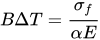
Thermal shock resistance measures can be used for material selection in applications subject to rapid temperature changes. The maximum temperature jump, , sustainable by a material can be defined for strength-controlled models by: where is the failure stress (which can be yield or fracture stress), is the coefficient of thermal expansion, is the Young's modulus, and is a constant depending upon the part constraint, material properties, and thickness.


Hub AI
Thermal shock AI simulator
(@Thermal shock_simulator)
Thermal shock
Thermal shock is a phenomenon characterized by a rapid change in temperature that results in a transient mechanical load on an object. The load is caused by the differential expansion of different parts of the object due to the temperature change. This differential expansion can be understood in terms of strain, rather than stress. When the strain exceeds the tensile strength of the material, it can cause cracks to form, and eventually lead to structural failure.
Methods to prevent thermal shock include:
Borosilicate glass is made to withstand thermal shock better than most other glass through a combination of reduced expansion coefficient, and greater strength, though fused quartz outperforms it in both these respects. Some glass-ceramic materials (mostly in the lithium aluminosilicate (LAS) system) include a controlled proportion of material with a negative expansion coefficient, so that the overall coefficient can be reduced to almost exactly zero over a reasonably wide range of temperatures.
Among the best thermomechanical materials, there are alumina, zirconia, tungsten alloys, silicon nitride, silicon carbide, boron carbide, and some stainless steels.
Reinforced carbon-carbon is extremely resistant to thermal shock, due to graphite's extremely high thermal conductivity and low expansion coefficient, the high strength of carbon fiber, and a reasonable ability to deflect cracks within the structure.
To measure thermal shock, the impulse excitation technique proved to be a useful tool. It can be used to measure Young's modulus, Shear modulus, Poisson's ratio, and damping coefficient in a non destructive way. The same test-piece can be measured after different thermal shock cycles, and this way the deterioration in physical properties can be mapped out.
Thermal shock resistance measures can be used for material selection in applications subject to rapid temperature changes. A common measure of thermal shock resistance is the maximum temperature differential, , which can be sustained by the material for a given thickness.
Thermal shock resistance measures can be used for material selection in applications subject to rapid temperature changes. The maximum temperature jump, , sustainable by a material can be defined for strength-controlled models by: where is the failure stress (which can be yield or fracture stress), is the coefficient of thermal expansion, is the Young's modulus, and is a constant depending upon the part constraint, material properties, and thickness.