


Community hub
Recent from talks
Contribute something
Nothing was collected or created yet.
Shear modulus
View on Wikipedia| Shear modulus | |
|---|---|
Common symbols | G, S, μ |
| SI unit | Pa |
Derivations from other quantities | G = τ / γ = E / [2(1 + ν)] |

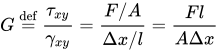
In materials science, shear modulus or modulus of rigidity, denoted by G, or sometimes S or μ, is a measure of the elastic shear stiffness of a material and is defined as the ratio of shear stress to the shear strain:[1]
where
- = shear stress
- is the force which acts
- is the area on which the force acts
- = shear strain. In engineering , elsewhere
- is the transverse displacement
- is the initial length of the area.





The derived SI unit of shear modulus is the pascal (Pa), although it is usually expressed in gigapascals (GPa) or in thousand pounds per square inch (ksi). Its dimensional form is M1L−1T−2, replacing force by mass times acceleration.
Explanation
[edit]| Material | Typical values for shear modulus (GPa) (at room temperature) |
|---|---|
| Diamond[2] | 478.0 |
| Steel[3] | 79.3 |
| Iron[4] | 52.5 |
| Copper[5] | 44.7 |
| Titanium[3] | 41.4 |
| Glass[3] | 26.2 |
| Aluminium[3] | 25.5 |
| Polyethylene[3] | 0.117 |
| Rubber[6] | 0.0006 |
| Granite[7][8] | 24 |
| Shale[7][8] | 1.6 |
| Limestone[7][8] | 24 |
| Chalk[7][8] | 3.2 |
| Sandstone[7][8] | 0.4 |
| Wood | 4 |
The shear modulus is one of several quantities for measuring the stiffness of materials. All of them arise in the generalized Hooke's law:
- Young's modulus E describes the material's strain response to uniaxial stress in the direction of this stress (like pulling on the ends of a wire or putting a weight on top of a column, with the wire getting longer and the column losing height),
- the Poisson's ratio ν describes the response in the directions orthogonal to this uniaxial stress (the wire getting thinner and the column thicker),
- the bulk modulus K describes the material's response to (uniform) hydrostatic pressure (like the pressure at the bottom of the ocean or a deep swimming pool),
- the shear modulus G describes the material's response to shear stress (like cutting it with dull scissors).
These moduli are not independent, and for isotropic materials they are connected via the equations[9]

The shear modulus is concerned with the deformation of a solid when it experiences a force perpendicular to one of its surfaces while its opposite face experiences an opposing force (such as friction). In the case of an object shaped like a rectangular prism, it will deform into a parallelepiped. Anisotropic materials such as wood, paper and also essentially all single crystals exhibit differing material response to stress or strain when tested in different directions. In this case, one may need to use the full tensor-expression of the elastic constants, rather than a single scalar value.
One possible definition of a fluid would be a material with zero shear modulus.
Shear waves
[edit]
In homogeneous and isotropic solids, there are two kinds of waves, pressure waves and shear waves. The velocity of a shear wave, is controlled by the shear modulus,


where
- G is the shear modulus
- is the solid's density.

Shear modulus of metals
[edit]
The shear modulus of metals is usually observed to decrease with increasing temperature. At high pressures, the shear modulus also appears to increase with the applied pressure. Correlations between the melting temperature, vacancy formation energy, and the shear modulus have been observed in many metals.[13]
Several models exist that attempt to predict the shear modulus of metals (and possibly that of alloys). Shear modulus models that have been used in plastic flow computations include:
- the Varshni-Chen-Gray model developed by[14] and used in conjunction with the Mechanical Threshold Stress (MTS) plastic flow stress model.[15][16]
- the Steinberg-Cochran-Guinan (SCG) shear modulus model developed by[17] and used in conjunction with the Steinberg-Cochran-Guinan-Lund (SCGL) flow stress model.
- the Nadal and LePoac (NP) shear modulus model[12] that uses Lindemann theory to determine the temperature dependence and the SCG model for pressure dependence of the shear modulus.
Varshni-Chen-Gray model
[edit]The Varshni-Chen-Gray model (sometimes referred to as the Varshni equation) has the form:
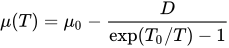
where is the shear modulus at , and and are material constants.


SCG model
[edit]The Steinberg-Cochran-Guinan (SCG) shear modulus model is pressure dependent and has the form

where, μ0 is the shear modulus at the reference state (T = 300 K, p = 0, η = 1), p is the pressure, and T is the temperature.
NP model
[edit]The Nadal-Le Poac (NP) shear modulus model is a modified version of the SCG model. The empirical temperature dependence of the shear modulus in the SCG model is replaced with an equation based on Lindemann melting theory. The NP shear modulus model has the form:
![{\displaystyle \mu (p,T)={\frac {1}{{\mathcal {J}}\left({\hat {T}}\right)}}\left[\left(\mu _{0}+{\frac {\partial \mu }{\partial p}}{\frac {p}{\eta ^{\frac {1}{3}}}}\right)\left(1-{\hat {T}}\right)+{\frac {\rho }{Cm}}~T\right];\quad C:={\frac {\left(6\pi ^{2}\right)^{\frac {2}{3}}}{3}}f^{2}}](https://wikimedia.org/api/rest_v1/media/math/render/svg/2a44071b746c80d284fb8d0e0f1ac54b8b3e1d20)
where
![{\displaystyle {\mathcal {J}}({\hat {T}}):=1+\exp \left[-{\frac {1+1/\zeta }{1+\zeta /\left(1-{\hat {T}}\right)}}\right]\quad {\text{for}}\quad {\hat {T}}:={\frac {T}{T_{m}}}\in [0,6+\zeta ],}](https://wikimedia.org/api/rest_v1/media/math/render/svg/e1eaa94198fcbeba0ea126aea1b4e743ce62f1c4)
and μ0 is the shear modulus at absolute zero and ambient pressure, ζ is an area, m is the atomic mass, and f is the Lindemann constant.
Shear relaxation modulus
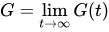
[edit]The shear relaxation modulus is the time-dependent generalization of the shear modulus[18] :


- .
See also
[edit]References
[edit]- ^ IUPAC, Compendium of Chemical Terminology, 5th ed. (the "Gold Book") (2025). Online version: (2006–) "shear modulus, G". doi:10.1351/goldbook.S05635
- ^ McSkimin, H.J.; Andreatch, P. (1972). "Elastic Moduli of Diamond as a Function of Pressure and Temperature". J. Appl. Phys. 43 (7): 2944–2948. Bibcode:1972JAP....43.2944M. doi:10.1063/1.1661636.
- ^ a b c d e Crandall, Dahl, Lardner (1959). An Introduction to the Mechanics of Solids. Boston: McGraw-Hill. ISBN 0-07-013441-3.
{{cite book}}: ISBN / Date incompatibility (help)CS1 maint: multiple names: authors list (link) - ^ Rayne, J.A. (1961). "Elastic constants of Iron from 4.2 to 300 ° K". Physical Review. 122 (6): 1714–1716. Bibcode:1961PhRv..122.1714R. doi:10.1103/PhysRev.122.1714.
- ^ Material properties
- ^ Spanos, Pete (2003). "Cure system effect on low temperature dynamic shear modulus of natural rubber". Rubber World.
- ^ a b c d e Hoek, Evert, and Jonathan D. Bray. Rock slope engineering. CRC Press, 1981.
- ^ a b c d e Pariseau, William G. Design analysis in rock mechanics. CRC Press, 2017.
- ^ [Landau LD, Lifshitz EM. Theory of Elasticity, vol. 7. Course of Theoretical Physics. (2nd Ed) Pergamon: Oxford 1970 p13]
- ^ Shear modulus calculation of glasses
- ^ Overton, W.; Gaffney, John (1955). "Temperature Variation of the Elastic Constants of Cubic Elements. I. Copper". Physical Review. 98 (4): 969. Bibcode:1955PhRv...98..969O. doi:10.1103/PhysRev.98.969.
- ^ a b Nadal, Marie-Hélène; Le Poac, Philippe (2003). "Continuous model for the shear modulus as a function of pressure and temperature up to the melting point: Analysis and ultrasonic validation". Journal of Applied Physics. 93 (5): 2472. Bibcode:2003JAP....93.2472N. doi:10.1063/1.1539913.
- ^ March, N. H., (1996), Electron Correlation in Molecules and Condensed Phases, Springer, ISBN 0-306-44844-0 p. 363
- ^ Varshni, Y. (1970). "Temperature Dependence of the Elastic Constants". Physical Review B. 2 (10): 3952–3958. Bibcode:1970PhRvB...2.3952V. doi:10.1103/PhysRevB.2.3952.
- ^ Chen, Shuh Rong; Gray, George T. (1996). "Constitutive behavior of tantalum and tantalum-tungsten alloys". Metallurgical and Materials Transactions A. 27 (10): 2994. Bibcode:1996MMTA...27.2994C. doi:10.1007/BF02663849. S2CID 136695336.
- ^ Goto, D. M.; Garrett, R. K.; Bingert, J. F.; Chen, S. R.; Gray, G. T. (2000). "The mechanical threshold stress constitutive-strength model description of HY-100 steel" (PDF). Metallurgical and Materials Transactions A. 31 (8): 1985–1996. Bibcode:2000MMTA...31.1985G. doi:10.1007/s11661-000-0226-8. S2CID 136118687. Archived from the original on September 25, 2017.
- ^ Guinan, M; Steinberg, D (1974). "Pressure and temperature derivatives of the isotropic polycrystalline shear modulus for 65 elements". Journal of Physics and Chemistry of Solids. 35 (11): 1501. Bibcode:1974JPCS...35.1501G. doi:10.1016/S0022-3697(74)80278-7.
- ^ Rubinstein, Michael, 1956 December 20- (2003). Polymer physics. Colby, Ralph H. Oxford: Oxford University Press. p. 284. ISBN 019852059X. OCLC 50339757.
{{cite book}}: CS1 maint: multiple names: authors list (link) CS1 maint: numeric names: authors list (link)
Elastic moduli for homogeneous isotropic materials | |
|---|---|
|


| Conversion formulae | |||||||
|---|---|---|---|---|---|---|---|
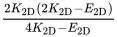
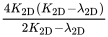
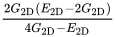
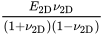
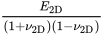
| Homogeneous isotropic linear elastic materials have their elastic properties uniquely determined by any two moduli among these; thus, given any two, any other of the elastic moduli can be calculated according to these formulas, provided both for 3D materials (first part of the table) and for 2D materials (second part). | |||||||
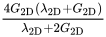
| 3D formulae | Notes | ||||||
There are two valid solutions. | |||||||
| Cannot be used when | |||||||
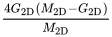
| 2D formulae | Notes | ||||||
| Cannot be used when | |||||||
|
| |||||||































Shear modulus
View on GrokipediaFundamentals
Definition
The shear modulus, denoted by , is defined as the ratio of shear stress to shear strain for a material undergoing simple shear deformation, expressed mathematically as This constant quantifies the material's resistance to shearing forces that cause layers to slide parallel to each other./20%3A_Miscellaneous/20.03%3A_Shear_Modulus_and_Torsion_Constant) Shear deformation represents a distortion of the material's shape without altering its volume, as the trace of the infinitesimal strain tensor is zero in pure shear, distinguishing it from tensile or compressive deformations that primarily involve changes in length and potentially volume.[5] In the International System of Units (SI), the shear modulus is measured in pascals (Pa), equivalent to newtons per square meter (N/m²), though values for engineering materials are often reported in gigapascals (GPa) due to their magnitude./20%3A_Miscellaneous/20.03%3A_Shear_Modulus_and_Torsion_Constant) The concept was introduced by Thomas Young in 1807 as part of his work on elastic constants in "A Course of Lectures on Natural Philosophy and the Mechanical Arts," where he described shear deformation and its associated modulus.[6] Early experimental measurements of the shear modulus were conducted by Guillaume Wertheim in 1848 through studies on the elasticity of homogeneous solid bodies.[7] For homogeneous and isotropic materials, where properties are uniform and independent of direction, the shear modulus is a scalar quantity. In anisotropic materials, such as crystals or composites, it takes the form of a fourth-rank tensor to account for direction-dependent stiffness.[3]Relation to Other Moduli
In isotropic linear elastic materials, the shear modulus is interrelated with other elastic constants, such as Young's modulus and Poisson's ratio , through the equation . This relation arises from the equivalence of strain energy under uniaxial tension and pure shear deformation, ensuring consistency in the Hookean constitutive laws for isotropic solids.[8] Similarly, connects to the bulk modulus via , which derives from the volumetric response under hydrostatic stress and the incompressibility limit approached as .[9] These interdependencies extend to the Lamé parameters, where the shear modulus corresponds directly to the second Lamé constant , while the first Lamé constant relates to the bulk modulus through . This formulation parameterizes the isotropic elasticity tensor compactly, with capturing the coupling between normal strains and the resistance to uniform compression.[10] For thermodynamic stability in isotropic materials, the elastic energy must be positive definite, constraining Poisson's ratio to , which in turn requires to prevent unphysical negative stiffness.[11] As an illustrative example, for typical structural steel with GPa and , the shear modulus computes to GPa using the relation with Young's modulus. In anisotropic materials, such as cubic crystals, the shear modulus is not a single scalar but involves direction-dependent components; notably, the stiffness constant represents a key shear modulus for specific orientations, like shear in the {100} plane.[12]Physical Properties and Behavior
Shear Waves and Propagation
Shear waves, also known as S-waves, are transverse elastic waves that propagate through solids, characterized by particle displacements perpendicular to the direction of wave propagation. Unlike longitudinal waves, these transverse motions induce shear stresses in the medium, making the shear modulus a key parameter governing their behavior. This perpendicular motion distinguishes S-waves from other seismic or acoustic waves and underscores their sensitivity to the material's resistance to shearing deformation.[13] The propagation speed of shear waves in an isotropic elastic solid is determined by the formula where is the shear modulus and is the material density. This expression arises from applying Newton's second law to the harmonic oscillation of particles under shear stress, coupled with Hooke's law relating shear stress to strain via the shear modulus; the resulting wave equation yields the speed as the square root of the ratio of elastic stiffness to inertial density. In comparison, longitudinal P-waves travel at where is the bulk modulus, illustrating how the shear modulus contributes to overall rigidity but is solely responsible for S-wave propagation, as P-waves rely more on compressional resistance. These speeds reflect the fundamental interplay between elastic properties and density in wave dynamics.[13] In solid media, shear waves exhibit polarization depending on the orientation of particle motion relative to the propagation direction and the surface. Horizontally polarized shear waves (SH waves) feature particle motion parallel to the free surface and perpendicular to propagation, while vertically polarized shear waves (SV waves) involve motion in the vertical plane containing the propagation direction. This polarization allows SH and SV components to respond differently to material anisotropy and interfaces, aiding in detailed imaging of subsurface structures.[14] Seismological applications highlight the diagnostic value of shear waves, as their inability to traverse fluids—where the shear modulus —creates distinct shadow zones in earthquake records. For instance, S-waves halt at the core-mantle boundary, producing an S-wave shadow zone opposite the epicenter and providing evidence for Earth's liquid outer core. This property, rooted in the absence of shear rigidity in fluids, contrasts with P-waves and enables differentiation of solid and fluid layers in planetary interiors.[15][16] During propagation, shear waves undergo attenuation primarily due to internal friction, where energy is dissipated as heat through irreversible microscopic processes like dislocation motion or grain boundary sliding. This damping reduces wave amplitude over distance without altering the ideal elastic speed formula, though it introduces frequency-dependent losses in real materials. Such attenuation provides insights into material microstructure and energy dissipation mechanisms in geophysical contexts.[17]Temperature and Frequency Dependence
The shear modulus of elastic materials decreases with increasing temperature primarily due to thermal expansion, which widens interatomic spacings and reduces bonding strength, and phonon softening, whereby thermal agitation introduces anharmonicity in lattice vibrations, thereby weakening the effective interatomic potentials.[18][19] Near the melting point, this softening intensifies, causing the shear modulus to approach zero as the solid loses its capacity to sustain shear stresses, foreshadowing the zero shear rigidity of the liquid phase.[20] Typical temperature dependence curves for metals, such as those derived from ultrasonic measurements, show a roughly linear decline in shear modulus at low temperatures (up to about 0.5 Tm, where Tm is the melting temperature) followed by a steeper drop near Tm, reflecting enhanced anharmonic effects.[21] For instance, in aluminum, the shear modulus decreases from approximately 26 GPa at room temperature to about 18 GPa at 500°C, a reduction of roughly 31% over this range, as measured using piezoelectric ultrasonic composite oscillator techniques up to near the melting point.[22] In the ideal elastic regime, applicable to most crystalline solids at ambient conditions, the shear modulus remains independent of frequency, as deformation responses are instantaneous and non-dissipative.[23] However, at sufficiently high frequencies—typically in the ultrasonic or hypersonic range—or in materials approaching viscoelastic transitions, the modulus becomes frequency-dependent, with the storage modulus increasing and approaching the low-frequency elastic limit while energy dissipation rises.[24] Anelasticity, stemming from internal friction processes like localized atomic rearrangements or defect interactions, introduces subtle frequency dispersion in the shear modulus, particularly below the glass transition in amorphous solids or at elevated temperatures in crystals, where the real part of the complex modulus shows mild logarithmic variation over seismic to audio frequencies.[25][26]Measurement and Applications
Experimental Determination
The shear modulus, a key measure of a material's resistance to shear deformation, is determined experimentally through various laboratory techniques that apply controlled stresses or waves to samples and analyze the resulting responses. These methods are essential for characterizing isotropic and anisotropic materials, with selections depending on sample geometry, material type, and desired frequency range. Common approaches include static and dynamic tests, often standardized to ensure reproducibility and accuracy. One primary method is the torsion test, which involves applying a torque to a cylindrical specimen fixed at one end and measuring the resulting angular twist. The shear modulus is calculated using the relation , where is the applied torque, is the gauge length, is the polar moment of inertia of the cross-section, and is the twist angle in radians. This technique is particularly suitable for metals and structural materials at room temperature, providing static measurements with typical accuracies of 1-5% when proper alignment is maintained.[27] Ultrasonic pulse-echo methods offer a non-destructive alternative by sending shear waves through the material and measuring their travel time. Transducers generate pulses that reflect off boundaries, allowing determination of shear wave velocity , from which is derived, with as the material density. This approach excels for bulk samples and composites, achieving precisions below 1% for homogeneous materials, though it requires corrections for attenuation in highly damping substances.[28][29] Resonant ultrasound spectroscopy (RUS) involves exciting a sample to vibrate at its natural frequencies and fitting the spectrum to theoretical models to extract elastic constants, including the shear modulus. Using contact transducers on regular geometries like cubes or cylinders, RUS determines all independent elastic moduli simultaneously with uncertainties often under 0.1%, making it ideal for precise characterization of single crystals and polycrystals.[30][31] For frequency-dependent behavior, dynamic mechanical analysis (DMA) applies oscillatory shear strains to thin films or bars and measures the storage modulus , which represents the elastic component of the shear response. Instruments impose sinusoidal deformations in shear mode while varying temperature or frequency, yielding viscoelastic moduli with resolutions of 0.1-1% over ranges from 0.01 Hz to 100 Hz. This method is widely used for polymers and composites to assess dynamic shear properties.[32][33] Experimental challenges include sample preparation, such as ensuring uniform geometry for torsion tests or minimizing surface roughness for ultrasonic coupling, which can introduce errors up to 10% if neglected. Anisotropy requires orientation-specific measurements and tensor corrections, while clamping artifacts in RUS or DMA may cause spurious resonances or damping overestimation. Error sources like instrumental drift or environmental vibrations are mitigated through calibration and isolation, with overall accuracies varying from 0.5% in ideal cases to 5-10% for heterogeneous samples.[34][30] Standardized procedures, such as ASTM E143 for torsion-based shear modulus determination at room temperature, guide testing for structural materials where creep is negligible, emphasizing torque application limits below 50% of yield shear stress.Engineering and Geophysical Uses
In structural engineering, the shear modulus is essential for calculating torsional rigidity and shear stresses in beams and structural components subjected to twisting loads, such as those in bridges and aircraft wings. The torsional rigidity, expressed as where is the polar moment of inertia, quantifies a structure's resistance to angular deformation, enabling engineers to design safe margins against failure in applications like prestressed concrete bridge girders under combined shear and torsion.[35][36][37] In geophysics, the shear modulus serves as a primary input for seismic inversion techniques to reconstruct subsurface rigidity profiles, with low values signaling potential fault zones or weakened rock layers that facilitate seismic wave scattering and energy dissipation. These inversions, often based on exact Zoeppritz equations within Bayesian frameworks, allow direct estimation of shear modulus variations to delineate brittle reservoirs or fault structures critical for earthquake hazard mapping and hydrocarbon exploration.[38][39][40] For the 1989 Loma Prieta earthquake, seismic velocity models indicated a low-rigidity wedge (with shear wave speeds of 3.3–5.8 km/s extending to mid-crustal depths) between the Zayante and San Andreas faults, highlighting inherent crustal weakness that preconditioned the fault for rupture during the magnitude 6.9 event.[41] In biomechanics, the shear modulus of soft tissues—typically 1–10 kPa—enables modeling of blood vessel compliance, where it predicts radial and tangential deformations under pulsatile flow-induced shear, informing simulations of vascular patency and aneurysm risk.[42][43] The shear modulus is vital for failure prediction, as it helps differentiate ductile yielding from brittle shear rupture; in elasto-plastic analyses of rocks, it defines the elastic regime before activation of the Mohr-Coulomb yield surface, where shear stress exceeds cohesion plus frictional resistance to initiate failure.[44][45] One limitation of the shear modulus is its restriction to infinitesimal, linear elastic strains, neglecting plastic flow or hardening at high deformations, which can underestimate risks in ductile materials or post-failure scenarios.[46]Material-Specific Characteristics
In Metals
The shear modulus of polycrystalline metals at room temperature depends on their composition and crystal structure, with typical values for common engineering metals including approximately 80 GPa for carbon steels, 26 GPa for aluminum alloys like 6061, and 48 GPa for pure copper.[47][48] These values reflect the elastic resistance to shear deformation in bulk forms, where grain boundaries average out directional variations.[49] Face-centered cubic (FCC) metals generally exhibit lower shear moduli than body-centered cubic (BCC) metals, a trend linked to differences in their slip systems and atomic packing density that influence overall stiffness.[50] For example, aluminum (FCC structure) has a shear modulus of about 26 GPa, significantly lower than that of iron (BCC structure) at around 81 GPa.[48][47] Alloying influences the shear modulus through mechanisms like solid solution strengthening, which causes slight increases by distorting the lattice and altering atomic interactions, typically on the order of a few percent for dilute additions.[51] Precipitation hardening has a more pronounced effect, as the formation of second-phase particles with mismatched shear moduli creates local elastic incompatibilities that enhance overall rigidity. In aluminum-copper alloys, for instance, θ-phase precipitates can raise the effective modulus beyond what solid solution alone achieves.[52] In single-crystal metals, the shear modulus displays strong anisotropy due to directional bonding preferences in the lattice. For copper, the shear modulus in the <100> direction is approximately 75 GPa, while it is about 23 GPa in the <111> direction (for the {111}<110> shear system), reflecting the softer response along close-packed planes.[21][53] Temperature significantly affects the shear modulus in metals, with a general decrease as thermal expansion softens interatomic bonds. In the titanium alloy Ti-6Al-4V, the shear modulus drops from 44 GPa at 20°C to around 30 GPa at 600°C, highlighting its utility in high-temperature applications despite reduced stiffness.[54] Comprehensive empirical data on these properties, including alloy-specific trends and phase effects, are compiled in the ASM Handbook Volume 2: Properties and Selection: Nonferrous Alloys and Special-Purpose Materials.[49]In Rocks and Composites
In rocks, the shear modulus varies significantly with lithology and microstructure, reflecting their heterogeneous and often porous nature. For instance, granite typically exhibits a shear modulus in the range of 20–30 GPa, as measured in laboratory tests on intact samples under moderate confining pressures, while sandstone shows lower values of approximately 5–15 GPa, influenced by its higher porosity and grain packing.[55][56] Porosity plays a key role in reducing the effective shear modulus of the rock frame, as higher void content diminishes intergranular contacts and load-bearing capacity; this effect is incorporated into predictive models like the Gassmann relation, which, while primarily addressing bulk modulus changes due to fluid saturation, highlights how porosity degrades the dry-frame shear stiffness in fluid-bearing rocks.[57] Confining pressure further modulates the shear modulus in rocks through mechanisms such as crack closure, which stiffens the material by reducing compliant pore space and microcracks. In sedimentary rocks, the shear modulus increases nonlinearly with pressure, with typical pressure derivatives (dG/dP) ranging from 0.5 to 1 for unconsolidated to semi-consolidated sediments, indicating substantial hardening at depths exceeding a few hundred meters.[58] This pressure sensitivity is particularly pronounced in fractured or porous lithologies, where initial low-pressure compliance gives way to more isotropic behavior at higher effective stresses. Composite materials, such as fiber-reinforced polymers used in engineering applications, display shear moduli that depend on fiber orientation and matrix properties. In carbon-epoxy composites, the transverse shear modulus is around 5 GPa, reflecting the weaker matrix-dominated response perpendicular to the fibers, in contrast to higher longitudinal values. These properties are often approximated using the rule of mixtures, which weights the contributions of fiber and matrix shear moduli by volume fraction to estimate overall stiffness, providing a simple yet effective bound for design purposes.[59][60] Anisotropy in rocks like shale arises from aligned bedding planes, leading to directional variations in shear modulus up to 50%, with minimum values parallel to bedding due to weak interlayer slip and maximum values perpendicular to it from enhanced resistance across layers. Specific examples illustrate these trends: basalt in the oceanic crust has a shear modulus of about 25 GPa, supporting its role in seismic wave propagation through the lithosphere, whereas fault gouge zones exhibit much lower values below 1 GPa (typically 0.1–0.3 GPa), signifying mechanical weakness and localization of deformation.[61][62][63] Environmental factors, particularly fluid content, alter effective shear modulus in rocks; water saturation can lower it by 10–20% through reduced friction at grain contacts and increased pore pressure, exacerbating compliance in otherwise stiff formations. This saturation effect is leveraged in geophysical contexts, such as seismic mapping, to infer subsurface fluid distributions and rock integrity.[64]Advanced Models
Temperature-Dependent Models
The Varshni model provides an empirical description of the temperature dependence of the shear modulus in metals, given by where is the shear modulus at 0 K, is the Debye temperature, and , , and are fitting parameters. This form captures the softening at low temperatures through an Einstein-like anharmonic term while including a linear high-temperature contribution. It has been widely applied to fit experimental data for elastic constants in various metals, effectively modeling phonon contributions to modulus variation. The Chen-Gray model, developed within the Mechanical Threshold Stress (MTS) framework, employs a polynomial approximation for high-temperature behavior: where and are material-specific parameters tuned to experimental softening trends. This simple form emphasizes thermal expansion and anharmonic effects dominating at elevated temperatures, making it suitable for predictive simulations in high-strain-rate applications like shock loading in metals. It is often calibrated using room-temperature data and extrapolated for engineering steels. The Steinberg–Cochran–Guinan (SCG) model accounts for both pressure and temperature dependence, particularly useful for metals under extreme conditions. For temperature effects at constant pressure, it incorporates exponential softening and a term modeling the approach to zero modulus at the melting temperature , often expressed in a form such as where , , , and are parameters, with potentially adjusted for pressure. This enables modeling of modulus reductions near phase transitions or melting, improving accuracy in hydrodynamic simulations of material response under shock or high-temperature conditions compared to simpler polynomial models. Comparisons among these models reveal distinct suitability: the Varshni model excels for nuanced low-temperature fits in various metals, the Chen-Gray model for high-temperature softening in steels, and the SCG model for extreme pressure-temperature regimes, as demonstrated in fits to materials like AISI 4340 steel. Validation against density functional theory (DFT) simulations has shown reasonable agreement for these empirical models with ab initio predictions at elevated temperatures, enhancing their use in untested regimes. In recent years, machine learning approaches trained on DFT and experimental data have been developed to predict temperature-dependent shear moduli more efficiently, offering insights into novel materials.[65]Viscoelastic Relaxation Models
Viscoelastic materials exhibit time-dependent shear responses due to their combined elastic and viscous characteristics, particularly in polymers, where molecular rearrangements lead to relaxation processes following an applied shear stress. The shear relaxation modulus quantifies this behavior as the time-decaying stress response to a step strain, typically modeled using the generalized Maxwell model, which consists of multiple Maxwell elements in parallel with an equilibrium spring.[66] In this framework, the relaxation modulus is expressed as where is the long-term equilibrium modulus, are the moduli of individual elements, and are the relaxation times.[67] This model captures the spectrum of relaxation times arising from diverse molecular motions, enabling prediction of stress decay over time scales from milliseconds to hours. In the frequency domain, oscillatory shear testing reveals the dynamic shear modulus , where is the storage modulus representing elastic energy storage, and is the loss modulus indicating viscous energy dissipation.[68] The loss tangent serves as a measure of damping, with higher values signifying greater energy loss relative to storage.[68] These components highlight the material's transition from glassy (high , low ) to rubbery states as frequency decreases or temperature rises. To fit experimental relaxation data, the Prony series representation is widely employed, discretizing the continuous relaxation spectrum into a sum of exponential terms with specific and corresponding weights , where is the instantaneous modulus.[69] This approach facilitates numerical simulations in finite element analysis and accurate curve-fitting to time-domain measurements, ensuring the model aligns with observed decay profiles across multiple decades of time.[70] For amorphous polymers, temperature influences relaxation times through the Williams-Landel-Ferry (WLF) equation, which provides a shift factor to construct master curves via time-temperature superposition. The equation is given by where and are empirical constants (typically , K near the glass transition temperature ), and is a reference temperature.[71] This superposition extends short-term data to long-term predictions, revealing how thermal activation accelerates segmental motions and broadens the relaxation spectrum. Representative examples illustrate these models in practice. In rubbers, such as natural rubber, the storage modulus is approximately 1 MPa at 1 Hz and room temperature, relaxing to about 0.1 MPa within seconds due to rapid disentanglement of polymer chains.[72] Asphalt binders exhibit pronounced viscoelasticity, with shear relaxation moduli decreasing from initial values around 10^6 Pa to equilibrium levels below 10^4 Pa over minutes, influenced by oxidative aging and temperature.[73] Biological tissues, like human orbital fat, show long-term relaxation moduli averaging 646 Pa at 100 s, reflecting fluid-like dissipation in soft matrices.[74] At the molecular level, viscoelastic relaxation spectra stem from chain entanglements and glass transitions, where temporary topological constraints in polymer melts hinder reptation, leading to broad distributions of relaxation times.[75] Below , frozen segmental motions contribute to secondary relaxations, while above , cooperative chain dynamics enable faster stress relief, as evidenced in entangled networks.[76] These mechanisms underpin the time-dependent shear response, linking microstructure to macroscopic damping and recovery.[77]References
- https://wiki.seg.org/wiki/Mathematical_foundation_of_elastic_wave_propagation