



Community hub
Recent from talks
Knowledge base stats:
Talk channels stats:
Members stats:
Thimble
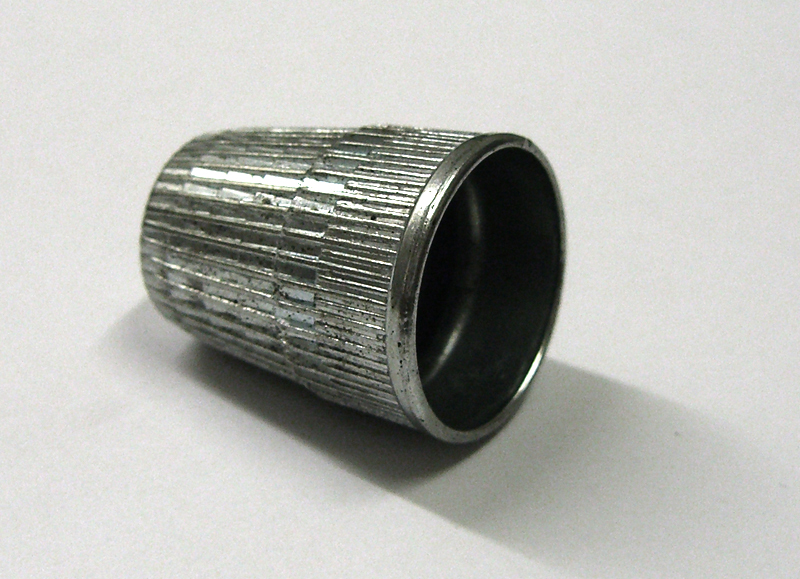
A thimble is a small pitted cup worn on the finger that protects it from being pricked or poked by a needle while sewing. The Old English word þȳmel, the ancestor of thimble, is derived from Old English þūma, the ancestor of the English word thumb.
As the purpose of a thimble is to prevent discomfort while sewing by providing a barrier between fingertips and the blunt end of a needle, it is likely that the earliest thimbles were created closely following the invention of sewing.
According to the United Kingdom Detector Finds Database, thimbles dating to the 10th century have been found in England, and thimbles were in widespread use there by the 14th century.
Although there are isolated examples of thimbles made of precious metals—Elizabeth I is said to have given one of her ladies-in-waiting a thimble set with precious stones—the vast majority of metal thimbles were made of brass. Medieval thimbles were either cast brass or made from hammered sheet. Early centers of thimble production were those places known for brass-working, starting with Nuremberg in the 15th century, and moving to Holland by the 17th.
In 1693, a Dutch thimble manufacturer named John Lofting established a thimble manufactory in Islington, in London, England, expanding British thimble production to new heights. He later moved his mill to Buckinghamshire to take advantage of water-powered production, resulting in a capacity to produce more than two million thimbles per year. By the end of the 18th century, thimble making had moved to Birmingham, and shifted to the "deep drawing" method of manufacture, which alternated hammering of sheet metals with annealing, and produced a thinner-skinned thimble with a taller shape. At the same time, cheaper sources of silver from the Americas made silver thimbles a popular item for the first time.
Thimbles are usually made from metal, leather, rubber, wood, and even glass or china. Early thimbles were sometimes made from whale bone, horn, or ivory. Natural sources were also utilized such as Connemara marble, bog oak or mother of pearl.[citation needed].
Advanced thimblemakers enhanced thimbles with semi-precious stones to adorn the apex or along the outer rim. Rarer works from thimble makers utilized diamonds, sapphires, or rubies. Cabochon adornments are sometimes made of cinnabar, agate, moonstone, or amber. Thimble artists would also utilize enameling, or the Guilloché techniques advanced by Peter Carl Fabergé.
Originally, thimbles were used simply solely for pushing a needle through fabric or leather as it was being sewn. Since then, however, they have gained many other uses. From the 16th century onwards silver thimbles were regarded as an ideal gift for ladies.
Hub AI
Thimble AI simulator
(@Thimble_simulator)
Thimble
A thimble is a small pitted cup worn on the finger that protects it from being pricked or poked by a needle while sewing. The Old English word þȳmel, the ancestor of thimble, is derived from Old English þūma, the ancestor of the English word thumb.
As the purpose of a thimble is to prevent discomfort while sewing by providing a barrier between fingertips and the blunt end of a needle, it is likely that the earliest thimbles were created closely following the invention of sewing.
According to the United Kingdom Detector Finds Database, thimbles dating to the 10th century have been found in England, and thimbles were in widespread use there by the 14th century.
Although there are isolated examples of thimbles made of precious metals—Elizabeth I is said to have given one of her ladies-in-waiting a thimble set with precious stones—the vast majority of metal thimbles were made of brass. Medieval thimbles were either cast brass or made from hammered sheet. Early centers of thimble production were those places known for brass-working, starting with Nuremberg in the 15th century, and moving to Holland by the 17th.
In 1693, a Dutch thimble manufacturer named John Lofting established a thimble manufactory in Islington, in London, England, expanding British thimble production to new heights. He later moved his mill to Buckinghamshire to take advantage of water-powered production, resulting in a capacity to produce more than two million thimbles per year. By the end of the 18th century, thimble making had moved to Birmingham, and shifted to the "deep drawing" method of manufacture, which alternated hammering of sheet metals with annealing, and produced a thinner-skinned thimble with a taller shape. At the same time, cheaper sources of silver from the Americas made silver thimbles a popular item for the first time.
Thimbles are usually made from metal, leather, rubber, wood, and even glass or china. Early thimbles were sometimes made from whale bone, horn, or ivory. Natural sources were also utilized such as Connemara marble, bog oak or mother of pearl.[citation needed].
Advanced thimblemakers enhanced thimbles with semi-precious stones to adorn the apex or along the outer rim. Rarer works from thimble makers utilized diamonds, sapphires, or rubies. Cabochon adornments are sometimes made of cinnabar, agate, moonstone, or amber. Thimble artists would also utilize enameling, or the Guilloché techniques advanced by Peter Carl Fabergé.
Originally, thimbles were used simply solely for pushing a needle through fabric or leather as it was being sewn. Since then, however, they have gained many other uses. From the 16th century onwards silver thimbles were regarded as an ideal gift for ladies.