
Recent from talks
Third Anglo-Mysore War
Knowledge base stats:
Talk channels stats:
Members stats:
Third Anglo-Mysore War
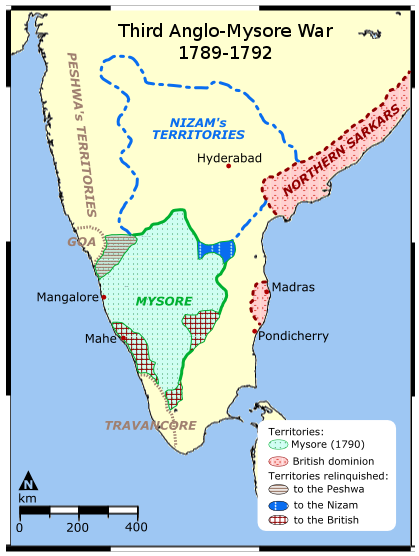
The Third Anglo-Mysore War (1789–1792) was a military conflict in Southern India between the Sultanate of Mysore and the East India Company, Maratha Empire, Kingdom of Travancore and the Nizam of Hyderabad. It was the third of four Anglo-Mysore Wars.
Tipu Sultan, the ruler of the Kingdom of Mysore, and his father Hyder Ali before him, had previously fought twice with the forces of the British East India Company. The First Anglo-Mysore War, fought in the 1760s, had ended inconclusively on both sides, with treaty provisions including promises of mutual assistance in future conflicts. British failure to support Mysore in conflicts with the Maratha Confederacy and other actions supportive of Mysore's enemies led Hyder to develop a dislike for the British.[citation needed]
After the British took the French-controlled port of Mahé in 1779, Hyder, who had been receiving military supplies through that port and had placed it under his protection, opened the Second Anglo-Mysore War. This war ended with the last British–Indian treaty with an Indian ruler on equal footing, the 1784 Treaty of Mangalore, which restored the status quo ante bellum under terms company officials such as Warren Hastings found extremely unfavourable for the British East India Company. Tipu, who gained control of Mysore after his father's death in December 1782, maintained an implacable hatred of the British, and declared not long after signing the 1784 treaty that he intended to continue battle with them given the opportunity. He refused to free British prisoners taken during the war, one of the conditions of the treaty. Tipu Sultan further strengthened his alliances with Ali Raja Bibi Junumabe II the Muslim ruler and the Mappila Muslim community of a region under the Zamorin of the Calicut empire, thus expanding the Sultanate of Mysore's sphere of influence.[citation needed]
British General Charles, 2nd Earl Cornwallis became the Governor-General of Bengal and Commander-in-Chief for the East India Company in 1786. While he formally abrogated agreements with the Marathas and Hyderabad that violated terms of the 1784 treaty, he sought informally to gain their support and that of the Nizam of Hyderabad, or at least their neutrality, in the event of conflict with Mysore.[citation needed]
Also, Pitt's "India Act" came into force in 1784, which made East India Company subordinated to the British crown, making the Company's power insignificant and marking the rise of direct British imperial control in India. Thus, unlike the earlier wars, where Tipu and his father confronted the Company, Tipu would now be fighting, in effect, against the British Empire.
In 1788, the company gained control of the Circar of Guntur, the southernmost of the Northern Circars, which the company had acquired under earlier agreements with the Nizam. In exchange, the company provided the Nizam with two battalions of company troops. Both of these acts placed British troops closer to Mysore, but also guaranteed the Nizam would support the British in the event of conflict.
Travancore had been a target of Tipu for acquisition or conquest since the end of the previous war. Indirect attempts to take over the kingdom had failed in 1788, and Archibald Campbell, the Madras president at the time, had warned Tipu that an attack on Travancore would be treated as a declaration of war on the company as per the Treaty of Mangalore. The rajah of Travancore also angered Tipu by extending fortifications along the border with Cochin into territory claimed by Mysore as belonging to its vassal state, and by purchasing from the Dutch East India Company two forts in the Kingdom of Cochin, a state paying tribute to Tipu Sultan.[citation needed]
In 1789 Tipu Sultan sent forces onto the Malabar Coast to put down a rebellion. Many people fled to Travancore, a state independent of Mysore and to Cochin, a state paying tribute to Tipu, in the wake of his advance. To follow them, Tipu began in the fall of 1789 to build up troops at Coimbatore in preparation for an assault on the Nedumkotta, a fortified line of defence built by Dharma Raja of Travancore to protect his domain. Cornwallis, observing this build-up, reiterated to Campbell's successor, John Holland, that an attack on Travancore should be considered a declaration of war, and met with a strong British response. Tipu, aware that Holland was not the experienced military officer that Campbell was, and that he did not have the close relationship that Campbell and Cornwallis had (both had served in North America in the American Revolutionary War), probably decided that this was an opportune time to attack.[citation needed]
Hub AI
Third Anglo-Mysore War AI simulator
(@Third Anglo-Mysore War_simulator)
Third Anglo-Mysore War
The Third Anglo-Mysore War (1789–1792) was a military conflict in Southern India between the Sultanate of Mysore and the East India Company, Maratha Empire, Kingdom of Travancore and the Nizam of Hyderabad. It was the third of four Anglo-Mysore Wars.
Tipu Sultan, the ruler of the Kingdom of Mysore, and his father Hyder Ali before him, had previously fought twice with the forces of the British East India Company. The First Anglo-Mysore War, fought in the 1760s, had ended inconclusively on both sides, with treaty provisions including promises of mutual assistance in future conflicts. British failure to support Mysore in conflicts with the Maratha Confederacy and other actions supportive of Mysore's enemies led Hyder to develop a dislike for the British.[citation needed]
After the British took the French-controlled port of Mahé in 1779, Hyder, who had been receiving military supplies through that port and had placed it under his protection, opened the Second Anglo-Mysore War. This war ended with the last British–Indian treaty with an Indian ruler on equal footing, the 1784 Treaty of Mangalore, which restored the status quo ante bellum under terms company officials such as Warren Hastings found extremely unfavourable for the British East India Company. Tipu, who gained control of Mysore after his father's death in December 1782, maintained an implacable hatred of the British, and declared not long after signing the 1784 treaty that he intended to continue battle with them given the opportunity. He refused to free British prisoners taken during the war, one of the conditions of the treaty. Tipu Sultan further strengthened his alliances with Ali Raja Bibi Junumabe II the Muslim ruler and the Mappila Muslim community of a region under the Zamorin of the Calicut empire, thus expanding the Sultanate of Mysore's sphere of influence.[citation needed]
British General Charles, 2nd Earl Cornwallis became the Governor-General of Bengal and Commander-in-Chief for the East India Company in 1786. While he formally abrogated agreements with the Marathas and Hyderabad that violated terms of the 1784 treaty, he sought informally to gain their support and that of the Nizam of Hyderabad, or at least their neutrality, in the event of conflict with Mysore.[citation needed]
Also, Pitt's "India Act" came into force in 1784, which made East India Company subordinated to the British crown, making the Company's power insignificant and marking the rise of direct British imperial control in India. Thus, unlike the earlier wars, where Tipu and his father confronted the Company, Tipu would now be fighting, in effect, against the British Empire.
In 1788, the company gained control of the Circar of Guntur, the southernmost of the Northern Circars, which the company had acquired under earlier agreements with the Nizam. In exchange, the company provided the Nizam with two battalions of company troops. Both of these acts placed British troops closer to Mysore, but also guaranteed the Nizam would support the British in the event of conflict.
Travancore had been a target of Tipu for acquisition or conquest since the end of the previous war. Indirect attempts to take over the kingdom had failed in 1788, and Archibald Campbell, the Madras president at the time, had warned Tipu that an attack on Travancore would be treated as a declaration of war on the company as per the Treaty of Mangalore. The rajah of Travancore also angered Tipu by extending fortifications along the border with Cochin into territory claimed by Mysore as belonging to its vassal state, and by purchasing from the Dutch East India Company two forts in the Kingdom of Cochin, a state paying tribute to Tipu Sultan.[citation needed]
In 1789 Tipu Sultan sent forces onto the Malabar Coast to put down a rebellion. Many people fled to Travancore, a state independent of Mysore and to Cochin, a state paying tribute to Tipu, in the wake of his advance. To follow them, Tipu began in the fall of 1789 to build up troops at Coimbatore in preparation for an assault on the Nedumkotta, a fortified line of defence built by Dharma Raja of Travancore to protect his domain. Cornwallis, observing this build-up, reiterated to Campbell's successor, John Holland, that an attack on Travancore should be considered a declaration of war, and met with a strong British response. Tipu, aware that Holland was not the experienced military officer that Campbell was, and that he did not have the close relationship that Campbell and Cornwallis had (both had served in North America in the American Revolutionary War), probably decided that this was an opportune time to attack.[citation needed]
Recent media