Hubbry Logo
Third Punic WarThird Punic WarMain
Open search
Third Punic War
Community hub
Third Punic War
logo
8 pages, 0 posts
0 subscribers
Be the first to start a discussion here.
Third Punic War
Third Punic War
from Wikipedia

Third Punic War
Part of the Punic Wars
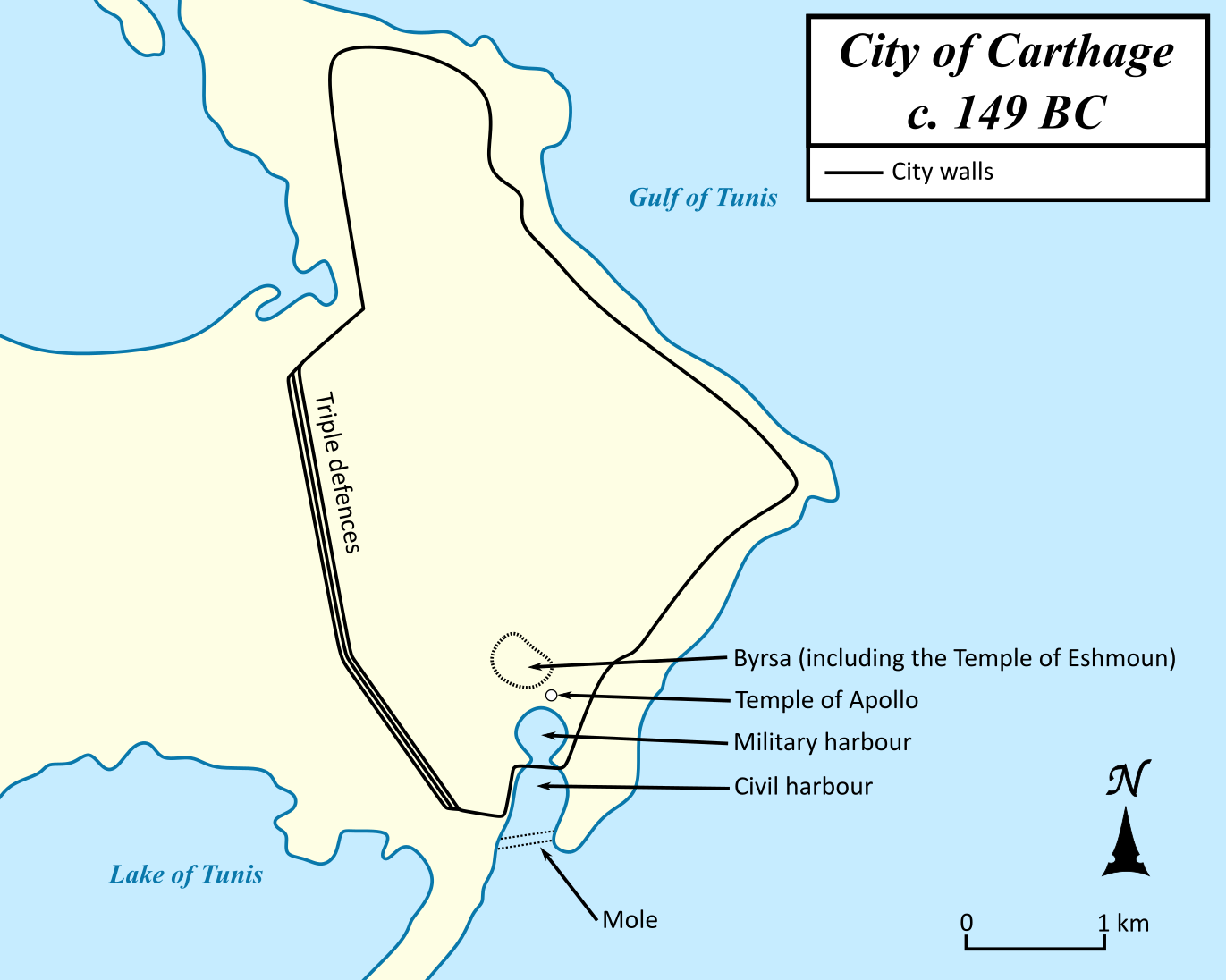
a map showing the defences of the city of Carthage
The defences of the city of Carthage
Date149–146 BC (3 years)
Location
Carthaginian territory (Modern-day Tunisia)
Result
  • Roman victory
Belligerents
Rome Carthage
Commanders and leaders
Strength
  • 36,000–46,000 infantry
  • 4,000 cavalry
  • 20,000 or more soldiers
  • Armed civilians
Casualties and losses
Unknown

The Third Punic War (149–146 BC) was the third and last of the Punic Wars fought between Carthage and Rome. The war was fought entirely within Carthaginian territory, in what is now northern Tunisia. When the Second Punic War ended in 201 BC one of the terms of the peace treaty prohibited Carthage from waging war without Rome's permission. Rome's ally, King Masinissa of Numidia, exploited this to repeatedly raid and seize Carthaginian territory with impunity. In 149 BC Carthage sent an army, under Hasdrubal, against Masinissa, the treaty notwithstanding. The campaign ended in disaster as the Battle of Oroscopa ended with a Carthaginian defeat and the surrender of the Carthaginian army. Anti-Carthaginian factions in Rome used the illicit military action as a pretext to prepare a punitive expedition.

Later in 149 BC a large Roman army landed at Utica in North Africa. The Carthaginians hoped to appease the Romans, but despite the Carthaginians surrendering all of their weapons, the Romans pressed on to besiege the city of Carthage. The Roman campaign suffered repeated setbacks through 149 BC, only alleviated by Scipio Aemilianus, a middle-ranking officer, distinguishing himself several times. A new Roman commander took over in 148 BC and fared equally badly. At the annual election of Roman magistrates in the spring of 147 BC the public support for Scipio was so great that the usual age restrictions were lifted to allow him to be appointed consul and commander in Africa.

Scipio's term commenced with two Carthaginian successes, but he tightened the siege and started to build a large mole to prevent supplies from getting into Carthage via blockade runners. The Carthaginians had partially rebuilt their fleet, and it sortied, to the Romans' surprise. After an indecisive engagement, the Carthaginians mismanaged their withdrawal and lost many ships. The Romans then built a large brick structure in the harbour area that dominated the city wall. Once this was complete, Scipio led a strong force that stormed the camp of Carthage's field army and forced most of the towns and cities still supporting Carthage to surrender. In early 146 BC the Romans launched their final assault and, over six days, systematically destroyed the city and killed its inhabitants; only on the last day did they take prisoners, 50,000 of them, who were sold into slavery. The conquered Carthaginian territories became the Roman province of Africa, with Utica as its capital. It was a century before the site of Carthage was rebuilt as a Roman city.

Primary sources

[edit]

The main source for most aspects of the Punic Wars[note 1] is the historian Polybius (c. 200 – c. 118 BC), a Greek sent to Rome in 167 BC as a hostage.[2] His works include a now-lost manual on military tactics,[3] but he is best known for The Histories, written sometime after 146 BC.[4][5] He accompanied his patron and friend,[6] the Roman general Scipio Aemilianus, in North Africa during the Third Punic War;[7] this causes the normally reliable Polybius to recount Scipio's actions in a favourable light.[8][9][10] In addition, significant portions of The Histories' account of the Third Punic War have been lost.[8][11]

The account of the Roman annalist Livy, who relied heavily on Polybius, is much used by modern historians of the Punic Wars,[12] but all that survives of his account of events after 167 BC is a list of contents.[13][14] Other ancient accounts of the Third Punic War or its participants which have also been largely lost include those of Plutarch, Dio Cassius[15] and the Greek Diodorus Siculus.[16] Modern historians also use the account of the 2nd-century AD Greek Appian.[17][18] The modern historian Bernard Mineo states that it "is the only complete and continuous account of this war".[15] It is thought to have been largely based on Polybius's account, but several problems with it have been identified.[10][19] These issues mean that of the three Punic Wars, the third is the one about which the least is reliably known.[20] Other sources include coins, inscriptions, archaeological evidence and empirical evidence from reconstructions.[21]

Background

[edit]

In the mid-2nd century BC Rome was the dominant power in the Mediterranean region,[22] while Carthage was a large city-state in the north east of what is now Tunisia.[23][24] Carthage and Rome had fought the 23-year-long First Punic War from 264 to 241 BC and the 17-year-long Second Punic War between 218 and 201 BC. Both wars ended with Roman victories; the Second when the Roman general Scipio Africanus defeated Hannibal, the premier Carthaginian general of the war, at the Battle of Zama, 160 kilometres (100 mi) south-west of Carthage.[25] Africanus imposed a peace treaty on the Carthaginians which stripped them of their overseas territories and some of their African ones. An indemnity of 10,000 silver talents[note 2] was to be paid over 50 years.[26] Hostages were taken and Carthage was prohibited from waging war outside Africa—and could wage war in Africa only with Rome's express permission. Many senior Carthaginians wanted to reject the treaty, but Hannibal spoke strongly in its favour and it was accepted in spring 201 BC.[28][29] Henceforth, it was clear that Carthage was politically subordinate to Rome.[30]

a map of the western Mediterranean with the territories of Numidia, Carthage and Rome shown
Map of approximate extent of Numidian, Carthaginian and Roman territory in 150 BC

At the end of the war Masinissa, an ally of Rome, emerged as by far the most powerful ruler among the Numidians, the indigenous population which controlled much of what is now Algeria and Tunisia.[31] Over the following 50 years, he repeatedly took advantage of Carthage's inability to protect its possessions. Whenever Carthage petitioned Rome for redress or permission to take military action, Rome backed Masinissa and refused.[32] Masinissa's seizures of and raids into Carthaginian territory became increasingly flagrant. In 151 BC Carthage raised a large army commanded by the previously unrecorded[33] general Hasdrubal and, the treaty notwithstanding, counter-attacked the Numidians. The campaign ended in disaster at the Battle of Oroscopa and the army surrendered.[34][35] Many Carthaginians were subsequently massacred by the Numidians.[33] Hasdrubal escaped to Carthage, where, in an attempt to placate Rome, he was condemned to death.[36]

Carthage paid off its indemnity in 151 BC[37] and was prospering economically[38] but was no military threat to Rome.[39] Nevertheless, there had long been a faction within the Roman Senate that had wished to take further military action against Carthage.[40] For example, the dislike of Carthage by the senior senator Cato was so well known that since the 18th century (AD), he has been credited with ending all of his speeches with Carthago delenda est ("Carthage must be destroyed").[41][42] The opposing faction included Scipio Nasica, who argued that fear of a strong enemy such as Carthage would keep the common people in check and avoid social division.[33][43] Cato was a member of an embassy to Carthage, probably in 153 BC, and noted her growing economy and strength;[43] Nasica was likely a member of the same embassy.[44] Using the illicit Carthaginian military action as a pretext,[40] Rome began preparing a punitive expedition.[45]

the obverse and reverse of a slightly corroded siver coin
A silver double shekel from Carthage's last minting of coins before its destruction[46]

Modern scholars have advanced several theories as to why Rome was eager for war.[47] These include: a Roman fear of Carthaginian commercial competition;[48][49][50] a desire to forestall a wider war which might have broken out with the death of Masinissa, who was aged 89 at the time;[51] the factional use of Carthage as a political "bogeyman", irrespective of its true power;[52][53] a greed for glory and loot;[48][54] and a desire to quash a political system which Rome considered anathema.[52] No consensus has been reached regarding these and other hypotheses.[55] Carthaginian embassies attempted to negotiate with Rome, which responded evasively.[36][56] The large North African port city of Utica, some 55 km (34 mi) north of Carthage,[57] went over to Rome in 149 BC. Aware that Utica's harbour would greatly facilitate any assault on Carthage, the Senate and the People's Assembly of Rome declared war on Carthage.[34][58]

The Romans elected two men each year, known as consuls, as senior magistrates, who at time of war would each lead an army; on occasion their term of office was extended.[59][60][61] A large Roman army landed at Utica in 149 BC under both consuls for the year, Manius Manilius commanding the army and Lucius Marcius Censorinus the fleet. The Carthaginians continued to attempt to appease Rome and sent an embassy to Utica. The consuls demanded that they hand over all weaponry; reluctantly the Carthaginians did so. Large convoys took enormous stocks of equipment from Carthage to Utica. Surviving records state that these included 200,000 sets of armour and 2,000 catapults. Carthage's warships all sailed to Utica and were burnt in the harbour.[62] Once Carthage was disarmed, Censorinus made the further demand that the Carthaginians abandon their city and relocate 16 km (10 mi) away from the sea; Carthage would then be destroyed.[62][63] The Carthaginians abandoned negotiations and prepared to defend their city.[64]

Opposing forces

[edit]

The city of Carthage was unusually large for the time: modern scholars give population estimates ranging from 90,000 to 800,000. Any of these would make Carthage one of the most populous cities in the Mediterranean area at the time.[65][66] It was strongly fortified with walls of more than 35 km (20 mi) circumference.[67] Defending the main approach from the land were three lines of defences, of which the strongest was a brick-built wall 9 metres (30 ft) wide and 15–20 metres (50–70 ft) high with a 20-metre-wide (70 ft) ditch in front of it. Built into this wall was a barracks capable of holding over 24,000 soldiers.[63][68] The city had few reliable sources of ground water but possessed a complex system to catch and channel rainwater and many cisterns to store it.[69]

The Carthaginians raised a strong and enthusiastic force to garrison the city from their citizenry and by freeing all slaves willing to fight.[64][70][71] They also formed a field army at least 20,000 strong,[72] which was placed under Hasdrubal, freshly released from his condemned cell. This army was based at Nepheris, 25 km (16 mi) south of Carthage.[73] Appian gives the strength of the Roman army which landed in Africa as 84,000 soldiers; modern historians estimate it at 40,000–50,000 men, of whom 4,000 were cavalry.[68][74]

Course of the war

[edit]

149 BC

[edit]

The Roman army moved to Carthage, unsuccessfully attempted to scale the city walls, and settled down for a siege. They set up two camps under command of legates: Censorinus' had the primary role of protecting the beached Roman ships and Manilius's housed the Roman legions. Hasdrubal moved up his army to harass the Roman supply lines and foraging parties.[75] The Romans launched another assault on the city but were repulsed again. Scipio Aemilianus, the adopted grandson of Scipio Africanus, who was serving as a tribune – a middle-ranking military position – held back his men and was able to deploy them to beat off the pursuing Carthaginians, preventing heavy losses.[76][77]

a colourful oil painting showing men hauling on a large siege engine
Catapulta by Edward Poynter, 1868; modern depiction of a Roman siege engine during the siege of Carthage

The camp established by Censorinus was badly situated and by early summer was so pestiferous that it was moved to a healthier location. This was not as defensible, and the Carthaginians inflicted losses on the Roman fleet with fireships.[76] The Romans then made these attacks more difficult by building additional fortifications.[78] Nevertheless, the Carthaginians repeatedly attacked the camps. In often confused fighting Scipio distinguished himself further by his role in thwarting these; the discipline which he imposed on his troops was in contrast with the behaviour of most of the rest of the Roman army.[79]

Manilius decided to strike against the Carthaginians' main camp near Nepheris, despite its strong position and fortifications. Arriving there, Manilius ordered an immediate assault, against Scipio's advice. This initially went well, but the Romans advanced into an untenable position. When they attempted to withdraw, the Carthaginians counterattacked, inflicting heavy casualties. Scipio led 300 cavalrymen in a series of limited and well-disciplined charges and threats which caused the Carthaginians to pause long enough for most of the infantry to complete their retreat. That night Scipio led his cavalry back to rescue a trapped group of Romans.[80] The Roman column retreated to its camp near Carthage, where a committee from the Senate had arrived to evaluate Scipio and Manilius' progress. Scipio's performance was prominent in their subsequent report.[81] Scipio made contact with several of the leaders of Carthage's Numidian cavalry, then joined a second, better-planned expedition led by Manilius against Hasdrubal at Nepheris. Despite the greater forethought, the Romans made no progress, although one of the Numidians contacted by Scipio did defect to the Romans with 2,200 men. Manilius withdrew after the Romans ran out of food and Scipio led the Romans' new allies on a successful foraging expedition.[82][83]

148 BC

[edit]

The Romans elected two new consuls in 148 BC, but only one of them was sent to Africa: Lucius Calpurnius Piso Caesoninus; Lucius Hostilius Mancinus commanded the navy as his subordinate. He pulled back the close siege of Carthage to a looser blockade and attempted to mop up the other Carthaginian-supporting cities in the area. He failed: Neapolis surrendered and was subsequently sacked, but Aspis withstood assaults from both the Roman army and navy, while Hippo was fruitlessly besieged. A Carthaginian sortie from Hippo destroyed the Roman siege engines, causing the Romans to break off the campaign and go into winter quarters. Hasdrubal, already in charge of the Carthaginian field army, overthrew the civilian leadership of Carthage and took command himself. Carthage allied with Andriscus, a pretender to the Macedonian throne. Andriscus had invaded Roman Macedonia, defeated a Roman army, had himself crowned King Philip VI and sparked the Fourth Macedonian War.[84][85]

147 BC

[edit]
a glass display case containing stones and a pot
Arrowheads, remains of a dagger and stones for slingshots exhibited at the National Museum of Carthage

Scipio intended to stand in the 147 BC elections for the post of aedile, which was a natural progression for him. Aged 36 or 37, he was too young to stand as consul, for which by the Lex Villia the minimum age was 41. There was considerable political manoeuvring behind the scenes. Scipio and his partisans played on his successes over the previous two years and the fact that it was his adoptive grandfather, Scipio Africanus, who had sealed Roman victory in Africa in the Second Punic War. Public demand to appoint him as consul and so allow him to take charge of the African war, was so strong that the Senate put aside the age requirements for all posts for the year. Scipio was elected consul and appointed to sole command in Africa; usually theatres were allocated to the two consuls by lot. He was granted the usual right to conscript enough men to make up the numbers of the forces there and the unusual entitlement to enroll volunteers.[86][87]

Scipio moved the Romans' main camp back to near Carthage, closely observed by a Carthaginian detachment of 8,000. He made a speech demanding tighter discipline and dismissed those soldiers he considered ill-disciplined or poorly motivated. He then led a successful night attack and broke into the city with 4,000 men. Panicked in the dark, the Carthaginian defenders, after an initial fierce resistance, fled. Scipio decided that his position would be indefensible once the Carthaginians reorganised themselves in daylight and so withdrew.[88] Hasdrubal, horrified at the way the Carthaginian defences had collapsed, had Roman prisoners tortured to death on the walls, in sight of the Roman army. He was reinforcing the will to resist in the Carthaginian citizens; from this point, there could be no possibility of negotiation or even surrender. Some members of the city council denounced his actions and Hasdrubal had them too put to death and took full control of the city.[89][90]

A black and white aerial photograph of an urban area by the sea with a water-filled, torus-shaped inlet.
A World War II United States Army Air Forces aerial reconnaissance photograph of the remains of the naval base of the city of Carthage. The remains of the mercantile harbour are in the centre and those of the military harbour are bottom right. (North is to the bottom-right)

The renewed close siege cut off landward entry to the city, but a tight seaward interdiction was all but impossible with the naval technology of the time. Frustrated at the amount of food being shipped into the city, Scipio built an immense mole to cut off access to the harbour via blockade runners. The Carthaginians responded by cutting a new channel from their harbour to the sea. They had built a new fleet and once the channel was complete, the Carthaginians sailed out, taking the Romans by surprise. In the ensuing Battle of the Port of Carthage the Carthaginians held their own, but when withdrawing at the end of the day many of their ships were trapped against the city's sea wall and sunk or captured.[91][92] The Romans now attempted to advance against the Carthaginian defences in the harbour area, eventually gaining control of the quay. Here, over several months, they constructed a brick structure as high as the city wall, which enabled up to 4,000 Romans to fire onto the Carthaginian ramparts from short range.[93][94][95]

Once this feature was complete, Scipio detached a large force and led it against the Carthaginian field army at Nepheris. The Carthaginians, commanded by a Greek named Diogenes, had established a fortified camp for their winter quarters. Late in 147 BC Scipio directed an assault on the camp from several directions and overran it. Fleeing Carthaginians were pursued by Rome's mounted Numidian allies and few escaped. The town of Nepheris was then besieged and surrendered after three weeks. Most of the fortified positions still holding out in Carthage's hinterland now opened their gates.[95][96]

146 BC

[edit]

Scipio's position as the Roman commander in Africa was extended for a year in 146 BC.[97] In the spring he launched a full-scale assault from the harbour area, which successfully breached the walls.[98] Over six days,[99] the Romans systematically worked their way through the residential part of the city, killing everyone they encountered and setting the buildings behind them on fire.[93] On the last day Scipio agreed to accept prisoners, except for 900 Roman deserters in Carthaginian service, who fought on from the Temple of Eshmoun and burnt it down around themselves when all hope was gone.[100] At this point, Hasdrubal surrendered to Scipio on the promise of his life and freedom. Hasdrubal's wife, watching from a rampart, then blessed Scipio, cursed her husband and walked into the temple with her children to burn to death.[101]

50,000 Carthaginian prisoners were sold into slavery.[102] The notion that Roman forces then sowed the city with salt is likely a 19th-century invention.[103][104][105] Many of the religious items and cult-statues which Carthage had pillaged from Sicilian cities and temples over the centuries were returned with great ceremony.[106]

Aftermath

[edit]
a colour photograph of the remains today of part of ancient Carthage
Ruins of the Punic Quarter, Carthage, in 2005

Rome was determined that the city of Carthage remain in ruins. The Senate despatched a ten-man commission and Scipio was ordered to carry out further demolitions. A curse was placed on anyone who might attempt to resettle the site in the future.[107] The former site of the city was confiscated as ager publicus, public land.[108] Scipio celebrated a triumph and took the agnomen "Africanus", as had his adoptive grandfather.[101][102] Hasdrubal's fate is not known, although he had surrendered on the promise of a retirement to an Italian estate.[101] The formerly Carthaginian territories were annexed by Rome and reconstituted to become the Roman province of Africa, with Utica as its capital.[108][109] The province became a major source of grain and other food.[110]

The Punic cities which had stood by Carthage to the end were forfeit to Rome as ager publicus, or, as in the case of Bizerte, were destroyed.[108][107] Surviving cities were permitted to retain at least elements of their traditional system of government and culture.[111][112] The Romans did not interfere in the locals' private lives and Punic culture, language and religion survived, and is known to modern scholars as "Neo-Punic civilization".[113][114] The Punic language continued to be spoken in north Africa until the 7th century AD.[115][116]

In 123 BC a reformist faction in Rome led by Gaius Gracchus was eager to redistribute land, including publicly held land. This included the site of Carthage and a controversial law was passed ordering the establishment of a new settlement there, called Junonia. Conservatives argued against the law and after its passage spread rumours that markers delimitating the new settlement had been dug up by wolves – a very poor omen. These rumours, and other political machinations, caused the plan to be scrapped.[note 3][119] In 111 BC legislation repeated the injunction against any resettlement.[120] A century after the war, Julius Caesar planned to rebuild Carthage as a Roman city, but little work was done. Augustus revived the concept in 29 BC and brought the plan to completion. Roman Carthage had become one of the main cities of Roman Africa by the time of the Empire.[121][122]

Rome still exists as the capital of Italy; the ruins of Carthage lie 16 km (10 mi) east of modern Tunis on the North African coast; the modern town is a suburb of Tunis and the site of the Tunisian Presidential Palace.[24] A symbolic peace treaty was signed by Ugo Vetere and Chedli Klibi, the mayors of Rome and modern Carthage, respectively, on 5 February 1985, 2,131 years after the war ended.[123]

Notes, citations and sources

[edit]
Revisions and contributorsEdit on WikipediaRead on Wikipedia
from Grokipedia
The Third Punic War (149–146 BC) was the final armed confrontation between the and the state, culminating in the total destruction of after a prolonged siege and its transformation into a . Unlike the Second Punic War (218–201 BC), which posed an existential threat through Hannibal's invasion of Italy, inflicting major defeats such as Cannae where over 70,000 Romans were killed, causing allied defections, and enduring for 17 years until Rome prevailed via resilience and the campaigns of Scipio Africanus, the Third War was a three-year siege of a weakened Carthage lacking significant military power or external allies; Rome faced initial setbacks including failed assaults and disease in camps, but Scipio Aemilianus overcame them decisively without the prolonged strategic threats or massive losses of the prior conflict. Prompted by 's economic recovery and military rearmament in violation of the harsh peace imposed after the Second Punic War, Roman policy—championed by figures like —sought to preempt any resurgence of its longtime Mediterranean rival, using border disputes with as a for demanding the city's unconditional . Initial Roman expeditions suffered setbacks due to ineffective consular leadership and fierce Carthaginian resistance, but the appointment of as in 147 BC enabled a decisive naval and land assault, breaching the city's elaborate double harbors and walls after months of attrition. The ensuing sack involved house-to-house combat, with Roman troops systematically razing structures; survivors numbering around 50,000 were enslaved, while the city burned for over two weeks before being leveled, marking the eclipse of Punic civilization and 's unchallenged dominance in the western Mediterranean. Archaeological layers at the site corroborate the scale of devastation, including mass destruction by fire around 146 BC, underscoring the war's role as an act of deliberate eradication rather than mere conquest.

Historiography and Sources

Ancient Accounts

of (c. 200–118 BC) offers the most authoritative contemporary account in Books 36–38 of his Histories, drawing on direct observation of the siege through his friendship with and access to Roman military dispatches. His narrative prioritizes and tactical minutiae, such as Roman consular failures in 149 BC and the strategic harbor breach, while critiquing rash Roman decisions yet framing the war's outcome as a manifestation of Roman resilience. Though advocated empirical verification over rumor, his embedded position in Roman elite circles as a political introduced a discernible pro-Roman tilt, subordinating Carthaginian agency to narratives of treaty breach and Numidian aggression. Appian of (c. 95–after 165 AD) expands on in the (sections 74–135), detailing diplomatic pretexts like the Carthaginian delivery of complete armor for 200,000 men and 2,000 catapults in 149 BC, alongside vivid depictions of urban combat and Scipio's command reforms in 147 BC. Appian's inclusion of invented orations, such as Carthaginian pleas for relocation, serves rhetorical ends, but cross-references with yield verifiable sequences like the Roman fleet's reinforcement and the city's three-year resistance until 146 BC. Composed under Roman imperial auspices, his text perpetuates a view of Carthaginian obstinacy as self-inflicted doom, with limited deviation from senatorial rationales. Titus Livius (Livy, 59 BC–17 AD) addressed the war in the lost Books 48–52 of , summarized in the Periochae as commencing with consular expeditions in 149 BC, marked by initial setbacks, and concluding with total Carthaginian subjugation in 146 BC under Scipio. These epitomes highlight Roman perseverance amid logistical woes but omit granular tactics, reflecting Livy's dependence on annalists and while favoring moral exempla over factual precision; his reputation for embellishment underscores caution in accepting unverified episodes like exaggerated enemy casualties. Diodorus Siculus (fl. 1st century BC) supplements these in Bibliotheca historica Books 32–34, excerpting senatorial debates on justice in 150 BC and Masinissa's border incursions as casus belli, largely paralleling Polybius but adding Numidian diplomatic maneuvers. His fragments affirm Roman claims of Carthaginian treaty violations under the 201 BC Epirus settlement, yet reveal inconsistencies in dating Numidian raids, attributable to excerptors' abridgment. No indigenous Carthaginian histories endure, as the 146 BC sack systematically razed the city's libraries and administrative archives, extinguishing Punic textual traditions beyond fragmentary inscriptions. Surviving Greco-Roman sources thus exhibit inherent asymmetry, amplifying propaganda motifs of Punic unreliability—echoing Cato's Delenda est Carthago—to retroactively legitimize preemptive aggression, while verifiable details like troop dispositions (e.g., 80,000 Roman infantry by 146 BC) demand triangulation across authors to mitigate embedded partisanship.

Archaeological and Material Evidence

Excavations at have uncovered extensive fortifications, including over 34 kilometers of defensive walls that withstood initial Roman assaults from 149 to 146 BC, corroborating accounts of the city's robust defenses during the siege. The double harbor system, comprising an inner circular naval arsenal () and an outer commercial port, has been partially revealed through archaeological work, demonstrating Carthaginian maritime capabilities up to the war's outset. Limited evidence of Roman siege works, such as earthworks and battering ramps, exists near the city, though major battlefield sites remain undiscovered, suggesting most engagements occurred within urban confines. Fragmentary stone stelae from , dated to the century preceding the city's 146 BC destruction, include inscriptions and dedications predating the final siege, providing material insight into pre-war Punic religious and civic life without direct war-related damage. Numismatic finds, including silver double shekels and issues minted circa 160-149 BC, indicate sustained Carthaginian economic activity and access to metal resources through local lead-silver in the , reflecting recovery after Punic . Post-146 BC, Roman provincial coinage appears in the region, marking the shift to Roman administrative control, while Carthaginian types cease abruptly. Ancient DNA analyses of Carthaginian remains, including a 2025 study sequencing over 200 genomes from Punic sites, reveal significant North African genetic admixture by the late period, with minimal direct Levantine Phoenician ancestry, emphasizing local population continuity and integration over mythic eastern purity narratives. This admixture, evident in samples from the 3rd to 2nd centuries BC, underscores the hybridized nature of Carthaginian society during the Third Punic War era.

Scholarly Interpretations and Debates

Scholars influenced by have long viewed the Third Punic War as a rational Roman response to security threats posed by Carthage's post-201 BC economic revival and violations, including the construction of over 100 warships without Roman permission and repeated failures to halt n king Masinissa's border raids. , a Greek with access to Roman elites, emphasized aitia (proximate causes) such as misleading reports from Roman envoys about Carthaginian armaments, framing the conflict as driven by pragmatic fear rather than irrational aggression. This interpretation prioritizes causal sequences of provocation—Carthage's breach of the 201 BC 's naval restrictions and deference to —over moralistic narratives of Roman paranoia. In the 19th and 20th centuries, historians like shifted focus to Roman imperialism, attributing the war to expansionist greed and the influence of Cato the Elder's "" rhetoric, which portrayed Carthage's mere existence as an existential danger despite its demilitarization. Such views often amplified ancient annalistic traditions emphasizing senatorial hawkishness, interpreting the conflict as unnecessary overreach amid Rome's Mediterranean dominance, with economic —Carthage's recovery challenging Roman interests—serving as a key motive. These framings, while highlighting power dynamics, downplayed empirical indicators of Carthaginian agency, such as documented that violated clauses, in favor of critiques of Roman "ruthlessness." Post-2000 has reintegrated logistical and dimensions, arguing that Roman decision-making reflected genuine security dilemmas exacerbated by flawed , where envoys underestimated Carthage's defensive preparations but accurately noted infractions. Analyses reject exaggerated Roman propaganda on Carthaginian strength—such as inflated army sizes in and —through cross-verification with archaeological data confirming urban rebuilding and agricultural output but no offensive buildup. Diplomatic favoritism toward , who exploited Roman inaction on his 40+ raids from 200–150 BC, emerges as a pivotal factor, with Rome's inconsistent enforcement enabling escalations that Carthage met with proportional resistance. Debates center on source credibility, where Roman-centric accounts (e.g., those deriving from lost annalists) invite for potential bias toward justifying conquest, yet ' relative independence as a non-Roman provides a , corroborated by Numidian clauses demanding Carthaginian passivity. Some revisionist interpretations, prevalent in post-colonial academic lenses, minimize Carthage's provocative actions— defiance and arming against —as mere survival responses, thereby attributing primary causality to Roman aggression without sufficient empirical grounding in violation timelines. Proponents of causal realism counter that Roman fears were not fabricated but rooted in verifiable precedents like Hannibal's prior invasions, urging prioritization of diplomatic records and material evidence over ideologically driven downplaying of Punic agency. This approach favors multi-source triangulation, acknowledging institutional biases in ancient while affirming the war's origins in iterated breaches and asymmetries rather than unilateral .

Causes and Prelude

Post-Second Punic War Settlement and Carthaginian Revival

The peace treaty signed in 201 BC imposed stringent conditions on Carthage following its defeat at the Battle of Zama. Carthage was compelled to relinquish all territories beyond Africa, restrict its naval forces to ten warships for coastal policing, and obtain Roman approval for any military engagements. The treaty further banned the possession or use of war elephants, limited the standing army to a minimal defensive contingent, and mandated an indemnity payment of 10,000 talents spread over fifty years. In the decades after 201 BC, Carthage underwent significant economic rehabilitation despite these limitations. , elected sufet circa 196 BC, implemented tax and financial reforms that curbed corruption, reduced public debt, and bolstered fiscal stability, transforming Carthage from a war-ravaged state into a thriving commercial center focused on and . Local exploitation of lead-silver mines in from around 180 BC onward provided resources for silver production, supporting payments and fueling in ceramics, livestock, and metals amid renewed urban expansion. This resurgence enabled Carthage to discharge its indemnity prematurely; by 191 BC, the city proposed settling the outstanding balance, reflecting accumulated wealth and agricultural productivity by the 160s BC. The economic vitality also fostered demographic rebound from the Second Punic War's devastations, restoring manpower levels that underpinned subsequent defensive capabilities.

Masinissa's Raids and Carthaginian Violations of the Treaty

After the Treaty of Zama in 201 BC, which barred from waging war without prior Roman approval, King of —secured as a Roman ally during the —launched persistent border raids into Carthaginian territory beginning around 200 BC. These incursions capitalized on vague treaty boundaries, enabling Masinissa to seize disputed lands and expand Numidian control incrementally, often under pretexts of reclaiming ancestral territories. Rome, bound by alliance to protect Numidia, repeatedly dismissed Carthaginian appeals for intervention or arbitration, fostering a pattern of non-enforcement that exacerbated tensions and left Carthage defenseless against aggression. By 151 BC, enduring years of unpunished raids that depleted their resources and territory, Carthaginian leaders opted for retaliation, assembling an army of approximately 25,400 infantry, 800 cavalry, and 20 elephants under . This force invaded , capturing several frontier forts including Oroscopa, in clear contravention of the treaty's prohibition on unauthorized warfare. The campaign culminated in the , where Masinissa's Numidian forces inflicted a decisive defeat on the Carthaginians, compelling their retreat but solidifying the treaty breach as a for Roman involvement. In response to the ongoing threat and recent setbacks, Carthage initiated the construction of warships, numbering around 120, violating the treaty's naval clauses that limited them to a small defensive fleet. This buildup, aimed at bolstering defenses against further Numidian incursions, prompted Roman commissioners in 149 BC to demand the surrender of 300 noble hostages alongside the fleet and all armaments. While Carthage yielded the hostages and publicly demolished weapons and ships to demonstrate compliance, Roman envoys viewed these measures as superficial, given the prior actions and evident capacity for rapid rearmament, thus failing to avert escalation.

Roman Deliberations and Decision for War

In the years following the Second Punic War, reports reached of assembling a large army to counter Numidian incursions led by King , an action interpreted as a breach of the 201 BC prohibiting from waging war without Roman permission. Roman envoys dispatched in 150 BC confirmed the buildup of armaments, including up to 50,000 infantry, sufficient to alarm senators haunted by memories of Hannibal's invasions decades earlier. This intelligence shifted senatorial focus toward preventive measures, viewing 's military revival—fueled by economic recovery and early repayment of war indemnities—as a potential existential threat to Roman dominance in the western Mediterranean. Debates in the crystallized around contrasting strategic assessments. , a veteran of the Second Punic War and in 195 BC, relentlessly advocated for Carthage's destruction, concluding nearly every speech with the phrase to underscore the necessity of eliminating any risk of resurgence. His position reflected a calculus prioritizing the permanent neutralization of a rival capable of rearming, rather than relying on amid Carthage's demonstrated commercial resurgence and proximity to . Opposing him, Scipio Nasica argued for sparing if it fully disarmed, positing that a subdued but intact would serve as a buffer against emerging powers in , such as . Despite Nasica's influence as a leading , Cato's faction prevailed, swayed by envoy reports and broader fears that partial compliance could mask future aggression, as had occurred under Hannibal's predecessors. The formalized its resolve in 149 BC by issuing an demanding 300 noble , the surrender of all weapons and warships, and Carthaginian relocation to an inland site at least 10 miles from the coast, effectively dismantling its . complied with the hostage and disarmament provisions—handing over an estimated 200,000 weapons and 2,000 catapults—but rejected the territorial uprooting, prompting the to declare war as a direct response to perceived intransigence and violations. This decision, ratified by popular assemblies, framed the conflict not as unprovoked expansion but as a defensive imperative to forestall a revived Punic challenge, aligning with Roman precedent for preemptive action against fortified rivals.

Belligerents and Preparations

Roman Forces and Command Structure

The Roman expeditionary force for the Third Punic War in 149 BC was commanded by the year's consuls, Manius Manilius, who directed land operations, and Lucius Marcius Censorinus, who oversaw naval elements. According to the ancient historian , this initial army comprised approximately 80,000 infantry, including legionaries drawn from Italian citizen levies and allied contingents from states, supplemented by about 4,000 cavalry, primarily from Numidian allies under King . The naval component included an initial fleet of around 50 quinqueremes for combat, supported by roughly 100 transports for troop and supply movement across the Mediterranean. Roman military doctrine emphasized heavy infantry maniples organized into legions, with operational flexibility for siege warfare through field fortifications and artillery, contrasting with Carthage's reliance on urban defenses and irregular levies. However, the force faced inherent logistical strains from extended supply lines reliant on Sicilian and Italian grain shipments, vulnerable to weather and enemy raids, compounded by outbreaks in unsanitary camps near Utica. Annual consular rotations further disrupted continuity, as new commanders in 148 BC inherited stalled sieges without prior operational knowledge, leading to tactical hesitancy and resource misallocation. Publius Cornelius Scipio Aemilianus emerged as a key figure amid these inefficiencies, initially serving as a in 149 BC under Manilius, where he demonstrated prudence by restraining impulsive assaults on Carthaginian positions. Leveraging his reputation from prior campaigns and family prestige, Scipio secured an unprecedented consular election in 147 BC via waiving age requirements, granting him independent command and authority to reform the army's discipline and engineering focus. This bypassed traditional senatorial vetting, reflecting troop morale demands for effective leadership over political appointees.

Carthaginian Defenses and Resources

Upon the Roman in 149 BC, , bound by the of Zama to maintain no or warships, rapidly mobilized its defenses under , a general recently released from imprisonment to assume command. Hasdrubal organized approximately 30,000 troops, comprising mobilized citizens formed into units supplemented by mercenaries and freed slaves, reflecting the improvised nature of Carthaginian military preparations from a civilian base. The city's fortifications included extensive walls encircling the urban core and the distinctive double harbors—a rectangular commercial basin and an adjacent circular military designed for secure berthing—which provided strategic depth and protection against naval assaults. To counter the Roman landing at nearby Utica, Carthaginians razed outer suburbs to construct additional walls across vulnerable approaches, leveraging the densely packed urban layout housing hundreds of thousands to facilitate house-to-house resistance if breached. Resource-wise, Carthage benefited from pre-war agricultural prosperity in its hinterlands, amassing grain stockpiles that, combined with the population's confinement within fortified bounds, sustained the defenders through initial months of encirclement despite severed external supply lines. Governance under a unified council supported Hasdrubal's leadership, fostering internal cohesion amid crisis, though the absence of seasoned officers from the prior Hannibalic era limited tactical expertise and coordination among the largely untrained levies.

Course of the War

Initial Roman Campaign and Setbacks (149 BC)

In spring 149 BC, the Roman consuls Manius Manilius and Calpurnius Piso Caesoninus arrived in with a large expeditionary force, landing unopposed at Utica, a Punic ally of Rome that provided a secure base for operations. The Romans immediately demanded the surrender of , but upon refusal and despite the Carthaginians delivering their weapons as a gesture of submission, the consuls pressed for the city's complete evacuation. Initial attempts to storm 's formidable walls failed decisively, as the defenders repelled the assaults with heavy Roman losses due to the city's strong fortifications and prepared resistance. Lucius Calpurnius Piso then detached forces to attack Hadrumetum (modern Sousse), a key Carthaginian port, but the assault was repulsed without capturing the city. Meanwhile, Manilius shifted efforts to ravaging the countryside for supplies and loot, successfully pillaging Aspis (Hippo Diarrhytus) but failing to take Hippagreta (Hippo Acra), where his army became stalled before the walls. These diversions yielded material gains—such as captured grain and livestock—but produced no strategic progress toward reducing Carthage, highlighting the consuls' lack of focus and coordination in conducting a proper siege. The campaign suffered further from Carthaginian countermeasures, including ambushes that inflicted notable casualties; Manilius lost over 500 men in a single surprise attack while foraging near . Exploiting Roman vulnerabilities, the Carthaginians secretly constructed around 50 warships from stored timber and launched naval sorties against the blockading fleet, using fire ships and aggressive tactics to destroy or damage several Roman vessels, capitalizing on the relative inexperience of Rome's sailors in recent decades. These early reverses, attributed in ancient accounts to consular incompetence rather than overwhelming Carthaginian strength, resulted in thousands of Roman dead or wounded by year's end, stalling the invasion and necessitating reinforcements.

Stalemate and Reinforcement (148 BC)

The Roman siege of entered a prolonged in 148 BC, as the consular armies under Manius Manilius from the previous year had failed to capture key strongholds like Nepheris, where Carthaginian forces under Himilco Phameas successfully repelled assaults and inflicted significant casualties through guerrilla tactics and fortified defenses. Lucius Calpurnius Piso Caesoninus, elected for 148 BC alongside Spurius Postumius Albinus, arrived in with reinforcements numbering approximately 20,000 and additional , yet his command achieved no decisive breakthroughs against the unbreached city walls despite repeated attempts at direct assaults. Roman operations were hampered by logistical challenges, including disrupted supply lines vulnerable to Numidian raids allied with Carthage and internal issues such as an epidemic that decimated troops during the summer heat. Amid these setbacks, Roman discipline faltered, with reports of mutinies sparked by prolonged inactivity, harsh conditions, and unpaid stipends, culminating in around 900 legionaries deserting to the Carthaginian side, where they were integrated into the defenses. The responded by dispatching further praetorian forces under Calpurnius Piso—distinct from but operating in coordination—to bolster the African theater, yet these additions failed to overcome the , as Piso's efforts to invest Nepheris and Carthaginian parties yielded only minor skirmish victories without capturing the stronghold. Carthage's defenders at Nepheris maintained control of the surrounding countryside, enabling sporadic resupply that prolonged the deadlock. Carthage itself endured severe economic and subsistence pressures from the naval , with grain stocks dwindling to induce conditions among the civilian population of roughly 200,000 confined within the walls. Internal measures, enforced by the citizen assembly and military leadership under , distributed limited provisions equitably—prioritizing combatants—while citizens supplemented diets with foraged roots, boiled for sustenance, and imported hides, demonstrating resilient organization that forestalled collapse. These adaptations, combined with the redirection of artisanal labor to weapon production, underscored the causal role of defensive geography and popular mobilization in sustaining Carthaginian resistance against Roman numerical superiority.

Escalation of the Siege (147 BC)

In 147 BC, Publius Cornelius Scipio Aemilianus was elected consul despite being approximately 37 or 38 years old, below the legal minimum age of 42, due to widespread Roman public demand for his proven competence during earlier phases of the siege. Upon assuming command in Africa, Scipio immediately imposed strict discipline on the Roman legions, which had grown lax and insubordinate under prior leaders; he curtailed excessive baggage trains, enforced rigorous training regimens, and punished laxity to restore order and combat effectiveness. This reform addressed morale issues stemming from prolonged stalemate, shifting Roman strategy toward methodical encirclement rather than impulsive assaults, echoing the cautious Fabian tactics of earlier wars. Scipio initiated major engineering projects to intensify the blockade, including the construction of a massive mole—a stone and rubble causeway—across the entrance to Carthage's commercial harbor, effectively sealing off maritime resupply routes despite challenging terrain and Carthaginian naval interference. This feat, involving thousands of laborers and materials transported overland, extended the existing Roman lines and prevented Carthaginian ships from evading the fleet, though it required ongoing reinforcement against enemy sabotage. Complementing the mole, Scipio erected additional circumvallation walls and earthworks to isolate the city fully from landward relief, capturing outlying strongholds like Nepheris to eliminate external threats. Roman forces under Scipio's subordinate Lucius Hostilius Mancinus briefly penetrated the outer district—a vulnerable outside the main walls—seizing a and advancing several thousand troops, though most were repelled or trapped before full consolidation. Carthaginians mounted fierce counterattacks, including organized sorties that destroyed with fire and close-quarters combat, leveraging their knowledge of local terrain and improvised incendiary tactics to disrupt efforts. These defenses, bolstered by internal tunneling and barricades, temporarily stalled Roman progress, but Scipio's emphasis on attrition and preparation prevented decisive Carthaginian breakthroughs, prolonging the siege into a war of endurance.

Final Roman Victory (146 BC)

In spring 146 BC, launched the decisive assault on , directing his forces to breach the seaward walls of the commercial and military harbors using battering rams and concentrated pressure. This breakthrough allowed Roman legionaries to pour into the lower city, where they faced immediate counterattacks from Carthaginian defenders positioned along the quays and in adjacent structures. The ensuing urban combat devolved into brutal house-to-house fighting, with Romans methodically clearing blocks amid narrow streets choked by and debris. Carthaginian resistance proved tenacious, as defenders exploited the multi-story by raining tiles, stones, and javelins from rooftops while engaging in close-quarters when Romans scaled walls or set fires to dislodge holdouts. , who accompanied Scipio as an eyewitness, described the chaos as Romans tunneled under or undermined buildings to collapse them on occupants, prolonging the struggle. The push toward the elevated citadel and its temples consumed six full days of unrelenting attrition. As Roman troops finally overran the citadel's defenses, Carthaginian commander Hasdrubal emerged to surrender unconditionally, throwing himself at Scipio's feet in supplication for his life and that of his remaining followers. In a dramatic witnessed by the Romans, Hasdrubal's wife ascended the temple roof, excoriated her husband for his capitulation, cast their two young sons into the sacred flames below, and then immolated herself. Approximately 900 Roman and Italian deserters, who had defected to the Carthaginian cause, chose by setting fire to the rather than face recapture. Thousands of civilians perished amid the flames that engulfed temples and homes where they had sought refuge, though exact figures remain uncertain due to the fog of urban infernos and . Scipio, exercising command restraint, imposed order on the victorious legions by regulating plunder divisions—allocating shares to troops, , and allies—to curb indiscriminate looting and avert the total that had marred prior sieges. Roughly 50,000 surviving non-combatants, primarily women and children, were captured and sold into , marking the effective end of organized Carthaginian resistance.

Destruction and Immediate Aftermath

Sack of Carthage

Following the breach of Carthage's walls in spring 146 BC, Roman forces under Scipio Aemilianus overwhelmed the remaining defenders in intense street-to-street combat, leading to the city's unconditional surrender. Scipio permitted organized plunder for a limited period, during which troops looted civilian property while he reserved gold, silver, and temple artifacts for public auction, yielding proceeds equivalent to over 10,000 talents for the Roman treasury. This structured division maintained military discipline, countering tendencies toward uncontrolled pillage seen in prior sieges, as Scipio prioritized elite allocations and state benefit over soldier anarchy. Amid the chaos, an estimated 50,000 Carthaginian survivors—primarily non-combatants—were captured and marched to Roman slave markets, where they fetched high prices due to their skilled artisanal backgrounds. Carthaginian leaders, facing defeat, resorted to mass suicides; Hasdrubal's wife publicly immolated their children before taking her own life in reproach, while thousands of nobles and priests barricaded themselves in temples like that of Esmun, preferring to capture. Roman troops subsequently desecrated these sanctuaries, stripping votive offerings and inscriptions that later archaeological recovery has corroborated as authentic Punic dedications, though exaggerated claims of widespread Roman atrocities lack support in eyewitness accounts like '. Scipio's oversight ensured the sack concluded with relative order, preserving Roman forces for subsequent operations rather than devolving into prolonged indiscipline.

Systematic Razing and Human Toll

Following the capture of Carthage on April 4, 146 BC, directed a methodical of the city's over approximately one week, with soldiers burning wooden structures and toppling stone walls and towers using rams and manual labor. The process targeted key defensive elements, including the circuit walls and the citadel, reducing much of the urban core to rubble suitable for later quarrying. Archaeological layers at sites like the harbors and confirm widespread fire damage and structural collapse from this phase, evidenced by ash deposits and displaced masonry, though foundational levels on elevated areas such as hill endured, later incorporated into Roman-era foundations. No primary accounts or material traces support the notion of Romans sowing salt across the territory for seventeen days to render it barren, a detail absent from ancient historians like and and traceable instead to 19th-century embellishments without evidentiary basis. The siege and razing inflicted catastrophic demographic losses, with ancient estimates deriving from indicating roughly 50,000 survivors enslaved after the final assaults, suggesting prior attrition from starvation and combat claimed the majority of the trapped population. Pre-siege urban numbers, inferred from harbor capacity and grain storage , likely ranged 200,000–400,000 including civilians and refugees, yielding death tolls conservatively bounded at 150,000–300,000 when discounting inflated classical totals for rhetorical effect. These perished primarily from three years of blockade-induced , where defenders consumed hides, leather, and even reported instances of , compounded by that yielded mass graves. Enslaved survivors faced immediate dispersal to Roman markets and labor pools, with auctions documented in Sicily and Italy, though pockets of Punic speakers persisted in rural North Africa, gradually assimilating into the new provincial economy without formal repatriation.

Long-Term Consequences

Reorganization of North Africa

Following the destruction of Carthage in 146 BC, Rome annexed its core territories in North Africa, establishing the province of Africa (later designated Africa Proconsularis), which encompassed the fertile coastal plains and hinterlands previously under Carthaginian control but excluded the adjacent kingdom of Numidia, left intact under its native rulers as a client state. The city of Utica, which had defected to the Roman side during the war, served as the initial administrative capital and provincial seat for the governor, reflecting Rome's strategy of leveraging loyal local centers for governance rather than rebuilding at the razed site of Carthage. The annexed lands were classified as ager publicus, state-owned property available for Roman exploitation and settlement, with early efforts focused on securing the region through military colonization at key sites. In 133 BC, ' lex Sempronia agraria created a three-man commission to survey and redistribute portions of this ager publicus, including African holdings, by limiting individual tenures to 500 iugera (approximately 125 hectares) and allocating the surplus to landless citizens and veterans, aiming to bolster Rome's manpower but igniting disputes with entrenched occupants who claimed prescriptive rights. These distributions continued under , establishing veteran colonies in , though enforcement waned after 121 BC, leaving much land in private hands and sowing seeds for later provincial unrest over tenure and taxation. By 111 BC, the lex agraria of Marcus Livius Drusus formalized privatization of surveyed lands, stabilizing holdings but entrenching latifundia-style estates worked by slaves. Economically, Roman administration preserved Carthaginian agricultural practices, emphasizing production and cultivation on the region's alluvial soils, which rapidly integrated into Rome's supply chains to augment grain imports for the urban populace and legions. Large estates emerged as primary units, exporting staples that enhanced provincial revenues through tithes and supported Rome's without disrupting established and terracing systems inherited from Punic times. This pragmatic continuity transformed into one of Rome's most productive overseas assets, yielding annual taxes equivalent to those of by the late Republic.

Effects on Roman Politics and Expansion

The successful conclusion of the Third Punic War in 146 BC propelled to unparalleled military and political stature, as his orchestration of the siege and destruction of exemplified decisive leadership amid earlier Roman failures. This triumph, earning him the agnomen Africanus, bolstered the influence of conservative senatorial factions aligned with traditional republican values, which Scipio defended against encroachments on elite authority. Yet, his rapid elevation through popular acclaim for battlefield exploits underscored a growing reliance on personal military success for political advancement, straining the and foreshadowing tensions between entrenched optimates and ambitious generals. The war's protracted costs, including massive troop deployments and logistical failures in 149–148 BC, imposed heavy financial demands on the Roman treasury, indirectly fueling economic disparities through reliance on provincial revenues and slave labor post-victory. Carthage's fall released vast tracts of fertile into Roman hands, accelerating the consolidation of small farms into expansive latifundia worked by enslaved captives from the sacked city, which displaced soldiers and widened the gulf between wealthy landowners and the dispossessed masses. This structural shift intensified class antagonisms, contributing to the erosion of the citizen-farmer ideal central to republican stability and priming internal strife over redistribution. With eradicated, faced no viable western adversary, enabling the simultaneous suppression of the and sack of in 146 BC, which liquidated the final Hellenistic stronghold opposing oversight in . These synchronized demolitions affirmed 's Mediterranean supremacy, redirecting strategic priorities eastward toward fragmented Seleucid and Ptolemaic domains without a balancing peer power until Parthian incursions in the . The resultant unipolar order facilitated unchecked provincial integration and tribute flows, cementing 's trajectory as the dominant imperial force for generations.

Survival and Fate of Carthaginian Elements

Approximately 50,000 Carthaginian inhabitants survived the final assault on the city in 146 BC and were sold into slavery across the , representing a fraction of the pre-siege population but evidence against claims of total demographic erasure. These captives, primarily civilians including women and children, were dispersed to and other provinces, where enslavement did not preclude long-term integration; epigraphic records from and Italian sites document freedmen with Punic-derived names or origins, indicating and social incorporation over generations. Roman policy emphasized selective destruction of the political elite and urban fortifications rather than indiscriminate slaughter, allowing for the preservation of through enslavement rather than extermination. Cultural continuity manifested prominently in North Africa, where the Punic language evolved into Late Punic and persisted via Neo-Punic inscriptions—characterized by a script—dated post-146 BC and extending into the 1st through 3rd centuries AD, found at sites like Lepcis Magna and in . These texts, often dedicatory or funerary, reflect ongoing use in administrative, religious, and private contexts amid Roman overlay, with no abrupt linguistic discontinuity. Punic religious elements, including veneration of deities like and Baal-Hammon, similarly endured in rural hinterlands, syncretizing with indigenous Berber practices and Roman cults without wholesale suppression. Linguistic evidence extends to the late Imperial era, with Punic speakers documented in rural and into the 4th and 5th centuries AD; (354–430 AD), born in Roman Africa, noted Punic's prevalence among locals, describing a Punic-speaking as valuable and referring to the in terms evoking cultural familiarity. This persistence, corroborated by scattered inscriptions and patristic accounts, demonstrates that Carthaginian elements—demographic through dispersed survivors, cultural through language and ritual—outlasted the polity's collapse, evolving under Roman hegemony rather than vanishing entirely.

Controversies and Alternative Views

Was the War Preventative or Aggressive?

The Roman justification for the Third Punic War centered on 's alleged violation of the imposed after Punic War in 201 BC, which prohibited from engaging in military actions without Roman approval. Specifically, between 153 and 151 BC, King of , a Roman ally, conducted repeated incursions into Carthaginian territory, seizing lands under claims of ancient rights; 's defensive counteroffensives in 151–150 BC, including the construction of approximately 100 warships to bolster coastal defenses, were interpreted by as a direct breach of this clause. , drawing from eyewitness accounts and Roman senatorial deliberations, portrayed these developments as evidence of Carthaginian resurgence, with their victories over —such as reclaiming disputed territories—evoking fears of a "Second War redux" due to revived naval and land capabilities that mirrored pre-218 BC threats. Empirical indicators supported Roman perceptions of strategic risk: archaeological and sediment analyses from the Medjerda Delta reveal 's exceptional economic resilience post-201 BC, driven by intensified , (notably silver and iron), and networks that enabled repayment of the 10,000-talent ahead of the 50-year by around 191 BC. This recovery, yielding surplus resources for military rebuilding, positioned as a potential in the western Mediterranean, where Hellenistic powers like the Seleucids maintained indirect influence. Roman commissions dispatched in 153 BC and 152 BC to investigate Masinissa's raids demonstrated initial restraint, as they mediated without endorsing n claims outright, adhering to arbitration protocols until 's unilateral arming escalated the crisis in 150 BC. Critiques framing the war as aggressive expansionism highlight Rome's diplomatic favoritism toward , whose expansions—adding roughly 20,000 square kilometers of Carthaginian farmland by 150 BC—were tolerated despite treaty ambiguities on disputes, potentially serving as a proxy to erode Punic strength without direct Roman involvement. However, counters this by emphasizing that Roman envoys repeatedly urged Carthaginian compliance and only mobilized legions after verified breaches, including the documented mustering of 30,000 infantry and naval preparations, underscoring a pattern of deference to legal pretexts over unprovoked conquest. Quantitative assessments of pre-war dynamics, such as Carthage's export volumes in grain and metals exceeding levels by the 160s BC, lent credence to preventative rationales rooted in power-balancing realism rather than mere opportunism.

Ethical Assessments of Carthage's Annihilation

The Roman Senate's decision to annihilate in 146 BC was framed as an exemplary act of retribution and deterrence, rooted in the city's repeated violations of treaties and demonstrated capacity for resurgence, as evidenced by its rapid rearmament with 200 quinqueremes and 100,000 after surrendering arms in 149 BC. Ancient historians like and portray this as a strategic imperative to eliminate a perennial rival that had thrice waged aggressive war against , culminating in Hannibal's , rather than an expression of ethnic animus. In the context of ancient Mediterranean warfare, such total destruction aligned with precedents like Assyrian campaigns, where cities such as were razed and populations deported en masse to instill terror and prevent , underscoring a of over modern notions of proportionality. Critics, including some contemporary Greek observers cited by Polybius, viewed the escalation as excessive even by ancient standards, arguing it marked a shift toward unbridled after Carthage had disarmed and submitted. However, this overlooks Carthage's resilience—its defenders' three-year resistance and mobilization of non-citizen forces— which prolonged the conflict and amplified Roman resolve, as enforced the senatorial decree to raze all structures and prohibit resettlement. Evidence of Carthaginian practices, such as sacrifices of infants (confirmed by isotopic analysis of over 20,000 urns containing cremated remains of children aged perinatal to several weeks), provided Romans with a , portraying as inherently barbaric and justifying reciprocal severity in a era where negated quarter for defiant foes. Modern labels of "" applied to Carthage's fall, as proposed by historians like who cite Cato's incantation "" as incitement, falter under scrutiny of the UN definition requiring intent to destroy a group "as such" on national, ethnic, or religious grounds; Roman actions targeted the polity and its martial capacity, enslaving 50,000 survivors for dispersal rather than systematic extermination, consistent with security-driven absent ideological exterminationism. Counterarguments emphasize the absence of —many Punic elements persisted in —and frame the annihilation as proportionate to Carthage's historical aggressions, including proxy wars via , within a paradigm where defeated cities like faced similar fates in 146 BC. This reciprocity, devoid of transcendent hatred, reflects causal realism: Rome's prior leniency after Zama in 202 BC enabled Carthage's revival, necessitating finality to secure .

Counterfactuals and Roman Alternatives

In the decade preceding the war, the Roman Senate debated policy toward Carthage, with factions led by Cato the Elder favoring preemptive destruction due to the city's economic resurgence—observed during Cato's 153 BC embassy, where he noted abundant harvests and imported figs symbolizing prosperity—and Scipio Nasica advocating preservation as a strategic counterweight to internal Roman unrest, arguing that fear of a distant foe would foster civic unity and discipline. Nasica's position aligned with diplomatic records indicating Carthage's compliance with initial demands in 150 BC, including surrender of approximately 200,000 weapons, 2,000 catapults, and 300 noble hostages, which could have sufficed to neutralize military threats without escalation. Had Nasica's faction prevailed, full acceptance of this —without Rome's subsequent ultimatum to raze and relocate it 80 stadia (about 15 km) inland to eliminate its harbors—might have forestalled invasion, establishing as a pacified under oversight similar to post-Second Punic War arrangements. attributes the war's origins partly to such escalation, noting Rome's exploitation of Numidian incursions under to justify intervention, despite 's non-aggression toward Rome since 201 BC. A counterfactual preservation of as a disarmed dependency could have amplified Roman economic gains, leveraging the city's revived commerce—having prepaid its 10,000-talent by 151 BC and exporting agricultural surpluses—to bolster Mediterranean trade networks, potentially supplying with and timber amid expanding provincial demands. Yet this scenario carried inherent risks of instability, as Numidia's expansionist raids, tacitly enabled by Roman arbitration favoring since 200 BC, might have persisted, drawing into proxy entanglements or forcing direct administration of African frontiers. The conflict's trajectory appeared structurally predisposed by the post-Second Punic power dynamics: Hannibal's exile and suicide in 183 BC left Carthage militarily impotent, creating a vacuum exploited by Numidian aggrandizement, while Rome's conquests in , Macedonia (168 BC), and instilled an expansionist momentum that viewed recovering rivals as latent threats, rendering diplomatic stasis untenable absent Nasica's unlikely dominance. Cato's persistent advocacy, rooted in defensive against Carthage's demographic rebound to over 700,000 inhabitants by mid-century, ultimately aligned with this imperial logic, prioritizing elimination over coexistence.

References

Add your contribution
Related Hubs
User Avatar
No comments yet.