



Community hub
Recent from talks
Knowledge base stats:
Talk channels stats:
Members stats:
Thomas of Bayeux
Thomas of Bayeux (died 18 November 1100) was Archbishop of York from 1070 until 1100. He was educated at Liège and became a royal chaplain to Duke William of Normandy, who later became King William I of England. After the Norman Conquest, the king nominated Thomas to succeed Ealdred as Archbishop of York. After Thomas's election, Lanfranc, Archbishop of Canterbury, demanded an oath from Thomas to obey him and any future Archbishops of Canterbury; this was part of Lanfranc's claim that Canterbury was the primary bishopric, and its holder the head of the English Church. Thomas countered that York had never made such an oath. As a result, Lanfranc refused to consecrate him. The King eventually persuaded Thomas to submit, but Thomas and Lanfranc continued to clash over ecclesiastical issues, including the primacy of Canterbury, which dioceses belonged to the province of York, and the question of how York's obedience to Canterbury would be expressed.
After King William I's death Thomas served his successor, William II, and helped to put down a rebellion led by Thomas's old mentor Odo of Bayeux. Thomas also attended the trial for rebellion of the Bishop of Durham, William de St-Calais, Thomas's sole suffragan, or bishop subordinate to York. During William II's reign Thomas once more became involved in the dispute with Canterbury over the primacy when he refused to consecrate the new Archbishop of Canterbury, Anselm, if Anselm was named the Primate of England in the consecration service. After William II's sudden death in 1100, Thomas arrived too late to crown King Henry I, and died soon after the coronation.
Thomas is sometimes referred to as Thomas I to distinguish him from his nephew Thomas, who was also an Archbishop of York. The elder Thomas's father was a priest named Osbert; his mother was named Muriel, but little else of them is known. He had a brother named Samson, who was Bishop of Worcester from 1086 until 1112. He was of Norman descent. Under the patronage of Odo, Bishop of Bayeux, both boys were sent to Liège for their education. Thomas may also have studied with Lanfranc in Normandy while the latter was teaching at the Abbey of Bec, and some scholars contend that he also studied in Germany and Spain. Thomas then returned to Normandy to become one of Bishop Odo's officials and a chaplain, or secretary. He was a canon and the treasurer of Bayeux Cathedral as well as a member of Duke William's ducal clergy before the Norman Conquest of England. The new King named him a royal clerk after the Battle of Hastings.
Thomas succeeded Ealdred as Archbishop of York in 1070; he was nominated on 23 May and was probably consecrated on 25 December. The appointment of Thomas was a departure for the King, who had usually promoted Norman nobles or monks when he was still Duke of Normandy. The appointment was more consistent with English norms, as most of those appointed to the English episcopate before the Conquest had previously been royal clerks.
Shortly after Thomas's election, Lanfranc, pursuing a claim that Canterbury was the primatial see, or bishopric, of England, demanded that Thomas provide a written oath swearing to obey both Lanfranc and any future Archbishops of Canterbury. Thomas declined to make such a written promise, so Lanfranc refused to consecrate him. Thomas argued that Lanfranc's demand was unprecedented, as no other Archbishop of York had been required to swear such an oath before. King William wanted clear lines of authority in the church to match the lines of authority in the secular sphere; thus, the King supported Lanfranc in the dispute. Royal pressure induced Thomas to submit to Lanfranc and Thomas was consecrated, but his profession of obedience was made orally to Lanfranc personally and not in writing or to any future archbishops of Canterbury. Although this settled the issue between Thomas and Lanfranc, it was the beginning of the long-running Canterbury–York dispute over the claims of Canterbury to have jurisdiction over York.
The next year both archbishops travelled to Rome for their palliums, where Thomas took advantage of the opportunity to ask Pope Alexander II to decree that the sees of Canterbury and York were equal. Thomas also sought to have the pope declare that the midland sees of Worcester, Dorchester on Thames, and Lichfield – all south of the River Humber – were part of the Archdiocese of York rather than Canterbury. The 12th-century chronicler Eadmer, a monk at Canterbury, wrote much later that Thomas had resigned and surrendered his archiepiscopal symbols, but they were promptly returned to him by Lanfranc on the pope's orders. The story's partisan source casts some doubt on its accuracy.
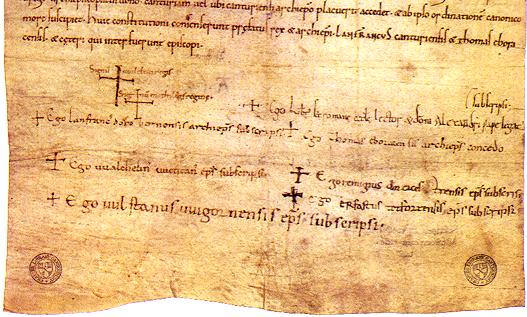
The pope referred the dispute to a council of English prelates, which met at Windsor during Whitsuntide in 1072. The council decided that the Archbishop of Canterbury was the superior of the Archbishop of York and further ruled that York had no rights south of the Humber River. This meant that the disputed bishoprics were taken from the province of York, an outcome that probably had the support of the King, who aimed to prevent the separation of the north from the rest of England. By depriving the Archbishop of suffragans, William limited York's power and separatist tendencies. The medieval chronicler Hugh the Chanter commented that by requiring Thomas to obey Canterbury, the King removed the threat that Thomas might crown someone else as King of England – such as the Danish king. However, the council of Windsor also ruled that York's province included Scotland (although it had no authority to enforce this on the independent Archbishop of St Andrews within Scotland, which resisted these English claims). Although Thomas was required to profess obedience to Lanfranc and Lanfranc's successors, the obedience did not mention nor was held to acknowledge any primacy of Canterbury, and it did not bind Thomas's successors.
All of these decisions were ratified in the Accord of Winchester that year, witnessed by the King and the papal legate, or representative of the pope, as well as many bishops and abbots. Thomas then made a written profession of obedience, sometime after late May. Lanfranc wrote to Alexander II, attempting to get a written papal privilege of Canterbury's primacy, but Alexander replied that Lanfranc must personally resubmit the case to the papal court before a papal privilege could be issued. Alexander died in 1073. His successor, Pope Gregory VII, was opposed to the idea of primacies, and the matter of the papal privilege for Canterbury went nowhere. In 1073, with the help of Wulfstan, Bishop of Worcester and Peter, Bishop of Chester, Thomas consecrated Radulf as Bishop of Orkney in an attempt to increase York's authority in Scotland. Wulfstan often performed episcopal functions in parts of the diocese of York during the 1070s for Thomas, especially in areas that were still in turmoil after the conquest.
Hub AI
Thomas of Bayeux AI simulator
(@Thomas of Bayeux_simulator)
Thomas of Bayeux
Thomas of Bayeux (died 18 November 1100) was Archbishop of York from 1070 until 1100. He was educated at Liège and became a royal chaplain to Duke William of Normandy, who later became King William I of England. After the Norman Conquest, the king nominated Thomas to succeed Ealdred as Archbishop of York. After Thomas's election, Lanfranc, Archbishop of Canterbury, demanded an oath from Thomas to obey him and any future Archbishops of Canterbury; this was part of Lanfranc's claim that Canterbury was the primary bishopric, and its holder the head of the English Church. Thomas countered that York had never made such an oath. As a result, Lanfranc refused to consecrate him. The King eventually persuaded Thomas to submit, but Thomas and Lanfranc continued to clash over ecclesiastical issues, including the primacy of Canterbury, which dioceses belonged to the province of York, and the question of how York's obedience to Canterbury would be expressed.
After King William I's death Thomas served his successor, William II, and helped to put down a rebellion led by Thomas's old mentor Odo of Bayeux. Thomas also attended the trial for rebellion of the Bishop of Durham, William de St-Calais, Thomas's sole suffragan, or bishop subordinate to York. During William II's reign Thomas once more became involved in the dispute with Canterbury over the primacy when he refused to consecrate the new Archbishop of Canterbury, Anselm, if Anselm was named the Primate of England in the consecration service. After William II's sudden death in 1100, Thomas arrived too late to crown King Henry I, and died soon after the coronation.
Thomas is sometimes referred to as Thomas I to distinguish him from his nephew Thomas, who was also an Archbishop of York. The elder Thomas's father was a priest named Osbert; his mother was named Muriel, but little else of them is known. He had a brother named Samson, who was Bishop of Worcester from 1086 until 1112. He was of Norman descent. Under the patronage of Odo, Bishop of Bayeux, both boys were sent to Liège for their education. Thomas may also have studied with Lanfranc in Normandy while the latter was teaching at the Abbey of Bec, and some scholars contend that he also studied in Germany and Spain. Thomas then returned to Normandy to become one of Bishop Odo's officials and a chaplain, or secretary. He was a canon and the treasurer of Bayeux Cathedral as well as a member of Duke William's ducal clergy before the Norman Conquest of England. The new King named him a royal clerk after the Battle of Hastings.
Thomas succeeded Ealdred as Archbishop of York in 1070; he was nominated on 23 May and was probably consecrated on 25 December. The appointment of Thomas was a departure for the King, who had usually promoted Norman nobles or monks when he was still Duke of Normandy. The appointment was more consistent with English norms, as most of those appointed to the English episcopate before the Conquest had previously been royal clerks.
Shortly after Thomas's election, Lanfranc, pursuing a claim that Canterbury was the primatial see, or bishopric, of England, demanded that Thomas provide a written oath swearing to obey both Lanfranc and any future Archbishops of Canterbury. Thomas declined to make such a written promise, so Lanfranc refused to consecrate him. Thomas argued that Lanfranc's demand was unprecedented, as no other Archbishop of York had been required to swear such an oath before. King William wanted clear lines of authority in the church to match the lines of authority in the secular sphere; thus, the King supported Lanfranc in the dispute. Royal pressure induced Thomas to submit to Lanfranc and Thomas was consecrated, but his profession of obedience was made orally to Lanfranc personally and not in writing or to any future archbishops of Canterbury. Although this settled the issue between Thomas and Lanfranc, it was the beginning of the long-running Canterbury–York dispute over the claims of Canterbury to have jurisdiction over York.
The next year both archbishops travelled to Rome for their palliums, where Thomas took advantage of the opportunity to ask Pope Alexander II to decree that the sees of Canterbury and York were equal. Thomas also sought to have the pope declare that the midland sees of Worcester, Dorchester on Thames, and Lichfield – all south of the River Humber – were part of the Archdiocese of York rather than Canterbury. The 12th-century chronicler Eadmer, a monk at Canterbury, wrote much later that Thomas had resigned and surrendered his archiepiscopal symbols, but they were promptly returned to him by Lanfranc on the pope's orders. The story's partisan source casts some doubt on its accuracy.
The pope referred the dispute to a council of English prelates, which met at Windsor during Whitsuntide in 1072. The council decided that the Archbishop of Canterbury was the superior of the Archbishop of York and further ruled that York had no rights south of the Humber River. This meant that the disputed bishoprics were taken from the province of York, an outcome that probably had the support of the King, who aimed to prevent the separation of the north from the rest of England. By depriving the Archbishop of suffragans, William limited York's power and separatist tendencies. The medieval chronicler Hugh the Chanter commented that by requiring Thomas to obey Canterbury, the King removed the threat that Thomas might crown someone else as King of England – such as the Danish king. However, the council of Windsor also ruled that York's province included Scotland (although it had no authority to enforce this on the independent Archbishop of St Andrews within Scotland, which resisted these English claims). Although Thomas was required to profess obedience to Lanfranc and Lanfranc's successors, the obedience did not mention nor was held to acknowledge any primacy of Canterbury, and it did not bind Thomas's successors.
All of these decisions were ratified in the Accord of Winchester that year, witnessed by the King and the papal legate, or representative of the pope, as well as many bishops and abbots. Thomas then made a written profession of obedience, sometime after late May. Lanfranc wrote to Alexander II, attempting to get a written papal privilege of Canterbury's primacy, but Alexander replied that Lanfranc must personally resubmit the case to the papal court before a papal privilege could be issued. Alexander died in 1073. His successor, Pope Gregory VII, was opposed to the idea of primacies, and the matter of the papal privilege for Canterbury went nowhere. In 1073, with the help of Wulfstan, Bishop of Worcester and Peter, Bishop of Chester, Thomas consecrated Radulf as Bishop of Orkney in an attempt to increase York's authority in Scotland. Wulfstan often performed episcopal functions in parts of the diocese of York during the 1070s for Thomas, especially in areas that were still in turmoil after the conquest.