
Recent from talks
Rebellion of the Three Guards
Knowledge base stats:
Talk channels stats:
Members stats:
Rebellion of the Three Guards
The Rebellion of the Three Guards (simplified Chinese: 三监之乱; traditional Chinese: 三監之亂; pinyin: Sān Jiàn zhī Luàn), or less commonly the Wu Geng Rebellion (simplified Chinese: 武庚之乱; traditional Chinese: 武庚之亂), was a civil war, instigated by an alliance of discontent Zhou princes, Shang loyalists, vassal states and other non-Zhou peoples against the Western Zhou government under the Duke of Zhou's regency in late 11th century BC.
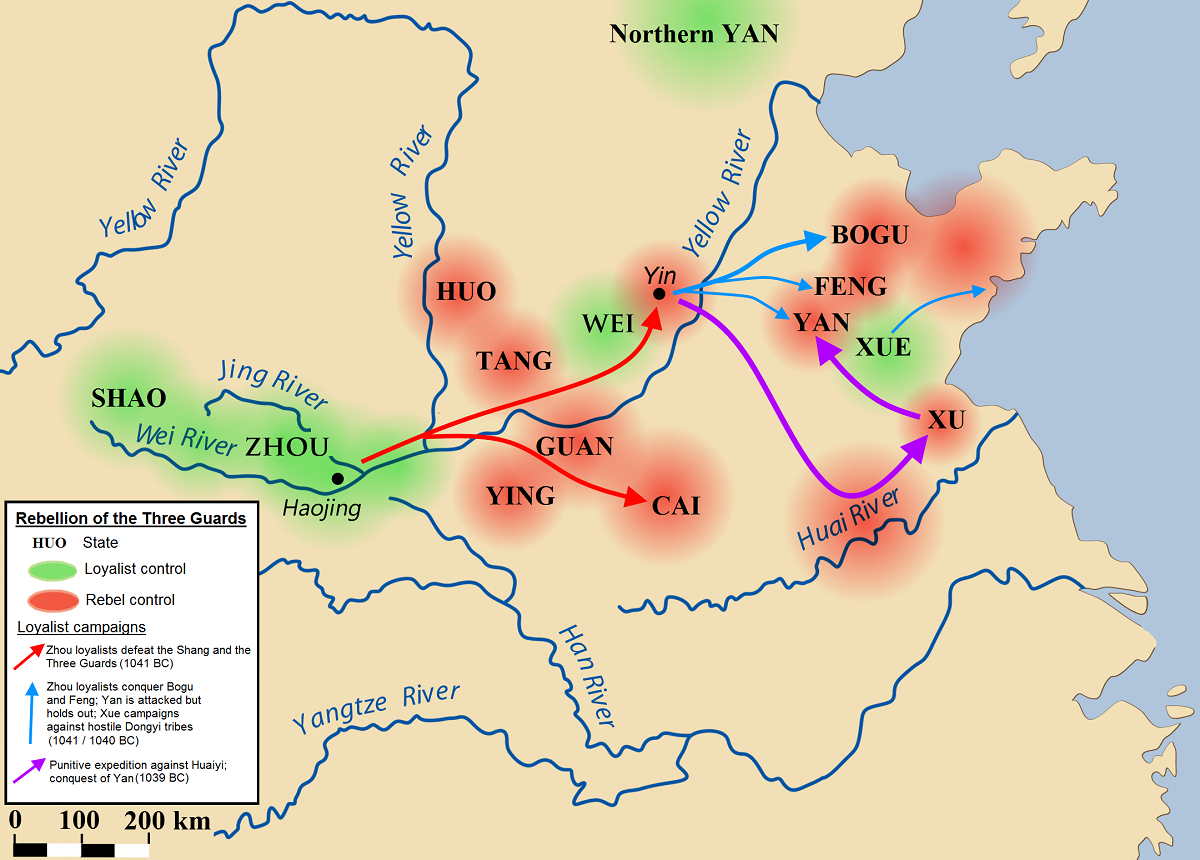
After the fall of the Shang dynasty, King Wu of Zhou had appointed his younger brothers Guanshu, Caishu and Huoshu as the "Three Guards" of the East to secure the newly conquered Shang lands. After his death and his young son King Cheng's coronation, King Wu's brother Dan, the Duke of Zhou, declared himself regent and took over the court. This aroused the anger of the Three Guards who suspected Dan of usurpation and believed that they should serve as regents. The Three Guards allied with many separatist eastern nobles, Shang loyalists under Prince Wu Geng, and several Dongyi and Huaiyi (淮夷) states in rebellion. The Duke of Zhou then launched a second "eastern campaign" to put down the rebellion, and defeated the rebels in three years, killing or disempowering their leaders. In doing so, he also further expanded the authority of Zhou kingdom into East China, transforming it into an empire using the new Fengjian system.
Edward L. Shaughnessy called the rebellion "a succession crisis that has come to be seen as defining moment not only for the Western Zhou dynasty but for the entire history of Chinese statecraft".
In 1059 BC, an extremely rare planetary conjunction occurred as Mercury, Venus, Mars, Jupiter, and Saturn were visible in the northwestern sky over northern China, grouped closely together. This was taken by the Zhou people as sign of great importance, showcasing that their ruler had been granted the "Mandate of Heaven". Declaring himself king, Wen of Zhou broke away from his previous overlords, the Shang dynasty, and launched a war for dominance over China. The Zhou consolidated the territories surrounding their homeland in the Wei River valley under King Wen. Following his death, his son King Wu of Zhou defeated the Shang dynasty and conquered the latter's capital of Yin in 1046 BC.
The Zhou dynasty supplanted the old Shang rule, but uncertainty and unrest remained. Most of the eastern vassal states remained loyal to the fallen Shang dynasty and resented the new "barbarian" rulers. King Wu recognized this, and appointed the last Shang king Di Xin's son Wu Geng as the deputy ruler of the east. He hoped that by doing so, the Zhou could rule the eastern lands through a Shang prince. Still wary of possible revolts against his rule, King Wu left his three brothers Guanshu Xian, Caishu Du, and Huoshu Chu (霍叔處) as the "Three Overseers" of the newly conquered lands and ordered them to watch over Wu Geng and the other eastern nobles. But not only the states of the Central Plain wanted to restore the Shang dynasty. Many Dongyi tribes and states of Shandong were "Shang strongholds" with strong cultural and political ties to the fallen regime, as they had served as the late dynasty's allies and vassals for over two centuries. Among them, only the state of Xue in southern Shandong welcomed the rise of the Zhou dynasty, as it had long fought the Shang for independence.
After ordering the eastern lands, King Wu returned west to his capital Fenghao, where he appointed his other brothers, Dan, the Duke of Zhou and Shi, the Duke of Shao, royal chancellor and "Grand Protector", respectively. These two quickly became the two most powerful figures at the court.
King Wu died around 1043 BC, leaving the throne to his eldest son, Song, to be known as King Cheng of Zhou. The Duke of Zhou, however, claimed that King Cheng was too young to rule, which was probably untrue. Either way, he declared himself regent for Cheng and took over the court. Despite some initial criticism, Dan managed to win over the most important court members, and firmly established his position at the capital. Together with his half-brother Duke of Shao and King Cheng, he formed a ruling triumvirate with himself as de facto leader. In the East, however, the Duke of Zhou's takeover caused great resentment among the Three Guards, as Guanshu and Caishu suspected their brother of usurpation. Furthermore, Guanshu was older than Dan, and the traditional line of seniority would have favored him as regent. According to Li Feng, communication in the Western Zhou period would also take forty to sixty days to traverse the difficult mountain roads in western Henan, causing "a problem of miscommunication and therefore mistrust between the Zhou commanders stationed on the eastern plain and the new leadership in the capital." In 1042 BC, the second year of the Duke of Zhou's regency, Guanshu and Caishu finally instigated Wu Geng and his followers to rise in rebellion.
The two rebellious brothers quickly convinced Huoshu of the rightfulness of their cause, uniting the Three Guards against the Duke of Zhou. They and the Shang loyalists were soon joined by many independent-minded nobles, especially from the southeast. Large swaths of the Zhou dynasty's eastern realm rose against the official government at Fenghao, including some states that controlled crucial passes and routes. The rebel state of Ying, for example, "was located near the exit of the Ying River valley connecting with the Luoyang plain and right at the entrance to the Nanyang Basin, controlling the road to the middle Yangtze region". Furthermore, the rebels were able to gain several external allies. Led by the states of Pugu and Yan, powerful Shang sympathizers, most of the Dongyi polities of Shandong rallied to the rebel cause. Even some Huaiyi tribes, which controlled the Huai River region and had little connection to either the Zhou or the Shang, joined the rebel forces. Among them was the state of Xu, which would grow into one of the Zhou dynasty's greatest enemies.
Hub AI
Rebellion of the Three Guards AI simulator
(@Rebellion of the Three Guards_simulator)
Rebellion of the Three Guards
The Rebellion of the Three Guards (simplified Chinese: 三监之乱; traditional Chinese: 三監之亂; pinyin: Sān Jiàn zhī Luàn), or less commonly the Wu Geng Rebellion (simplified Chinese: 武庚之乱; traditional Chinese: 武庚之亂), was a civil war, instigated by an alliance of discontent Zhou princes, Shang loyalists, vassal states and other non-Zhou peoples against the Western Zhou government under the Duke of Zhou's regency in late 11th century BC.
After the fall of the Shang dynasty, King Wu of Zhou had appointed his younger brothers Guanshu, Caishu and Huoshu as the "Three Guards" of the East to secure the newly conquered Shang lands. After his death and his young son King Cheng's coronation, King Wu's brother Dan, the Duke of Zhou, declared himself regent and took over the court. This aroused the anger of the Three Guards who suspected Dan of usurpation and believed that they should serve as regents. The Three Guards allied with many separatist eastern nobles, Shang loyalists under Prince Wu Geng, and several Dongyi and Huaiyi (淮夷) states in rebellion. The Duke of Zhou then launched a second "eastern campaign" to put down the rebellion, and defeated the rebels in three years, killing or disempowering their leaders. In doing so, he also further expanded the authority of Zhou kingdom into East China, transforming it into an empire using the new Fengjian system.
Edward L. Shaughnessy called the rebellion "a succession crisis that has come to be seen as defining moment not only for the Western Zhou dynasty but for the entire history of Chinese statecraft".
In 1059 BC, an extremely rare planetary conjunction occurred as Mercury, Venus, Mars, Jupiter, and Saturn were visible in the northwestern sky over northern China, grouped closely together. This was taken by the Zhou people as sign of great importance, showcasing that their ruler had been granted the "Mandate of Heaven". Declaring himself king, Wen of Zhou broke away from his previous overlords, the Shang dynasty, and launched a war for dominance over China. The Zhou consolidated the territories surrounding their homeland in the Wei River valley under King Wen. Following his death, his son King Wu of Zhou defeated the Shang dynasty and conquered the latter's capital of Yin in 1046 BC.
The Zhou dynasty supplanted the old Shang rule, but uncertainty and unrest remained. Most of the eastern vassal states remained loyal to the fallen Shang dynasty and resented the new "barbarian" rulers. King Wu recognized this, and appointed the last Shang king Di Xin's son Wu Geng as the deputy ruler of the east. He hoped that by doing so, the Zhou could rule the eastern lands through a Shang prince. Still wary of possible revolts against his rule, King Wu left his three brothers Guanshu Xian, Caishu Du, and Huoshu Chu (霍叔處) as the "Three Overseers" of the newly conquered lands and ordered them to watch over Wu Geng and the other eastern nobles. But not only the states of the Central Plain wanted to restore the Shang dynasty. Many Dongyi tribes and states of Shandong were "Shang strongholds" with strong cultural and political ties to the fallen regime, as they had served as the late dynasty's allies and vassals for over two centuries. Among them, only the state of Xue in southern Shandong welcomed the rise of the Zhou dynasty, as it had long fought the Shang for independence.
After ordering the eastern lands, King Wu returned west to his capital Fenghao, where he appointed his other brothers, Dan, the Duke of Zhou and Shi, the Duke of Shao, royal chancellor and "Grand Protector", respectively. These two quickly became the two most powerful figures at the court.
King Wu died around 1043 BC, leaving the throne to his eldest son, Song, to be known as King Cheng of Zhou. The Duke of Zhou, however, claimed that King Cheng was too young to rule, which was probably untrue. Either way, he declared himself regent for Cheng and took over the court. Despite some initial criticism, Dan managed to win over the most important court members, and firmly established his position at the capital. Together with his half-brother Duke of Shao and King Cheng, he formed a ruling triumvirate with himself as de facto leader. In the East, however, the Duke of Zhou's takeover caused great resentment among the Three Guards, as Guanshu and Caishu suspected their brother of usurpation. Furthermore, Guanshu was older than Dan, and the traditional line of seniority would have favored him as regent. According to Li Feng, communication in the Western Zhou period would also take forty to sixty days to traverse the difficult mountain roads in western Henan, causing "a problem of miscommunication and therefore mistrust between the Zhou commanders stationed on the eastern plain and the new leadership in the capital." In 1042 BC, the second year of the Duke of Zhou's regency, Guanshu and Caishu finally instigated Wu Geng and his followers to rise in rebellion.
The two rebellious brothers quickly convinced Huoshu of the rightfulness of their cause, uniting the Three Guards against the Duke of Zhou. They and the Shang loyalists were soon joined by many independent-minded nobles, especially from the southeast. Large swaths of the Zhou dynasty's eastern realm rose against the official government at Fenghao, including some states that controlled crucial passes and routes. The rebel state of Ying, for example, "was located near the exit of the Ying River valley connecting with the Luoyang plain and right at the entrance to the Nanyang Basin, controlling the road to the middle Yangtze region". Furthermore, the rebels were able to gain several external allies. Led by the states of Pugu and Yan, powerful Shang sympathizers, most of the Dongyi polities of Shandong rallied to the rebel cause. Even some Huaiyi tribes, which controlled the Huai River region and had little connection to either the Zhou or the Shang, joined the rebel forces. Among them was the state of Xu, which would grow into one of the Zhou dynasty's greatest enemies.
Recent media