Hubbry Logo
Ying RiverYing RiverMain
Open search
Ying River
Community hub
Ying River
logo
8 pages, 0 posts
0 subscribers
Be the first to start a discussion here.
Ying River
Ying River
from Wikipedia
Ying River
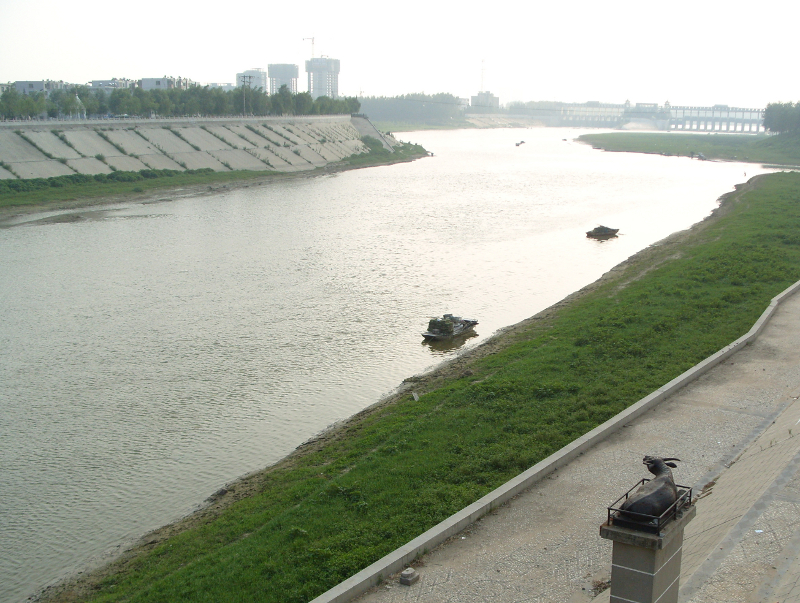
The Shaying River at Zhoukou
Native name颍河 (Chinese)
Location
CountryChina
Physical characteristics
SourceHenan
MouthHuai River (淮河)
 • location
Zhengyang County, Henan, China
Length557 km (346 mi)[1]

The Ying River (simplified Chinese: ; traditional Chinese: ; pinyin: Yǐng Hé) is the largest tributary of the Huai River with its origin in Henan Province, People's Republic of China.[2] From Zhoukou City in Henan, the river flows through Fuyang City in Anhui Province then empties into the Huai River at Shouxian.[3]

Seriously polluted along its entire length, in 2007 the Ying River's water quality was rated as below Grade 5 by the Chinese Environmental Protection Agency.[4]

Tributaries

[edit]

The Sha River (沙河) is the largest tributary and from the confluence onward, the Ying River is often referred to as the Shaying River (沙颍河).[3]

The Shaying river at Fuyang, Anhui province.
North bank South bank
Jialu River (贾鲁河) Sha River (沙河)
Xin Canal (新运河) Quan River (泉河)
Xin Cai River (新蔡河)
Ci River (茨河)

See also

[edit]

References

[edit]
Revisions and contributorsEdit on WikipediaRead on Wikipedia
from Grokipedia
The Ying River (Chinese: 潁河; pinyin: Yǐng Hé), also known as the Shaying River (沙潁河; Shā Yǐng Hé), is the largest tributary of the in east-central , originating in the eastern foothills of the Funiu Mountains in and flowing approximately 620 kilometers (385 miles) southeast to its confluence with the Huai River at Mohekou in Yingshang County, , draining a basin of 36,651 square kilometers (14,154 square miles). This major waterway traverses densely populated regions, passing through or near key cities such as , , , Luohe, in , and Jieshou, Taihe, , and Yingshang in , supporting agriculture, industry, and transportation in one of China's vital grain-producing areas. Historically, the Ying River has held significant importance in ancient Chinese hydrology and infrastructure, serving as a key link in early canal systems like the pre-Qin Hong Canal (built around 361 BCE by the ) and later and networks, which connected it to the and facilitated military logistics, grain tribute transport, and regional trade across the . In modern times, the river has faced severe pollution challenges, contributing over one-third of the and ammonia nitrogen loads to the despite comprising only 14% of its basin, leading to multiple restoration efforts amid its role as one of China's most contaminated waterways. Navigation on the Ying River, historically intermittent due to gates and seasonal flows, has been enhanced since 2005 through projects like the Anhui Inland Waterway Development Plan (2005–2020), enabling year-round Class IV waterway standards (50-meter width, 2.8-meter depth) in sections below Zhoukou, with new ship locks at Genglou (opened 2009), Yingshang (2008), and Fuyang (reconstructed from 2006), boosting cargo capacity to an estimated 14–18 million tons annually by 2030.

Geography

Course and Length

The Ying River, also known as the Yinghe or Shaying River, originates in the Funiu Mountains in , , specifically in areas such as Xinmi County or near the southern slopes of the in . This origin point lies in a hilly and mountainous region with elevations ranging from 600 to 1,500 meters above sea level, marking the start of the river's main stem. From its source, the river flows southeastward for a total length of approximately 620 kilometers, traversing a diverse terrain that transitions from the northwestern highlands to southeastern plains with elevations dropping to 30 to 100 meters above sea level. Along its course, it passes through several major urban centers in and , including , (via nearby Yuzhou), Luohe, , and , where the landscape features wide, even plains inclined gently southeastward with minimal slope variations. These sections often include meandering paths through agricultural lowlands, with the river widening in the eastern plains to support local infrastructure and water management. The river's endpoint is at its confluence with the near Mohekou in Yingshang County, , completing its journey as the largest tributary of the .

Basin and Tributaries

The of the Ying River, also known as the Shaying River, covers a total area of 36,651 square kilometers, primarily spanning eastern and northwestern in . Of this area, approximately 32,539 square kilometers lie within Henan Province, while 4,112 square kilometers are in Anhui Province, with the basin sloping gently from northwest to southeast across vast plains surrounded by mountains such as the Funiu Mountains. The basin can be divided into upstream, midstream, and downstream zones, where the upstream section originates in mountainous terrain near the Funiu Mountains in Henan, the midstream traverses central plains through cities like , and the downstream extends into Anhui's low-lying areas before joining the . Land use patterns in the Ying River basin are predominantly agricultural, characterized by extensive farmlands supporting crops such as , , , cotton, , beans, fruits, vegetables, , and across densely populated plains that have long been dedicated to aerial farming and cultivation. Urban development is concentrated in midstream areas around major cities, while upstream and downstream zones feature more rural landscapes with , , and interspersed among the agricultural fields, contributing to a typical . The Ying River's major tributaries include the Sha River, Quan River, Jialu River, and Xincai River, each contributing significantly to the river's flow from the left or right banks. The Sha River, originating in , is the largest tributary and confluences with the upper Ying River at in , after which the main stem is often called the Shaying River; its exact length is not specified in available records, but it plays a key role in forming the primary channel. The Quan River, also known as the Fenquan River upstream, originates at Shaolinggang in Yangcheng County, , stretches for 241 kilometers (with 82.27 kilometers in Henan from Zhoulou to ), and joins the Ying River on the right bank at Sanliwan in , , draining a basin of 1,990 square kilometers. The Jialu River, 256 kilometers long, originates in Xinmi, , enters as a left-bank tributary, flowing northeast to and then southeast through Weishi, Fugou, and Xihua counties before its confluence with the Ying River at . Similarly, the Xincai River joins as another left-bank tributary, contributing to the midstream flow, with its origin and length not fully detailed but confirmed as a significant inflow in the basin system.

Hydrology and Drainage

The Ying River's is characterized by significant seasonal variability driven by the East Asian monsoon climate, with average annual rainfall in the of approximately 770 mm, of which 63% falls between June and September. This leads to high-flow periods during the (June to October), when summer rainstorms originating from the western mountains increase and pose flood risks, contrasted by low-flow conditions in the dry season (November to May), when reduced results in diminished and limited dilution capacity for . Peak flood discharges on the Ying River are substantial, with recorded values of 4,580 m³/s for a and 5,961 m³/s for a in key sections, such as near the Fuyang Sluice, where the designed discharge capacity to the is 3,760 m³/s. Low-flow periods during the dry season are marked by notably reduced , exacerbating water quality issues due to stagnant conditions and accumulation of contaminants, as observed in monitoring data from 2009–2010 across multiple stations. The river's flow regime is further modulated by anthropogenic structures like dams and , which regulate water release to mitigate floods but can alter natural low-flow dynamics by retaining water upstream during non-flood seasons. Sedimentation patterns in the Ying River basin reflect historical and ongoing fluvial processes, with episodes of alluvial aggradation occurring in the middle and late Holocene between 7.7–5.4 ka B.P. and 4.5 ka B.P., contributing to landscape evolution and potentially reducing drainage capacity through sediment buildup in valleys. In modern contexts, high flows during the monsoon season transport eroded sediments from upstream soil erosion, which can deposit in downstream reaches and impact channel morphology, though quantitative rates of contemporary sedimentation remain influenced by both natural runoff and human interventions like reservoirs. of the Ying River often incorporate to analyze flow regime alterations, such as those evaluating the on environmental flows, revealing shifts in that affect overall . Measurements from , including from 2009–2010, support these models by providing for simulating and predicting relative to .

History

Ancient Significance

The Ying River, known in ancient times as the Ying Shui (潁水), held significant status in classical Chinese geography as one of the "eight streams" (八流) associated with the four major rivers (四渎) of , specifically as a key tributary of the alongside the Ru, Si, and Yi Rivers. This designation appears in ancient geographical concepts documented in historical records, reflecting the river's recognized importance in the hydrological framework of . The term "four majors and eight streams" underscores the Ying River's role in the broader network of waterways that shaped prehistoric and dynastic landscapes, with references to it appearing in texts from the onward. In classical literature and historical documents, the Ying River is frequently mentioned during the (206 BCE–220 CE), where it formed the core of Yingchuan Commandery (潁川郡), an administrative division in central that served as a vital political and economic hub. This commandery, centered around modern Yuzhou, was established by the after conquering the state of Han and played a crucial role in , with its governors exemplifying the dual accountability system between local officials and the central court. During the , Yingchuan was a center for scholarly and administrative activities, producing notable figures and contributing to the region's integration into the 's bureaucratic structure. Earlier mentions in texts like the Shui Jing Zhu (水經注), a Northern Wei dynasty commentary on ancient waterways, describe the Ying River's course and its connections to surrounding terrains, highlighting its enduring presence in geographical treatises from the Han and post-Han eras. The river's ancient uses were multifaceted, supporting irrigation for , , and along its banks. Archaeological evidence from the Ying River basin reveals extensive fields dating back to the , indicating the river's critical role in early irrigation systems that sustained through controlled and . In the upper Ying River valley, sites like Wangchenggang demonstrate how fluvial landscapes facilitated , with ancient communities leveraging the river for and fertile , as seen in the evolution of settlements from the onward. For transportation, the river's navigable sections enabled the movement of goods and people in prehistoric and dynastic times, connecting inland areas to the and supporting in the . Militarily, the Ying River's strategic position is evident in its association with legendary flood control efforts by the Great Yu of the , with the Wangchenggang site interpreted as a potential capital linked to early and defensive settlements against flooding and invasions. Key archaeological sites underscore the river's historical importance, including the Wadian site in the Ying River valley, a major from the (ca. 2600–2000 BCE) spanning 100 hectares and featuring diverse that points to and economic activities tied to the riverine environment. Similarly, the Wangchenggang site on the upper reaches represents a pivotal to settlement, where landscape changes influenced prehistoric community development, including adaptations to and that supported . These sites, excavated and surveyed by institutions like the Henan Provincial Institute of Cultural Relics, reveal linked to flood events and human modification of the river course, tying directly to historical narratives of the Ying River as a cradle of civilization.

Modern Developments

Following the establishment of the in 1949, the management of the Ying River (also known as the Shaying River) underwent significant transformations driven by national policies aimed at flood control, , and . The focused on constructing to mitigate flooding and support amid rapid industrialization and . However, these efforts achieved limited success due to the caused by regulatory structures, which exacerbated water resource challenges in the densely populated regions along the river's course through and provinces. led to that prioritized regulatory structures. Major flood control projects proliferated in the Ying River basin starting from the , with a large number of dams and sluices built primarily in the upper reaches for storage and in the middle and lower sections for regulation. Key structures include the Sluice in the middle reaches, designed for flood prevention and irrigation over a 25,800 km² , and the Huaidian Sluice, constructed in the approximately 60 km downstream to serve as a critical . Additional projects from the 1970s encompass the Sluice, located 130 km downstream with a 35,246 km² drainage area for downstream flood management, and the Yingshang Sluice, 69 km further downstream covering 36,606 km² for irrigation and control. These initiatives significantly modified the hydrologic regime, reducing median monthly flows, , and the range of daily variations while increasing and the rate of change, as evidenced by analyses of data from stations like Zhoukou and Fuyang. Development intensified these impacts by contributing to decreases during dry seasons through expanded irrigation demands, necessitating to balance with flood risk reduction. Key flood events in the modern era highlight the ongoing challenges and responses in . Notable floods occurred in 1950, 1954, 1956, 1957, , and , with the 1975 and 2021 events particularly severe due to unprecedented heavy rainfall that overwhelmed existing infrastructure. These incidents prompted enhanced , including the Anhui Shaying River Channel Improvement Project launched in 2008 with construction from 2009 to 2012, which integrated of 18,367,000 m³ of sediment and over 36,700 m along 205.6 km to upgrade the channel to Grade IV standards. This project facilitated year-round in sections below since 2005, enabled by the reopening of the section and completion of hubs like the Genglou Navigation Hub in 2009, alongside locks such as the Yingshang Ship Lock (operational December 2008) and Fuyang Ship Lock (reconstructed starting in 2009). Outcomes included projected traffic increases to 14 million tons by 2020, supporting post-flood economic recovery while incorporating like . The Ying River, also known as the Sha Ying River, has seen significant improvements in navigability since 2005, particularly in sections below , where restoration efforts enabled year-round navigation following the initiation of a -backed program aimed at rejuvenating the waterway for enhanced shipping capacity. This program, aligned with the Anhui Inland Waterway Transport Development Plan (2005-2020), targeted upgrades to support perennial navigation along key stretches, including from Zhoukou in to Jieshou in , through the completion of infrastructure like the Genglou Navigation Hub. Prior to these efforts, navigation had been severely limited or suspended in lower reaches due to siltation and low water levels, but post-2005 and works restored continuous access for vessels, with the upgraded sections now accommodating ships up to 500 under Class IV standards along a 196.6 km route from Jieshou to Mohekou. Existing infrastructure includes several key locks and ports that facilitate this navigability. The Yingshang Ship Lock, completed in 2008 as the final lock in the downstream section, supports vessel passage with capacities for up to 500-ton ships, while the subsequent Yingshang 2nd Ship Lock project, designed to Grade IV criteria with a chamber measuring 200 m long by 23 m wide and 4.0 m deep at the sill, further boosts annual throughput to 12 million tons unidirectional. Ports and wharfs, such as those in and , handle cargo like grain, with dredging operations integral to maintaining channel depths of at least 2.8 meters for Class IV compliance; for instance, the Yingshang 2nd Ship Lock Project incorporated dredging that generated 1.35 million cubic meters of spoil. Historical improvements trace back to the 2005 plan, which prioritized the river as one of 's "Three-Branch" waterways for Class IV upgrades, involving bank strengthening, navigation aids, and bridge modifications to ensure reliable passage. The Ship Lock, commissioned in approximately 2011, fully restored navigation across the entire Shaying River stretch by addressing previous blockages like the downstream of Fuyang. These initiatives build on the 2005-2020 development framework, with efforts like the three-year improvement program starting in 2012 incorporating additional and lock expansions to handle larger vessels up to 1,000 tons seasonally. In contrast, the upper sections above face limitations due to insufficient water depth and seasonal fluctuations, restricting navigation to smaller under Class V standards and rendering parts non-navigable during dry periods without . Additional challenges include aquatic weeds that require manual clearing and occasional in shallower areas, as well as congestion at existing like those in , which can delay traffic for hundreds of boats.

Economic Importance

The Ying River plays a pivotal role in the regional economy of , particularly as a vital water source for agriculture in its basin, which spans and provinces. The Henan section of the Sha Ying River Basin serves as a core agricultural area within the , supporting extensive grain production that contributed 17.4174 million tons in 2022, accounting for 26.29% of Henan Province's total grain output. This productivity relies heavily on , with the basin's exceeding 3 billion cubic meters annually from 2010 to 2022, enabling the cultivation of major crops like and across a large irrigated area that underpins for the region. Comprehensive irrigation and drainage facilities have enhanced water use efficiency, reducing waste and bolstering sustainable farming practices in areas such as , where agricultural water demands are particularly high due to intensive crop production. In terms of transportation, the navigable sections of the Ying River facilitate the movement of goods, especially grain and agricultural products, to , integrating into broader that lower logistics costs and support export-oriented agriculture. Harbors along the Ying River Channel provide favorable conditions for this trade, contributing to economic connectivity between northern production hubs and southern markets. The river's role in these networks has helped establish major food export regions, enhancing overall . The river significantly bolsters the economies of cities like and , where it drives growth through agriculture and related activities. In the section, the basin's total GDP reached 2495.073 billion in 2022, representing 40.67% of 's GDP, with Zhoukou emerging as a key contributor via its focus on grain production and initial processing of farm goods. Local agricultural output in areas along the river, such as , includes substantial food crop yields totaling around 70,998 tons annually, underscoring the river's direct support for rural livelihoods and trade volumes in these urban centers. Flood control and restoration projects along the Ying River further promote economic stability by safeguarding these productive zones and creating job opportunities, with initiatives generating hundreds of positions in construction and related sectors. Industrial uses of the Ying River also contribute to economic vitality, providing water for factories and manufacturing in riverside cities. In the Henan basin, industrial water consumption supports energy-intensive sectors like and in , as well as high-tech production in , with water efficiency per 10,000 of showing strong correlations to overall economic coordination. Along segments in , specializing in materials like and generated an output value of 89.18 million in 2020, relying on the river for operational stability and flood mitigation to minimize disruptions. These activities enhance regional industrialization while integrating with for .

Ecology and Environment

Flora and Fauna

The Ying River basin supports a diverse array of aquatic and riparian flora, with 28 species of vascular aquatic plants identified across 17 families and 22 genera, primarily consisting of emergent, floating, and submerged types adapted to the river's floodplain and wetland environments. Key native aquatic plants include common reed (Phragmites communis) and Manchurian wild rice (Zizania latifolia), which form dense clusters in shallow waters and contribute to habitat stability, alongside floating species such as water chestnut (Trapa natans) and lesser duckweed (Lemna minor). Riparian vegetation along the riverbanks features 53 species of terrestrial vascular plants in 24 families, dominated by Asteraceae (15 species) and Poaceae (5 species), with representative examples including Chinese white poplar (Populus × simonii) in artificial forests and shrubs like wolfberry (Lycium chinense) and paper mulberry (Broussonetia papyrifera) on embankment slopes. Aquatic fauna in the basin is characterized by rich fish communities, with surveys detecting 63 unique corresponding to at least 42 fish species across multiple sites, including native members that dominate the ecosystem. Representative native fish species include , , bighead carp (Hypophthalmichthys nobilis), and , which inhabit , , reservoir, and ; additional species of conservation concern, such as Chinese false gudgeon (Abbottina rivularis) and bitterling (Rhodeus ocellatus), are noted for their regional significance. communities comprise 78 species in 36 genera, predominantly (60 species), with dominant taxa like Brachionus angularis and Keratella valga serving as key components of the in upstream sections. include 31 species, such as the freshwater mussel Cristaria plicata and snail Bellamya aeruginosa, supporting the overall aquatic biodiversity in and shoal habitats. Bird populations dependent on the river ecosystem number 31 observed species, with historical records indicating up to 82 across 14 orders and 32 families, including conservation-priority species like black kite (Milvus migrans) and hen harrier (Circus cyaneus) that utilize riparian floodplains and wetlands for foraging. Mammal communities feature 15 species in 5 orders and 9 families, with riparian-dependent examples such as raccoon dog (Nyctereutes procyonoides) and leopard cat (Prionailurus bengalensis), which inhabit shrubby riverbanks and adjacent grasslands. Amphibians and reptiles total 16 species in 7 families, including protected taxa like Reeves' turtle (Mauremys reevesii) and black-browed snake (Elaphe taeniura), thriving in the basin's wetland hotspots and floodplain edges. The river's habitats, encompassing extensive wetlands, floodplains, reservoirs, and shoals covering much of the 36,651 km² drainage area, serve as biodiversity hotspots fostering these assemblages, though no strictly endemic species unique to the Ying basin have been documented.

Environmental Challenges and Conservation

The Ying River faces significant environmental challenges primarily from caused by , , and , which have severely degraded its water quality over the past two decades. In particular, nitrogen and phosphorus contaminants from have led to , with 2020 monitoring data showing that 63.16% of the river's 19 assessment sections classified as Class IV-V, indicating moderate to heavy pollution levels unsuitable for most uses. A notable incident in 2007 involved serious chemical pollution in the river, the 's largest tributary, resulting from that produced white froth and elevated levels of , prompting emergency responses from local authorities. Upstream activities, including rapid and in cities like , have exacerbated these issues, with construction land expanding by approximately 103 km² between 2013 and 2023, reducing permeable surfaces and increasing nutrient loads into the river. and represent additional major threats, driven by and in the , of which the Ying River is the primary tributary. Habitat loss has been pronounced, as decreased by nearly 3,000 km² from 1995 to 2015 while construction land grew by over 3,600 km² in the , fragmenting and elevating overall ecological risk across 90.40% of the Huai River watershed during 2010-2015. These degradations have led to broader health impacts, including the designation of nearby villages as "cancer villages" due to pollution-linked cancers, with a 2013 report attributing elevated risks to from the Ying and Huai Rivers. Conservation efforts have intensified since the mid-2010s, with the Chinese government's Water Pollution Prevention and Control Action Plan (Water Ten Plan) launched in 2015 targeting industrial polluters through shutdowns of over 50,000 facilities and stricter penalties, resulting in noticeable improvements in the Ying River by 2017. In along the river, a 2018 policy initiative enhanced ecological management, reducing total nitrogen and phosphorus outputs by 23,770 kg from 2013 to 2023 through measures like and in agricultural zones. Ongoing restoration projects include the construction of and to boost water purification capacity, with models like InVEST recommending an increase in water body land use to at least 859 km² by 2035 to enhance . Public participation tools, such as the Blue Map app, have supported enforcement by enabling rapid reporting of pollution incidents, mandating government responses within seven days. Despite these advances, challenges persist, with ecological risk assessments calling for continued monitoring to address residual and in the basin.

References

Add your contribution
Related Hubs
User Avatar
No comments yet.