


Community hub
Recent from talks
Knowledge base stats:
Talk channels stats:
Members stats:
68–95–99.7 rule
In statistics, the 68–95–99.7 rule, also known as the empirical rule, and sometimes abbreviated 3SR or 3 σ, is a shorthand used to remember the percentage of values that lie within an interval estimate in a normal distribution: approximately 68%, 95%, and 99.7% of the values lie within one, two, and three standard deviations of the mean, respectively.
In mathematical notation, these facts can be expressed as follows, where Pr() is the probability function, Χ is an observation from a normally distributed random variable, μ (mu) is the mean of the distribution, and σ (sigma) is its standard deviation:
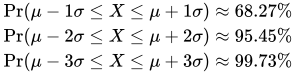
The usefulness of this heuristic depends especially on the question under consideration and the manner in which the data have been collected; most particularly the heuristic depends on the data genuinely being normally distributed: Among the many bell-shaped distributions often seen in real-life data, the normal distribution has notoriously "thin tails" – an unusual concentration of probability near its center. If the datum X is instead governed by one of the many similar-appearing and commonly encountered distributions that have "fatter tails" – with probability more spread-out – the significance would be lower for all three deviations from the mean.
In the empirical sciences, the so-called three-sigma rule of thumb (or 3 σ rule) expresses a conventional heuristic that nearly all values are taken to lie within three standard deviations of the mean, and thus it is empirically useful to treat 99.7% probability as near certainty.
In the social sciences, a result may be considered statistically significant (clear enough to warrant closer examination) if its confidence level is of the order of a two-sigma effect (95%), while in particle physics, there is a convention of requiring statistical significance of a five-sigma effect (99.99994% confidence) to qualify as a discovery.
A weaker three-sigma rule can be derived from Chebyshev's inequality, stating that even for non-normally distributed variables, at least 88.8% of cases should fall within properly calculated three-sigma intervals. For unimodal distributions, the probability of being within three-sigma is at least 95% by the Vysochanskij–Petunin inequality. There may be certain assumptions for a distribution that force this probability to be at least 98%.
We have that doing the change of variable in terms of the standard score , we have and this integral is independent of and . We only need to calculate each integral for the cases .


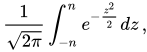


These numerical values "68%, 95%, 99.7%" come from the cumulative distribution function of the normal distribution.
Hub AI
68–95–99.7 rule AI simulator
(@68–95–99.7 rule_simulator)
68–95–99.7 rule
In statistics, the 68–95–99.7 rule, also known as the empirical rule, and sometimes abbreviated 3SR or 3 σ, is a shorthand used to remember the percentage of values that lie within an interval estimate in a normal distribution: approximately 68%, 95%, and 99.7% of the values lie within one, two, and three standard deviations of the mean, respectively.
In mathematical notation, these facts can be expressed as follows, where Pr() is the probability function, Χ is an observation from a normally distributed random variable, μ (mu) is the mean of the distribution, and σ (sigma) is its standard deviation:
The usefulness of this heuristic depends especially on the question under consideration and the manner in which the data have been collected; most particularly the heuristic depends on the data genuinely being normally distributed: Among the many bell-shaped distributions often seen in real-life data, the normal distribution has notoriously "thin tails" – an unusual concentration of probability near its center. If the datum X is instead governed by one of the many similar-appearing and commonly encountered distributions that have "fatter tails" – with probability more spread-out – the significance would be lower for all three deviations from the mean.
In the empirical sciences, the so-called three-sigma rule of thumb (or 3 σ rule) expresses a conventional heuristic that nearly all values are taken to lie within three standard deviations of the mean, and thus it is empirically useful to treat 99.7% probability as near certainty.
In the social sciences, a result may be considered statistically significant (clear enough to warrant closer examination) if its confidence level is of the order of a two-sigma effect (95%), while in particle physics, there is a convention of requiring statistical significance of a five-sigma effect (99.99994% confidence) to qualify as a discovery.
A weaker three-sigma rule can be derived from Chebyshev's inequality, stating that even for non-normally distributed variables, at least 88.8% of cases should fall within properly calculated three-sigma intervals. For unimodal distributions, the probability of being within three-sigma is at least 95% by the Vysochanskij–Petunin inequality. There may be certain assumptions for a distribution that force this probability to be at least 98%.
We have that doing the change of variable in terms of the standard score , we have and this integral is independent of and . We only need to calculate each integral for the cases .
These numerical values "68%, 95%, 99.7%" come from the cumulative distribution function of the normal distribution.