
.svg/232px-Peace_symbol_(bold).svg.png)


.svg/2000px-Peace_symbol_(bold).svg.png)
Community hub
Recent from talks
Contribute something
Nothing was collected or created yet.
Peace symbols
View on Wikipedia
.svg)
A number of peace symbols have been used many ways in various cultures and contexts. The dove and olive branch was used symbolically by early Christians and then eventually became a secular peace symbol, popularized by a Dove lithograph by Pablo Picasso after World War II. In the 1950s, the "peace sign", as it is known today (also known as "peace and love"), was designed by Gerald Holtom as the logo for the British Campaign for Nuclear Disarmament (CND),[1] a group at the forefront of the peace movement in the UK, and adopted by anti-war and counterculture activists in the US and elsewhere. The symbol is a superposition of the semaphore signals for the letters "N" and "D", taken to stand for "nuclear disarmament",[2] while simultaneously acting as a reference to Goya's The Third of May 1808 (1814) (aka "Peasant Before the Firing Squad").[3]
The V hand signal and the peace flag also became international peace symbols.
Olive branch
[edit]Classical antiquity
[edit]
The use of the olive branch as a symbol of peace in Western civilization dates at least to 5th century BC Greece. The olive branch, which the Greeks believed represented plenty and drove away evil spirits,[4] was one of the attributes of Eirene,[5] the Greek goddess of peace. Eirene (whom the Romans called Pax), appeared on Roman Imperial coins[6] with an olive branch.
The Roman poet Virgil (70–10 BC) associated "the plump olive"[7] with Pax and he used the olive branch as a symbol of peace in his Aeneid:[8]
High on the stern Aeneas his stand,
And held a branch of olive in his hand,
While thus he spoke: "The Phrygians' arms you see,
Expelled from Troy, provoked in Italy
By Latian foes, with war unjustly made;
At first affianced, and at last betrayed.
This message bear: The Trojans and their chief
Bring holy peace, and beg the king's relief."
The Romans believed there was an intimate relationship between war and peace. Mars, the god of war, had another aspect, Mars Pacifer, Mars the bringer of Peace, who is shown on coins of the later Roman Empire bearing an olive branch.[9][10] Appian describes the use of the olive-branch as a gesture of peace by the enemies of the Roman general Scipio Aemilianus in the Numantine War[11] and by Hasdrubal of Carthage.[12]
Later representations
[edit]
Poets of the 17th century associated the olive branch with peace.[13] A Charles I gold coin of 1644 shows the monarch with sword and olive branch.[14] Throughout the 18th century, English coins show Britannia with a spear and olive branch.
The Old Royal Naval College, Greenwich, contains an allegorical painting by James Thornhill, Peace and Liberty Triumphing Over Tyranny (1708–1716), depicting King William III and Queen Mary (who had enacted the English Bill of Rights) enthroned in heaven with the Virtues behind them. Peace, with her doves and lambs, hands an olive branch to William, who in turn hands the cap of liberty to Europe, where absolute monarchy prevails. Below William is the defeated French king, Louis XIV.[15]
In January 1775, the frontispiece of the London Magazine published an engraving of Peace descending on a cloud from the Temple of Commerce, bringing an olive branch to America and Britannia. In July that year, the American Continental Congress adopted the "Olive Branch Petition" in the hope of avoiding a full-blown war with Great Britain.[8]
On the Great Seal of the United States (1782), the olive branch denotes peace, as explained by Charles Thomson, Secretary to Congress: "The Olive branch and arrows denote the power of peace & war which is exclusively vested in Congress."[8]
Dove and olive branch
[edit]Christianity
[edit]


The use of a dove as a symbol of peace originated with early Christians, who portrayed baptism accompanied by a dove, often on their sepulchres.[10][16]
The New Testament compared the dove to the Spirit of God that descended on Jesus during his baptism.[17][18] Christians saw similarities between baptism and Noah's Flood. The First Epistle of Peter (composed around the end of the first century AD[19]) said that the Flood, which brought salvation through water, prefigured baptism.[20] Tertullian (c. 160 – c. 220) compared the dove, who "announced to the world the assuagement of divine wrath, when she had been sent out of the ark and returned with the olive branch, to the Holy Spirit who descends in baptism in the form of a dove that brings the peace of God, sent out from the heavens".[21]
At first the dove represented the subjective personal experience of peace, the peace of the soul, and in the earliest Christian art it accompanies representations of baptism. By the end of the second century (for example in the writing of Tertullian)[22] it also represented social and political peace, "peace unto the nations", and from the third century it began to appear in depictions of conflict, such as Noah and the Ark, Daniel and the lions, the three young men in the furnace, and Susannah and the Elders.[23][24]
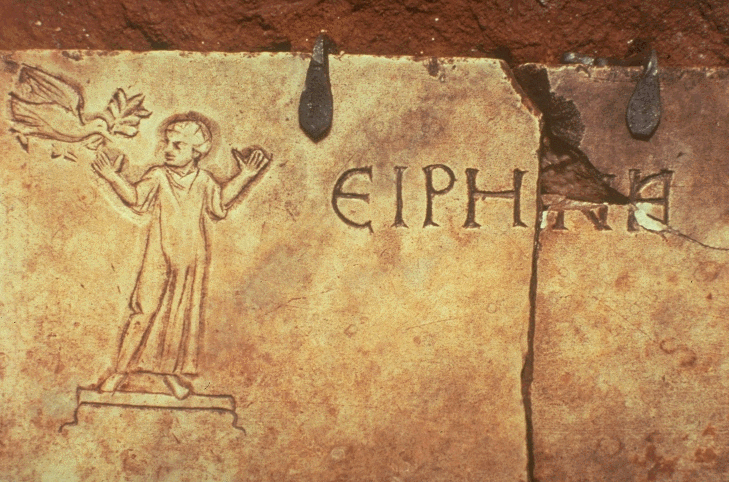
The dove appears in Christian inscriptions in the Roman catacombs, sometimes accompanied by the words in pace (Latin for in peace). For example, in the Catacomb of Callixtus, a dove and branch are drawn next to a Latin inscription NICELLA VIRCO DEI OVE VI XIT ANNOS P M XXXV DE POSITA XV KAL MAIAS BENE MERENTI IN PACE, meaning 'Nicella, God's virgin, who lived for more or less 35 years. She was placed [here] 15 days before the Kalends of May [17 April]. For the well deserving one in peace.'[25] In another example, a shallow relief sculpture shows a dove with a branch flying to a figure marked in Greek as ΕΙΡΗΝΗ (Eirene, or 'Peace').[26] The symbol has also been found in the Christian catacombs of Sousse, Tunisia (ancient Carthage), which date from the end of the first century AD.[27][28][29]
The Christian symbolism of the olive branch, invariably carried by the dove, derives from Greek usage and the story of Noah in the Hebrew Bible.[30] The story of Noah ends with a dove bringing a freshly plucked olive leaf (Hebrew: עלה זית alay zayit),[31] a sign of life after the Flood and of God's bringing Noah, his family and the animals to land. Rabbinic literature interpreted the olive leaf as "the young shoots of the Land of Israel"[32] or the dove's preference for bitter food in God's service, rather than sweet food in the service of men.[33][34][35] Neither represented peace in Jewish thought, but the dove and olive branch acquired that meaning in Christianity.[36]
Before the Peace of Constantine (313 AD), in which Rome ceased its persecution of Christians following Constantine's conversion, Noah was normally shown in an attitude of prayer, a dove flying toward him or alighting on his outstretched hand. According to Graydon Snyder, "The Noah story afforded the early Christian community an opportunity to express piety and peace in a vessel that withstood the threatening environment" of Roman persecution.[23] According to Ludwig Budde and Pierre Prigent, the dove referred to the descending of the Holy Spirit rather than the peace associated with Noah. After the Peace of Constantine, when persecution ceased, Noah appeared less frequently in Christian art.[23]
In the fourth century, St. Jerome's Latin Bible translated the Hebrew alay zayit in the Noah story as ramum olivae, ('olive branch'), possibly reflecting the Christian equivalence between the peace brought by baptism and peace brought by the ending of the Flood. By the fifth century, St Augustine confirmed the Christian adoption of the olive branch as a symbol of peace, writing that, "perpetual peace is indicated by the olive branch (Latin: oleae ramusculo) that the dove brought with it when it returned to the ark."[37]
Medieval illuminated manuscripts, such as the Holkham Bible, showed the dove returning to Noah with a branch.[38] Wycliffe's Bible, which translated the Vulgate into English in the 14th century, uses "a braunche of olyue tre with greene leeuys" ("a branch of olive tree with green leaves") in Gen. 8:11.[39] In the Middle Ages, some Jewish manuscripts, which were often illustrated by Christians,[40] also showed Noah's dove with an olive branch, for example, the Golden Haggadah (about 1420).[41][42]
English Bibles from the 17th-century King James Bible onwards, which translated the story of Noah direct from Hebrew, render the Hebrew aleh zayit as 'olive leaf' rather than 'olive branch', but by this time the association of the dove with an olive branch as a symbol of peace in the story of Noah was firmly established.[citation needed]
Secular representations
[edit]
- Late 15th century In the late 15th century, a dove with an olive branch was used on the seal of Dieci di Balia, the Florentine committee known as The Ten of Liberty and Peace,[43] whose secretary was Machiavelli; it bore the motto Pax et Defencio Libertatis (Peace and the Defence of Liberty).[44]
- Late 18th century In 18th-century America, a £2 note of North Carolina (1771) depicted the dove and olive with a motto meaning: "Peace restored". Georgia's $40 note of 1778 portrayed the dove and olive and a hand holding a dagger, with a motto meaning "Either war or peace, prepared for both."[8]
- Early 19th century The Society for the Promotion of Permanent and Universal Peace, also known as The London Peace Society, formed on a Quaker initiative in 1816, used the symbol of a dove and olive branch.[45]
- Early 20th century A German war loan poster of 1917 showed the head of an eagle over a dove of peace in flight, with the text, "Subscribe to the War Loan".[citation needed]
- Mid-20th century Picasso's lithograph, La Colombe (The Dove), a traditional, realistic picture of a pigeon, without an olive branch, was chosen as the emblem for the World Peace Council in Paris in April 1949.[46] The dove became a symbol for the peace movement and the ideals of the Communist Party and was used in Communist demonstrations of the period. At the 1950 World Peace Council in Sheffield, Picasso said that his father had taught him to paint doves, concluding, "I stand for life against death; I stand for peace against war."[47][48] At the 1952 World Peace Council in Berlin, Picasso's Dove was depicted in a banner above the stage. The dove symbol was used extensively in the post-war peace movement.[citation needed] Anti-communists had their own take on the peace dove: the group Paix et Liberté distributed posters titled La colombe qui fait BOUM ('the dove that goes BOOM'), showing the peace dove metamorphosing into a Soviet tank.[49]
Broken rifle
[edit]
The broken rifle symbol is used by War Resisters' International (WRI) and its affiliates but predates the foundation of WRI in 1921. The first known example of the symbol is in the masthead of the January 1909 issue of De Wapens Neder (Down with Weapons), the monthly paper of the International Antimilitarist Union in the Netherlands. In 1915 it appeared on the cover of a pamphlet, Under det brukne Gevær (Under the Broken Rifle), published by the Norwegian Social Democratic Youth Association. The (German) League for War Victims, founded in 1917, used the broken rifle on a 1919 banner.[citation needed]
In 1921, Belgian workers marching through La Louvrière on 16 October 1921, carried flags showing a soldier breaking his rifle. Ernst Friedrich, a German who had refused military service, founded the Anti-Kriegs Museum in Berlin, which featured a bas-relief broken rifle over the door. The museum distributed broken-rifle badges, girls' and women's brooches, boys' belt buckles, and men's tie pins.[50]
White poppy
[edit]In 1933, during a period in which there was widespread fear of war in Europe, the Women's Co-operative Guild began the practice of distributing white poppies[51] as an alternative to the red poppies distributed by the Royal British Legion in commemoration of servicemen who died in the First World War.[51] In 1934 the newly formed Peace Pledge Union (PPU), which was the largest British peace organization in the inter-war years, joined in distributing white poppies and laying white poppy wreaths "as a pledge to peace that war must not happen again". In 1980, the PPU revived the symbol as a way of remembering the victims of war without glorifying militarism.[citation needed]
Roerich's peace banner
[edit].svg)
Nicholas Roerich (1874–1947), a Russian artist, cultural activist, and philosopher, founded a movement to protect cultural artifacts. Its symbol was a maroon-on-white emblem consisting of three solid circles in a surrounding circle. It has also been used as a peace banner. In 1935 a pact initiated by Roerich was signed by the United States and Latin American nations, agreeing that "historic monuments, museums, scientific, artistic, educational and cultural institutions" should be protected both in times of peace and war.
According to the Roerich Museum,
The Banner of Peace symbol has ancient origins. Perhaps its earliest known example appears on Stone Age amulets: three dots, without the enclosing circle. Roerich came across numerous later examples in various parts of the world, and knew that it represented a deep and sophisticated understanding of the triune nature of existence. But for the purposes of the Banner and the Pact, Roerich described the circle as representing the totality of culture, with the three dots being Art, Science, and Religion, three of the most embracing of human cultural activities. He also described the circle as representing the eternity of time, encompassing the past, present, and future. The sacred origins of the symbol, as an illustration of the trinities fundamental to all religions, remain central to the meaning of the Pact and the Banner today.[52]
Peace symbol
[edit]| ☮ | |
|---|---|
Peace symbol | |
| In Unicode | U+262E ☮ PEACE SYMBOL |
| Different from | |
| Different from | Mercedes-Benz logo |
| Related | |
| See also | U+1F54A 🕊 DOVE OF PEACE U+270C ✌ VICTORY HAND |
The symbol now known internationally as the "peace symbol" or "peace sign", was created in 1958 as a symbol for Britain's campaign for nuclear disarmament.[53] It went on to be widely adopted in the American anti-war movement in the 1960s and was re-interpreted as generically representing world peace. It was also used by activists opposing nuclear power in the 1980s,[citation needed] although the Smiling Sun image ( ) ["Nuclear power? No thanks!"] predominated.
Origin
[edit]The symbol was designed by Gerald Holtom (1914–1985), who presented it to Direct Action Committee on 21 February 1958.[1] It was "immediately accepted" as a symbol for the movement and used for a march from Trafalgar Square, London, to the Atomic Weapons Research Establishment at Aldermaston in Berkshire on 4 April.[54][53][55][56] Holtom's design was adapted by Eric Austen (1922–1999) to ceramic lapel badges.[57][58][59] The original design is in the Peace Museum in Bradford, England.[57]


The symbol is a super-imposition of the flag semaphore for the characters "N" and "D", taken to stand for "nuclear disarmament".[2] This observation was made as early as 5 April 1958 in the Manchester Guardian.[60][61] In addition to this primary genesis, Holtom additionally cited as inspiration Francisco Goya's painting The Third of May 1808 :[a]
I was in despair. Deep despair. I drew myself: the representative of an individual in despair, with hands palm outstretched outwards and downwards in the manner of Goya's peasant before the firing squad. I formalised the drawing into a line and put a circle round it.[62]
Ken Kolsbun, a correspondent of Holtom's, says that the designer came to regret the symbolism of despair, as he felt that peace was something to be celebrated and wanted the symbol to be inverted.[63] Eric Austen is said to have "discovered that the 'gesture of despair' motif had long been associated with 'the death of man', and the circle with 'the unborn child'".[57]
The symbol became the badge of the Campaign for Nuclear Disarmament, and wearing it became a sign of support for the campaign that argued for British unilateral nuclear disarmament. An account of CND's early history described the image as "a visual adhesive to bind the [Aldermaston] March and later the whole Campaign together ... probably the most powerful, memorable and adaptable image ever designed for a secular cause".[57]
-
 Campaign for Nuclear Disarmament badge (1960s)
 -
 A U.S. soldier in Vietnam wearing various amulets, including the "peace symbol" and the Buddhist swastika (1971 photograph)
 -
 A "peace symbol" forming part of the "Hippie Memorial" (1992) in Arcola, Illinois, United States
 -
 A "Give Peace a Chance" pin, likely a reference to the 1969 John Lennon song


International reception
[edit]
Not copyrighted, trademarked or restricted, the symbol spread beyond CND and was adopted by the wider disarmament and anti-war movements. It became widely known in the United States in 1958 when Albert Bigelow, a pacifist protester, sailed a small boat fitted with the CND banner into the vicinity of a nuclear test.[64] Buttons with the symbol were imported into the United States in 1960 by Philip Altbach, a freshman at the University of Chicago. Altbach had traveled to England to meet with British peace groups as a delegate from the Student Peace Union (SPU) and, on his return, he persuaded the SPU to adopt the symbol.[citation needed]
Between 1960 and 1964, they sold thousands of the buttons on college campuses. By 1968, the symbol had been adopted as a generic peace sign,[65] associated especially with the hippie movement and opposition to the Vietnam War.[66]
In 1970, two US private companies tried to register the peace symbol as a trade mark: the Intercontinental Shoe Corporation of New York and Luv, Inc. of Miami. Commissioner of Patents William E. Schuyler Jr, said that the symbol "could not properly function as a trade mark subject to registration by the Patent Office".[67]
In 1973, the South African government tried to ban its use by opponents of apartheid.[68]
Interpretations
[edit]Gerald Holtom had originally considered using a Christian cross symbol within a circle, but he was dissuaded by several priests who expressed reservations towards using the cross on a protest march.[69] Holtom's symbol was nevertheless compared to the Christian cross symbol, as well as to the death rune (the inverted ᛘ rune associated with death in early 20th century esotericism).[70]
In 1968, the anti-Communist evangelist Billy James Hargis described the symbol as a "broken cross", which he claimed represented the antichrist. Hargis' interpretation was taken up by a member of the John Birch Society, Marjorie Jensen, who wrote a pamphlet claiming the symbol was equivalent to "a symbol of the devil, with the cross reversed and broken" supposedly known as "the crow's foot or witch's foot".[71] In June 1970, American Opinion, the journal of the John Birch Society, published an article which compared the symbol to a supposed "broken cross" claimed to have been "carried by the Moors when they invaded Spain in the 8th century". The newsletter of the National Republican Congressional Committee of 28 September 1970 on its question page made the comparison to a design of a "death rune" in a wreath published by the German Nazi party as representing (heroic) death, in 1942.[72] Time magazine in its 2 November 1970 issue made note of these comparisons, pointing out that any such resemblance was "probably coincidental".[73]

The international peace flag in the colours of the rainbow was first used in Italy on a 1961 peace march from Perugia to Assisi organized by the pacifist and social philosopher Aldo Capitini (1899–1968). Inspired by the peace flags used on British peace marches, Capitini got some women of Perugia hurriedly to sew together coloured strips of material.[74] The march has been repeated many times since 1961, including in 2010.[75] The original flag was kept by Capitini's collaborator, Lanfranco Mencaroni, at Collevalenza, near Todi.[74] In 2011, plans were announced to transfer it to the Palazzo dei Priori in Perugia.[76]
The flag commonly has seven rainbow-colored stripes with the word PACE (Italian for 'peace') in the center. It has been explained as follows:
In the account of the Great Flood, God set the rainbow to a seal the alliance with man and nature, promising that there will never be another Flood. The rainbow thus became a symbol of Peace across the earth and the sky, and, by extension, among all men.[74]
The flag usually has the colours violet, indigo, blue, green, yellow, orange and red from top to bottom, but some have the violet stripe below the blue one (as in the picture at the right) or a white one at the top.[77] A picture of Capitini's first peace flag, carried by Anna Capitini and Silvana Mencaroni, shows the colours red, orange, white, green, violet, indigo, and lavender.[74]
In 2002, renewed display of the flag was widespread with the Pace da tutti i balconi ('Peace from every balcony') campaign, a protest against the impending war in Iraq planned by the United States and its allies. In 2003, the Italian newspaper Corriere della Sera reported leading advertising executives saying that the peace flag had become more popular than the Italian national flag.[78] In November 2009, a huge peace flag, 21m wide by 40m long, was made in Lecce, Salento, by young members of "GPACE – Youth for Peace – Give Peace a Chance Everywhere".[79]
Predator and prey lie down together
[edit]
The imagery of a predator and prey lying down together in peace is depicted in the Bible:
The wolf will live with the lamb, the leopard will lie down with the goat, the calf and the lion and the yearling together; and a little child will lead them.
— Isaiah 11:6
One of the first coins to be minted was the croeseid. It depicted the Lydian Lion and Hellenic Bull, representing the peaceful alliance between Croesus and the dynasty of Agamemnon enthroned in Cyme. This alliance had been sealed through two royal marriages, Hermodike I c. 800 BC[80] to the Phrygian king Midas and Hermodike II c. 600 BC[81] to Alyattes of Lydia. Alyattes was Croesus' father and Hermodike II was likely his mother. When he came to power, Croesus minted the first coin depicting two animals. The roaring lion – symbol of Lydia – and the bull – symbol of Hellenic Zeus[82] (from the Seduction of Europa[83]) – are facing each other in truce.[b] The imagery of a predator and prey lying down together in peace is reflected in other ancient literature, e.g. "...the calf and the lion and the yearling together..." c. 700 BC (Isaiah 11:6, see above). The croeseid symbolism of peace between the Greeks of Asia Minor, Lydians and later Persians (under Cyrus the Great) persisted long after Croesus' death – until Darius the Great introduced new coins c. 500 BC.[citation needed]
The union of Phrygia and Lydia with Aeolian Greeks resulted in regional peace, which facilitated the transfer of ground-breaking technological skills into Ancient Greece; respectively, the phonetic written script[dubious – discuss] and the minting of coinage (to use a token currency, where the value is guaranteed by the state).[84] Both inventions were rapidly adopted by surrounding nations through further trade and cooperation and have been of fundamental benefit to the progress of civilization.[citation needed]
V sign
[edit]
The V sign (U+270C ✌ VICTORY HAND in Unicode) is a hand gesture, palm outwards, with the index and middle fingers open and all others closed. It had been used to represent victory during the Second World War.[85] During the 1960s in the US, activists against the Vietnam War and in subsequent anti-war protests adopted the gesture as a sign of peace.[86]
Paper cranes
[edit]
The crane, a traditional symbol of luck in Japan, was popularized as a peace symbol by the story of Sadako Sasaki (1943–1955), a girl who died as a result of the atomic bomb exploding over Hiroshima in 1945. According to the story, popularized through the book Sadako and the Thousand Paper Cranes,[87] in the last stages of her illness she started folding paper cranes, inspired by the Japanese saying that one who folded a thousand origami cranes was granted a wish. This made an impression in people's minds. As a result, she is remembered on every 6 August, which is an annual peace day for people all over Japan.[citation needed]

Japanese Peace Bell
[edit]
The Japanese Peace Bell is a United Nations peace symbol. Cast on 24 November 1952, it was an official gift of the Japanese people to the United Nations on 8 June 1954. The symbolic bell of peace was donated by Japan to the United Nations at a time when Japan had not yet been officially admitted to the United Nations. The Japanese Peace Bell was presented to the United Nations by the United Nations Association of Japan.[88]
Shalom/salaam
[edit]A wordmark of the three words, Hebrew word shalom (Hebrew: שָׁלוֹם), together with the Arabic salaam (Arabic: سلام) and the English word peace has been used as a peace symbol in the Middle East. Shalom and salaam mean 'peace' and are cognates of each other, derived from the Semitic triconsonantal of S-L-M (realized in Hebrew as Š-L-M and in Arabic as S-L-M). The symbol has come to represent peace in the Middle East and an end to the Arab–Israeli conflict. Wall plaques, signs, T-shirts, and buttons are sold with only those words.[89]
See also
[edit]


- Earth anthems, songs celebrating or eulogizing the world
- Green ribbon, Russian anti-war symbol
- List of anti-war songs
- Nonviolence
- White-blue-white flag, Russian anti-war flag
Notes
[edit]References
[edit]- ^ a b "The CND symbol". Cnduk.org. 22 January 2014. Archived from the original on 24 July 2011.
- ^ a b Breyer, Melissa (21 September 2010). "Where did the peace sign come from?". Shine. Yahoo!. Archived from the original on 7 November 2012. Retrieved 30 September 2010.
- ^ "History of the Symbol". Campaign for Nuclear Disarmament. Archived from the original on 26 July 2018. Retrieved 8 May 2019.
- ^ Rupert Graves, The Greek Myths, Harmonsdsworth: Penguin Books, 1962, Section 53.7
- ^ "Theoi Greek Mythology". Theoi.com. Archived from the original on 22 February 2012. Retrieved 21 February 2012.
- ^ "Coins of Roman Egypt". Coins of Roman Egypt. Archived from the original on 13 March 2012. Retrieved 21 February 2012.
- ^ Virgil, Georgics, 2, pp.425ff (trans. Fairclough)
- ^ a b c d "Great Seal". Great Seal. Retrieved 21 February 2012.
- ^ Ragnar Hedlund, "Coinage and authority in the Roman empire, c. AD 260–295", Studia Numismatica Upsaliensia, 5, University of Uppsala, 2008
- ^ a b James Elmes, A General and Bibliographical Dictionary of the Fine Arts, London Archived 10 April 2023 at the Wayback Machine: Thomas Tegg, 1826 Elmes, James (1826). "A General and Bibliographical Dictionary of the Fine Arts: Containing Explanations of the Principal Terms Used in the Arts of Painting, Sculpture, Architecture, and Engraving, in All Their Various Branches; Historical Sketches of the Rise and Progress of Their Different Schools; Descriptive Accounts of the Best Books and Treatises on the Fine Arts; and Every Useful Topic Connected Therewith". Archived from the original on 10 April 2023. Retrieved 30 September 2010.
{{cite web}}: CS1 maint: bot: original URL status unknown (link) - ^ Appian of Alexandria. "Appian's History of Rome: The Spanish Wars (§§91–95)". Livius.org. Archived from the original on 13 January 2012. Retrieved 21 February 2012.
- ^ Nathaniel Hooke, The Roman history: From the Building of Rome to the Ruin of the Commonwealth, London: J. Rivington, 1823 Archived 20 February 2018 at the Wayback Machine
- ^ Anselment, Raymond A. (1988). A. Anselment, Loyalist resolve: patient fortitude in the English Civil War, Associated University Presses, 1988. University of Delaware Press. ISBN 9780874133387. Archived from the original on 19 June 2013. Retrieved 21 February 2012.
- ^ "Coins of Quality: The art of Coins". Petitioncrown.com. Archived from the original on 15 February 2012. Retrieved 21 February 2012.
- ^ "Old Naval College" (PDF). Archived from the original (PDF) on 26 June 2007.
- ^ "Catholic Encyclopedia, Roman Catacombs: Paintings". Newadvent.org. 1 November 1908. Archived from the original on 11 January 2012. Retrieved 21 February 2012.
- ^ Mt 3:16
- ^ "'Catholic Encyclopedia' Dove: As an artistic symbol". Newadvent.org. 1 May 1909. Archived from the original on 6 February 2012. Retrieved 21 February 2012.
- ^ The Early Christian World, Volume 1, p. 148, Philip Esler
- ^ 1Pt 3:20–21
- ^ Hall, Christopher A. (2010) [2009]. Worshipping with the Church Fathers. InerVarsity Press. p. 32. ISBN 9780830838660. Archived from the original on 16 June 2013. Retrieved 21 February 2012.
- ^ " ... praeco columba terris adnuntiavit dimissa ex arca et cum olea reversa – quod signum etiam ad nationes pacis praetenditur eadem dispositione spiritalis effectus terrae ... " Tertullian, On Baptism, Chapter 8 Archived 24 December 2016 at the Wayback Machine
- ^ a b c Graydon D. Snyder, Ante Pacem: archaeological evidence of church life before Constantine, Macon: Mercer University Press, 2003
- ^ "John Dominic Crossan, Inventory of Biblical Scenes on Pre-Constantinian Christian Art". Faculty.maryvillecollege.edu. Archived from the original on 25 March 2012. Retrieved 21 February 2012.
- ^ "Bene Merenti – Inscriptions from the Roman Catacombs". Usask.ca. Archived from the original on 10 January 2012. Retrieved 21 February 2012.
- ^ "David Salmoni". Archived from the original on 14 March 2012. Retrieved 21 February 2012.
- ^ Babelon, Ernest Charles François (1911). . In Chisholm, Hugh (ed.). Encyclopædia Britannica. Vol. 12 (11th ed.). Cambridge University Press. pp. 802–803, see page 803.
In these catacombs we find numerous sarcophagi and inscriptions painted or engraved of the Roman and Byzantine periods
- ^ "Where the stones cry out". The Moslem World. October 1922. Retrieved 21 February 2012.
- ^ "The Sousse Catacombs". Patrimoinedetunisie.com.tn. Archived from the original on 18 January 2012. Retrieved 21 February 2012.
- ^ Graydon F. Snyder, "The Interaction of Jews with Non-Jews in Rome", in Karl P. Donfreid and Peter Richardson, Judaism and Christianity in Early Rome, Grand Rapids: Wm B. Ferdman, 1998
- ^ Gen 8:11
- ^ [1] Genesis Rabbah 33:6'
- ^ "Babylonian Talmud Sanhedrin 108b". Halakhah.com. Archived from the original on 3 February 2012. Retrieved 21 February 2012.
- ^ "Eruvin 18b" (PDF). Archived (PDF) from the original on 2 February 2012. Retrieved 21 February 2012.
- ^ "Rashi". Tachash.org. Archived from the original on 19 August 2018. Retrieved 21 February 2012.
- ^ "Peace Sign – Meaning And A Brief History In 2021". 28 August 2021. Archived from the original on 20 September 2021. Retrieved 20 September 2021.
- ^ Hippo, Saint Augustine of (1883). Augustine of Hippo, 'On Christian Doctrine'. Aeterna Press. ISBN 9781593774943. Archived from the original on 19 June 2013. Retrieved 21 February 2012.
{{cite book}}: ISBN / Date incompatibility (help) - ^ "British Library, The Holkham Bible". Bl.uk. 30 November 2003. Archived from the original on 7 February 2012. Retrieved 21 February 2012.
- ^ "Wycliffe Bible, Gen 8:11". Studylight.org. Archived from the original on 2 February 2012. Retrieved 21 February 2012.
- ^ "British Library, "Golden Haggadah"". Archived from the original on 6 August 2016.
- ^ Narkiss, Bezalel, The Golden Haggadah, London: The British Library, 1997, p. 22
- ^ British Library, Online Gallery, Sacred Texts. Archived 14 August 2011 at the Wayback Machine The Golden Haggadah, p.3, lower left hand panel.
- ^ Mattingly, Gareth, "Michiavelli", in Plumb, J.H., The Horizon Book of the Renaissance, London: Collins, 1961
- ^ ""Commission and instruction to Niccolo Machiavelli, Sent to Sienna by the Ten of Liberty and Peace", in Niccolo Machiavelli, The Historical, Political, and Diplomatic Writings, vol. 3 (Diplomatic Missions 1498–1505)". Oll.libertyfund.org. Archived from the original on 24 October 2012. Retrieved 21 February 2012.
- ^ "Santi, Rainer, 100 years of peace making: A history of the International Peace Bureau and other international peace movement organisations and networks, Pax förlag, International Peace Bureau, January 1991". Santibox.ch. Archived from the original on 21 April 2012. Retrieved 21 February 2012.
- ^ "Museum of Modern Art". Moma.org. 9 January 1949. Archived from the original on 12 October 2011. Retrieved 21 February 2012.
- ^ "Tate Gallery". Tate.org.uk. Archived from the original on 13 January 2012. Retrieved 21 February 2012.
- ^ "BBC Modern Masters". BBC. Archived from the original on 14 April 2012. Retrieved 21 February 2012.
- ^ "Princeton University Library". Infoshare1.princeton.edu. Archived from the original on 18 March 2012. Retrieved 21 February 2012.
- ^ Bill Hetheringon, Symbols of Peace, Housmans Peace Diary 2007,' London: Housmans, 2006
- ^ a b "Margaret Llewelyn Davies (1861–1943) and Emmy Freundlich (1878–1948)". Women of Conviction. Hull Women's Archives. Archived from the original on 12 October 2008.
- ^ "Pact and Banner Of Peace Through Culture" Archived 16 March 2013 at the Wayback Machine, Nicholas Roerich Museum, New York
- ^ a b "Nuclear Disarmament Symbol Drawings". The Peace Museum's Collection. The Peace Museum, Bradford. Archived from the original on 1 February 2014."
- ^ Jack, Ian (28 November 2015). "He gave his unforgettable work for nothing. Shouldn't the designer of the peace symbol be commemorated?". The Guardian. Archived from the original on 20 February 2018. Retrieved 20 February 2018.
- ^ "First use of the peace symbol, 1958". Archived from the original on 19 February 2012. Retrieved 21 February 2012.
- ^ Lacayo, Richard (27 March 2008). "A Piece of Our Time". Time Magazine. Archived from the original on 1 April 2008. Retrieved 2 April 2008.
- ^ a b c d Christopher Driver, The Disarmers: A Study in Protest, London: Hodder and Stoughton, 1964.
- ^ W. J. Mc Cormack (17 July 1999). "Obituary of Eric Austen, The Independent, 17 July 1998". The Independent. UK. Archived from the original on 22 January 2012. Retrieved 21 February 2012.
- ^ "On February 21, 1958, the Peace Symbol Design Was Completed by Gerald Holtom". vintag.es. Vintage Everyday. 21 February 2022. Archived from the original on 21 February 2022. Retrieved 20 March 2022.
- ^ "Early Defections in March", Manchester Guardian, 5 April 1958 Archived 22 November 2016 at the Wayback Machine "By the time the marchers had left Chiswick they numbered less than two thousand. Above them bobbed the signs of the Campaign for Nuclear Disarmament, a sort of formalised white butterfly which, it appeared, was the semaphore sign for "N.D." "
- ^ "The CND symbol". Hugh Brock Papers. Archived from the original on 3 October 2013.
- ^ "History of the Symbol". Campaign for Nuclear Disarmament. Archived from the original on 26 July 2018. Retrieved 8 May 2019.
- ^ Westcott, Kathryn (20 March 2008). "World's best-known protest symbol turns 50". BBC News. Archived from the original on 21 March 2008. Retrieved 20 March 2008.
- ^ Lawrence S Wittner (1993). The Struggle Against the Bomb: Volume Two, Resisting the Bomb: A History of the World Nuclear Disarmament Movement. Stanford University Press. p. 55. ISBN 9780804729185. Archived from the original on 16 June 2013. Retrieved 24 July 2009.
- ^ Ken Kolsbun with Mike Sweeney (1 April 2008). Peace: The Biography of a Symbol. National Geographic Books. ISBN 978-1-4262-0294-0. Retrieved 28 August 2008.
- ^ George Stanford, The Myth of the Witch's Foot: How the John Birch Society Created a Hoax About the Peace Sign, Monday, 3 December 2012 Archived 17 October 2015 at the Wayback Machine
- ^ "The Morning Record, Meriden, Conn, 22 Oct 1970, p.29". Archived from the original on 11 April 2016. Retrieved 18 March 2016.
- ^ "World's best-known protest symbol turns 50" Archived 20 March 2012 at the Wayback Machine. BBC News Magazine, 20 March 2008
- ^ "The CND logo". Campaign for Nuclear Disarmament. Archived from the original on 25 March 2008. Retrieved 3 April 2008.
- ^ "In the past, a very similar inverted cross was known to represent Peter hanging upside down on the cross. When that symbol was placed on the door, it was a sign to persecuted Christians that there would be church services in that home." Pasadena Star-News 8 May 1968, cited after George Stanford, The Myth of the Witch's Foot: How the John Birch Society Created a Hoax About the Peace Sign Archived 17 October 2015 at the Wayback Machine, Monday, 3 December 2012.
- ^ Walling, Marie H. (13 January 1969). "Popular pendant's meaning: symbol of peace or evil?". Arizona Republic. p. 41. Retrieved 21 March 2024 – via Newspapers.com.
- ^ National Republican Congressional Committee (28 September 1970), cited after Stanford (2012). Caption Wochenspruch der NSDAP. / Herausgeber / Folge 12, 15. – 21. Marz Wochenspruch Folge 12, 15–21 März, Reichspropagandaleitung der NSDAP (1942).
- ^ "What's in a Symbol". Time. Vol. 96, no. 18. 2 November 1970. ISSN 0040-781X. Archived from the original on 22 September 2024. Retrieved 22 September 2024.
- ^ a b c d The Story of the Peace Flag Archived 3 March 2016 at the Wayback Machine (Italian)
- ^ ""The Perugia-Assisi Peace March", Paolo Andruciolli, rassegna.it, 14 May 2010 (Italian)" (in Italian). Rassegna.it. Archived from the original on 15 March 2012. Retrieved 21 February 2012.
- ^ Perugia Today Archived 26 June 2015 at the Wayback Machine (In Italian)
- ^ "Pace Oggi (Peace Today) (Italian)". Scuoleingioco.it. Archived from the original on 19 January 2012. Retrieved 21 February 2012.
- ^ RCS Corriere della Sera. ""Bandiera della pace più popolare del tricolore", Corriere della Sera, 20 February 2003 (Italian)". Corriere della Sera (in Italian). Archived from the original on 13 January 2012. Retrieved 21 February 2012.
- ^ [dead link]"Youth for Peace". GPACE. Archived from the original on 1 March 2012. Retrieved 21 February 2012.
- ^ The Cambridge Ancient History, edited by John Boederman, Cambridge University Press, 1997, p. 832
- ^ Mycenaean Origin of Greek Mythology, Martin Nilsson, 1983 Univ of California Press, p. 48.
- ^ Perseus 1:2.7 Archived 31 December 2022 at the Wayback Machine: "[Hercules] had Agelaus, from whom the family of Croesus was descended."
- ^ Grimal, Pierre, (1991). The Penguin Dictionary of Classical Mythology. Kershaw, Stephen. ([Abridged ed.] ed.). London, England: Penguin Books. ISBN 0140512357. OCLC 25246340.
- ^ Amelia Dowler, Curator, British Museum; A History of the World; http://www.bbc.co.uk/ahistoryoftheworld/objects/7cEz771FSeOLptGIElaquA Archived 22 January 2010 at the Wayback Machine
- ^ "Archived copy" (PDF). Archived (PDF) from the original on 15 October 2016. Retrieved 15 October 2017.
{{cite web}}: CS1 maint: archived copy as title (link) - ^ "The Japanese Version (the Sign of Peace)" Archived 21 June 2008 at the Wayback Machine, Icons website. Retrieved 29 July 2007
- ^ Eleanor Coerr, Sadako and the Thousand Paper Cranes, 1977
- ^ "7 things you didn't know about the Peace Bell". ONE. 21 September 2018. Archived from the original on 14 September 2021. Retrieved 14 September 2021.
- ^ the music band called 'emma's revolution'. "Online retail page for the music band called 'emma's revolution'". Archived from the original on 4 July 2008. Retrieved 30 December 2010.


External links
[edit]
- The Peace Flag
- Peace Sign
- A Circle and Three Lines
- The biography of the Peace Symbol by Ken Kolsbun
- The Hoax of the Witch's foot: How the John Birch Society created a myth about the peace sign
- Happy Birthday Peace – celebrating 50 years of Gerald Holtom's peace symbol
- World's best-known protest symbol turns 50
- What is the origin of the peace symbol?
- Unveiling of "Peace & Harmony", European Peace Monument – Dedicated to John Lennon
- A British Museum expert's view of the CND badge
- The Different Peace Flags of Pisa
Peace symbols
View on GrokipediaPeace symbols are diverse icons and emblems signifying peace, reconciliation, and the cessation of hostilities, with roots in ancient motifs such as the dove bearing an olive branch, which in the biblical account of Noah's flood indicated receding waters and divine favor after destruction.[1] The olive branch itself traces to at least fifth-century BCE Greek usage as a token of truce and victory, later integrated into Roman and Christian traditions.[2] In the twentieth century, pacifist organizations developed targeted designs, including the broken rifle emblem, first appearing in 1909 and formalized by War Resisters' International to symbolize the dismantling of militarism and refusal of conscription.[3] The origami paper crane emerged as a poignant emblem following the story of Sadako Sasaki, a Japanese girl exposed to radiation from the 1945 Hiroshima bombing, who folded cranes in a traditional wish for longevity and recovery, inspiring global tributes for nuclear abolition and healing.[4] Most iconic among modern variants is the circumscribed semaphore-derived design created in 1958 by British artist Gerald Holtom for the Campaign for Nuclear Disarmament, merging signals for "N" (nuclear) and "D" (disarmament) to rally against atomic weaponry amid Cold War tensions.[5] These symbols have proliferated in protests, memorials, and diplomacy, yet their causal impact on reducing violence is empirically limited, as evidenced by persistent warfare despite widespread adoption in anti-conflict rhetoric.[6]
Ancient and Pre-Modern Symbols
Olive Branch
The olive branch emerged as a symbol of truce and reconciliation in ancient Greece by the 5th century BC, rooted in the mythological contest where Athena gifted an olive tree to Athens, outshining Poseidon's saltwater spring, as the tree offered practical sustenance through its fruit, oil, and wood—resources critical for rebuilding after warfare. This narrative, preserved in Herodotus's Histories (circa 440 BC), linked the olive to divine favor and the transition from conflict to prosperity, with the tree's sacred status ensuring its protection during hostilities.[7][8] Empirically, the symbolism derived from the olive tree's biological demands: its slow maturation (up to a decade for full productivity) and vulnerability to disruption meant branches signaled non-aggression, as warring parties refrained from harvesting or destroying groves to preserve long-term yields amid resource scarcity, a causal dynamic evident in agricultural practices of the Mediterranean. Heralds extended olive branches during negotiations to denote safe passage and temporary ceasefires, embodying the practical cessation of raids on vital orchards.[9] Rome incorporated the olive branch into iconography of pacified frontiers and treaties, where it represented submission yielding to imperial order rather than mere goodwill; for instance, coins from the Augustan era (circa 27 BC–14 AD) depict Pax, the goddess of peace, holding an olive branch alongside a cornucopia, signifying abundance secured through conquest. Verifiable artifacts include silver denarii in the British Museum collection, such as those minted under Octavian, showing Pax advancing with the branch to symbolize stabilized provinces post-civil war.[10][11] Pre-Christian parallels appear in Mesopotamian and Egyptian contexts, where palm branches—analogous in function to olives—denoted the restoration of harmony after strife, as seen in Assyrian reliefs and Egyptian tomb art portraying fronds in scenes of triumph and divine renewal, grounded in the palms' role as lifelines for dates and fiber in arid zones prone to famine during prolonged conflicts. These branches marked the end of scarcity-driven raids, with artifacts like Brooklyn Museum apkallu figures (circa 9th–7th century BC) integrating palms with sacred trees to evoke eternal stability.[12]Dove
In ancient Near Eastern cultures, the dove symbolized fertility and respite, rooted in observations of its nesting and flocking behaviors, which evoked stability and communal harmony amid environmental challenges. Archaeological evidence from Mesopotamian contexts includes depictions of doves alongside the goddess Ishtar on cylinder seals and reliefs dating to the third millennium BCE, where the bird represented procreative renewal and feminine vitality rather than abstract pacifism.[13] Similarly, in Canaanite and Phoenician art, doves appeared in Iron Age clay shrines and figurines associated with goddesses like Asherah and Astarte, signifying maternal protection and fecundity, as seen in Levantine artifacts from the first millennium BCE featuring doves perched on sacred doorways or in dovecotes.[14] The Epic of Gilgamesh, a Mesopotamian text predating the second millennium BCE, illustrates the dove's role as a harbinger of safety post-catastrophe, when Utnapishtim releases it to scout for dry land after a divine flood, empirically linking the bird's exploratory flight and return to signals of habitable respite based on its innate homing tendencies.[15] This predates monotheistic overlays and aligns with causal observations of doves' navigational reliability, as their ability to return over long distances—driven by geomagnetic and visual cues—made them practical messengers of safe passage in pre-modern societies.[16] In ancient Greece, the dove's association with Aphrodite underscored harmony and safe return, tied to the bird's documented homing instincts rather than divine fiat alone. Texts and vase paintings from the Archaic period (circa 800–500 BCE) portray doves drawing the goddess's chariot or accompanying her, symbolizing gentle affection and resolution of discord through their non-aggressive flocking and monogamous nesting, qualities empirically observed in columbiform avifauna.[17] Greek naturalists like Aristotle noted doves' fidelity in pairing and navigation, fostering symbolism of reliable reunion and tranquility in seafaring contexts where safe harbor heralded peace from peril.[16] Egyptian iconography from the Old Kingdom onward (circa 2686–2181 BCE) employed doves in non-deified contexts for purity and unhindered transit, as evidenced by amulets and tomb reliefs depicting the bird facilitating safe journeys across the Nile or deserts, reflecting its observed endurance in migration and avoidance of confrontation. Phoenician parallels extended this to maritime safe passage, with doves invoked in trade rituals for Astarte's favor in calm voyages, grounded in the species' coastal flocking patterns.[18] These usages highlight causal realism: the dove's empirical traits—resilient homing, communal roosting, and low predation risk—prefigured its emblematic role in denoting cessation of strife independent of later theological interpretations.[16]Swastika
The swastika, an equilateral cross with arms bent at right angles, appears in archaeological records from Neolithic Eurasia, with motifs dated to approximately 10,000 BCE on artifacts such as ivory carvings featuring meander patterns of joined swastikas, interpreted as representations of solar cycles and perpetual motion.[19][20] These early instances, found across sites in Europe and Asia, link the symbol to concepts of cosmic order and well-being, often etched on pottery and tools associated with settled communities practicing agriculture and seasonal rituals.[21] In Bronze Age contexts, such as those in the Samarra culture of Mesopotamia around 3000 BCE and Troja sites in Anatolia, the swastika denoted cyclical renewal and harmony, reflecting patterns of environmental stability rather than conflict.[22] In the Indus Valley Civilization, swastika seals from Mohenjo-daro and Harappa, dated to circa 2700–2500 BCE, illustrate its use as an emblem of auspiciousness amid urban planning and trade networks indicative of societal continuity.[23] Artifacts like terracotta seals and pottery bear the symbol alongside motifs of fertility and abundance, suggesting associations with prosperity in agrarian and mercantile life free from overt militaristic iconography.[24] Across ancient Eastern traditions, the swastika embodied non-aggressive ideals of harmony and fortune; in Hinduism, the clockwise form (sauwastika) signified the sun's life-giving path, prosperity, and good luck, drawn during rituals for household stability.[25] Buddhism incorporated it as a mark of the Buddha's footprint or heart, symbolizing eternal peace and abundance, while Jainism linked it to the seventh Tirthankara, representing the soul's cyclical liberation and ethical order in stable cosmic cycles.[23][26] These meanings, rooted in Sanskrit etymology as "su-asti" (conducive to well-being), aligned with philosophies emphasizing balance over conquest, evidenced in temple carvings and manuscripts predating 1000 BCE.[27] The symbol's ubiquity extended to other Indo-European and indigenous contexts, appearing on Native American Hopi and Pima pottery from circa 1000–500 BCE as whirling log motifs denoting migration cycles and communal luck, tied to pottery traditions of enduring settlements.[28] In Celtic Bronze Age artifacts from Ireland and Britain, around 1200 BCE, it evoked protective fortune and solar vitality, carved on bronzes linked to ritual deposits for societal continuity.[27] Greco-Roman uses, though sparser, included meander-swastika borders on vases and mosaics from the 6th century BCE onward, symbolizing eternal flow and domestic stability in Hellenistic art.[29] Such deployments empirically correlate with emblematic roles in fostering perceptions of ordered, prosperous existence across dispersed agrarian cultures.[30]Ankh and Other Early Icons
The ankh, an ancient Egyptian hieroglyphic symbol emerging in the late Predynastic Period around 3100 BCE, consists of a T-shaped cross surmounted by an oval loop and denotes the word for "life" (Ꜥnḫ). It appears in early inscriptions and artifacts, such as ivory labels from the tomb of Abydos attributed to King Den of the First Dynasty (c. 2925–c. 2900 BCE), where it signifies vital force and immortality offered by deities like Osiris.[31] In temple reliefs and funerary art from the Old Kingdom (c. 2686–2181 BCE), the ankh is depicted in the grasp of gods extending life to pharaohs, intertwining with ma'at—the principle of truth, balance, and cosmic order—to evoke stability and harmony restored after upheavals like invasions or Nile floods disrupting equilibrium.[32] This association underscores the ankh's role in rituals affirming eternal renewal, grounded in archaeological contexts linking divine favor to post-conflict societal order.[33] In Mesopotamian civilizations, the sacred tree motif, traceable to fourth-millennium BCE proto-cuneiform seals from Uruk, portrays a stylized palm or date tree as a nexus of fertility and regeneration, often guarded by apkallu sages or flanked by flowing rivers symbolizing irrigation's life-giving bounty. Reliefs from Assyrian palaces, such as those at Nimrud dated to the ninth century BCE, integrate the tree with royal figures in scenes of cosmic kingship, evoking agricultural abundance that quelled strife through ensured harvests and communal sustenance.[34] Sumerian exemplars, including cylinder seals from the Early Dynastic period (c. 2900–2350 BCE), tie the motif to Enki's domain over water and fertility, where harmony post-conflict manifests in myths of taming primordial chaos (abzu) for cultivated peace via predictable yields.[35] Cuneiform hymns, such as those to Inanna, reinforce this by praising the tree's fruits as divine gifts averting famine-induced discord.[36] Palm fronds in ancient Near Eastern Semitic contexts, evidenced in Bronze Age (c. 3000–1200 BCE) Levantine ivories and stelae from Ugarit, emblemized triumph over disorder, with fronds clutched by victors in processions denoting survival and renewed stability after battles or droughts. Artifacts like the Megiddo ivories (c. 14th–13th century BCE) show figures bearing palms amid fertility motifs, causal links to post-chaos prosperity rooted in the tree's resilience as a staple crop ensuring endurance.[37] This usage prefigures broader emblematic roles in victory rites, prioritizing empirical ties to ecological mastery over abstract ideals.Religious Symbols
Dove and Olive Branch in Abrahamic Traditions
In the Book of Genesis (8:8–11), Noah dispatches a dove from the ark during the flood receding phase; it returns bearing a freshly plucked olive leaf, empirically signaling the reemergence of vegetation and dry land after forty days of submersion. This episode, integrated into the Priestly source of the Pentateuch with redactions circa the 6th century BCE, establishes the dove-olive motif as emblematic of divine covenantal shalom—peace as ordered restoration post-cataclysmic judgment on human corruption, rather than abstract harmony absent accountability.[38] The olive's resilience, as trees capable of sprouting anew from submerged rootstocks, underscores causal realism in the symbolism, tying avian foraging behavior to verifiable post-flood ecology.[39] Christian theology extends this imagery to the New Testament baptism of Jesus circa 28–30 CE, where the Holy Spirit descends "like a dove" upon him (Matthew 3:16; Mark 1:10; Luke 3:21–22; John 1:32), inaugurating his public ministry of redemption. Early Church Fathers, including Tertullian (c. 160–220 CE), interpreted the dove as evoking Genesis purity and simplicity amid deluge-like purification, symbolizing the Spirit's role in reconciling humanity to God through Christ's atoning work, which encompasses both mercy and eschatological judgment.[40][41] This linkage affirms peace as covenantal renewal following sin's consequences, not unilateral concession to evil, with the olive branch implicitly connoting enduring divine favor amid trials.[42] Islamic tradition preserves the Nuh (Noah) narrative in the Quran (Surah Hud 11:25–49), emphasizing prophetic warning and divine mercy post-flood, though without explicit dove-olive detail; the olive tree, invoked seven times (e.g., Surah At-Tin 95:1; Surah An-Nur 24:35), signifies Allah's barakah (blessing) and sustenance, paralleling Abrahamic restoration themes. Quranic exegesis ties such motifs to rahma (compassionate peace) succeeding adab (divine discipline), maintaining continuity in viewing peace as equilibrium restored after moral upheaval, grounded in shared prophetic heritage rather than isolated symbolism.[43]Shalom and Salaam
The Hebrew term shalom originates from the Proto-Semitic root š-l-m, which conveys wholeness, completeness, and security, encompassing not only the cessation of war but also prosperity, health, justice, and relational harmony.[44][45] This multifaceted meaning appears over 237 times in the Hebrew Bible, where it denotes a state of total well-being grounded in covenantal stability rather than mere tranquility.[46] For example, in Judges 6:23, after Gideon encounters the angel of the Lord, Yahweh declares "Shalom lekha," assuring comprehensive safety and wholeness amid potential divine judgment, underscoring peace as divine reassurance of protection and fulfillment.[47][48] In Jewish tradition, shalom functions as both a verbal greeting and a gestural affirmation—often accompanied by a handshake or nod—symbolizing safe passage and mutual wholeness within communal or covenantal frameworks, as evidenced by its invocation in priestly blessings (Numbers 6:26) and prophetic visions of restored justice (Isaiah 9:7).[46] Philological analysis confirms this root's emphasis on empirical security, linking it to Semitic cognates that prioritize undivided integrity over vulnerability.[45] The Arabic salaam, cognate with shalom via the shared s-l-m root, similarly denotes peace as safety, perfection, and freedom from defect, serving as a ritual greeting "as-salaamu alaykum" (peace be upon you) that invokes reciprocal security and protection.[49][50] Rooted in Quranic usage, such as Surah Al-Hashr 59:23 naming Allah As-Salaam (the Source of Peace and Security), it acknowledges mutual harmlessness and well-being, with the response "wa alaykum as-salaam" (and upon you be peace) formalizing this exchange as a covenant-like assurance.[51] In Islamic contexts, salaam extends gesturally through a hand-to-heart placement or slight bow, historically signaling safe passage during encounters and diplomatic truces, as in medieval treaties where it denoted pledged non-aggression based on verified mutual strength.[52] Both terms thus embody a causal realism wherein peace emerges from reciprocal enforcement of justice and security, countering interpretations that reduce them to pacifist ideals detached from empirical conditions of wholeness.[46][50]Symbols in Eastern Religions
In Hinduism, the syllable Om (ॐ), regarded as the primordial sound underlying the universe, symbolizes cosmic unity and the essence of Brahman, the ultimate reality.[53] First referenced in Vedic texts dating to approximately 1500 BCE and elaborated in the Upanishads composed between 800 and 400 BCE, Om represents the vibration from which creation emerges, encompassing states of waking, dreaming, and deep sleep, thereby fostering a sense of wholeness that transcends individual strife. Chanting Om during meditation promotes inner tranquility by aligning the practitioner with universal energy, with empirical studies indicating that such mindfulness practices causally reduce emotional reactivity and enhance constructive conflict resolution through decreased avoidance and increased collaboration.[54][55] In Buddhism, the lotus flower (padma) embodies purity and enlightenment, emerging untainted from muddy waters to signify spiritual awakening amid worldly attachments. This motif appears in early sutras and iconography, such as lotus pedestals in depictions of the Buddha from the 3rd century BCE onward, as evidenced in archaeological remains of stupas like those at Sanchi, where floral motifs illustrate transcendence over suffering.[56] The symbol underscores disciplined mental cultivation leading to nirvana, a state of peace free from cyclic conflict, reinforced by meditation's observed effects in lowering psychological distress and fostering equanimity.[57][58] Jainism employs variants of the swastika, integrated with dots representing the three jewels (right faith, knowledge, conduct) and often paired with the word "ahimsa," to denote non-violence as a rigorous ethical discipline rooted in ancient texts like the Agamas, which emphasize restraint from harm to liberate the soul from karmic bondage.[59] This emblem, predating modern associations and appearing in temple art from the 1st century BCE, promotes causal avoidance of violence through self-control, countering impulses toward domination by prioritizing empirical non-interference, which historically sustained Jain communities amid adversarial environments without reliance on conquest.[60]Modern Political and Activist Symbols
Broken Rifle
The broken rifle symbol illustrates a rifle fractured into two segments, embodying a deliberate renunciation of arms and militarism within early 20th-century European antimilitarist circles. It debuted in January 1909 on the cover of De Wapens Neder ("Lay Down Your Arms"), the periodical of the Netherlands-based International Antimilitarist Association, signaling opposition to compulsory military service and armament.[3] By 1915, amid escalating World War I conscription efforts, the motif appeared on the cover of the Norwegian pamphlet Under det brukne Gevær ("Under the Broken Rifle"), produced by the Social Democratic Youth Association to advocate against mobilization and promote class-based solidarity as an alternative to interstate conflict.[3] War Resisters' International (WRI), established on March 15-16, 1921, in Bilthoven, Netherlands, to coordinate global conscientious objectors and nonviolent action in the wake of World War I's devastation, formalized the broken rifle as its emblem in 1931.[3][61] This choice aligned with the organization's pledge—"War is a crime against humanity. I renounce war and am therefore determined not to support any kind of war"—reflecting empirical revulsion toward industrialized slaughter but critiqued for absolutism that overlooks causal realities of defensive necessities, such as armed deterrence against revanchist powers, where non-resistance enabled territorial seizures in the 1930s.[62][63] The emblem persists in WRI's campaigns and affiliates, including the U.S.-based War Resisters League, which integrated it post-1931 for protests against rearmament and interventionism, prioritizing unilateral disarmament over balanced security architectures.[3]V Sign
The V sign, formed by raising the index and middle fingers in a V shape with the palm facing outward, originated as a gesture of defiance and triumph during World War II. In January 1941, Belgian exile Victor de Laveleye proposed the "V for Victory" campaign via BBC broadcasts to symbolize resistance against Nazi occupation in Europe, drawing on the commonality of the letter V in languages like French ("victoire") and Dutch ("vrijheid" for freedom).[64] This evolved into a hand gesture popularized by Winston Churchill, who first used it publicly in August 1941 to boost Allied morale and signal unyielding resolve against Axis aggression, often captured in wartime photographs and propaganda materials.[65] [66] The gesture's effectiveness stemmed from its simplicity and adaptability for mass communication, including radio tags, wall chalkings, and flags, contributing to psychological warfare that emphasized empirical Allied advances over enemy setbacks.[64] By the 1960s, the V sign underwent a semantic shift in Western counterculture, particularly among anti-Vietnam War protesters in the United States, where it was repurposed to represent "peace" rather than martial victory. This inversion occurred amid widespread demonstrations against U.S. involvement, with activists flashing the gesture at rallies and events to advocate withdrawal, decoupling it from Churchill's context of defeating totalitarianism.[67] Figures like President Richard Nixon retained its original victorious connotation during his 1968 campaign and tenure, but hippie movements and youth subcultures amplified the peace interpretation, associating it with opposition to conscription and military escalation documented in over 500 major protests between 1965 and 1973.[67] The gesture's dual valence highlights a causal divergence: in WWII, it embodied collective determination yielding tangible outcomes like the 1945 unconditional surrenders, whereas its later peace usage often aligned with unilateral de-escalation demands, sometimes critiqued for overlooking strategic necessities in conflict resolution.[67] Despite the reinterpretation, the V sign's core form remained tied to its wartime roots, with palm-inward variants historically denoting insult in British contexts predating 1941 but suppressed during the victory era to avoid ambiguity.[65] Its persistence as a peace emblem in the post-1960s era reflects cultural diffusion through media and activism, though empirical surveys, such as those from the 1970s onward, show contextual variability in interpretation across generations and regions.[67]Peace Symbol
The peace symbol was designed in 1958 by Gerald Holtom, a British artist and conscientious objector who graduated from the Royal College of Art, specifically for the Campaign for Nuclear Disarmament (CND), a British organization founded in 1957 to oppose nuclear weapons.[5][68] Holtom created the emblem on 21 February 1958 at the request of the Direct Action Committee against Nuclear War, which collaborated with CND, to serve as a logo for anti-nuclear protests.[69] The design superimposes the semaphore flag positions for the letters "N" (Nuclear) and "D" (Disarmament)—with "N" indicated by flags held downward at an angle from the body and "D" by one flag straight down and the other horizontal—then encloses them in a circle representing the globe or encompassing unity.[70][71] Holtom later explained the downward-extending lines as symbolizing an individual's despair, evoking arms outstretched palms-down in surrender or anguish, akin to figures in Francisco Goya's depictions of executions.[72] It debuted publicly during the Aldermaston March, an annual Easter demonstration from 4 to 7 April 1958 against British nuclear testing and armament, where participants carried the symbol on badges and placards, marking its initial activist deployment.[73][5] The CND's emphasis on unilateral disarmament by Britain, irrespective of adversaries' actions, arose from heightened Cold War anxieties following events like the 1956 Suez Crisis and Soviet nuclear advancements, though this approach empirically disregarded balanced deterrence principles such as mutual assured destruction, which relied on reciprocal capabilities to prevent aggression.[74] Bertrand Russell, CND's president from 1958, amplified the organization's visibility through public appeals and rallies, facilitating the symbol's early dissemination among protesters, despite common misconceptions attributing its creation to him.[74][75]Commemorative and Cultural Symbols
White Poppy
The white poppy emerged in the United Kingdom in 1933, when the Co-operative Women's Guild produced and distributed the first instances as a deliberate pacifist counter-symbol to the red poppy associated with military remembrance.[76] This initiative stemmed from interwar concerns over rising militarism, with the Guild—comprising many women bereaved by World War I—viewing the symbol as a pledge against future conflicts, encompassing remembrance for all war victims rather than solely combatants.[77] Proceeds from sales funded anti-war advocacy, including support for conscientious objectors and peace education efforts, reflecting the Guild's commitment to absolute pacifism amid the economic and social scars of the 1914–1918 war.[78] By the 1930s, the white poppy gained traction among British pacifist groups, such as the Peace Pledge Union, which adopted it to challenge perceived glorification of warfare in traditional commemorations.[78] Sales remained modest, with initial distributions numbering in the thousands compared to millions of red poppies, underscoring its niche appeal within co-operative and Quaker circles committed to non-violence.[76] The symbol's anti-militarist ethos explicitly rejected preparations for renewed conflict, aligning with broader interwar movements that prioritized disarmament over rearmament, though empirical outcomes—such as the failure to avert World War II—later highlighted the limits of such absolutist stances. The white poppy provoked ongoing debates, particularly during the World War I centenary observances from 2014 to 2018, where critics, including military veterans' advocates, argued it undermined respect for those who served by prioritizing pacifist critique over solemn tribute.[79] Figures like university administrators opting for white poppy wreaths faced backlash for perceived insensitivity toward fallen soldiers, with detractors viewing the symbol as diluting the valor of defensive warfare against aggression.[79] While adopted in Canada by groups like the White Poppy Campaign since 2009 to honor civilian victims alongside military ones, and sporadically in Australia through pacifist networks, its uptake stayed marginal, with red poppy appeals by veterans' legions raising tens of millions annually versus white poppy initiatives' limited distributions.[80] This reflects broader societal preference for remembrance frameworks acknowledging military necessity over unqualified opposition to armed conflict.[81]Paper Cranes
In Japanese folklore, the crane (tsuru) symbolizes longevity and good fortune, with the tradition holding that folding one thousand origami cranes (senbazuru) grants the folder a wish.[82] This practice predates modern peace symbolism but gained new significance after World War II through its association with atomic bomb survivors.[83] The story of Sadako Sasaki, a two-year-old exposed to the Hiroshima atomic bombing on August 6, 1945, elevated paper cranes as emblems of endurance and anti-nuclear aspiration. Diagnosed with leukemia in February 1955, the 12-year-old Sasaki began folding cranes from her hospital bed, drawing on the folklore legend to wish for recovery; she completed over one thousand before her death on October 25, 1955.[4] Her classmates, inspired by her effort, raised funds for the Children's Peace Monument in Hiroshima Peace Memorial Park, dedicated on May 5, 1958, featuring a statue of Sasaki holding a crane with the inscription: "This is our cry. This is our prayer. Peace in the world."[84] The monument receives approximately ten million paper cranes annually from children worldwide, folded as gestures of solidarity against nuclear weapons and in hope for recovery from radiation effects.[85] This practice underscores the cranes' role in fostering meditative resilience, rooted in cultural beliefs of perseverance rather than defeat, and has been linked to Shinto-influenced views of nature's renewal amid destruction.[86] Sadako's narrative spread globally through educational campaigns, including school projects and peace initiatives, promoting cranes as symbols of healing from war's long-term scars; for instance, United Nations staff have folded and sent cranes to Hiroshima to advocate for a nuclear-free world.[87] Efforts continue to recognize Sasaki's cranes for UNESCO Memory of the World status, affirming their empirical tie to post-war anti-nuclear sentiment.[88]Japanese Peace Bell
The Japanese Peace Bell was presented to the United Nations Headquarters in New York City on June 8, 1954, by the United Nations Association of Japan, having been cast in 1952 from coins and medals donated by individuals across more than 60 countries.[89][90] Initiated by Japanese businessman Chiyoji Nakagawa in the aftermath of World War II, the bell reflects Japan's shift toward pacifism under its 1947 constitution, which renounces war and military aggression.[91][92] Housed in a cypress wood pavilion in the UN's North Garden, it features an inscription in eight Japanese characters proclaiming "Long live absolute world peace" and decorative elements including the sun, moon, and laurel leaves symbolizing harmony.[89][93] The bell's resonant sound, propagated twice annually—on the vernal equinox in March and the International Day of Peace on September 21—is intended to carry messages of global unity and non-violence, with the UN Secretary-General or a representative striking it in ceremony.[94][89] This practice underscores its role as an emblem of reflection on the atomic age, particularly following the 1945 bombings of Hiroshima and Nagasaki, which prompted widespread Japanese contributions emphasizing anti-war sentiments.[89] However, while the symbol aligns with empirical outcomes of Japan's post-war demilitarization and economic focus, analyses of its narrative highlight a tendency in Japanese peace symbolism to prioritize atomic victimhood, potentially sidelining accountability for imperial expansions and atrocities in Asia during the 1930s and 1940s.[95] In recent decades, including the 2020s, the bell has been rung in UN ceremonies invoking peace amid ongoing conflicts, maintaining its tradition as a mid-20th-century artifact adapted to contemporary global tensions.[96][94]Roerich's Peace Banner
The Banner of Peace, proposed by Nicholas Roerich in 1931, features three red spheres encircled by a larger red ring on a white field, representing the indivisible continuity of past, present, and future cultural heritage. This design served as the emblem for the Roerich Pact, a treaty drafted to safeguard artistic, scientific, and historic sites from wartime destruction by designating them as neutral territories under international law. The banner's placement over protected institutions aimed to signal immunity, drawing on precedents like the red cross for medical facilities.[97][98] Signed on April 15, 1935, in Washington, D.C., by the United States and 20 Latin American republics in the presence of President Franklin D. Roosevelt, the pact received initial endorsements from 21 nations. However, subsequent ratifications were limited, with only about 10 countries completing the process by the late 20th century, including Brazil, Chile, Colombia, Cuba, and Mexico. The U.S. signed but did not pursue full Senate ratification, reflecting diplomatic enthusiasm without binding commitment.[97][99] Empirical outcomes during World War II demonstrated the banner's inefficacy, as cultural sites across Europe and Asia suffered extensive damage despite the pact's provisions—over 500 historic monuments in Poland alone were destroyed or looted, underscoring that symbolic protections falter without enforceable military deterrence or aligned state interests. Post-Cold War, the banner has experienced limited revival through cultural diplomacy initiatives, with Roerich-affiliated organizations hosting exhibitions and advocating its principles in conflict zones like the Balkans, though adoption remains marginal compared to later frameworks such as the 1954 Hague Convention.[100][97]