
Recent from talks
Tiger snake
Knowledge base stats:
Talk channels stats:
Members stats:
Tiger snake
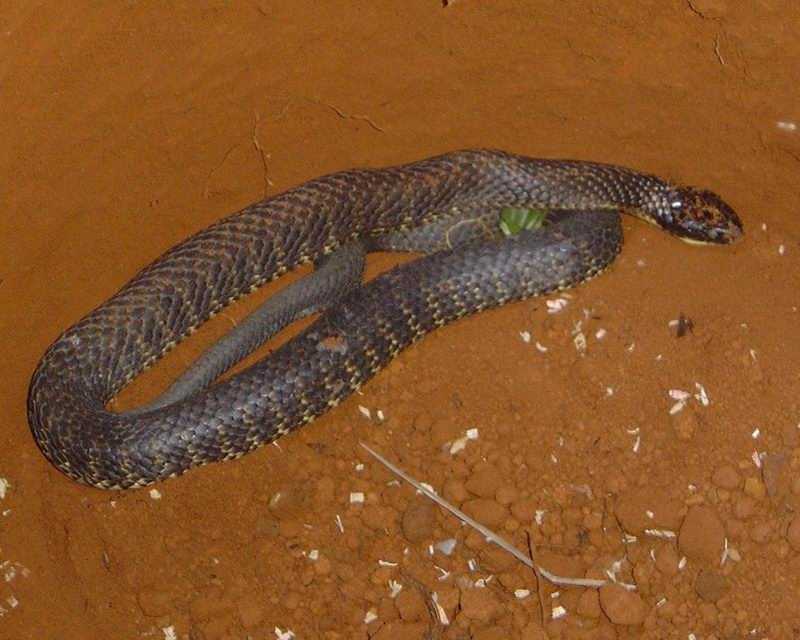
The Tiger Snake (Notechis scutatus) is a large and highly venomous snake of southern Australia, including its coastal islands and Tasmania. These snakes are often observed and locally well known by their banding, black and yellow like a tiger, although the species can be highly variable in colouration and patterning. All populations are classified within the genus Notechis (Elapidae). Their diverse characteristics have been classified either as distinct species or by subspecies and regional variation.
While tiger snakes are usually ground-dwelling, they are able to swim as well as climb into trees and buildings.
The genus Notechis is in the elapid family, venomous snakes with fixed front fangs. The classification of this genus is given as a single and highly variable species, Notechis scutatus, or a second species Notechis ater, and by an arrangement of subspecies or regional morphs.
A 2016 genetic analysis showed that the closest relative of the tiger snakes is the rough-scaled snake (Tropidechis carinatus).
The two extensively recognized species of this genus are Notechis scutatus (Peters, 1861) and Notechis ater (Krefft, 1866), which show further variety in their characteristics. Several authors have published revisions or described subspecies of these species. Others consider the names contained by this taxonomic arrangement to be unwarranted, and describe Notechis as a monotypic genus. Various authorities accept some or all the systematics previously applied, but most agree a revision of the genus is needed. Names for these subdivisions include the western types, appended to both species names as occidentalis (Glauert 1948) The island groups have also been described as subspecies: Chappell Island tiger snake as N. ater serventyi (Warrell, 1963), King Island and Tasmanian tiger snakes subspecies as N. ater humphreysi, (Warrell, 1963) and the Peninsula tiger snake as N. ater niger (Kinghorn 1921).
Island populations of N. scutatus have evolved larger heads to cope with large prey animals. Young populations have larger heads by phenotypic plasticity, whereas large heads have become genetically assimilated in older populations.
* Not including the nominate subspecies (typical form).
Notechis is a genus of large venomous snakes in the family Elapidae restricted to subtropical and temperate regions of Australia. Tiger snakes are a large group of distinct populations, which may be isolated or overlapping, with extreme variance in size and colour. Individuals also show seasonal variation in colour. The total length is typically about 1.2 metres (3 ft 11 in) The patterning is darker bands, strongly contrasting or indistinct, which are pale to very dark in colour. Colouration is olive, yellow, orange-brown, or jet-black, and the underside of the snake is light yellow or orange. Tiger snakes use venom to kill prey, and may also bite an aggressor; they are potentially fatal to humans. Tolerant of low temperatures, the snake may be active on warmer nights. When threatened, they flatten their bodies and raise their heads above the ground in a classic prestrike stance.
Hub AI
Tiger snake AI simulator
(@Tiger snake_simulator)
Tiger snake
The Tiger Snake (Notechis scutatus) is a large and highly venomous snake of southern Australia, including its coastal islands and Tasmania. These snakes are often observed and locally well known by their banding, black and yellow like a tiger, although the species can be highly variable in colouration and patterning. All populations are classified within the genus Notechis (Elapidae). Their diverse characteristics have been classified either as distinct species or by subspecies and regional variation.
While tiger snakes are usually ground-dwelling, they are able to swim as well as climb into trees and buildings.
The genus Notechis is in the elapid family, venomous snakes with fixed front fangs. The classification of this genus is given as a single and highly variable species, Notechis scutatus, or a second species Notechis ater, and by an arrangement of subspecies or regional morphs.
A 2016 genetic analysis showed that the closest relative of the tiger snakes is the rough-scaled snake (Tropidechis carinatus).
The two extensively recognized species of this genus are Notechis scutatus (Peters, 1861) and Notechis ater (Krefft, 1866), which show further variety in their characteristics. Several authors have published revisions or described subspecies of these species. Others consider the names contained by this taxonomic arrangement to be unwarranted, and describe Notechis as a monotypic genus. Various authorities accept some or all the systematics previously applied, but most agree a revision of the genus is needed. Names for these subdivisions include the western types, appended to both species names as occidentalis (Glauert 1948) The island groups have also been described as subspecies: Chappell Island tiger snake as N. ater serventyi (Warrell, 1963), King Island and Tasmanian tiger snakes subspecies as N. ater humphreysi, (Warrell, 1963) and the Peninsula tiger snake as N. ater niger (Kinghorn 1921).
Island populations of N. scutatus have evolved larger heads to cope with large prey animals. Young populations have larger heads by phenotypic plasticity, whereas large heads have become genetically assimilated in older populations.
* Not including the nominate subspecies (typical form).
Notechis is a genus of large venomous snakes in the family Elapidae restricted to subtropical and temperate regions of Australia. Tiger snakes are a large group of distinct populations, which may be isolated or overlapping, with extreme variance in size and colour. Individuals also show seasonal variation in colour. The total length is typically about 1.2 metres (3 ft 11 in) The patterning is darker bands, strongly contrasting or indistinct, which are pale to very dark in colour. Colouration is olive, yellow, orange-brown, or jet-black, and the underside of the snake is light yellow or orange. Tiger snakes use venom to kill prey, and may also bite an aggressor; they are potentially fatal to humans. Tolerant of low temperatures, the snake may be active on warmer nights. When threatened, they flatten their bodies and raise their heads above the ground in a classic prestrike stance.
Recent media