



Community hub
Recent from talks
Knowledge base stats:
Talk channels stats:
Members stats:
Tilbury Fort
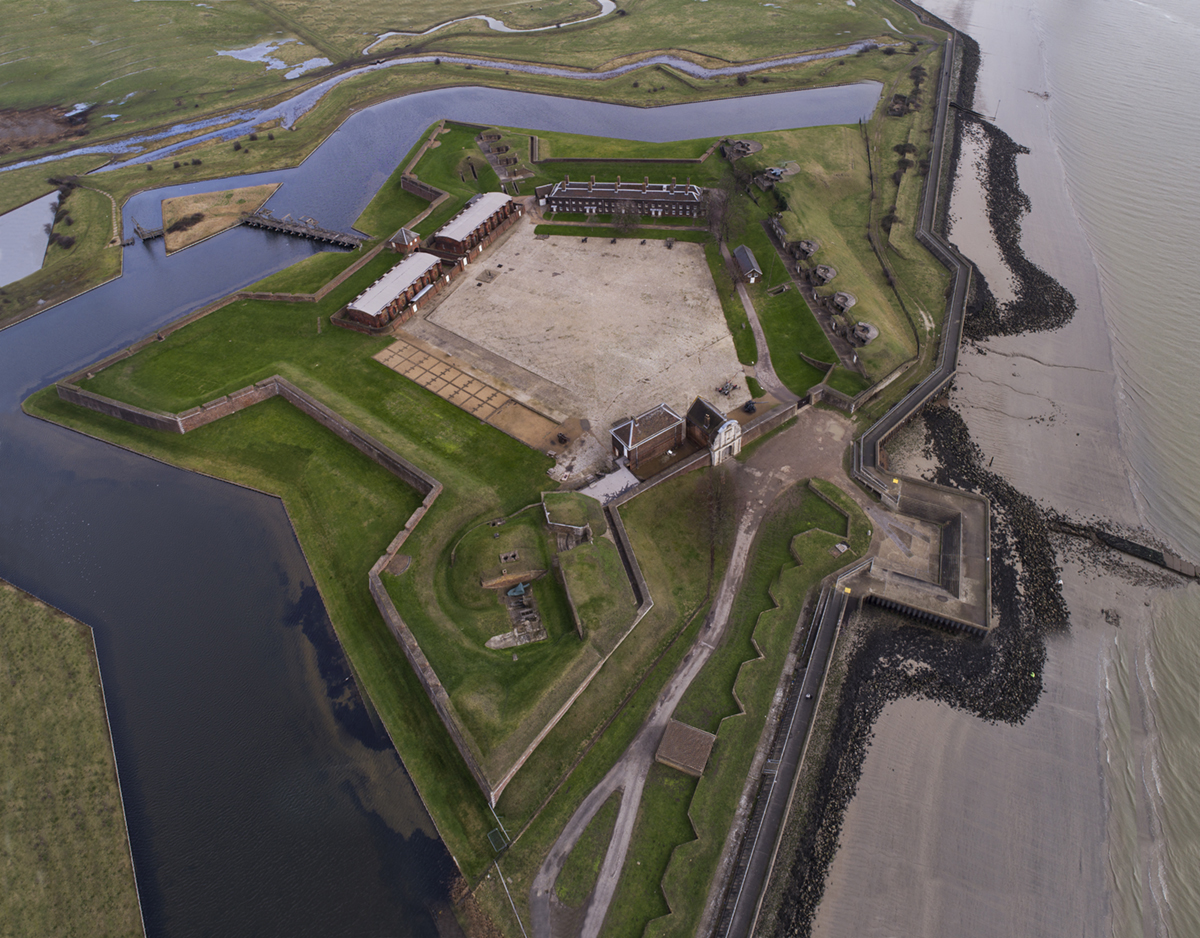
Tilbury Fort, also known historically as the Thermitage Bulwark and the West Tilbury Blockhouse, is an artillery fort on the north bank of the River Thames in England. The earliest version of the fort, comprising a small blockhouse with artillery covering the river, was constructed by King Henry VIII to protect London against attack from France as part of his Device programme. It was reinforced during the 1588 Spanish Armada invasion scare, after which it was reinforced with earthwork bastion, and Parliamentary forces used it to help secure the capital during the English Civil War of the 1640s. Following naval raids during the Anglo-Dutch Wars, the fort was enlarged by Sir Bernard de Gomme from 1670 onwards to form a star-shaped defensive work, with angular bastions, water-filled moats and two lines of guns facing onto the river.
In addition to protecting the Thames, in the 18th century Tilbury also began to be used as a transit depot and for storing gunpowder. It continued to be essential for the defence of the capital and a new artillery battery was added in the south-east corner during the Napoleonic Wars. The fort became decreasingly significant as a defensive structure as military technology developed in the 19th century. It was redeveloped to hold heavy artillery after 1868, providing a second line of defence along the river, but further changes in technology meant that it had become obsolete by the end of the century. Instead Tilbury became a strategic depot, forming a logistical hub for storing and moving troops and materiel throughout the First World War. The fort had only a limited role in the Second World War and was demobilised in 1950.
Tilbury Fort is now operated by the charity English Heritage Trust as a tourist attraction, receiving 16,154 visitors in 2014. Many of the more modern military features were demolished during the 1950s, with further restoration work taking place during the 1970s ahead of the site opening to the public in 1983. The 17th-century defences are considered by the historian Paul Pattison to be the "best surviving example of their kind in Britain", and the fort includes the only surviving early 18th century gunpowder magazines in Britain.
The first permanent fortification at Tilbury in Essex was built as a consequence of international tensions between England, France and the Holy Roman Empire in the final years of the reign of King Henry VIII. Traditionally the Crown had left coastal defences to the local lords and communities, only taking a modest role in building and maintaining fortifications, and while France and the Empire remained in conflict with one another, maritime raids were common but an actual invasion of England seemed unlikely. Basic defences, based around simple blockhouses and towers, existed in the south-west and along the Sussex coast, with a few more impressive works in the north of England, but in general the fortifications were very limited in scale.
In 1533, Henry broke with Pope Paul III in order to annul the long-standing marriage to his wife, Catherine of Aragon, and remarry. Catherine was the aunt of Charles V, the Holy Roman Emperor, and he took the annulment as a personal insult. This resulted in France and the Empire declaring an alliance against Henry in 1538, and the Pope encouraging the two countries to attack England. An invasion of England appeared certain. In response, Henry issued an order, called a "device", in 1539, giving instructions for the "defence of the realm in time of invasion" and the construction of forts along the English coastline.
The River Thames was strategically important, as the city of London and the newly constructed royal dockyards of Deptford and Woolwich were vulnerable to seaborne attacks arriving up the estuary, which was a major maritime route, carrying 80 per cent of England's exports. At the mouth of the estuary, the Thames narrowed considerably, forming a natural hub for communications: the "Long Ferry" took passengers into the capital, and the "Cross Ferry" moved traffic across the river. This was also the first point that an invasion force would be able to easily disembark along the Thames, as before this point the mudflats along the sides of the estuary would have made landings difficult. Temporary defences had been constructed at Tilbury as early as the 14th and 15th centuries, although little is known about their design.
Under the King's new programme of work, the Thames was protected with a mutually reinforcing network of blockhouses at Gravesend, Milton, and Higham on the south side of the river, and West and East Tilbury on the opposite bank. West Tilbury Blockhouse, part of the inner line, was initially called the "Thermitage Bulwark", because it was on the site of a hermitage dissolved by the King in 1536. It was designed by James Nedeham and Christopher Morice, supported by three overseers; prior to the work, the estimated cost had been given as £211, allowing for stone, timber, 150,000 bricks and 200 tonnes (200 long tons; 220 short tons) of chalk. The D-shaped blockhouse was curved at the front, with two storeys of gun-ports, and probably had additional gun platforms stretching along the river on either side of it; ancillary buildings were placed at the rear and the whole site was protected by a rampart and a ditch, with extensive marshlands and creeks giving additional protection to the east. It was initially commanded by Captain Francis Grant and his deputy, and garrisoned with a porter, two soldiers and four gunners, equipped with up to five artillery pieces including a demi-cannon and sakers.
The invasion threat passed and in 1553 all of the blockhouses were ordered to return their guns; Milton and Higham were demolished. In the summer of 1588, however, there was a fresh threat of invasion by the Spanish Armada. An army was mobilised to protect the mouth of the estuary and emergency improvements to the fortifications at Tilbury Blockhouse were made by Robert Dudley, the Earl of Leicester. Queen Elizabeth I visited the fort by barge on 8 August 1588 and rode in procession to the nearby army camp, where she gave a speech to the assembled forces. Fears of invasion continued even after the defeat of the Armada, and over the course of the next year the Italian engineer, Federigo Giambelli, reinforced the blockhouse with probably two concentric earthwork ramparts, with ditches and a palisade. A boom was stretched across the river to Gravesend at a cost of £305.
Hub AI
Tilbury Fort AI simulator
(@Tilbury Fort_simulator)
Tilbury Fort
Tilbury Fort, also known historically as the Thermitage Bulwark and the West Tilbury Blockhouse, is an artillery fort on the north bank of the River Thames in England. The earliest version of the fort, comprising a small blockhouse with artillery covering the river, was constructed by King Henry VIII to protect London against attack from France as part of his Device programme. It was reinforced during the 1588 Spanish Armada invasion scare, after which it was reinforced with earthwork bastion, and Parliamentary forces used it to help secure the capital during the English Civil War of the 1640s. Following naval raids during the Anglo-Dutch Wars, the fort was enlarged by Sir Bernard de Gomme from 1670 onwards to form a star-shaped defensive work, with angular bastions, water-filled moats and two lines of guns facing onto the river.
In addition to protecting the Thames, in the 18th century Tilbury also began to be used as a transit depot and for storing gunpowder. It continued to be essential for the defence of the capital and a new artillery battery was added in the south-east corner during the Napoleonic Wars. The fort became decreasingly significant as a defensive structure as military technology developed in the 19th century. It was redeveloped to hold heavy artillery after 1868, providing a second line of defence along the river, but further changes in technology meant that it had become obsolete by the end of the century. Instead Tilbury became a strategic depot, forming a logistical hub for storing and moving troops and materiel throughout the First World War. The fort had only a limited role in the Second World War and was demobilised in 1950.
Tilbury Fort is now operated by the charity English Heritage Trust as a tourist attraction, receiving 16,154 visitors in 2014. Many of the more modern military features were demolished during the 1950s, with further restoration work taking place during the 1970s ahead of the site opening to the public in 1983. The 17th-century defences are considered by the historian Paul Pattison to be the "best surviving example of their kind in Britain", and the fort includes the only surviving early 18th century gunpowder magazines in Britain.
The first permanent fortification at Tilbury in Essex was built as a consequence of international tensions between England, France and the Holy Roman Empire in the final years of the reign of King Henry VIII. Traditionally the Crown had left coastal defences to the local lords and communities, only taking a modest role in building and maintaining fortifications, and while France and the Empire remained in conflict with one another, maritime raids were common but an actual invasion of England seemed unlikely. Basic defences, based around simple blockhouses and towers, existed in the south-west and along the Sussex coast, with a few more impressive works in the north of England, but in general the fortifications were very limited in scale.
In 1533, Henry broke with Pope Paul III in order to annul the long-standing marriage to his wife, Catherine of Aragon, and remarry. Catherine was the aunt of Charles V, the Holy Roman Emperor, and he took the annulment as a personal insult. This resulted in France and the Empire declaring an alliance against Henry in 1538, and the Pope encouraging the two countries to attack England. An invasion of England appeared certain. In response, Henry issued an order, called a "device", in 1539, giving instructions for the "defence of the realm in time of invasion" and the construction of forts along the English coastline.
The River Thames was strategically important, as the city of London and the newly constructed royal dockyards of Deptford and Woolwich were vulnerable to seaborne attacks arriving up the estuary, which was a major maritime route, carrying 80 per cent of England's exports. At the mouth of the estuary, the Thames narrowed considerably, forming a natural hub for communications: the "Long Ferry" took passengers into the capital, and the "Cross Ferry" moved traffic across the river. This was also the first point that an invasion force would be able to easily disembark along the Thames, as before this point the mudflats along the sides of the estuary would have made landings difficult. Temporary defences had been constructed at Tilbury as early as the 14th and 15th centuries, although little is known about their design.
Under the King's new programme of work, the Thames was protected with a mutually reinforcing network of blockhouses at Gravesend, Milton, and Higham on the south side of the river, and West and East Tilbury on the opposite bank. West Tilbury Blockhouse, part of the inner line, was initially called the "Thermitage Bulwark", because it was on the site of a hermitage dissolved by the King in 1536. It was designed by James Nedeham and Christopher Morice, supported by three overseers; prior to the work, the estimated cost had been given as £211, allowing for stone, timber, 150,000 bricks and 200 tonnes (200 long tons; 220 short tons) of chalk. The D-shaped blockhouse was curved at the front, with two storeys of gun-ports, and probably had additional gun platforms stretching along the river on either side of it; ancillary buildings were placed at the rear and the whole site was protected by a rampart and a ditch, with extensive marshlands and creeks giving additional protection to the east. It was initially commanded by Captain Francis Grant and his deputy, and garrisoned with a porter, two soldiers and four gunners, equipped with up to five artillery pieces including a demi-cannon and sakers.
The invasion threat passed and in 1553 all of the blockhouses were ordered to return their guns; Milton and Higham were demolished. In the summer of 1588, however, there was a fresh threat of invasion by the Spanish Armada. An army was mobilised to protect the mouth of the estuary and emergency improvements to the fortifications at Tilbury Blockhouse were made by Robert Dudley, the Earl of Leicester. Queen Elizabeth I visited the fort by barge on 8 August 1588 and rode in procession to the nearby army camp, where she gave a speech to the assembled forces. Fears of invasion continued even after the defeat of the Armada, and over the course of the next year the Italian engineer, Federigo Giambelli, reinforced the blockhouse with probably two concentric earthwork ramparts, with ditches and a palisade. A boom was stretched across the river to Gravesend at a cost of £305.